How to Write Google Ads for Lead Generation
July 21, 2026If your Google Ads bring clicks but not calls, forms, or booked demos, the problem is usually intent match.
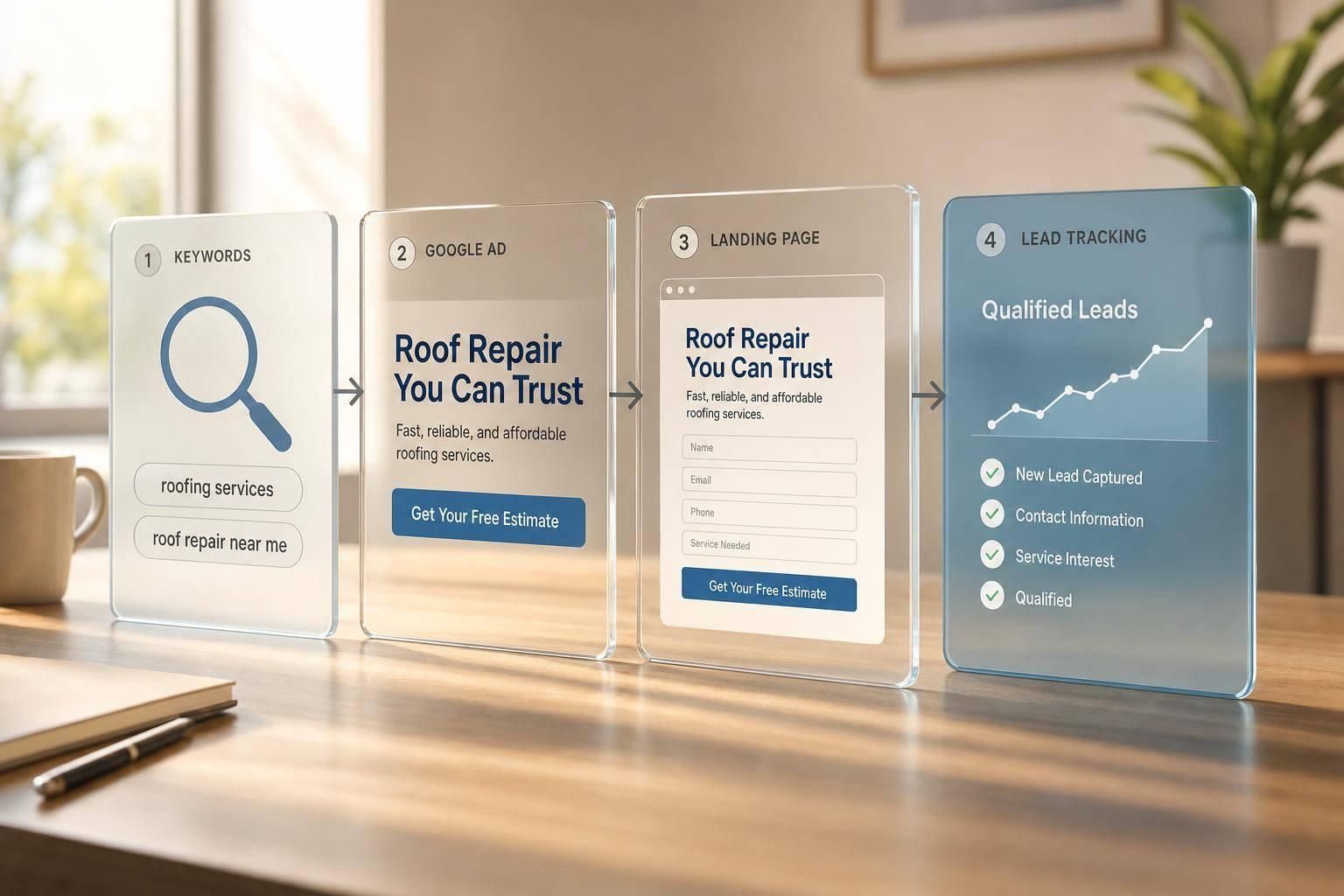
When I write lead-gen ads, I focus on four things: one clear lead goal, high-intent keywords, ad copy that matches the search, and tracking that shows lead quality - not just volume. That matters because the average Google Search conversion rate is about 6.96%, and average cost per lead is about $66.69. If I waste clicks on low-intent traffic, costs climb fast.
Here’s the short version:
- I define one lead action first: call, form fill, quote request, or demo booking
- I group keywords by service, problem, and buying intent
- I write headlines that match the search and descriptions with proof + CTA
- I use assets like calls, sitelinks, and lead forms to make response easier
- I keep the landing page message aligned with the ad
- I track CPL, conversion rate, and cost per qualified lead
A simple rule runs through the whole process: every part of the campaign should screen for people who are ready to act.
The article below walks through how I set that up step by step for U.S. lead generation campaigns.
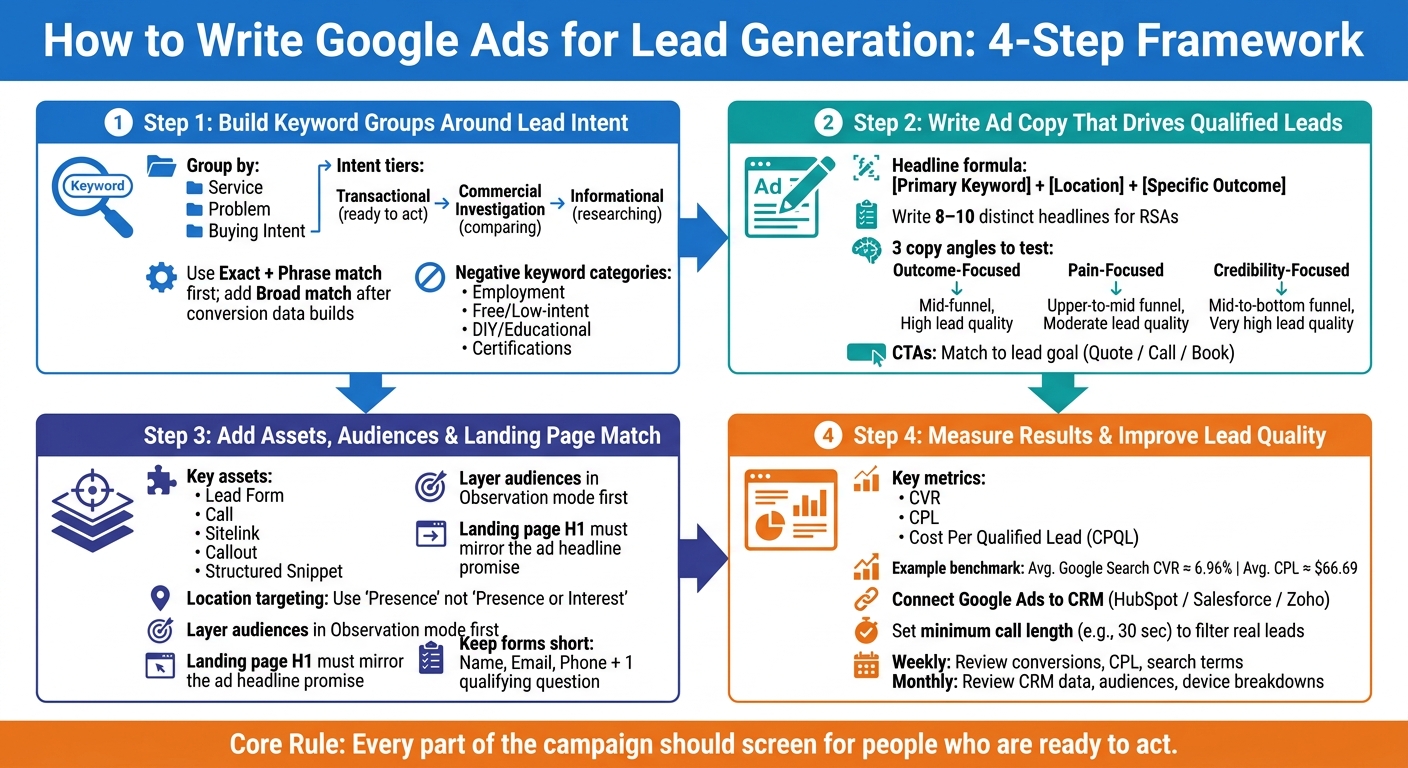
How to Write Google Ads for Lead Generation: 4-Step Framework
How To Write Google Ads Copy That CONVERTS!
sbb-itb-cef5bf6
Step 1: Build Keyword Groups Around Lead Intent
Keyword structure shapes who sees your ads and how qualified those searches are. Tight keyword groups make your ads more relevant and can lower CPL. This is the point where your lead goal becomes an actual keyword plan.
Group keywords by service, problem, and buying intent
Group keywords based on what the person wants, not just the words they type.
For example, a Utah HVAC company shouldn't dump everything into one ad group. "AC repair Salt Lake City", "air conditioner making loud noise," and "schedule AC repair near me" point to three different states of mind. One person knows the service they want. Another is diagnosing a problem. Another is ready to book. Each one needs its own ad group and its own headline.
It also helps to organize keywords by intent:
- Transactional (ready to act): "quote", "near me", "schedule", "same-day", "emergency", "pricing"
- Commercial investigation (comparing options): "best", "top-rated", "reviews", "vs."
- Informational (researching, not buying yet): "how to", "what is", "guide", "DIY"
For lead gen, put more weight on transactional terms. Those searches usually come from people closer to taking action. For research-stage searches, use softer offers instead of hard-sell copy.
In local campaigns, keep city-specific services split by ad group. For instance, "emergency plumber Phoenix AZ" and "tankless water heater installation Phoenix" should not sit in the same bucket. They describe different services and call for different ads.
Use match types and negative keywords to control lead quality
Match types work like a volume knob.
Exact match gives you the most control. Your ad appears only for searches that closely match your keyword. That often leads to the best lead quality, though volume is usually lower.
Phrase match gives you a bit more reach while keeping intent fairly steady.
Broad match can widen reach, but don't rush into it. It tends to work better once you have enough conversion data and smart bidding set up. Until then, it can wander.
A solid starting point for most U.S. lead-gen campaigns is simple: launch with exact and phrase match for your core service + location keywords. Then add broad match later, once your account has enough conversion data for Google to learn what a qualified lead looks like. As data comes in, review search terms often and cut irrelevant queries.
Negative keywords matter just as much as the terms you target. If you're running ads for a roofing contractor, searches like "roofing jobs" or "DIY roofing" won't turn into leads. They just burn budget.
Start with a base negative list across four groups:
- Employment-related: jobs, careers
- Free or low-intent: free, cheap
- DIY or educational: how to build, tutorial
- Course or certification searches: courses, degree
Apply shared negative lists at the campaign level for broad exclusions. Then add tighter negatives at the ad group level as your search term report starts showing what doesn't belong.
Use keyword insertion only when the wording stays natural
Dynamic keyword insertion works best in tightly themed ad groups. If the group mixes intent, the headline can come out awkward, and that hurts trust fast.
A group like "emergency plumber Dallas", "24-hour plumber Dallas," and "plumber near me Dallas" can fit neatly into a headline like "Need a {KeyWord:Plumber in Dallas} Today?" because the intent stays the same across every term.
Always use clear default text so your message still makes sense when a keyword doesn't fit. Also, check live ads on a regular basis. For top ad groups, highly relevant static headlines often do a better job and give you more control. Clear, natural wording matters because qualified leads respond to ads that sound direct and human.
With keyword intent mapped, the next step is writing ads that match the search and push the right action.
Step 2: Write Google Ads That Drive Qualified Leads
Once your keyword groups are in place, the next step is writing ads that pull in the right people, not just more clicks. The goal is simple: turn search intent into ad copy that feels like a direct match and moves the person to act.
Write headlines that reflect the search and promise a clear outcome
Your headline needs to do two jobs fast: show the ad is relevant and make the next step feel worth taking. A simple formula that works well is [primary keyword] + [location, if relevant] + [specific outcome or offer].
For example, Emergency Plumber Chicago – 24/7 Same-Day Service tells the searcher what you do, where you do it, and what they can expect.
For RSAs, write 8–10 distinct headlines. Mix shorter options with longer ones so they can show well across different screen sizes. Add action-driven phrasing to at least a few of them, like Get a Free Quote 24/7 or Book Your Inspection Today. In search ads, the headline often does the work of the CTA.
Skip loose claims like Best or #1. They don't say much. Specific details do more heavy lifting, such as 4.8/5 rating from 300+ clients or Serving Utah businesses since 2013.
Use descriptions to add proof, benefits, and a next step
Descriptions are where you support the promise in the headline. A good setup looks like this:
- Use the first line for proof, like years in business, certifications, service area, or a measured result.
- Use the second line to show why that proof matters to the reader.
- End with a direct CTA.
A strong description for a local roofing company might read: Serving Dallas homeowners for 15+ years with licensed and insured crews. Request a free roof inspection today.
For a B2B context, SEO Werkz frames it this way: SEO & PPC for U.S. businesses looking to grow leads. Book a free strategy consultation today.
Your CTA should line up with the exact lead goal. Request a Free Quote fits form fills. Call for Same-Day Service fits phone leads. Book Your Free Consultation fits scheduled meetings. Benefit-led CTAs like Get My Free Consultation can beat plain Contact Us buttons; one source reports up to 202% better performance for personalized CTAs.
Compare ad copy angles: outcome, pain, and credibility
Not every buyer responds to the same message. That's why it's smart to test a few angles against the same keyword group.
| Ad Copy Angle | Best Use Case | Lead Quality | Funnel Stage |
|---|---|---|---|
| Outcome-Focused | Prospects actively searching for a solution and comparing options, such as Get More Leads in 30 Days | High | Mid-funnel (solution comparison) |
| Pain-Focused | Prospects with urgent, active problems, such as Leaking Roof? Stop Damage Before It Gets Worse | Moderate - can attract broader intent | Upper-to-mid funnel (problem awareness) |
| Credibility-Focused | Prospects choosing between providers in high-competition markets, such as Licensed & Insured Roofers – 500+ 5-Star Reviews | Very high | Mid-to-bottom funnel (provider selection) |
For emergency services, a mix of pain and outcome often works best. No Heat? Get Same-Day Furnace Repair hits the problem and the fix in one line.
For B2B campaigns, outcome plus credibility often brings in stronger lead quality. Increase Qualified Leads with a Certified PPC Agency gives the prospect a reason to click and a reason to trust you.
Watch cost per lead and sales-team feedback closely. If one angle keeps bringing in better leads, shift more budget there.
Once the ad copy is set, match the message with assets and landing-page content.
Step 3: Add Assets, Audiences, and Landing Page Match
Once the ad copy is done, the next step is support: the right assets, tighter audience filters, and a landing page that lines up with the ad.
Use lead form, call, sitelink, and trust-building assets
| Asset Type | Setup Effort | Lead Type | Best Use Case |
|---|---|---|---|
| Lead form | Low–Medium | In-ad form submission | Fast lead capture for mobile users; requires a privacy policy URL. |
| Call | Low | Phone call | Urgent or local services such as HVAC, legal, or dental. |
| Sitelink | Low | Click to specific page | High-intent pages like Get a Quote, Pricing, or Book a Consultation. |
| Callout | Low | Support signal | Short benefit phrases like free consultation, 24/7 support, or no setup fees. |
| Structured snippet | Low–Medium | Trust signal | Listing services under a header such as Services, with at least 3 values like SEO, PPC, and Web Design. |
Keep lead forms short. In most cases, you only need:
- Name
- Phone
- One qualifying question
For B2B campaigns, that extra question can save your sales team a lot of wasted time. Something like monthly ad budget helps screen out weak submissions before they get passed along. And for call assets, only run them during staffed business hours. If no one can answer, that click may go nowhere.
After the ad is set up to collect leads, tighten up who gets to see it.
Refine audience targeting by location, demographics, and intent signals
Start with tight location targeting. A service business may do well with radius targeting around its office. A metro-based B2B campaign may get better results by targeting specific cities or DMAs.
If you need local leads, use Presence instead of Presence or interest. That setting helps you reach people who are physically in your service area, not just people who looked it up. Then check location reports on a regular basis and cut areas with poor lead quality or high cost per lead.
For audiences, layer in demographic segments and intent-based audiences like in-market, remarketing, or custom segments. At first, use them in observation mode. That gives you data without cutting reach too early.
Then watch what happens. Which age groups bring in better leads? Which income tiers submit stronger forms? Which in-market groups turn into sales calls?
If users ages 35–54 send more high-value B2B inquiries, a +20% bid adjustment can push more budget toward that group. The goal isn't broad reach. It's getting in front of the people most likely to convert.
Keep the landing page offer consistent with the ad promise
This part sounds simple, but it's where a lot of campaigns fall apart.
If your ad headline promises a free Google Ads strategy call for U.S. businesses, the landing page H1 should say almost the same thing. Not a vague welcome message. Not a generic agency pitch. The ad makes a promise, and the page should keep it.
The offer in the ad and the main CTA on the page should match closely. The page should also stay focused on that one action, without pulling people in five different directions.
Keep the form short: name, work email, phone, and one qualifying question. Put trust proof near the form, like client logos, a brief case study result, or a Google Partner badge. Use U.S. formatting for prices, dates, and phone numbers, such as $2,500/month, 12/31/2026, and (801) 123-4567, with a clickable tel link for mobile users.
Match the landing page headline, CTA, and form to the ad's promise. When everything lines up, people are less likely to bounce after the click.
Step 4: Measure Results and Improve Lead Quality Over Time
Once your ad copy, keywords, and landing pages are live, the next job is simple: watch the data and find where lead quality starts to slip.
A campaign can look good on the surface and still send weak leads. Plenty of clicks don't mean much if the wrong people are filling out your form.
Track conversions, cost per lead, and lead quality
Clicks and impressions only tell part of the story. For lead gen, pay close attention to CVR, CPL, and lead quality.
Example: 500 clicks and 25 form fills = 5% CVR; $2,500 in spend and 50 leads = $50 CPL.
That said, CPL by itself can fool you. A cheap lead that never qualifies isn't worth much. A more expensive lead that books a call and moves into the pipeline is often worth far more. That's why cost per qualified lead (CPQL) is often the better number to watch.
To track CPQL, connect Google Ads to your CRM, such as HubSpot, Salesforce, or Zoho. Then label each lead as qualified, unqualified, or spam. After a bit of time, you'll see which campaigns and keywords are driving actual pipeline instead of just form fills.
For call-based leads, set a minimum call length, such as 30 seconds, to filter out calls that don't count as real leads.
Test copy, keywords, and targeting based on real results
Review conversions, CPL, and search terms every week so you can catch waste before it piles up. Then look at CRM data, audience performance, and device breakdowns each month to spot which segments bring in qualified leads.
When you review ad copy, judge headlines by conversion rate, not just CTR. If an ad gets clicks but doesn't convert, pause it. Then rewrite it around the benefits, proof points, or CTAs that are already working.
For keywords, move strong terms into exact match and cut weak queries each month. Words like "free", "DIY," or "jobs" often drive extra clicks without bringing in leads.
On the targeting side, check which locations and demographic segments send the most qualified leads. If some ZIP codes keep producing low-quality submissions, exclude them or put more budget into the areas that perform better.
Use this data to decide what to pause, scale, or rewrite.
Conclusion: Core steps for writing better lead generation ads
Each step in this guide points to one outcome: getting the right people to take a meaningful action. That starts with a clear lead goal and clean conversion tracking before the campaign even begins.
From there, keep adjusting keywords, copy, audiences, and landing pages based on qualified lead data. If your team can't manage all of that in-house, a full-service PPC agency like SEO Werkz can help with keyword research, ad copy testing, landing page alignment, and reporting, so changes are based on actual conversion and lead-quality data.
Use conversion, CRM, and search-term data to improve lead quality over time.
FAQs
How long should I wait before optimizing a lead-gen campaign?
Give the campaign enough time to produce a pattern you can trust. Conversion data often starts showing up within 24 to 48 hours, but if you make big changes right away, you can throw off the read.
If you use automated bidding, try to wait until you have 15 to 50 conversions in 30 days before you optimize. If you handle bids manually, check performance on a steady basis and make small, measured changes based on your numbers.
What is a good cost per qualified lead for Google Ads?
There’s no single cost per qualified lead for Google Ads. It changes based on your industry, how crowded the market is, your customer lifetime value, and what your business is trying to achieve.
So instead of chasing one “right” number, start with your revenue goals and profit margins. Then work backward to figure out what you can afford to pay per lead while still keeping a profitable return on ad spend.
Your conversion rate and average cost per click will help you set the right target CPA.
Should I send traffic to my homepage or a dedicated landing page?
Send traffic to a dedicated landing page, not your homepage.
Why? Because landing pages are built for lead generation. They let you line up your content, messaging, and keywords with the exact intent behind the ad.
A homepage usually tries to do too much at once. A landing page does the opposite. It stays focused on one service or one offer, which makes the path from click to action feel much smoother for the visitor.