Ultimate Guide to Featured Snippet Tools
April 2, 2026Want to rank above the #1 spot on Google? Featured snippets, or "Position Zero", are your answer. These are the highlighted answer boxes at the top of search results, driving up to 8% of all clicks and boosting click-through rates by over 850%. They're also a primary source for voice search results on platforms like Siri and Alexa.
To win these snippets, you need the right tools. Featured snippet tools help you:
- Identify keywords likely to trigger snippets.
- Analyze competitor snippets and find content gaps.
- Optimize your content structure (lists, tables, headings) for better snippet chances.
- Track and monitor snippet performance, including AI-driven search systems.
Key stats to know:
- 40% of question-based queries trigger snippets.
- Queries with 10+ words have a 55.5% snippet trigger rate.
- Tools like Semrush, Surfer SEO, and AccuRanker are game-changers for keyword research, content optimization, and snippet tracking.
Featured snippets aren't just about ranking - they're about becoming the source Google and AI platforms trust. With the right strategy and tools, you can secure Position Zero and boost your visibility dramatically. Let’s dive into how these tools work and which ones to choose.
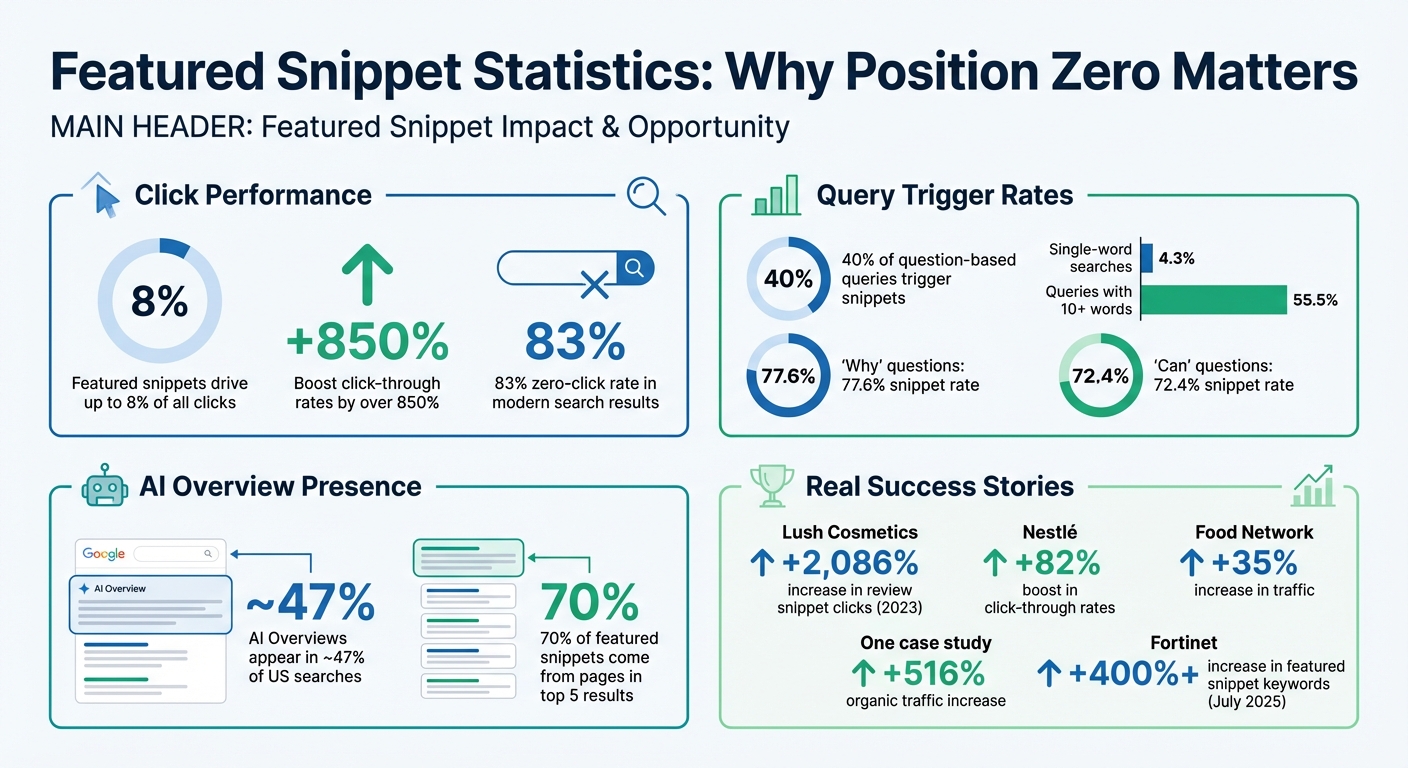
Featured Snippet Statistics and Performance Metrics
How to Find Featured Snippet Opportunities using Semrush
sbb-itb-cef5bf6
How Featured Snippet Tools Work
Featured snippet tools are designed to scan SERPs (Search Engine Results Pages) for keywords that trigger snippets, assess your current ranking relative to Position Zero, and identify quick-win opportunities. These tools often focus on keywords where your content already ranks in the top 10 or 15 positions since being on the first page is typically a prerequisite for Google to consider your content for a featured snippet.
Another key feature is competitor gap analysis. By entering a competitor's domain, these tools can show which snippets they currently hold. This helps uncover content gaps and opportunities to claim those snippets by offering clearer, more concise, or better-formatted answers. Some tools even track snippets you previously held but lost, signaling when it might be time to refresh or improve your content.
Modern tools take it a step further by analyzing secondary data sources like "People Also Ask" (PAA) boxes and "Searches Related To" sections. These often align with snippet opportunities. Additionally, they can differentiate between traditional snippets (which pull from a single source) and AI-generated overviews (which compile multiple sources), letting you tailor your optimization strategies accordingly. Some platforms even monitor up to 50 different SERP features, such as knowledge panels and reviews, for a broader view of your search visibility.
Identifying Snippet-Triggering Keywords
Pinpointing the right keywords is essential for effective snippet optimization. Tools prioritize long-tail and question-based keywords since these are more likely to trigger snippets. For example, over 40% of question-based queries result in a featured snippet. In contrast, single-word searches only generate snippets 4.3% of the time, while queries with 10 words or more trigger snippets 55.5% of the time. Certain question words, like "why" and "can", have even higher snippet-triggering rates at 77.6% and 72.4%, respectively.
Most tools allow you to filter keywords by word count, focusing on those with five or more words to target queries with higher snippet potential. Filters like "Domain Doesn't Rank" can identify keywords where a snippet exists, but your site isn’t present, helping you focus on areas with untapped potential. Prioritizing keywords where you already rank in the top 10 ensures faster results and a better return on your efforts.
Analyzing Competitor Snippets
Once a competitor’s snippet is identified, tools analyze its format - whether it’s a paragraph, numbered list, bulleted list, or table. Recommendations often include adjustments like shortening sentences, using HTML list or table tags, or tweaking word counts to improve your chances of overtaking the snippet.
"Analyze SERP features and keyword positions to understand what features are showing for a given keyword and if you, your competitors, or clients are showing up within these."
– Gerald Murphy, Solution Business Manager, Similarweb
These tools also track historical trends, notifying you when a competitor overtakes your snippet or when Google swaps the featured URL to another page on the same domain. This insight helps you understand which content structures Google currently favors for a specific query, allowing you to adjust your approach. By monitoring the "rank gap" - the difference between your position and the snippet holder - these tools help you focus on the easiest opportunities to close that gap.
Main Categories of Featured Snippet Tools
Featured snippet tools generally fall into three main categories, each designed to tackle a specific part of your optimization process. Depending on your strategy, you can choose tools that identify opportunities, refine content, or track performance. Let’s take a closer look at how these categories help you secure Position Zero.
Keyword Research Tools
These platforms are the backbone of snippet optimization, helping you find the right keywords to target. Tools like Semrush and Ahrefs specialize in uncovering question-based queries and long-tail keywords that often trigger featured snippets. Their advanced filtering options - like "Domain Doesn't Rank" and "Parent Topic" - make it easy to find opportunities. For instance, Semrush’s Keyword Gap feature lets you compare your site with competitors, showing which snippets they own, the format they use (list, table, or paragraph), and even snippets they’ve lost over time.
Here’s why question-based queries are so important: over 40% of them return a featured snippet, which makes them prime targets. Semrush also offers tools to explore "People Also Ask" and "Searches Related To" sections, helping you zero in on the best options. A great example of success is Lush Cosmetics, which used Semrush to grow its rich snippets by 15% and saw a staggering 2,086% jump in clicks for review snippets in 2023.
"SERP features are your answer... you can identify SERP feature opportunities for keywords you already rank for in just a few clicks."
– Brenna Kelly, Author, Semrush
Most platforms also include metrics like "Potential Growth" to prioritize keywords based on traffic potential. Plus, they track historical SERP data, showing snippets your site once held but lost, giving you a chance to reclaim them.
Content Optimization Tools
Once you've identified snippet opportunities, the next step is crafting content that aligns with what search engines prefer for Position Zero. Tools like Surfer SEO and Clearscope excel in this area, offering real-time feedback on factors like word count, heading structures, and semantic keywords. These platforms analyze the content of current snippet holders to provide actionable recommendations for improvement.
For example, Surfer SEO’s "Coverage Booster" highlights subtopics or entities your competitors include that you might have missed. If a competitor’s snippet uses a list, these tools will suggest reformatting your content into a concise, well-structured list with proper HTML tags.
"The site that gets a featured snippet is the one that most successfully and concisely answers the user's query."
– Internet Marketing Ninjas
Some specialized tools, like the Featured Snippet Optimization Tool by Ninjas, focus on fine-tuning headings, lists, and schema markup to meet snippet requirements. They even integrate "People Also Ask" data, ensuring your content addresses frequent user questions. Advanced features like "Auto-Optimize" can instantly enhance weaker sections of your content. High-quality visuals are also becoming increasingly important for snippet success, and some tools analyze image quality alongside text structure.
Snippet Tracking and Monitoring Tools
Tracking tools are essential for keeping tabs on your snippet performance, ensuring you stay on top of changes in ownership or competitive shifts. Unlike keyword research tools, these platforms focus on what happens after your content is live, providing insights to refine your strategy further.
AccuRanker, SE Ranking, and Keyword.com are some of the leading options here. They monitor snippet visibility with precision, even measuring how far snippets appear from the top of the SERP to ensure they’re not pushed below the fold by ads or other features. For instance, SE Ranking offers up to 24 months of historical data, allowing you to analyze trends over time. It also includes a "storm metric" to identify whether ranking fluctuations are due to algorithm updates or competitor activity.
Modern tools have expanded their scope to track brand mentions and citations in AI-driven search systems like ChatGPT, Perplexity, and Gemini. Pricing is flexible, too - Keyword.com starts at just $3/month for basic tracking, while more comprehensive platforms like AccuRanker can cost up to $129/month. These insights help you fine-tune your approach and maintain a competitive edge.
Using Structured Data for Featured Snippets
Structured data goes beyond basic keyword and content strategies by helping search engines extract answers from your content for featured snippets. Using JSON-LD - Google's preferred format - you can make your content machine-readable, increasing the chances of landing in Position Zero.
The results speak for themselves. For example, Nestlé saw an 82% boost in click-through rates, while Food Network enjoyed a 35% increase in traffic after adopting structured data.
"Schema markup isn't just an SEO checkbox anymore, it's one of the cleanest ways to make your content machine-readable for search engines and answer engines and AI systems that extract entities, facts, and relationships."
– Waqas Arshad, SEO Specialist, The Rank Masters
Structured data isn't just about traditional search engines anymore. AI-driven platforms like ChatGPT and Gemini increasingly rely on schema markup to verify information and recommend reliable sources in their summaries. This means that in 2026, adding schema isn't just about ranking on Google - it's about making your content accessible across the entire AI-powered search ecosystem.
Types of Structured Data for Featured Snippets
Different schema types serve different purposes, and choosing the right one depends on your content and goals. For example:
- FAQPage schema works well for Q&A and list-style snippets. Using
QuestionandAcceptedAnswertypes, it helps Google pull content for "People Also Ask" sections. Pages often qualify within weeks. - HowTo schema is ideal for step-by-step guides, highlighting sequences, tools, and instructions for visual-rich results.
- Product schema benefits e-commerce sites by structuring details like price, availability, and ratings. These attributes often appear in snippets and can boost click-through rates by 21% in just 30 days.
- Article and BlogPosting schema enhances paragraph snippets by defining headlines, descriptions, and authors, which helps search engines summarize your content better.
- LocalBusiness schema is perfect for physical locations, potentially doubling map impressions.
| Schema Type | Best For | Key Snippet Benefit |
|---|---|---|
| FAQPage | Q&A content | FAQ dropdowns in SERPs; AI answer extraction |
| HowTo | Step-by-step guides | Visual step-by-step rich results |
| Product | eCommerce pages | Price, availability, and star ratings |
| Article | Blogs and News | News carousels and enhanced headline visibility |
| LocalBusiness | Physical locations | Local pack results and map impressions |
The right schema type, combined with seamless implementation, can unlock significant benefits for your content.
Tools for Schema Markup Implementation
Adding schema to your site doesn’t require coding expertise, thanks to user-friendly tools. Options like Rankwise, SerpNap, and schemagen.org offer free, interactive forms where you can select a schema type (e.g., FAQ or HowTo), input your content, and generate JSON-LD code to paste into your site's HTML. These tools are great for quick, one-time implementations.
For WordPress users, plugins like Rank Math ($7.99/month) and Yoast SEO Premium ($118.80/year) automate schema creation. Yoast's "schema graph" simplifies entity unification for better search engine clarity, while Rank Math's modular workflow is handy for custom schema setups.
To ensure your schema is valid, use the Schema Markup Validator and Google Rich Results Test. Larger sites managing thousands of pages can benefit from tools like Screaming Frog SEO Spider (around $250/year), which audits structured data at scale and flags missing properties. For enterprise-level needs, Schema App offers scalable governance with custom pricing.
Once your schema is ready, use Google Search Console’s URL Inspection tool to request a crawl. This can reduce the time for rich snippets to appear from weeks to just days. Placing JSON-LD in your page’s <head> section ensures faster snippet activation. The goal is to create AI-ready structured data with consistent definitions and a robust validation process to keep your schema accurate as your site grows.
How to Choose the Right Tools
When it comes to featured snippet tools, picking the right ones requires a careful look at both what they offer and how much they cost. The goal is to find tools that align with your objectives without overspending. Considering that 87% of high-growth brands credit their organic traffic success to strong SEO setups, the pressure to choose wisely is real. The key is to balance cost with the value these tools bring to your efforts.
Evaluating Features and Functionality
Instead of relying on a single solution, the most effective setups often involve two or three tools working together. Start by identifying the features that are most important for your snippet strategy. For keyword research, look for tools that can identify SERP features like featured snippets, "People Also Ask" (PAA) boxes, and answer boxes. Tools that scrape PAA data and autocomplete suggestions are especially useful for aligning your content with what users are actually searching for.
When it comes to content optimization, focus on tools that provide real-time SERP analysis and specific recommendations rather than generic advice. Features like content scoring are crucial - they compare your page against current snippet winners and highlight areas for improvement, such as missing keywords, headings, or structural elements like lists and tables. Tools like Surfer SEO and Clearscope are great examples, offering NLP-based term suggestions tailored to snippet-winning content.
Performance tracking is another must-have since snippet positions can change quickly. Tools with monitoring features can alert you when you gain or lose snippets, allowing you to act quickly. For example, SE Ranking, with a 4.8/5 rating on G2, is known for its competitor analysis and SERP tracking, while Ahrefs, rated 4.5/5 on G2, is a top choice for backlink data and site audits.
Efficiency also matters. Tools with unified dashboards can cut reporting time in half, and AI-driven features like automated content briefs and ranking predictions can save hours of manual work.
"A report that doesn't change your next three actions is theatre" – Priya Kashyap, Serplux
These considerations lay the groundwork for the next step: ensuring your budget aligns with your goals.
Balancing Budget and ROI
Once you've identified the features you need, it's time to focus on budget and ROI. Start with free tools like Google Search Console for performance data and Answer Socrates, which offers three free searches per day for discovering questions. For those just starting out, entry-level tools like Ubersuggest (around $29/month) or Mangools ($29/month) can provide much of the insight offered by pricier platforms at a lower cost.
For more advanced features, mid-tier options like SE Ranking ($129/month) and Surfer SEO ($89/month) offer professional-grade capabilities without breaking the bank. If you're managing multiple sites, Ahrefs, starting at $129/month, uses a credit-based system for specific actions. Understanding how these credits work can help avoid unexpected costs.
Focus your spending on tools that target high-ROI opportunities. Since 70% of featured snippets come from pages already in the top five search results, tools that identify these "low-hanging fruit" keywords can deliver quick wins. Gap analysis features are particularly useful for spotting where competitors hold snippets while your content ranks just behind them. In one instance, a website saw a 516% increase in organic traffic after capturing targeted snippets.
Before committing, test the waters. Use free trials - most tools offer 14-day trials - to evaluate their impact. Focus on specific metrics: Did the tool help you find snippet opportunities you missed? Did it improve your content score? Did you secure more snippets? The right tools will pay for themselves through better visibility and traffic, while the wrong ones can waste both time and money.
Conclusion
Featured snippet tools have become crucial for maintaining visibility in search results. With AI Overviews now appearing in about 47% of US searches and the zero-click rate climbing to 83%, the search game has changed dramatically. The focus has shifted from just ranking high to becoming the source that search engines reference and extract data from. To adapt, businesses need a structured, tool-based strategy to capture these featured snippet opportunities.
The winning formula combines smart tool usage with targeted optimization efforts. Begin by pinpointing keywords where you rank between positions 2 and 10, then use content optimization tools to craft responses within the ideal word count. Incorporating schema markup is another key step. These tools help automate tasks that would be impossible to manage manually.
Real-world examples highlight the impact of these strategies. In July 2025, Fortinet saw a staggering 400%+ increase in featured snippet keywords by refining their content approach. Similarly, eFax outperformed the IRS (Domain Authority 92) for the term "IRS Fax Numbers" by reformatting their content specifically for snippet optimization. These aren't one-off wins - they're repeatable when the right tools and strategies are in play.
"The goal has changed: you're no longer fighting for a click - you're fighting for a citation. Being the source AI references is increasingly as valuable as traditional ranking." - Digital Applied
To stay ahead, businesses must weave these tools into their regular workflows. Set up monitoring alerts, routinely audit your content, and act quickly when competitors claim your snippets. With over half of Google searches now featuring at least one SERP element, optimizing for Position Zero is no longer optional - it’s a necessity in today’s AI-driven search environment.
FAQs
How long does it take to win a featured snippet?
The time it takes to secure a featured snippet depends on factors like keyword competition and the quality of your content. Google can create a snippet within 7–10 minutes after indexing your page. However, actually earning and holding that spot usually demands consistent SEO work. Using strategies such as providing clear, concise answers, organizing content with structured headers, and implementing schema markup can help. Depending on how effectively your content matches user search intent, you might see results in days or weeks.
What’s the best content format for featured snippets (paragraph, list, or table)?
The ideal format for featured snippets varies based on the type of query and the information being shared. Paragraphs are perfect for short, direct answers to "what" or "why" questions. If the query involves step-by-step processes or rankings, lists make the content easy to follow. For comparing data or presenting structured information, tables are the way to go. Always pick a format that matches the question and makes the content clear and easy to scan for users.
Do I need schema markup to get a featured snippet?
No, schema markup isn’t a must-have to land a featured snippet, but it can definitely increase your odds. By using structured data, you make it easier for search engines to understand your content, which can help it qualify for those coveted snippets. While it’s not a requirement, adding schema markup is a smart SEO move. Pair it with well-organized, high-quality, and relevant content to enhance your chances of standing out.