
How to Write SEO Content for Healthcare Blogs
May 3, 2026Healthcare blogs need to strike a balance between ranking high in search results and providing accurate, reliable medical information. This is critical because healthcare content falls under Google's "Your Money, Your Life" (YMYL) category, which requires the highest standards of trustworthiness and accuracy. Here's how you can craft SEO-friendly content for healthcare blogs while meeting these requirements:
- Focus on E-E-A-T (Experience, Expertise, Authoritativeness, Trustworthiness): Ensure content is reviewed by qualified medical professionals, cite credible sources like the CDC or NIH, and display author credentials prominently.
- Keyword Research: Target keywords that align with patient intent. Avoid misleading terms like "cure diabetes naturally" and instead focus on accurate phrases like "diabetes management tips."
- Content Structure: Use short-tail and long-tail keywords strategically, organize content by the patient journey (Awareness, Consideration, Decision), and ensure readability with clear subheadings and short paragraphs.
- Technical SEO: Optimize for mobile, improve page speed, and use schema markup like
MedicalConditionandPhysicianto help search engines understand your content. - Trust Signals: Include "Medically Reviewed" tags, use HTTPS for secure browsing, and update content regularly to reflect current medical standards.
The goal isn't just more traffic - it's connecting with the right audience while maintaining accuracy. With proper optimization and trust-building strategies, your healthcare blog can become a reliable resource for patients and a powerful tool for attracting new ones.
SEO for medical writers - Search Engine Optimisation (SEO) for medical writing
sbb-itb-cef5bf6
How to Research Keywords for Healthcare Topics
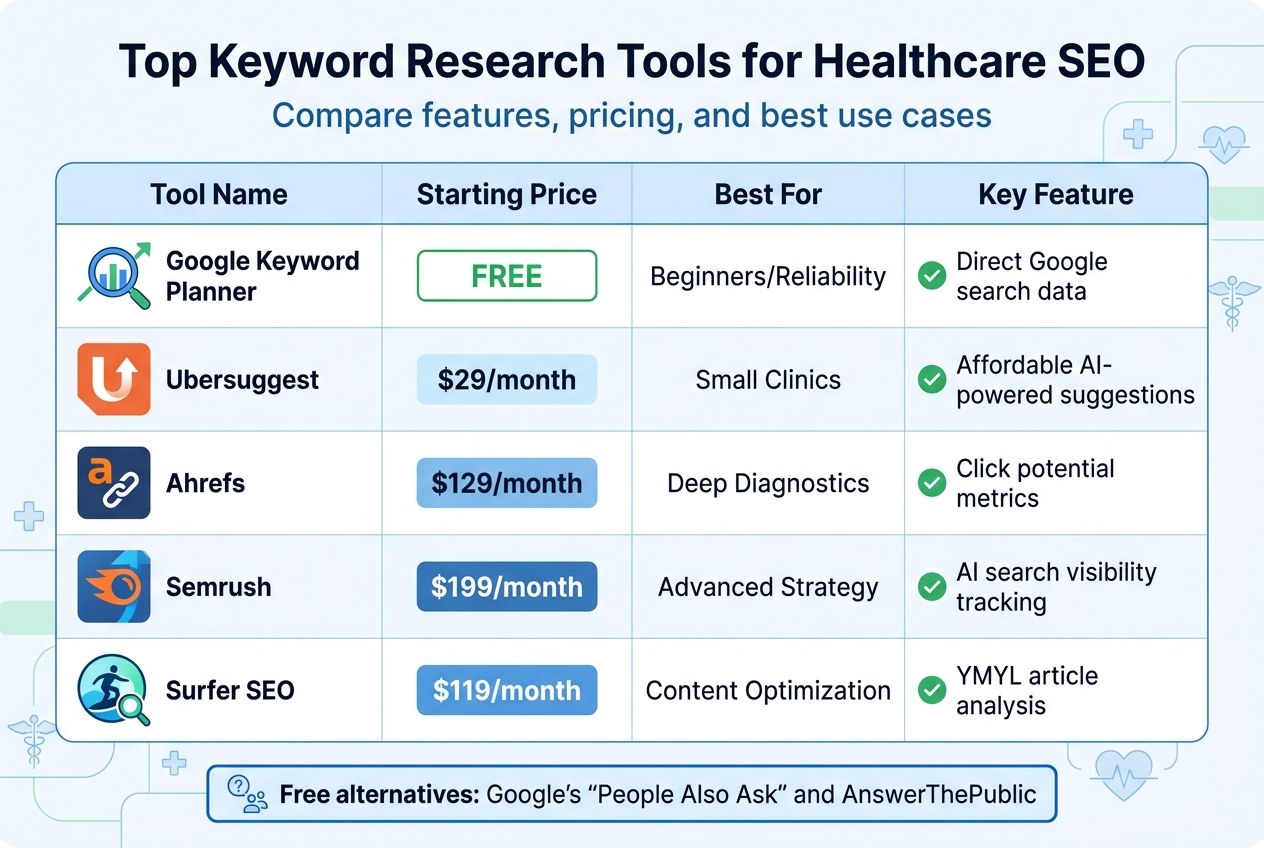
Healthcare Keyword Research Tools Comparison: Features and Pricing
Keyword research is the backbone of effective healthcare SEO. In this field, it’s not just about chasing high search volumes - you need to align with patient intent while adhering to ethical standards. For example, targeting a keyword like "cure diabetes naturally" might attract clicks, but it risks misleading patients and crossing ethical boundaries. Instead, opt for phrases like "when to see a doctor for diabetes management" that are both accurate and responsible. The goal is to identify keywords that reflect patient needs and meet ethical guidelines, then refine your list using the right tools.
Balancing Short-Tail and Long-Tail Keywords
A good keyword strategy blends short-tail and long-tail keywords. Short-tail terms like "diabetes" may bring significant search volume but come with intense competition. On the other hand, long-tail keywords - such as "chronic back pain treatment options for seniors" - attract more specific queries, often from patients closer to making a decision. For healthcare practices, aim for keywords with a difficulty score under 40 and at least 100 monthly searches.
"Healthcare SEO requires specialized knowledge of medical terminology, patient needs, and compliance with healthcare privacy regulations."
– Connor Wilkins, CMO, Direction.com
Organizing Keywords by Patient Journey
Structure your keywords based on the stages of the patient journey:
- Awareness: Keywords focused on symptoms (e.g., "headache causes").
- Consideration: Keywords exploring treatment options (e.g., "best migraine treatments").
- Decision: Keywords aimed at taking action (e.g., "neurologist appointment near me").
Additionally, categorize keywords as service-based (e.g., "emergency dental clinic") or condition-based (e.g., "symptoms of flu") to better match how patients search.
Analyzing Competitors
To uncover keyword opportunities, analyze three types of competitors:
- Direct practice competitors: Local clinics or hospitals in your area.
- SERP competitors: High-authority websites like Healthline or WebMD.
- Directory platforms: Sites like Zocdoc that rank for healthcare-related searches.
A keyword gap analysis can reveal terms where competitors rank but your site doesn’t, offering valuable opportunities to fill those gaps.
Tools for Finding Healthcare Keywords
The right tools can make keyword research more efficient. Here are some top options:
| Tool | Starting Price | Best For | Key Feature |
|---|---|---|---|
| Google Keyword Planner | Free | Beginners/Reliability | Direct Google search data |
| Ubersuggest | $29/month | Small Clinics | Affordable AI-powered suggestions |
| Ahrefs | $129/month | Deep Diagnostics | Click potential metrics |
| Semrush | $199/month | Advanced Strategy | AI search visibility tracking |
| Surfer SEO | $119/month | Content Optimization | YMYL article analysis |
Free resources like Google's "People Also Ask" section and AnswerThePublic can also help you uncover common patient queries.
What Search Intent Means in Healthcare
Search intent refers to the purpose behind a patient’s query. Understanding this helps you create content that not only ranks but also meets patient needs. For instance, a term like "diabetes" might attract users looking for symptoms, news, or treatment options, while "diabetes treatment" indicates a more specific intent.
Healthcare-related searches generally fall into these categories:
- Informational: Learning about a condition (e.g., "what is type 2 diabetes").
- Navigational: Looking for a specific provider or portal (e.g., "Mayo Clinic patient portal").
- Commercial: Comparing options (e.g., "Invisalign vs braces pros and cons").
- Transactional: Ready to take action (e.g., "book dermatology appointment").
"Keywords are the bridge between what people are searching for and the content you provide to meet that need."
– Jay Jolliffe, RCMO
Before finalizing a keyword, check the search results. If a term like "diabetes management" mainly returns recipe blogs but you’re planning a clinical guide, it’s a sign of mismatched intent. Look at the types of pages ranking - whether they’re educational articles, clinic websites, or booking pages - and adjust your content to fit.
Assign one primary keyword per page and support it with about five secondary keywords for blog posts or up to ten for comprehensive pillar pages. Use secondary keywords as synonyms or related subtopics to strengthen your content. For local practices, include geographical modifiers like "family doctor near the New York Public Library" to capture local searches.
How to Write Content That Ranks and Engages Readers
Healthcare content needs to do more than just rank well on search engines - it must also connect with readers. To achieve this, your writing should combine accuracy with a clear, easy-to-read format. By focusing on both search engine algorithms and human needs, you can create medical content that informs, engages, and ranks effectively.
Writing Accurate Medical Content in Plain Language
Healthcare topics fall under Google's "Your Money or Your Life" (YMYL) category, which means accuracy and trustworthiness are non-negotiable. Every piece of content should either be written or reviewed by licensed medical professionals, with their credentials prominently displayed. For example, include a "Medically reviewed by [Provider Name]" tag to meet E-E-A-T (Experience, Expertise, Authoritativeness, Trustworthiness) standards.
The American Medical Association suggests writing patient-facing medical content at a sixth-grade reading level. This doesn't mean oversimplifying - it means avoiding unnecessary jargon and explaining complex ideas in plain terms. Use language that aligns with how patients search online. For instance, say "high blood pressure" instead of "hypertension" when addressing general audiences. If technical terms are unavoidable, define them in the same sentence to keep readers engaged.
A great example of this in action is Oleg Kovalev's work with Aspect Health. By implementing a strong E-E-A-T strategy, the company grew its organic traffic from 1,000 to 60,000 monthly clicks in a year. This effort resulted in 331,000 clicks and 35.7 million impressions, with an average search position of 7.6.
"Medical content is the core YMYL category. Author credentials, review signatures, and source citations aren't nice-to-haves - they're ranking prerequisites."
– Oleg Kovalev, CEO, ASP Marketing
When citing sources, stick to primary, trusted organizations like the CDC, NIH, or peer-reviewed journals. Avoid secondary sources like health blogs. Be precise with data to establish authority. For example, instead of saying "cleanings are quick", specify "A standard cleaning takes 30–60 minutes." This approach not only builds trust but also increases your chances of being featured in AI snippets.
Once your content is accurate and easy to understand, the next step is optimizing it for search engines.
How to Optimize Headlines, Meta Descriptions, and URLs
Your headline (H1 tag) should grab attention while including the main keyword early on. Since 77% of patients research healthcare providers online before booking an appointment, your title should address their concerns clearly. For example, "How to Prepare for Your First MRI Scan" is more actionable and relevant than "MRI Information."
Meta descriptions are your chance to pitch your content in search results. Keep them between 155 and 160 characters, include your target keyword, and end with a call to action. For instance, instead of "Learn about diabetes management", try "Discover evidence-based strategies to manage type 2 diabetes effectively. Schedule your consultation today."
Clean, descriptive URLs are another key factor. Use simple, hyphenated slugs that reflect the page topic, like /how-to-prepare-for-mri-scan, rather than generic strings like /page-123. Stick to one H1 tag per page and use secondary keywords naturally in H2 and H3 subheadings to capture related search traffic.
Formatting Content for Better Readability and Rankings
To rank well, medical blog posts generally need to be 800 to 1,500 words long, offering enough depth for both readers and search engines. However, length alone isn't enough. Break up dense content with H2 and H3 subheadings that reflect common patient questions or specific aspects of the topic.
Keep paragraphs short and focused. Long, dense blocks of text can slow down comprehension and even page speed - important since 53% of mobile users will leave a healthcare site if it takes longer than 3 seconds to load. Visual elements like videos, infographics, and images with alt-text can also improve engagement and dwell time.
Answer the user’s main question within the first two paragraphs. For example, if someone searches "what are the symptoms of strep throat", list the symptoms immediately. Then, provide additional details and context after the initial answer.
"Good SEO is paying attention to all the details that most bloggers ignore."
– Ryan Biddulph
Highlight key points using bold text, and consider tables for comparing treatment options, listing symptoms, or organizing complex information. This not only helps readers scan for what they need but also gives search engines structured data to better understand your content.
Building Credibility with E-E-A-T Principles
Optimizing your healthcare blog isn’t just about sprinkling in keywords or improving readability - it’s about earning trust by following proven E-E-A-T strategies. Since healthcare content falls under Google’s "Your Money or Your Life" (YMYL) category, it’s held to the highest standards because misinformation in this space can have serious consequences. To succeed, your blog must reflect the four pillars of E-E-A-T: Experience, Expertise, Authoritativeness, and Trustworthiness.
- Experience stems from firsthand involvement, like patient care or verified patient stories.
- Expertise requires formal qualifications, such as an MD, DO, RN, or PharmD.
- Authoritativeness comes from external validation, like backlinks from .gov, .edu, or major health organizations.
- Trustworthiness - the cornerstone of all three - is built through secure sites (HTTPS), transparent author bios, clear disclaimers, and citing credible sources.
Let’s dive into two practical ways to apply these principles: citing medical sources accurately and displaying author credentials effectively.
How to Cite Medical Sources Correctly
When citing medical information, prioritize primary sources over consumer health websites. For example, reference peer-reviewed journals like JAMA, The Lancet, NEJM, or Cochrane Reviews. Government and global health organizations such as the CDC, NIH, and WHO are also reliable and authoritative. Always link directly to studies using DOI or PubMed URLs to back up your claims. For instance, instead of relying on a summary from WebMD, link to the original research published in a medical journal.
Adding "Last Reviewed" dates alongside publication dates is another way to show readers that your content reflects current medical standards. This is especially important given that more than 7% of all Google searches globally - over 1 billion searches daily - are health-related. Accuracy isn’t just recommended - it’s essential.
On the technical side, use MedicalWebPage Schema markup rather than generic Article tags. Incorporate reviewedBy tags to connect your content to a specific physician and include lastReviewed dates to highlight its freshness. These technical signals help search engines verify your content’s reliability.
While proper citations are crucial, showcasing the expertise of your authors and reviewers is just as important.
Displaying Author Credentials and Expertise
Make it easy for readers to see who’s behind your content by clearly distinguishing the author from the medical reviewer. Use bylines like "Written by [Name, Credentials] | Medically Reviewed by [Dr. Name, MD, Specialty]". Place this information above the fold, so it’s immediately visible, rather than hiding it in the footer. This is especially important since 94% of patients rely on online reviews to evaluate healthcare providers.
Author and reviewer names should link to detailed bio pages. These pages should include:
- Education and board certifications
- Years of experience
- Professional affiliations
- Headshots
- Links to LinkedIn profiles, published works, or media appearances
Write bios in the third person to maintain a professional tone. These pages not only build trust with readers but also serve as "linkable assets" for search engines and media outlets, further boosting your site’s authority.
| Bio Page Element | Purpose | SEO/Trust Impact |
|---|---|---|
| Full Credentials | Establishes formal expertise | High (E-E-A-T Signal) |
| Headshot | Adds a human touch to build rapport | Medium (UX/Trust) |
reviewedBy Schema |
Links content to a verified expert | High (Technical SEO) |
lastReviewed Date |
Demonstrates content is up-to-date | High (YMYL Requirement) |
| External Links | Verifies credentials through licenses or media mentions | Medium (Authority) |
To keep your content relevant, review medical posts every 6–12 months to align with updated care standards. While professional medical reviews can cost $100–$250 per hour or $200–$500 per article depending on the specialty, the investment is worth it. Healthcare SEO leads boast a 14.6% close rate, nearly 8 times higher than outbound marketing. The ROI speaks for itself.
Technical SEO for Healthcare Blogs
A strong technical setup is essential for healthcare blogs. With 65% to 75% of medical site traffic coming from mobile devices, technical performance plays a key role in whether patients stick around or head to a competitor.
Google focuses on three Core Web Vitals to evaluate user experience: Largest Contentful Paint (LCP) measures how quickly the main content loads, Interaction to Next Paint (INP) tracks the responsiveness of clicks and taps, and Cumulative Layout Shift (CLS) ensures content stays stable during loading. Aim for an LCP of ≤ 2.5 seconds, an INP of ≤ 100 milliseconds, and a CLS of ≤ 0.1 to meet these benchmarks. These improvements not only enhance rankings but also create a smoother experience for patients.
"Patients bounce in under three seconds on mobile." - Oleg Kovalev, Founder, ASP Marketing
In one case, Oleg Kovalev worked with Aspect Health, a women's health platform, to optimize Core Web Vitals and other technical SEO elements. Over 12 months, the platform's traffic skyrocketed from 1,000 to 60,000 monthly clicks.
Optimizing for Mobile Devices and Page Speed
Once the basics are in place, focus on mobile responsiveness and speed. A responsive design is non-negotiable since Google uses mobile-first indexing, meaning your mobile site is what gets ranked. Make sure calls-to-action are easy to tap, and include click-to-call buttons - especially since 70% of health-related searches happen on mobile devices.
Regularly check your site with Google PageSpeed Insights to catch mobile-specific issues like oversized images or scripts that delay loading. Compress images (like staff photos) without losing quality, and remove unused CSS or JavaScript. Tools like browser caching and a Content Delivery Network (CDN) can significantly cut server response times. Keep navigation simple with clear links for "Services", "Location", and "Book Appointment."
Accessibility is equally important. Follow WCAG 2.2 AA standards by ensuring features like adequate color contrast and keyboard-friendly navigation for users with disabilities. Secure your site with HTTPS and proper security headers to build trust - especially vital for YMYL (Your Money or Your Life) content. These steps signal to both users and search engines that your site is trustworthy and ready to serve patients.
Using Schema Markup for Medical Content
After fine-tuning mobile performance, use schema markup to make your content easier for search engines to interpret. Schema markup turns your site into machine-readable data, helping search engines understand details like your doctors, services, and specialties. This precision can secure featured snippets and AI-generated responses.
Key schema types for healthcare include: Physician to link doctors with their NPI numbers and certifications, MedicalCondition to describe symptoms and treatments, MedicalProcedure to outline services, and FAQPage to address common patient queries. Use MedicalClinic to ensure your name, address, and phone number (NAP) are consistent across your site, Google Business Profile, and directories. Inconsistent data confuses AI systems, reducing your visibility.
For example, a cardiology clinic that implemented schema markup and updated its content saw a 38% increase in visibility within Google's Search Generative Experience (SGE). As AI-driven search tools grow, structured data ensures your expertise is highlighted in AI summaries and voice search results.
| Schema Type | Purpose in Healthcare SEO |
|---|---|
Physician |
Links doctors to NPI, certifications, and specialties |
MedicalCondition |
Defines symptoms, causes, and treatments |
MedicalClinic |
Standardizes NAP and services for local search |
FAQPage |
Boosts SERP visibility and supports voice search |
MedicalProcedure |
Details treatments offered |
It's also crucial to balance technical performance with patient privacy. Standard tracking tools like Google Analytics 4 or Meta Pixels may violate HIPAA regulations if they collect Protected Health Information on condition-specific pages. To stay compliant, use server-side tracking for monitoring site performance without risking patient data.
Conclusion
Creating SEO-friendly healthcare blog content is all about finding the right balance between boosting search rankings and building trust with your audience. The strategies outlined here work together to help your blog attract patients via search engines while offering reliable, clinically accurate information. By focusing on real patient questions through keyword research and applying E-E-A-T (Experience, Expertise, Authoritativeness, and Trustworthiness) principles, you establish authority that resonates with both search engines and readers.
Healthcare content faces unique scrutiny because it falls under Google's YMYL (Your Money or Your Life) standards. This means search engines hold it to a higher standard compared to other topics. To succeed, it’s crucial to involve medical professionals in the content creation process, reference trusted sources like the CDC or peer-reviewed studies, and prominently display author credentials. These steps not only enhance visibility but also strengthen the credibility of your content.
"Healthcare is the single hardest vertical in SEO - and the one with the clearest payoff when you get it right." - Oleg Kovalev, Founder, ASP Marketing
The numbers back this up. Organic healthcare search has a conversion rate of 5.6%, and SEO-generated leads close nearly eight times more often than those from outbound marketing. However, high rankings alone don’t guarantee success. For instance, a practice with a 4.8-star rating at position #3 often draws more patients than a 3.9-star-rated practice sitting at #1. Technical aspects like mobile optimization, schema markup, and HIPAA-compliant tracking are key to turning visibility into trust and, ultimately, patient action.
As AI-powered search tools evolve, the core principles remain unchanged: write for people first and optimize for search engines second. Use simple, clear language alongside clinical accuracy, keep content updated with the latest medical standards, and never rely on unedited AI-generated material. When done right, these strategies can transform your healthcare blog into a long-term tool for attracting and retaining patients.
FAQs
How do I prove E-E-A-T on a healthcare blog?
To showcase E-E-A-T (Experience, Expertise, Authority, and Trustworthiness) on a healthcare blog, it's essential to have content written by qualified professionals such as MDs, DOs, or RNs. Implement a rigorous review process to ensure accuracy, referencing reliable medical sources throughout. Clearly display authorship details, emphasizing professional credentials to build trust. By maintaining these standards, you can strengthen credibility with both your audience and search engines.
How do I pick healthcare keywords without making medical claims?
When selecting healthcare-related keywords, it's important to strike a balance between relevance and responsibility. Stick to terms that accurately reflect your services, but steer clear of language that could be mistaken for medical advice or a diagnosis.
For example, incorporating long-tail keywords such as "symptoms of [condition]" or "treatment options for [condition]" can help you align with the way patients typically search online. These phrases are specific, making them more likely to match user intent.
Focus on informational and navigational keywords - the kind that answer common questions like "how to manage diabetes" or "what are the early signs of arthritis?". This approach ensures your content provides useful, relevant information without crossing into areas that require medical expertise.
What schema markup should a healthcare blog use?
Healthcare blogs can benefit greatly from using structured schema markup. This helps search engines and AI systems better understand important details about your practice. Some of the most commonly used types include:
- MedicalOrganization: Showcases details about your healthcare organization.
- Physician: Highlights information about individual doctors.
- Service: Describes the specific services you offer.
These schemas can make it easier for search engines to display crucial information, like your services, operating hours, and appointment booking options. When implemented correctly, schema markup not only boosts your SEO but also ensures that accurate details appear prominently in search results.