
Maximizing ROI with Retargeting for Social Media Leads
May 2, 2026Retargeting is one of the most effective ways to boost conversions and recover lost opportunities. Here’s the big picture:
- 97% of website visitors leave without converting - retargeting helps bring them back.
- Retargeted users are 43% more likely to convert and 10x more likely to click on ads compared to new audiences.
- Tools like Meta Pixel, TikTok Pixel, and LinkedIn Insight Tag track user behavior to create personalized ad campaigns.
- Audience segmentation is key - target users based on their actions (e.g., cart abandoners, page viewers) and funnel stage.
- Tailored ads with clear CTAs (e.g., urgency offers for cart abandoners, educational content for blog readers) drive better results.
- Frequency capping (3–5 impressions per week) and cross-channel retargeting (social media + email) improve engagement without overwhelming users.
Retargeting isn’t just about showing ads - it’s about delivering the right message at the right time. By using precise audience segmentation, dynamic ads, and consistent optimization, you can recover lost sales, build trust, and maximize ROI.
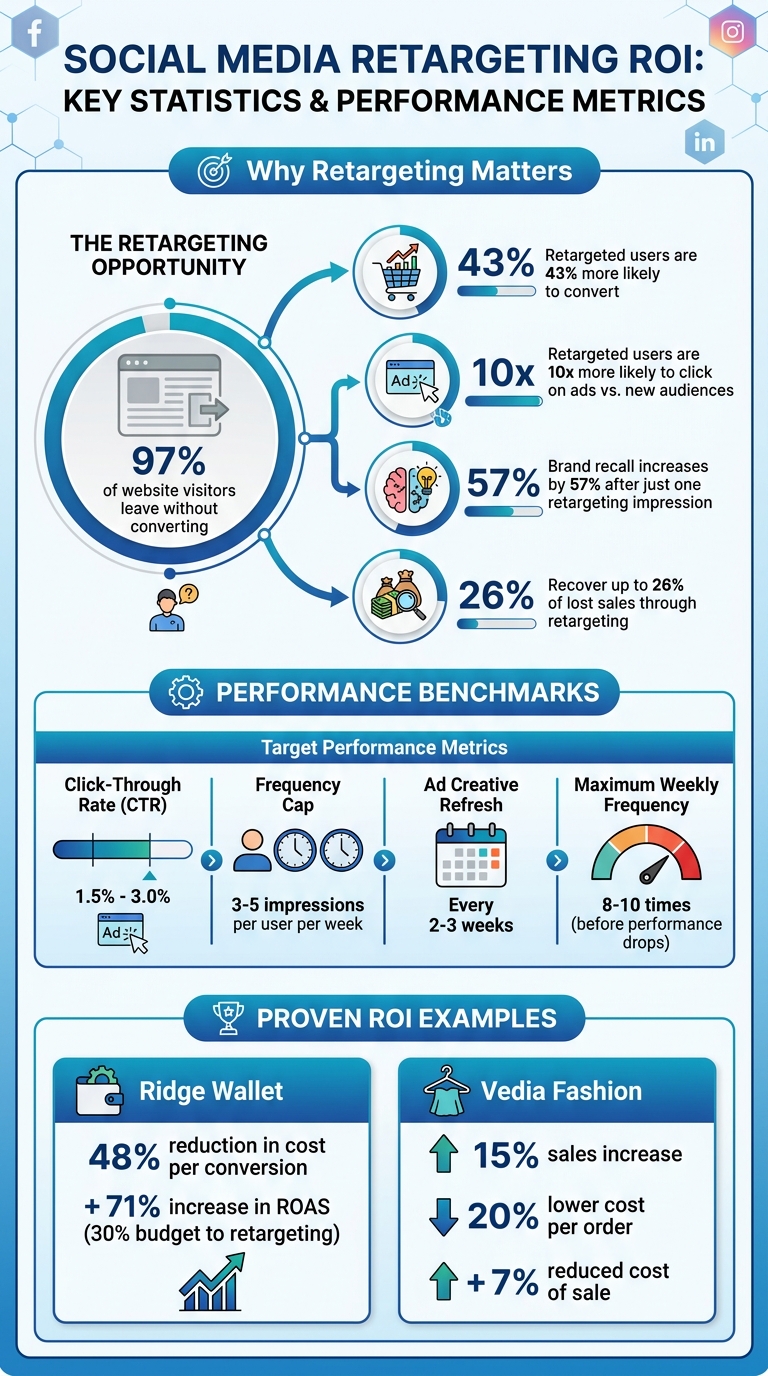
Social Media Retargeting ROI Statistics and Key Performance Metrics
5 Tips For Social Media Retargeting To Boost Your ROI
sbb-itb-cef5bf6
How Social Media Retargeting Works
Retargeting relies on tracking pixels - tiny JavaScript code snippets added to your website - that monitor visitor behavior. When someone visits your site, the pixel activates, storing a cookie in their browser or sending data directly to the platform. This allows platforms like Meta, LinkedIn, or TikTok to match that visitor to their user profile and display personalized ads as they browse their feeds. By capturing user behavior, these tools set the stage for retargeting campaigns that focus on driving ROI.
This approach targets visitors based on specific actions they take. For instance, if someone checks out your pricing page but doesn’t fill out a contact form, the pixel logs that behavior. Platforms then identify the visitor and show them tailored ads on platforms like Instagram, Facebook, LinkedIn, or TikTok. Essentially, you’re reaching users who have already expressed interest.
Each platform has its own tracking tools. Meta offers the Meta Pixel for Facebook and Instagram, which tracks actions like "Add to Cart" or "Purchase." LinkedIn’s Insight Tag is ideal for B2B retargeting, even allowing you to target entire organizations whose employees visited your site. TikTok uses its TikTok Pixel and an Events API for server-side tracking, while Google’s Google Tag helps you reach users across the Google Display Network.
Next, let’s break down how tracking pixels turn visitor data into highly targeted ads.
Tracking Leads with Retargeting Pixels
Installing and using pixels helps transform visitor actions into custom advertising opportunities. When a user takes an action - like viewing a product, watching a video, or abandoning their cart - the pixel captures that information and sends it back to the platform, enabling the creation of custom audiences for retargeting.
For example, Meta’s Dynamic Product Ads automatically show users the exact products they viewed on your site. If someone looked at a pair of running shoes but didn’t buy them, they’ll likely see those same shoes later in their Instagram feed. LinkedIn’s Insight Tag is particularly useful for B2B companies, as it identifies not only individuals but also entire organizations, giving you the ability to retarget the decision-makers within those companies.
Privacy changes are reshaping how pixels work. With browsers like Safari and Chrome phasing out third-party cookies, platforms are transitioning to server-side tracking methods like Meta’s Conversions API. This shift means you’ll need to rely more on first-party data - such as email lists, CRM data, and on-platform engagement - to create retargeting audiences that comply with privacy regulations.
Audience Segmentation for Effective Retargeting
Audience segmentation is crucial for delivering messages that resonate, ultimately improving conversion rates and ROI. Not all visitors are at the same stage in their journey, so grouping them by intent ensures the right message reaches the right audience. For instance, broader groups like "All Website Visitors" might receive brand awareness ads, while high-intent segments like "Cart Abandoners" can be targeted with specific offers.
Here’s how to segment your audience based on behavior and funnel stage:
| Audience Segment | Retargeting Window | Funnel Stage |
|---|---|---|
| Social Media Engagers | 90+ Days | TOFU (Awareness) |
| Website/Blog Visitors | 30+ Days | TOFU/MOFU (Interest) |
| Product Page Viewers | 14+ Days | MOFU (Consideration) |
| Cart Abandoners | 7+ Days | BOFU (Intent) |
| Past Purchasers | Varies (Upsell/Cross-sell) | Retention |
It’s also essential to create exclusion lists for users who have already converted.
You can refine your segmentation even further by targeting users based on specific behaviors. For example, focus on users who watched at least 50% of a video, spent over two minutes on a landing page, or browsed three or more product pages. Proper segmentation ensures you keep re-engaging visitors as they move through their decision-making process.
Building Retargeting Ad Campaigns That Convert
Once you've segmented your audience, the next step is creating ads that truly resonate. To drive conversions, focus on personalized creatives and clear calls-to-action (CTAs). Retargeting works best when the ads acknowledge a user's previous interactions with your brand and guide them toward the next step. For example, someone who abandoned their cart doesn’t need an introduction - they need a compelling reason to finalize their purchase. On the other hand, a blog reader might still be exploring and would benefit more from educational content. Let’s dig into how tailoring your ads to different stages of the funnel can boost engagement.
Personalizing Ad Creatives for Better Engagement
Generic ads don’t cut it when it comes to retargeting. To connect with your audience, align your ad creatives with where they are in the funnel:
- Top-of-funnel users (e.g., blog readers, social media engagers): They respond well to educational content, such as explainer videos or case studies.
- Middle-of-funnel users (e.g., product page visitors): Focus on product demos, feature comparisons, or customer testimonials to address their specific questions.
- Bottom-of-funnel users (e.g., cart abandoners): Use urgency-focused offers like discounts, free shipping, or limited-time deals to push them to act.
Dynamic Product Ads (DPAs) are a game-changer for personalization. These ads automatically showcase the exact products users viewed or left behind in their carts. For instance, Ridge Wallet allocated 30% of its Facebook Ads budget to retargeting campaigns, which led to a 48% reduction in cost per conversion and a 71% increase in ROAS. Similarly, Salt & Stone used cross-sell retargeting to promote complementary products, successfully increasing customer lifetime value.
Another effective approach is sequential retargeting, which prevents ad fatigue and tells a story. Instead of bombarding users with the same ad repeatedly, guide them through a series of messages. For example, ClickUp first targeted users with ads for a productivity guide. Then, they retargeted those who downloaded it with an offer for a free trial of their team management software. As marketing expert Ansherina Opena puts it:
"Sequential retargeting mimics the logic of email nurture flows - but in the ad space. Instead of blasting one message repeatedly, you guide users through a story".
The platform you’re advertising on also matters. TikTok audiences prefer native, vertical videos that feel user-generated, while LinkedIn users are more likely to engage with professional, thought-leadership content. Adding social proof - like testimonials or ratings - can further build trust. Research shows that 9 out of 10 customers rely on reviews when making purchasing decisions.
To keep your ads fresh, update creatives every 2 to 3 weeks to avoid "banner blindness." Additionally, set frequency caps of 3–5 impressions per user within a 7-day period. Showing ads more than 8–10 times a week can hurt performance.
Once your creatives are in place, the next step is to drive action with targeted CTAs.
Using Clear Calls-to-Action (CTAs)
Your CTAs should match where the user is in their journey. A one-size-fits-all approach won’t work - each stage of the funnel requires a unique strategy:
| Funnel Stage | Target Audience | Recommended CTA Strategy | Example CTA |
|---|---|---|---|
| Top (TOFU) | Blog readers, social engagers | Educational, trust-building | "See the Results" |
| Middle (MOFU) | Product page visitors, video viewers | Problem-solving, comparisons | "How We Compare" |
| Bottom (BOFU) | Cart abandoners, trial users | Urgency, direct conversion | "Claim My 10% Off" |
Urgency and scarcity are powerful motivators. Phrases like "Limited time offer", "Expires in 24 hours", or "While supplies last" can create the push needed to convert. For cart abandoners, pairing CTAs with incentives - such as 10% off, free shipping, or a bonus gift - can recover up to 26% of lost sales. Personalized CTAs in Dynamic Product Ads, such as "Still thinking about these? They're waiting in your cart", also perform exceptionally well.
Make sure your landing pages match the promises in your CTAs. A disconnect between the ad and the landing page can increase bounce rates and damage trust. Since most users browse on mobile, ensure CTAs are easy to click and navigation is straightforward.
Finally, A/B testing is essential for optimizing your CTAs. Experiment with elements like button text, color, and placement to see what works best. As Mick Essex and Gaukhar Murzagaliyeva from POWR highlight, retargeted users are about three times more likely to click on an ad than first-time viewers, so fine-tuning your CTAs can significantly impact your ROI.
Optimizing Campaign Performance to Increase ROI
Fine-tuning ad timing and coordinating across multiple channels can turn decent ads into campaigns that deliver impressive returns. These tweaks ensure your retargeting strategy keeps leads engaged throughout their buying journey. Here's how to avoid ad fatigue while staying top-of-mind.
Timing and Frequency Capping
Bombarding users with the same ad repeatedly can backfire. Overexposure leads to banner blindness, irritates users, and drives up costs. The fix? Frequency capping. This strategy limits how many times each user sees your ads within a set timeframe.
A good rule of thumb is 3–5 impressions per user per week. But this isn't a universal standard - it depends on where users are in their decision-making process. For top-of-funnel awareness campaigns, stick to 1–2 impressions daily. Users in the middle of the funnel, who are actively evaluating your product, can handle 2–3 impressions a day. Meanwhile, bottom-of-funnel users, like those who abandoned their carts, can see up to 4 impressions daily without becoming fatigued.
Time-decay segmentation sharpens this approach further by adjusting based on how recently someone engaged with your brand. For instance:
- 0–3 days ago: These "hot" leads are likely to respond to aggressive offers.
- 4–7 days ago: These users may need social proof, like testimonials or reviews.
- 8–30 days ago: Focus on educational content to reignite their interest.
Sequential retargeting is another way to keep your ads fresh and effective. Start with a simple reminder during Days 1–3, such as a product image and a message like "Still thinking about it?" Transition to social proof (Days 4–7) using customer reviews or user-generated content. Finally, offer an incentive (Days 8–14), such as a discount code or free shipping.
As retargeting expert Koro puts it:
"A healthy retargeting campaign typically sees a frequency between 3-5 over a 7-day period. If frequency exceeds this without conversions, you are likely suffering from audience saturation or creative fatigue".
Keep a close eye on your frequency metrics. If your 7-day frequency exceeds 4.0 and conversions aren't happening, adjust by trimming your budget or broadening your audience. But timing alone isn’t enough - combining efforts across channels can amplify your results.
Integrating Cross-Channel Retargeting
Retargeting on social media becomes even more effective when paired with other platforms. Cross-channel retargeting ensures your audience encounters your message through multiple touchpoints - like social media, email, and display ads - creating a consistent presence that drives conversions. Research shows brand recall increases by 57% after just one retargeting impression.
The secret lies in unified messaging. For example, if someone abandons their cart, follow up with both a social media ad and an email. This dual approach reinforces your message without feeling repetitive. Similarly, if a user downloads a lead magnet via email, serving them a retargeting ad the same day strengthens their connection to your brand.
Tailoring your ad creatives to fit each platform is equally important. TikTok users, for instance, engage more with raw, vertical, user-generated content, while LinkedIn audiences prefer polished, professional posts. Avoid duplicating ads across platforms; instead, match your content to the style of each channel.
Consider the example of Vedia, a fashion retailer. By using programmatic technology to expand beyond Facebook, they boosted overall sales by 15%, reduced cost per order by nearly 20%, and lowered their cost of sale by 7%.
CRM data integration can take cross-channel retargeting to the next level. Syncing your customer relationship management system with social platforms allows for the creation of lookalike audiences based on your best customers. It also enables personalized cross-selling campaigns. As third-party cookies phase out, leveraging first-party data becomes even more critical.
Lastly, don’t forget to set up exclusion lists. Automatically remove users who’ve already converted from your retargeting campaigns. Instead, shift them to onboarding or upsell campaigns to maximize your ad spend.
Measuring Retargeting Success and Improving Results
Once your retargeting campaigns are up and running, the real challenge begins: measuring their performance and making adjustments to get the best return on investment (ROI). Without keeping an eye on the right metrics, you risk wasting your ad budget on campaigns that aren't delivering.
Key Metrics to Track
The conversion rate is a great place to start. This measures the percentage of retargeted visitors who take the desired action, like becoming leads or customers, and gives you a clear picture of how well your ads are working. Next, look at Cost Per Lead (CPL) or Cost Per Acquisition (CPA) - divide your total spend by the number of leads or customers you gain. If your retargeting CPA is creeping close to your prospecting CPA, that's a red flag. Retargeting should always be your most cost-effective way to convert users.
Another key metric is the click-through rate (CTR), which shows how engaging your ads are. For retargeting campaigns, aim for a CTR between 1.5% and 3.0%. If it's lower, your visuals or messaging might need an update. Keep in mind, CTRs can drop by as much as 50% after a few months if you don't refresh your ads.
Don't overlook engagement rate (likes, shares, and comments) and referral traffic from platforms back to your site. These metrics reveal how well your audience is connecting with your content. For lead quality, track Sales Qualified Leads (SQLs) - these are the retargeted leads that are ready for your sales team to follow up with. And finally, calculate your overall ROI using the formula: (Revenue / Investment) × 100. This tells you how financially effective your campaign is.
By monitoring these metrics, you’ll gain the insights needed to tweak your campaigns and steadily improve your results. Testing and refining based on these numbers will help you stay on track.
A/B Testing and Campaign Iteration
A/B testing is a powerful way to fine-tune your campaigns, but it works best if you focus on one variable at a time. This could mean testing different headlines, ad copy, calls-to-action (CTAs), visuals, or even destination URLs. For instance, try comparing urgency-focused offers like "Limited time: 20% off" with more educational content aimed at users earlier in the funnel, such as "Learn how this works." Bottom-of-funnel users, like those who abandoned their carts, might respond better to the former, while top-of-funnel users may need a softer approach.
Audience segmentation is another area to explore. Test different lookback windows, like a 7-day versus a 30-day audience, or experiment with lookalike audiences at varying percentages (e.g., 1% vs. 3%). However, if your site traffic is under 5,000 monthly visitors, avoid over-segmenting. Broader audience groups will give algorithms more data to work with for optimization.
Also, consider tailoring your content to the platform. For example, raw, user-generated videos tend to perform better on TikTok, while LinkedIn users often prefer polished, professional presentations. To measure your campaign’s true impact, use Conversion Lift Studies. These studies compare a group exposed to your ads with a control group that wasn’t, helping you determine if your retargeting efforts are driving new sales or just catching users who were going to convert anyway.
Conclusion
Retargeting can be one of the most effective tools in your social media marketing toolkit. Think about this: 97% of visitors leave without converting, but by targeting warm audiences, you can recover up to 26% of lost sales and increase brand recall by 57% after just one impression. The secret is to treat retargeting as a continuous strategy, not a one-time effort.
The recipe for success includes segmenting your audience based on their position in the funnel, tailoring ad creatives to match user intent, and setting frequency caps to avoid overwhelming your audience. Regular testing and optimization backed by performance data are essential. Don’t forget to exclude users who’ve already converted to save budget, and use dynamic ads to deliver exactly what your audience is looking for. Combine these tactics with cross-channel strategies and first-party data, and you’ll have a retargeting system that consistently drives results.
However, implementing these strategies can get technical. From setting up tracking pixels to managing audience exclusions and creating unified reports, the process requires precision. That’s where expert help comes in. SEO Werkz specializes in retargeting marketing, offering the tools, expertise, and strategic insights to create campaigns that deliver. Whether it’s pixel setup, CRM integration, or ongoing campaign optimization, partnering with professionals ensures you make the most of every opportunity.
FAQs
Do I need pixels to run retargeting ads?
Pixels play a crucial role in retargeting ads. By embedding a small piece of code (often called a pixel or cookie) in a visitor's browser, you can track their activity on your website. This tracking enables you to show tailored ads to those users later, giving you the chance to reconnect with potential leads and boost your return on investment (ROI).
What retargeting window should I use?
The best retargeting window varies based on your campaign goals and how your audience behaves. Typically, a range of 7–14 days strikes a good balance - it keeps your brand visible without overloading users. For audiences with high intent, a shorter window (around 7 days) tends to work well. On the other hand, if your product or service involves longer decision-making cycles, extending the window to 30 days might be more effective. Experiment with different timeframes and review your campaign data to pinpoint the optimal duration for your audience.
How can I retarget without third-party cookies?
To navigate retargeting in a world without third-party cookies, server-side tracking is your go-to solution. Tools like the Meta Conversions API (CAPI) allow you to track high-intent actions - think 'Add to Cart' or 'Initiate Checkout' - directly from your server. This ensures you capture critical user behaviors without relying on browser cookies.
Take it a step further by building tiered audiences based on user intent. For example, segment users by their actions, such as engagement with your content, viewing specific pages, or abandoning their cart. Once you’ve grouped your audience, tailor your messaging to match their level of interest and intent.
These approaches let you maintain precise audience segmentation and run effective retargeting campaigns, even with cookie restrictions in place.