10 Best Practices for Social Media Optimization
April 17, 2026Social media success in 2026 requires more than just posting updates - it’s about creating meaningful interactions and being discoverable. Here are the top practices to improve your social media strategy:
- Post at the right times: Sync posts with audience activity for up to 192% higher engagement.
- Use high-quality visuals: Images boost Facebook engagement by 120%, and videos increase Twitter retweets by 150%.
- Leverage hashtags: A mix of popular, medium, niche, and branded hashtags can boost reach by 1,260%.
- Be consistent: Regular posting (e.g., 6–9 times weekly on Instagram) leads to faster follower growth.
- Write clear captions: Use hooks and single calls-to-action to triple engagement.
- Tailor content for each platform: Customize formats and tones to match platform-specific preferences.
- Share user-generated content (UGC): UGC drives 89% higher interaction rates and builds trust.
- Encourage sharing: Use direct prompts like “tag a friend” or contests to expand reach.
- Optimize profiles: Use keywords, geotags, and clear bios to make profiles searchable.
- Track performance: Use analytics tools to refine strategies and maximize results.
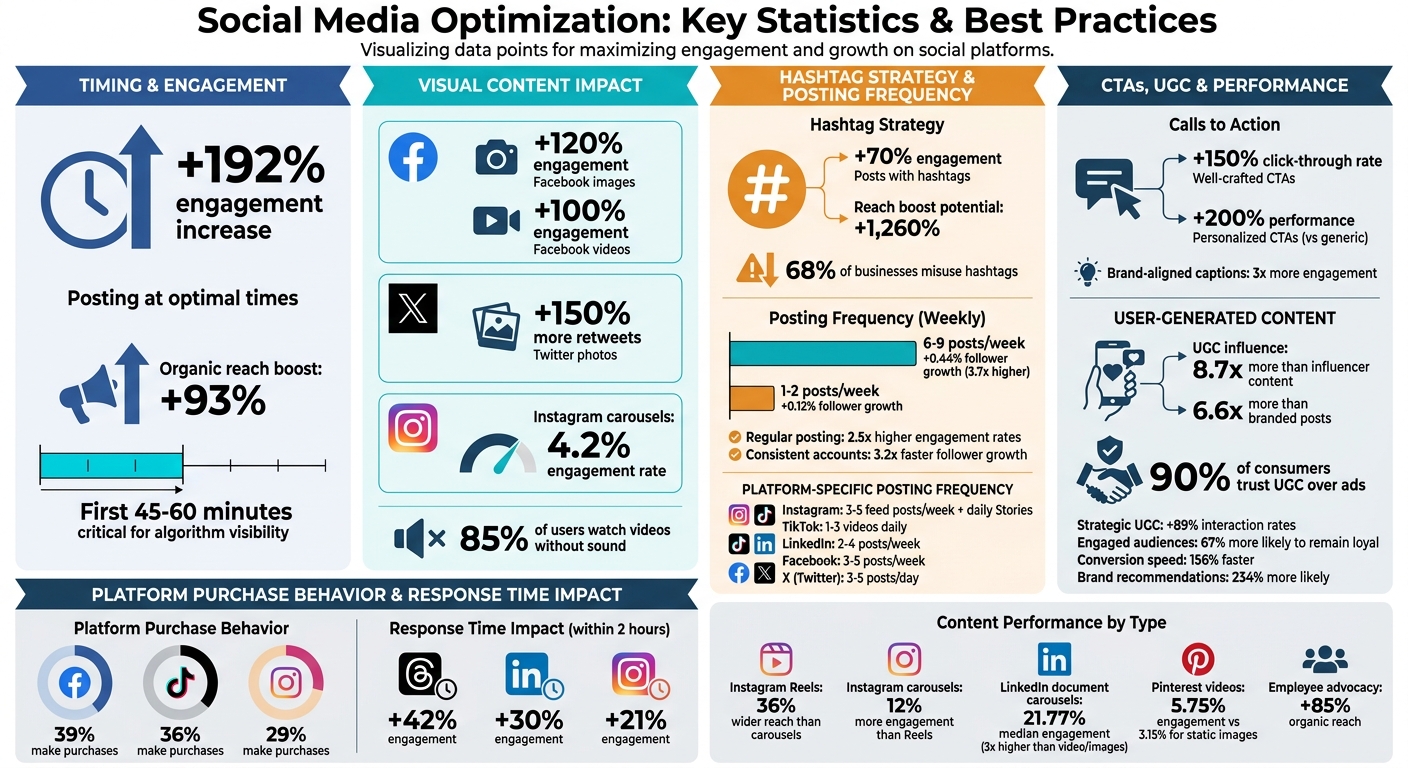
Social Media Optimization Statistics: Engagement Rates and Best Practices by Platform
1. Post When Your Audience Is Active
Why Timing Matters
Posting at the right time can make or break your content's performance. Early likes, comments, and shares are like a green light for social media algorithms, encouraging them to push your post to a broader audience. In fact, hitting the sweet spot for timing can increase engagement rates by up to 192% and organic reach by as much as 93%.
"Social media algorithms increasingly prioritize recency and early engagement signals. When you post at the right time, your content is more likely to receive immediate engagement, which tells the algorithm to show it to more people." – SocialRails Team
This underscores the importance of syncing your posting schedule with when your audience is most active.
Best Times for Different Platforms
Each platform has its own rhythm, and understanding these patterns can give you a serious edge:
- LinkedIn: Users are most active during early morning hours (8–10 a.m. EST) and late afternoon (3–6 p.m.).
- TikTok: Engagement peaks in the evening, between 6–11 p.m.
- Instagram: Wednesdays around 11 a.m. and 1 p.m. see the highest activity.
- Facebook: Weekday mornings, particularly between 8 a.m. and 12 p.m., work best.
A smart move? Schedule your posts about 15 minutes before these peak times to capture early engagement. If you’re running a campaign across multiple platforms, try staggering your posts by 2–4 hours to align with each platform's unique audience behavior.
Tools and Testing for Better Results
Analytics tools are your best friend when fine-tuning your posting schedule. Platforms like Instagram Insights and Facebook Pages Insights can help pinpoint when your followers are most active.
Want to take it a step further? Conduct a two-week A/B test by posting similar content at different times and analyzing the results. Reviewing 30–90 days of location data can also help you adjust your timing to match your audience's habits. These strategies ensure your content gets seen when your audience is most engaged, maximizing your social media efforts.
sbb-itb-cef5bf6
2. Use High-Quality Images and Videos
Content Quality
Strong visuals are the backbone of effective social media content. Sharp, well-composed images and videos not only grab attention but also build trust with your audience. On the flip side, blurry or poorly aligned visuals can make your brand seem unprofessional - or worse, spammy.
Visuals leave a lasting impression far better than text alone. For example, posts with images on Facebook see 120% more engagement, while video posts enjoy a 100% increase. On Twitter, tweets with photos generate 150% more retweets, and Instagram carousel posts achieve an average 4.2% engagement rate. It's important to adjust your visuals to meet the technical specs of each platform for the best results.
Platform-Specific Strategies
Each platform has its own preferred formats:
- Instagram Reels/TikTok: 9:16 (1080x1920)
- Facebook/LinkedIn: 1:1 or 4:5
- YouTube Thumbnails: 16:9 (1280x720)
"Details matter. The difference between a crisp, engaging visual and one that's poorly cropped or pixelated can affect everything from user trust to engagement rates." – Connor Francis, Senior Social Media Strategist, Zero Gravity Marketing
Videos, in particular, need to capture attention fast. The "3-second rule" applies here - use bold colors, motion, or a compelling text preview to hook viewers before they scroll away. Since 85% of users watch videos without sound, always include short captions (2–7 words per screen) to ensure your message gets across. Also, uploading videos directly to Facebook instead of linking to external sites can increase organic reach by 10x.
Use of Tools and Analytics
Creating polished visuals doesn’t have to be complicated. Tools like Canva, CapCut, and InShot offer user-friendly editing options, while platforms like Unsplash, Pexels, and Pixabay provide a wealth of free, high-quality images and videos.
When designing, follow basic principles like the Rule of Thirds and leveraging color hierarchy to guide the viewer's focus. To enhance both accessibility and SEO, include descriptive alt text for images (e.g., "woman presenting data on a laptop") and use #CamelCase in hashtags to help screen readers identify individual words. These small adjustments can make a big difference in how your content resonates with your audience and performs on social platforms.
How to Master Social Media in 2025 [COMPLETE GUIDE]
3. Develop a Smart Hashtag Strategy
After crafting high-quality visuals, the next step to elevate your content is developing a well-thought-out hashtag strategy.
Engagement Optimization
Hashtags are your gateway to reaching new audiences. In fact, posts with hashtags see a 70% increase in engagement and can boost reach by up to 1,260%. But here's the catch: 68% of businesses misuse hashtags, often sticking to overused ones that drown their content in a sea of posts. To avoid this, try the 30-30-30-10 rule:
- 30% popular hashtags (1M+ uses)
- 30% medium popularity (100K–1M uses)
- 30% niche hashtags (10K–100K uses)
- 10% branded hashtags specific to your business.
Platform-Specific Strategies
Not all platforms treat hashtags the same. Tailoring your approach to each platform’s quirks can make a big difference:
- Instagram: Use 20–30 hashtags, either in the caption or as the first comment for a cleaner look.
- Twitter and Facebook: Stick to 1–2 hashtags for better results.
- LinkedIn and TikTok: Use 3–5 hashtags to strike the right balance.
- YouTube: Add 3–5 hashtags at the end of your video description.
- Threads: Limit yourself to one hashtag per post.
"The difference between hashtag success and failure isn't using more hashtags - it's using the right hashtags strategically." – SocialRails
Another tip for Instagram: avoid recycling the same set of hashtags repeatedly. Rotate your hashtags to steer clear of being flagged by the algorithm for spam or "shadowbanning".
Use of Tools and Analytics
Leverage AI tools like SocialRails, RiteTag, or Hootsuite's hashtag generator to find trending and effective hashtags based on real-time data. Many platforms also offer search suggestions to help you discover hashtags that align with your content.
To refine your strategy, track performance. Tools like Sprout Social or Brandwatch can reveal which hashtags drive the most engagement. You can also cross-check your website’s top-performing keywords in Google Analytics and experiment with them as hashtags in your social posts. For deeper insights, create sets of hashtags - some broad, some niche - and A/B test them to see which combinations consistently boost reach and engagement.
When paired with other content strategies, a thoughtful hashtag plan ensures your posts reach the right eyes and generate meaningful engagement.
4. Post Consistently Without Overposting
Sticking to a consistent posting schedule can make a big difference. Accounts that post regularly experience 2.5 times higher engagement rates and 3.2 times faster follower growth compared to those with erratic posting habits. The key is to find a rhythm you can sustain over the long term - no quick bursts followed by weeks of inactivity. Let’s dive into how consistency works hand-in-hand with engagement.
Engagement Optimization
Social media platforms love predictability. Algorithms on Instagram, TikTok, LinkedIn, and others prioritize accounts that post regularly. By sticking to a schedule, you signal to these platforms that your account is active, which can lead to your content being shown to more people. Plus, your audience starts to expect and look forward to your posts, creating a loyal base that stays engaged.
Research backs this up: accounts that post 6–9 times a week see a +0.44% follower growth rate, which is 3.7 times higher than accounts posting just once or twice weekly (+0.12%). Each post builds momentum, amplifying the impact of your efforts.
But beware of overposting. Flooding your audience with content can overwhelm them, hurt your credibility, and even lead to algorithm penalties that reduce your reach.
Platform-Specific Strategies
Each platform has its own sweet spot for posting frequency. Here’s a quick guide to help you stay consistent without overdoing it:
| Platform | Recommended Frequency | Overposting Threshold |
|---|---|---|
| 3–5 feed posts per week + daily Stories | More than 1 feed post daily; over 10 Stories daily | |
| TikTok | 1–3 videos daily | Posting constantly without adding value |
| 2–4 posts per week | Multiple posts in a single day | |
| 3–5 posts per week | More than 2 posts in a day | |
| X (Twitter) | 3–5 posts per day | Excessive tweeting without engagement |
Content Quality
Quality always beats quantity. One well-thought-out post can outperform several mediocre ones in terms of engagement and reach. A good rule of thumb is the 80/20 rule: dedicate 80% of your content to providing value and 20% to promotional material.
To streamline content creation, use the 30–60–90 rule: aim for 30% new and experimental content, 60% proven formats or repurposed content, and try to complete 90% of your content in one focused session.
"Consistency does not equal maximum output. It means settling into a sustainable rhythm you can maintain for months without running yourself into the ground." – AdaptlyPost
If maintaining a high posting frequency feels overwhelming, start small - posting three times a week is better than burning out. After all, 78% of creators struggle to maintain a consistent schedule. Don’t let yourself become part of that statistic.
Use of Tools and Analytics
Consistency is easier when you have the right tools. Set aside 2–4 hours each week to batch-create content, which helps eliminate the daily stress of deciding what to post. Build a content buffer of at least 2–4 weeks to stay ahead of creative blocks or unexpected delays.
Tools like Buffer, Hootsuite, Later, and SocialBee can simplify scheduling. Many of these platforms even use AI to generate captions in your brand voice and suggest the best posting times based on your audience's activity. However, automation should complement - not replace - genuine interaction. Spend 15–30 minutes daily engaging with your audience by replying to comments and DMs.
Keep an eye on your analytics to avoid overposting. Warning signs include a drop in likes or comments per post and an increase in unfollow rates. Review your data from the past 90 days to determine when your audience is most active, instead of relying solely on generic advice about "best times" to post. Following a predictable schedule can boost your reach by as much as 23%.
To strike the right balance, plan 70–80% of your content calendar in advance, but leave 20–30% open for timely or trend-driven posts. This keeps your content fresh while maintaining the consistency that both audiences and algorithms appreciate.
5. Write Clear Captions with Calls to Action
Once you’ve nailed your visuals and posting schedule, the next step is writing captions that inspire action. A striking image or video might grab attention, but it’s the caption that convinces someone to take the next step. In fact, posts with thoughtful, brand-aligned captions can generate up to 3x more engagement than those with weak or missing captions. The key? Make every word pull its weight - keep captions concise and impactful.
Engagement Optimization
A well-structured caption can work wonders. Start with a hook to grab attention, follow it with a value-packed body, and end with a single, clear call to action (CTA).
When crafting CTAs, use action verbs and make the benefit clear. Add urgency if it fits. For example, instead of saying, "Click here", try something like, "Download your free guide now" or "Explore the full collection at [link]". Posts with direct CTAs can boost click-through rates by over 150%, while personalized CTAs tailored to audience needs can perform 200% better than generic ones.
Avoid overloading your audience with multiple requests. Asking them to "like, comment, and share" all at once often leads to inaction due to decision fatigue. Stick to one clear action per post. Short CTAs like "Drop an emoji if you agree" or "Save this for later" work well.
Platform-Specific Strategies
Every platform has its own formula for caption success. For Instagram, shorter captions - around 30 words or less - tend to perform better. Use CTAs like "Link in bio" or "Save this post" to signal value to the algorithm. On LinkedIn, longer captions (900–1,200 characters) with a professional tone and a question at the end can spark meaningful discussions. For TikTok, keep captions between 150–200 characters, focus on keywords for search, and use video-driven CTAs like "Follow for part 2".
| Platform | Ideal Caption Length | Primary CTA Strategy |
|---|---|---|
| 138–150 characters | "Link in bio", "Save for later", "Tag a friend" | |
| 900–1,200 characters | Hook-Story-Lesson; specific questions for discussion | |
| TikTok | 150–200 characters | Keyword-rich for SEO; "Follow for part 2", "Stitch/Duet" |
| 400 characters | Community-focused discussions; "Share with your team" | |
| X (Twitter) | 71–100 characters | "RT if you agree;" thread hooks |
Content Quality
Before hitting publish, make sure your caption passes the "So What?" Test - ask yourself why your audience should care. If the answer isn’t obvious, rework it until the value is clear. Use white space to break up text for better mobile readability, as dense captions often get skipped.
Keep your tone approachable, like a "smart friend giving advice" rather than a formal announcement. A couple of relevant emojis can make your caption pop, but don’t overdo it.
Use of Tools and Analytics
Well-crafted captions are more than just words - they’re a tool for amplifying your reach. Platforms like TikTok and Instagram now double as search engines, so naturally including keywords in your captions improves visibility. AI tools can also help you create captions tailored to each platform while keeping your brand voice consistent.
To refine your strategy, track how different CTAs perform. For instance, the phrase "read more" has been shown to achieve a higher engagement rate (0.58%) than "available now" (0.32%). Use this data to experiment with new CTAs and continuously improve your results.
6. Customize Content for Each Platform
Posting the same content across all platforms might seem efficient, but it often leads to underwhelming results. Each social media channel has its own vibe, audience expectations, and content preferences. For instance, Facebook users often engage with community-driven posts and customer support, while Instagram thrives on eye-catching visuals and bite-sized videos. LinkedIn is all about professional insights and educational material, whereas TikTok leans toward quick, entertaining, and often educational clips. By tailoring your content to fit the unique character of each platform, you can significantly boost engagement and make a stronger impact.
Platform-Specific Strategies
On Instagram, features like Reels and carousels are king. Carousel posts, for example, can increase reach by 1.4× and engagement by 3.1× compared to standard posts. The platform’s algorithm favors content that gets saved or shared, so focus on creating posts that people want to revisit or pass along. Over on LinkedIn, text-heavy posts with plenty of white space and document carousels tend to keep users engaged longer. To maximize post visibility, avoid including external links in the main post - drop them in the comments instead.
Facebook remains a top platform for driving direct purchases, with 39% of users making purchases there, followed by TikTok at 36% and Instagram at 29%. Short videos (under 60 seconds) and conversation-sparking status updates perform particularly well. Bari Rosenstein, Social Lead at Auntie Anne's and Jamba, highlights this:
"If you think about how people act on Facebook, they LOVE to comment, tag friends, and share on their own feed. We want to cater to that... the content that does the best is just basic status updates, especially asking questions and asking for opinions."
TikTok, on the other hand, is all about grabbing attention fast. The first 1–3 seconds of a video are crucial, with 63% of top-performing videos delivering their key message in that window. While shorter videos dominate, longer ones (3–10 minutes) are starting to gain traction. Meanwhile, X (formerly Twitter) is ideal for real-time updates and quick engagement. Its users are drawn to informative posts (55%) and content that’s either relevant or humorous (39%).
Content Quality
Customizing content isn’t just about format - it’s also about smart repurposing. For example, a long-form YouTube tutorial can be transformed into a 60-second Instagram Reel, a LinkedIn carousel, and a Facebook discussion starter. When posting videos, always upload them directly to each platform instead of sharing links. Native uploads often reach more people. Also, use the correct dimensions for each platform to avoid blurry or awkward visuals. For instance, Instagram feed posts should be 1,080×1,350 pixels, and vertical videos should follow a 9:16 aspect ratio.
Use of Tools and Analytics
Analytics tools are your best friend for fine-tuning your content strategy. Track performance metrics like reach, impressions, and engagement to identify what works best on each platform. Tagging posts by campaign or theme can uncover trends in what resonates with your audience. Keep in mind that 21% of consumers will unfollow a brand if the content feels repetitive, so it’s crucial to keep things fresh and tailored. By constantly analyzing and adjusting your approach, you’ll ensure your social media efforts stay effective and aligned with your broader goals.
7. Share Content Created by Your Audience
User-generated content (UGC) is a game-changer for social media. When customers share photos, videos, reviews, or testimonials featuring your brand, it creates authentic social proof that often feels more relatable than in-house content. In fact, UGC influences purchasing decisions 8.7 times more than influencer content and 6.6 times more than branded posts. Plus, 90% of consumers trust content from other users over traditional ads.
Boosting Engagement
Sharing UGC doesn’t just build trust - it ramps up engagement. Strategically using customer-created content can lead to 89% higher interaction rates, and engaged audiences are 67% more likely to stick with your brand. Even better, engaged users convert 156% faster and are 234% more likely to recommend your brand. To harness these benefits, encourage your audience to participate through branded hashtags, contests, or by featuring their posts on your official page. As Curator highlights:
"User-generated content is strongest when it's created in the heat of the moment. Right after a win, delivery, unboxing, or visible success, users are naturally more excited".
Social listening tools can help you uncover great content - even when your brand isn’t directly tagged - so you can find those hidden gems that resonate with your audience.
Tailoring UGC for Different Platforms
Not all platforms are the same, so your UGC strategy shouldn’t be either. On Instagram and TikTok, focus on short videos, Reels, and eye-catching visuals that show your products in action. LinkedIn is perfect for professional testimonials or case studies that highlight your expertise. Local businesses can benefit from encouraging customers to post photos and reviews on Google My Business, boosting credibility and local search rankings. For longer content, YouTube works well for detailed testimonials and product demos, which also enhance SEO.
Keeping It Authentic
When it comes to UGC, authenticity is key. Share content that aligns with your brand’s values and aesthetic. Overly polished or staged content can backfire - 78% of shoppers can tell when a brand is trying too hard to advertise. Instead, focus on authentic moments, as 82% of buyers say their purchasing decisions are influenced by a brand’s purpose. Always get permission from the creator and credit them properly. Regularly rotating featured UGC keeps your feed fresh and shows your audience that real customers trust your brand.
Tools to Streamline UGC Management
Managing UGC effectively requires the right tools. Social listening platforms can help you track mentions and branded hashtags across channels. Tools like ContentStudio (starting at $19/month) or Buffer (starting at $6/month per channel) allow you to manage audience interactions from one place. Use media libraries to store approved content for future use, and monitor metrics like engagement rates, reach, and sentiment to fine-tune your strategy and get the most out of your UGC campaigns.
At SEO Werkz, we use these UGC strategies to build stronger connections with audiences and drive meaningful engagement.
8. Promote Sharing and Engagement
Getting people to share your content starts with clear, direct calls to action. Phrases like "tag a friend" or "share this post" can encourage immediate responses. Want to take it a step further? Contests and giveaways that require sharing as part of the entry process can significantly expand your reach. The key is to keep your requests simple and straightforward.
Engagement Optimization
A smart content strategy follows the 80/20 rule: 80% of your posts should provide value - whether that's entertainment, education, or inspiration - while only 20% should promote your brand. This approach builds trust, making people more likely to share your content with others. Did you know that 66% of social media users say they find "edutainment" - a mix of education and entertainment - the most engaging type of brand content?
Engagement grows when you actively participate in conversations. Responding to comments within two hours can create a "conversation flywheel", where interaction leads to more shareable content. Quick responses matter: they can boost engagement by 42% on Threads, 30% on LinkedIn, and 21% on Instagram. As SocialRails wisely notes:
"Social media success isn't about going viral - it's about consistent execution of proven strategies".
Platform-Specific Strategies
Each platform has its quirks, and tailoring your tactics can make a big difference. For example:
- Instagram: Reels tend to have 36% wider reach than carousels, but carousels often earn 12% more engagement and saves.
- LinkedIn: Document and PDF carousels are gold here, with a median engagement rate of 21.77% - three times higher than videos or images.
- Threads: Focus on sparking conversations, as this platform thrives on back-and-forth interaction.
- Pinterest: Videos perform nearly twice as well as static images, with engagement rates of 5.75% versus 3.15%.
Another effective tactic? Employee advocacy. When your team shares your content, it can increase your organic reach by an impressive 85%. This personal touch helps humanize your brand and extends your message through trusted networks. Don’t forget to add social sharing buttons and "Click to Tweet" options on your blog posts to connect your website content with social media platforms.
9. Make Your Profiles Easy to Find
Your social media profiles aren't just placeholders - they're powerful tools for discovery. Think of them as mini search engines where potential followers and customers can find you. Platforms like Instagram, TikTok, LinkedIn, and Pinterest are increasingly used for keyword searches, much like Google. If your profiles aren't optimized, you're missing out on connecting with people who don't already know about your brand.
Platform-Specific Strategies
To make your profiles work harder for you, treat them like optimized landing pages. Start with your display name - be clear and descriptive. For example, instead of just "Sunrise Café", try "Sunrise Café | Miami Coffee Shop." In your bio, skip vague statements like "We're passionate about excellence" and go for specifics: "Organic cold brew & pour-over coffee in Brickell." Keep it short - under 160 characters - but impactful.
Each platform has its own quirks that you can leverage. On TikTok, for instance, the algorithm picks up on both spoken words and on-screen text, so make sure your target keywords appear in both. LinkedIn users often search by industry terms and job titles, so include these in your headline and "About" section. On Instagram, take advantage of alt text to reinforce the keywords in your posts.
Use of Tools and Analytics
Track how well your efforts are working by monitoring profile visits from non-followers. Tools like TikTok's search insights can help you identify trending keywords in your niche. Adding UTM parameters to the links in your bio allows you to measure traffic to your website through Google Analytics.
"SEO isn't just for websites, it's for your social media too! By optimizing your profiles, captions, hashtags, and posts with the right keywords, you make it easier for people to find you when they're actively searching for what you offer."
Don't forget to use geotags and targeted hashtags to further increase your visibility. These small tweaks can make a big difference in helping new audiences discover your brand.
10. Track Performance with Analytics and Scheduling Tools
Native platform insights can give you a basic overview of your performance, but they often leave gaps. Dedicated analytics and scheduling tools can take raw data and turn it into actionable strategies. For instance, LinkedIn doesn’t let you see timestamps on past posts, and manually gathering data from multiple platforms can be a real time sink. Let’s dive into how these tools can help you make sense of your metrics.
Use of Tools and Analytics
The right tool for your team depends on your goals and size. Social media management platforms like Buffer and Sendible combine analytics with scheduling and engagement features, making them a great fit for smaller teams. In fact, over 190,000 creators and small businesses rely on Buffer every month to grow their audiences, with plans starting as low as $6/month.
For more in-depth insights, tools like Rival IQ (starting at $239/month) or Brand24 ($99/month) specialize in competitive and sentiment analysis. These advanced options are ideal if you need to go beyond surface-level metrics.
Modern analytics tools generally focus on four key areas: descriptive, diagnostic, predictive, and prescriptive analytics. Platforms like DashThis and Google Analytics help you see how your social media activity ties into broader goals like website traffic and ROI. By consolidating data from over 30 sources into one dashboard, these tools make it easier to ensure your social media efforts are aligned with your overall strategy.
"Relying on native insights alone won't give you the full picture." – Rochi Zalani, Author, Buffer
Engagement Optimization
Once you’ve got your tools in place, it’s all about timing and early engagement. The first 45 to 60 minutes after posting are critical - this is when algorithms decide whether your post is worth showing to more people based on initial interactions. Scheduling tools like Semrush Social and Iconosquare can automatically pinpoint the best times to post, helping you maximize that early engagement window.
To stay on top of your performance, set up a review routine. Spend 15 minutes each week analyzing top-performing posts, dedicate an hour monthly to spotting trends, and hold a quarterly review to adjust your strategy. Using UTM tracking codes in your social posts is another great way to track traffic sources and campaign success through Google Analytics. And keep an eye on your engagement rates - if they dip below 2%, it’s a sign that your strategy might need a tune-up.
Conclusion
Social media optimization is a process that never truly ends. In today’s crowded digital world, regularly analyzing your performance data is essential if you want to stand out. The brands that succeed treat optimization as an ongoing effort rather than a one-time task.
The ten best practices we’ve discussed - from posting at the right times to leveraging analytics tools - work best when they’re part of a strategy driven by data. Successful brands rely heavily on audience research, performance tracking, and social listening to guide their decisions. Setting SMART goals (Specific, Measurable, Achievable, Relevant, and Time-bound) can provide clear benchmarks for progress, such as aiming to grow your follower count by a set percentage within six months. This kind of data-backed approach not only sharpens your strategy but also strengthens the foundation of your profile and content optimization efforts.
Focus on quality and authentic engagement rather than trying to do it all. It’s much more effective to have a strong, engaged presence on a few platforms where your audience is active than to stretch yourself too thin by trying to be everywhere. As social platforms increasingly function like search engines, using relevant keywords in your bios, hashtags, and location tags can help new audiences discover you organically.
If you’re looking for expert help to implement these strategies, SEO Werkz (https://www.seowerkz.com) offers a range of services, including social media marketing, SEO, content creation, and reputation management. Their customized campaigns aim to deliver measurable results while giving you the freedom to focus on running your business. They also help brands adapt to shifting search behaviors, ensuring visibility across AI-driven engines and social platforms.
Brands achieving real success today aren’t just posting - they’re creating communities, driving genuine engagement, and adjusting their strategies based on data. By adopting these best practices step-by-step, tracking audience reactions, and making necessary adjustments, you can keep your social media efforts effective as trends and algorithms continue to evolve. Continuous monitoring and flexibility are the keys to staying ahead.
FAQs
How do I find my best posting times?
To figure out the best times to post, start by looking at how your audience behaves on each platform. Spend two weeks testing various posting times, keeping a close eye on metrics like likes, comments, and shares. Use what you learn to tweak your schedule. Generally, weekdays - especially late mornings or afternoons - tend to see more activity on most platforms. By basing your timing on real engagement data, you’ll increase the chances of connecting with your most active followers.
How many hashtags should I use per platform?
For the best reach and engagement, aim to use 20-30 hashtags on Instagram, 1-2 on Twitter, and 3-5 on LinkedIn. Blend a mix of popular, moderately popular, and niche-specific hashtags to get the most out of your posts.
Which analytics metrics matter most?
Social media analytics metrics like engagement rate, follower growth, profile impressions, and post reach play a crucial role in understanding your audience. These numbers reveal how your content resonates with users and provide a clear picture of your campaign's performance.