Real-Time Content Monitoring for E-Commerce
April 24, 2026Real-time content monitoring helps e-commerce businesses track website performance, customer behavior, and feedback as they happen. This approach reduces downtime costs, prevents cart abandonment, and improves conversion rates by addressing issues instantly. For example:
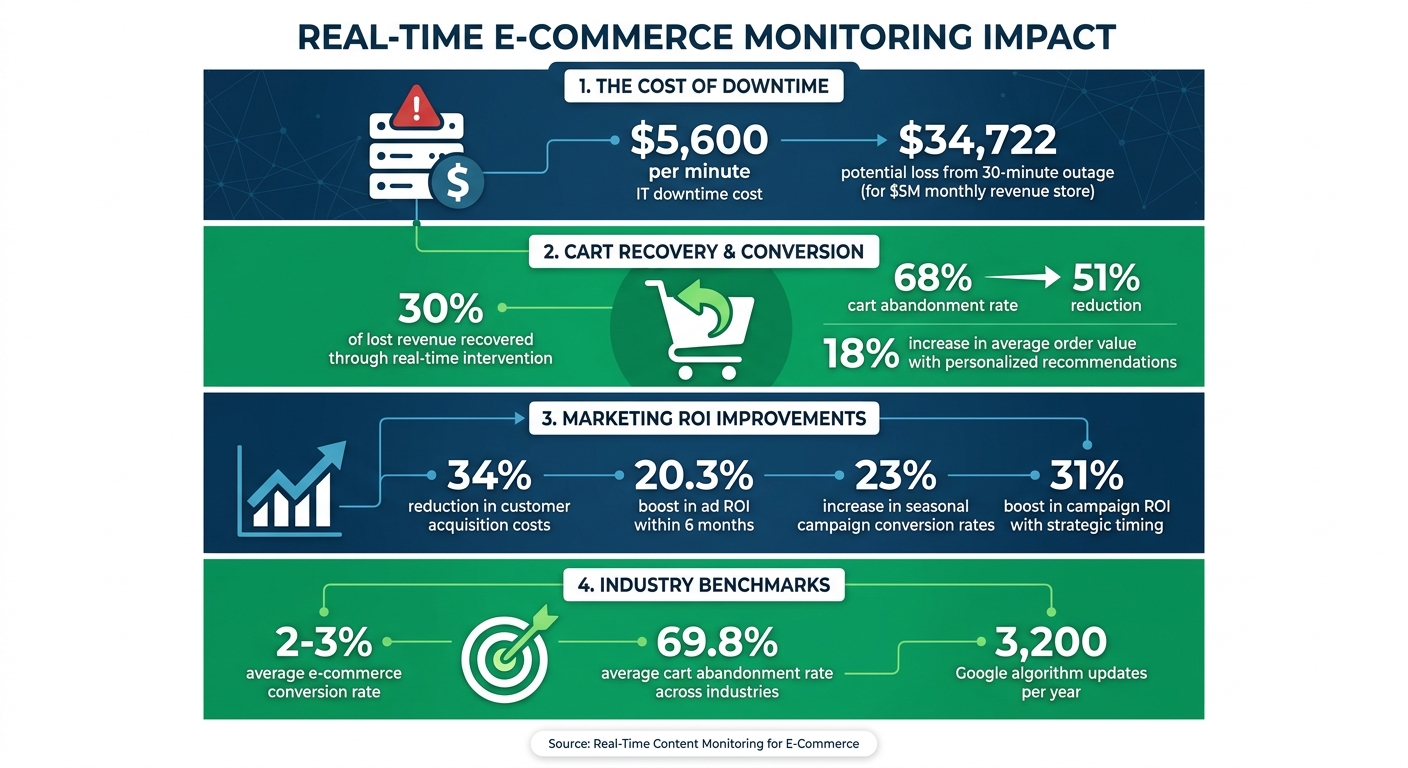
- Downtime Costs: IT downtime can cost $5,600 per minute. A 30-minute outage could lead to $34,722 in losses for a store earning $5M monthly.
- Cart Recovery: Intervening during hesitation (e.g., on a shipping page) can recover up to 30% of lost revenue.
- Customer Engagement: Monitoring user actions like hesitation or frustration enables instant responses, such as live chat or tailored promotions.
- Marketing ROI: Real-time data optimizes campaigns, reduces customer acquisition costs by 34%, and boosts ad ROI by 20.3%.
Tools like GA4, Shopify dashboards, and custom reporting platforms make this possible by offering live insights into user behavior and operational metrics. The key is acting on this data quickly to resolve issues and enhance the shopping experience.
Real-Time E-Commerce Monitoring: Key Statistics and ROI Impact
Get Real-Time eCommerce Analytics in One Dashboard | Putler Walkthrough
sbb-itb-cef5bf6
Why E-Commerce Businesses Need Real-Time Content Monitoring
Think of real-time monitoring as the difference between watching a live security feed and reviewing yesterday's footage. With traditional analytics, by the time you identify an issue, you may have already lost customers and revenue. Real-time monitoring flips the script, allowing businesses to act immediately on potential problems or opportunities.
For instance, instead of sending "we miss you" emails after someone abandons their cart, real-time systems can detect when a visitor hesitates - like pausing at the shipping calculator - and offer an incentive before they leave. As Markopolo AI puts it:
"The whole point is to act on deceleration, not abandonment. You solve the friction before the customer ever hits the exit button".
But it’s not just about preventing losses. Real-time monitoring also uncovers micro-opportunities throughout the buyer’s journey. Behaviors like rage-clicking, rapid back-button tapping, or comparison shopping can trigger tailored responses. For example, frustrated users might be directed to live support, price-sensitive shoppers could be shown discounts, or hesitant buyers might see testimonials that build trust. These real-time tweaks ensure smoother customer journeys, increasing engagement, conversions, and return on marketing investments.
Improving Customer Engagement
Real-time monitoring captures subtle signals of hesitation that traditional analytics often miss. Imagine a shopper hovering over the "Add to Cart" button or repeatedly zooming in on product images. These actions suggest uncertainty, and the system can respond instantly with personalized nudges - like a chat message explaining the return policy or a notification offering sizing advice.
This approach works because it adapts to the natural shopping patterns of customers. Some people shop quickly during a lunch break, while others take their time researching late at night. If someone shows signs of decision fatigue - bouncing between products, for example - the system can step in with curated suggestions to simplify their choices and guide them toward a purchase.
Boosting Conversion Rates
Real-time insights are key to addressing leaks in the conversion funnel. Common trouble spots include slow page loads, confusing checkout steps, and payment gateway errors. Real-time monitoring can detect these issues in under a minute, ensuring they’re resolved before they derail sales.
The results speak for themselves. Businesses using real-time interventions have reduced cart abandonment rates from 68% to 51%. Personalized recommendations based on live data can boost average order value by 18%. And when ad campaigns are adjusted in real time - pausing underperforming ads and increasing investment in high-converting ones - the cost of acquiring customers can drop by 34%. During high-stakes shopping events like Black Friday, real-time alerts for checkout or payment failures can save businesses from losses that are ten times higher than usual.
Increasing Marketing ROI
Real-time monitoring doesn’t just fix immediate issues - it also sharpens long-term marketing strategies. Instead of waiting days to evaluate campaign performance, marketers can identify top-performing ads within hours and shift budgets accordingly. This approach has been shown to improve overall ROI by 20.3% within six months.
It’s not just about ads, though. Real-time data can highlight content gaps by tracking search queries with high impressions but low clicks, showing where content isn’t meeting user needs. It can also flag when pages start losing traffic or rankings, so teams can refresh them before they lose relevance. Additionally, tracking inventory in real time prevents popular items from selling out while avoiding overstocking slow-moving products - keeping operations efficient and aligned with demand trends.
Tools for Real-Time Content Monitoring
When it comes to catching issues quickly, the right tools are game-changers. They can help you spot problems in seconds rather than hours. Tools like GA4, Shopify dashboards, and custom reports each shine in their own way. For example, GA4 processes data in under a minute, making it perfect for checking if a new campaign is tracking properly or for identifying a sudden surge in traffic from a viral post. Shopify's Live View, on the other hand, works with a 5-minute window to show real-time activity, such as users adding items to their carts or completing purchases.
Daniel Patricio, owner of Bull & Cleaver, sums up the synergy of these tools perfectly:
"I find Google Analytics is great for modeling visitor behaviors, whereas Shopify Reports is what I use for analyzing our sell-through rates and merchandising mix of our products. Together, the two help us optimize our website and our product mix on it."
Here's how each tool delivers precise, actionable data.
Google Analytics Real-Time Reports
GA4's real-time reports provide a rolling 30-minute snapshot of events like page views, clicks, and purchases. Its event-based tracking digs deep into user interactions, capturing details like scrolls, video plays, and form submissions. This level of granularity helps you understand how visitors engage with your content.
One of GA4's standout features is its ability to verify tracking codes and UTM parameters immediately after launching a campaign or making site updates. For instance, if you're running a flash sale but see no "add_to_cart" events despite high traffic, GA4 alerts you to technical issues instantly - saving you from waiting hours for standard reports.
Shopify Analytics Dashboards

Shopify's Live View provides a real-time, visual snapshot of store activity. It shows where visitors are located, what they're doing, and tracks metrics like "Visitors right now", which counts users active within the last 5 minutes. This dashboard is particularly useful during high-traffic events like Black Friday, where you can monitor sales as they happen, identify which products are flying off the shelves, and address any checkout issues before they lead to abandoned carts.
For added convenience, Shopify's Streamer mode can hide sensitive financial data while still displaying visitor activity. This feature is perfect for team meetings or presentations where live data needs to be shared without revealing confidential metrics.
Custom Reporting with SEO Werkz

While GA4 and Shopify provide excellent insights, they don’t automatically combine cross-channel KPIs - like conversion rates by acquisition source or revenue by product category. This is where custom reporting tools come into play.
Platforms like SEO Werkz create tailored dashboards that pull data from multiple sources. These dashboards are designed to align with your specific business goals, whether that’s tracking ROI on paid campaigns, evaluating content performance across platforms, or pinpointing which traffic sources deliver the highest customer lifetime value. By merging cross-channel KPIs into a single view, custom reports make it easier to act on insights immediately, helping you fine-tune your strategy to drive engagement and boost conversions.
How to Set Up Real-Time Content Monitoring
Real-time insights are crucial for driving immediate engagement and boosting sales. By setting up an effective monitoring system, you can track key metrics that directly impact revenue and make informed decisions on the fly.
Step 1: Define Key Metrics and Goals
Start by identifying the metrics that matter most at each stage of the customer journey: discovery, acquisition, conversion, and advocacy.
- Discovery metrics: These include impressions and reach, helping you understand who is finding your content.
- Acquisition metrics: Track traffic sources and cost per acquisition (CPA) to measure how effectively you're attracting visitors.
- Conversion metrics: Focus on bounce rates, checkout abandonment, and add-to-cart rates to pinpoint where potential customers drop off.
- Advocacy metrics: Metrics like Net Promoter Score (NPS) and social engagement levels reveal how loyal your customers are.
Austin Caldwell, Senior Product Marketing Manager at NetSuite, highlights the importance of one key metric:
"Sales conversion rate is one of the most critical and widely used ecommerce metrics."
For context, the average e-commerce conversion rate ranges between 2% and 3%, while cart abandonment rates hover around 69.8% across industries. These benchmarks provide a baseline for setting realistic goals and identifying potential issues.
It’s also essential to track cart abandonment patterns and the steps leading to checkout. Monitor smaller user actions that signal purchase intent - these can often lead to sales. Once you’ve defined your metrics, move on to building the infrastructure to track them.
Step 2: Implement Tracking Infrastructure
To start, use tools like Google Search Console, GA4, and UTM tagging to gather essential data. For more detailed insights, consider adding specialized tags or using a Customer Data Platform to capture nuanced user behaviors.
Integrate marketing data with sales insights by passing the GA4 client ID into lead capture forms as a hidden field. This allows your CRM to connect anonymous browsing activity with actual customers, showing which content drives conversions. Salesforce users can leverage tools like Bizible to track every page visit before a form is completed.
Set up automated alerts for events like spikes in mentions, negative sentiment, or competitor activity. Use threshold-based alerts to avoid information overload. Your setup will depend on your budget and needs:
- Basic setup: GA4 + Google Search Console + spreadsheet; costs $0, requires 4–6 hours.
- Intermediate setup: Includes tools like Semrush or Ahrefs with CRM integration; costs $100–$300 per month, requires 10–15 hours.
- Advanced setup: Multi-touch attribution systems; costs $300–$800 monthly, requires 20–40 hours to implement.
Step 3: Analyze and Optimize in Real Time
Once your tracking system is live, focus on analyzing data in real time and taking swift action. Use an intervention log to document your efforts. This log should include the date, action taken (e.g., published, updated, redirected), target URL, and expected outcome. It’s a simple but powerful way to connect performance changes to specific actions, avoiding guesswork.
"The most dangerous content tracking setup is one that shows you everything happening right now but nothing about what changed and why. Dashboards without intervention logs offer little actionable insight." – THE SEO ENGINE Editorial Team
Respond quickly to signs of hesitation. For instance, if checkout behavior suggests a customer might return (e.g., rushed navigation with little product page engagement), send "confidence builder" content like unboxing videos within 24 hours of purchase. Tailor urgency messaging to the shopper’s behavior. Use factual framing (e.g., "4 remain in your size") for detail-oriented buyers and emotional framing (e.g., "Grab yours before it's gone") for impulse shoppers.
Using Real-Time Data to Optimize E-Commerce Content
Once you’ve set up a system to track behavioral signals and performance metrics, the next step is turning that data into actionable content improvements. Real-time insights can uncover content inconsistencies, technical SEO errors, and gaps in your competitive strategy - issues that, if left unchecked, can hurt your revenue. Acting quickly on these signals is key to minimizing potential losses.
Using Data to Improve SEO
Real-time data does more than just monitor performance - it actively shapes your content strategy. With Google updating its search algorithm around 3,200 times a year, staying ahead requires constant vigilance. Real-time monitoring can help you catch critical SEO issues like unexpected noindex tags, missing H1 headers, or 404 errors before they impact your rankings. A drop in your SEO visibility score - an indicator of your organic click potential - can serve as an early warning sign.
You can also set up alerts to track changes in competitors’ title tags and H1 headers. If they start targeting new keywords, you’ll have the opportunity to adjust your strategy accordingly. Monitoring your content’s daily keyword rankings is equally important. For example, landing the #1 spot for a high-volume keyword can result in a visibility score of about 35%. Use real-time data streams to identify which keywords drive traffic, then optimize existing pages or create new content tailored to those terms.
Beyond fixing technical SEO issues, real-time insights can also enhance your seasonal marketing efforts.
Adjusting Content for Seasonal Trends
Seasonal campaigns often fall flat when they rely on fixed dates rather than actual customer demand. Real-time search trends can show when people are actively looking for your products, allowing you to align campaigns with these demand spikes. This approach can increase conversion rates by 23% while cutting customer acquisition costs by 18%.
"Seasonal campaign planning isn't about following a calendar – it's about understanding when your customers are actually ready to engage and when competitors are making their moves." – REYO Team
By monitoring competitors’ campaign launches in real time, you can spot opportunities to target quieter periods, avoiding direct competition. This strategic timing can boost your campaign ROI by 31%. You can also use trigger-based criteria - like changes in local weather patterns - to better match your campaigns to live customer demand.
These real-time insights pave the way for even more personalized marketing strategies.
Customized Campaigns with SEO Werkz
Personalization reaches new heights when campaigns are tailored to live data. SEO Werkz specializes in creating data-driven campaigns that adapt to real-time behavioral signals. Instead of relying on generic seasonal promotions, they use behavioral twin matching - a technique where AI analyzes customer patterns and matches current visitors with past buyers who exhibited similar behaviors.
They also employ behavioral momentum tracking to address potential drop-offs in real time. If a visitor hesitates on a critical page, the system immediately triggers a contextual offer, preventing cart abandonment. For e-commerce businesses managing large inventories (500+ SKUs), SEO Werkz uses automated tools to identify and resolve discrepancies between your product data and live content across channels. This ensures consistent branding and helps avoid revenue losses.
Conclusion
Real-time content monitoring has become a critical factor in staying competitive in the fast-paced world of e-commerce. With Google implementing around 3,200 updates to its search algorithm each year and digital disruptions costing Global 2000 companies over $400 billion annually, the risks of neglecting monitoring efforts are too high to ignore. Successful businesses take a proactive approach - identifying SEO issues early, resolving customer pain points quickly, and staying ahead of competitor strategies.
"Success isn't bought but earned through careful optimization and vigilance." – monity.ai
Proactive monitoring is a game-changer. It allows businesses to swiftly address challenges that could disrupt customer behavior. For instance, by tackling issues like surprise shipping fees or decision fatigue while customers are still engaged, companies can turn potential losses into completed sales and boost their conversion rates.
For e-commerce brands managing large inventories and competing for visibility, expert partnerships can make all the difference. SEO Werkz offers a blend of automated tools and strategic insights to keep your product data consistent, safeguard your SEO efforts, and adapt campaigns based on real-time customer behavior. Their tailored strategies ensure you're not just collecting data - you’re using it to generate measurable ROI, freeing your team to focus on growth instead of troubleshooting.
Real-time monitoring isn’t just about tracking - it’s about taking immediate action. By addressing issues as they arise, businesses can maintain customer engagement, improve the shopping experience, and ultimately drive revenue growth.
FAQs
What should I monitor in real time first?
Keep an eye on your website's key functions, like the checkout process and payment systems. These are crucial for ensuring customers can make purchases without any hiccups. By focusing on these areas, you can avoid potential revenue losses and keep the shopping experience running smoothly.
How do I turn hesitation signals into sales fast?
To turn hesitation into sales, try using AI-powered nudges. By tracking real-time behaviors like how far someone scrolls or how long they spend on a product page, you can spot when a customer might be unsure. At those moments, offer personalized prompts - like discounts or help - to guide them forward. Using real-time analytics, you can fine-tune these prompts to make sure they stay relevant and effective, helping to turn hesitation into action quickly.
How do I set up real-time monitoring on a budget?
To keep track of content changes without breaking the bank, opt for low-cost or free tools that cover the basics. These tools can help you stay on top of website updates, content modifications, and competitor activities. Set up alerts for key updates, such as broken links or SEO adjustments, so you can address issues promptly. Regularly reviewing the data ensures you're ready to act on opportunities or tackle challenges - all while keeping costs under control.