How Readability Scores Impact SEO Rankings
April 14, 2026Readability scores measure how easy it is to understand written content. While Google doesn’t use these scores directly to rank pages, they still impact your SEO efforts by influencing user behavior. Here’s what you need to know:
- What are readability scores? Metrics like Flesch Reading Ease and Flesch-Kincaid Grade Level evaluate sentence length and word complexity to estimate the reading level of your content.
- Why does readability matter? Around 50% of U.S. adults read below a 9th-grade level, and most web users scan content rather than reading it fully. Complex writing can alienate readers, increase bounce rates, and lower engagement.
- How does it impact SEO? Readable content keeps users on your page longer, reduces bounce rates, and improves chances of appearing in featured snippets and voice search results - factors that indirectly boost rankings.
Key Takeaway
Readable content isn’t just for user satisfaction - it directly affects metrics like dwell time and bounce rate, which search engines monitor closely. Aim for a 7th–9th grade reading level to balance simplicity and depth, ensuring your content connects with a broader audience.
What Research Shows About Readability and SEO
What Industry Studies Have Found
Two major studies have found that readability scores don't directly determine how pages rank on Google.
Portent analyzed over 5.8 million pages and found no evidence linking readability scores to higher rankings. Their conclusion was clear:
"Our study concludes that readability is not a direct ranking factor. There is no correlation between ranking on Google and reading level for the page."
Similarly, Originality.AI looked at the top 20 pages for 1,000 popular keywords (13,582 pages total). While readability scores didn't directly predict rankings, they noticed a pattern: top-ranking pages often had similar readability levels. The average Flesch Reading Ease score for pages in the top 30 ranged between 51.8 and 53.1 - equivalent to a 10th–12th grade reading level. This is higher than the 8th-grade level often recommended in many SEO guides.
These findings highlight that while readability scores might not directly affect rankings, they can influence how users interact with your content.
How Readability Affects User Behavior
Readability plays a big role in how users engage with your content, and those interactions can impact your rankings. If your text is too complicated, readers are more likely to leave quickly. Google tracks metrics like dwell time (how long someone stays on a page), and short dwell times often signal that the content didn't meet the user's needs.
On the flip side, content that's easy to follow keeps users on the page longer, lowers bounce rates, and encourages further interaction. These behavioral signals are important to Google's evaluation of page quality.
This connection between readability and user behavior aligns with Google's overall approach to understanding content.
Google's Position on Readability Scores
John Mueller, Google's Senior Webmaster Trends Analyst, has stated that readability scores are not a ranking factor:
"From an SEO point of view, it's probably not something that you need to focus on. In the sense that, as far as I know, we don't have the kind of these basic algorithms that just count words and try to figure out what the reading level is based on these existing algorithms."
He also explained:
"It's not a matter of Google using that reading level score and saying, this is good or bad. But rather, does it match what the people are searching for?"
In short, Google prioritizes content that meets user intent. Instead of aiming for a specific readability score, focus on creating content that matches what your audience expects and needs.
Interestingly, Google used to offer a "Reading Level" filter in search results from 2010 to 2015, but this feature was eventually removed. Modern algorithms like BERT and MUM now focus more on understanding context and intent rather than analyzing syllables or sentence structure. The bottom line? Write for your readers. If your content meets their expectations and keeps them engaged, you're doing it right.
sbb-itb-cef5bf6
Readability study | walkthrough
Common Readability Metrics and How They Work
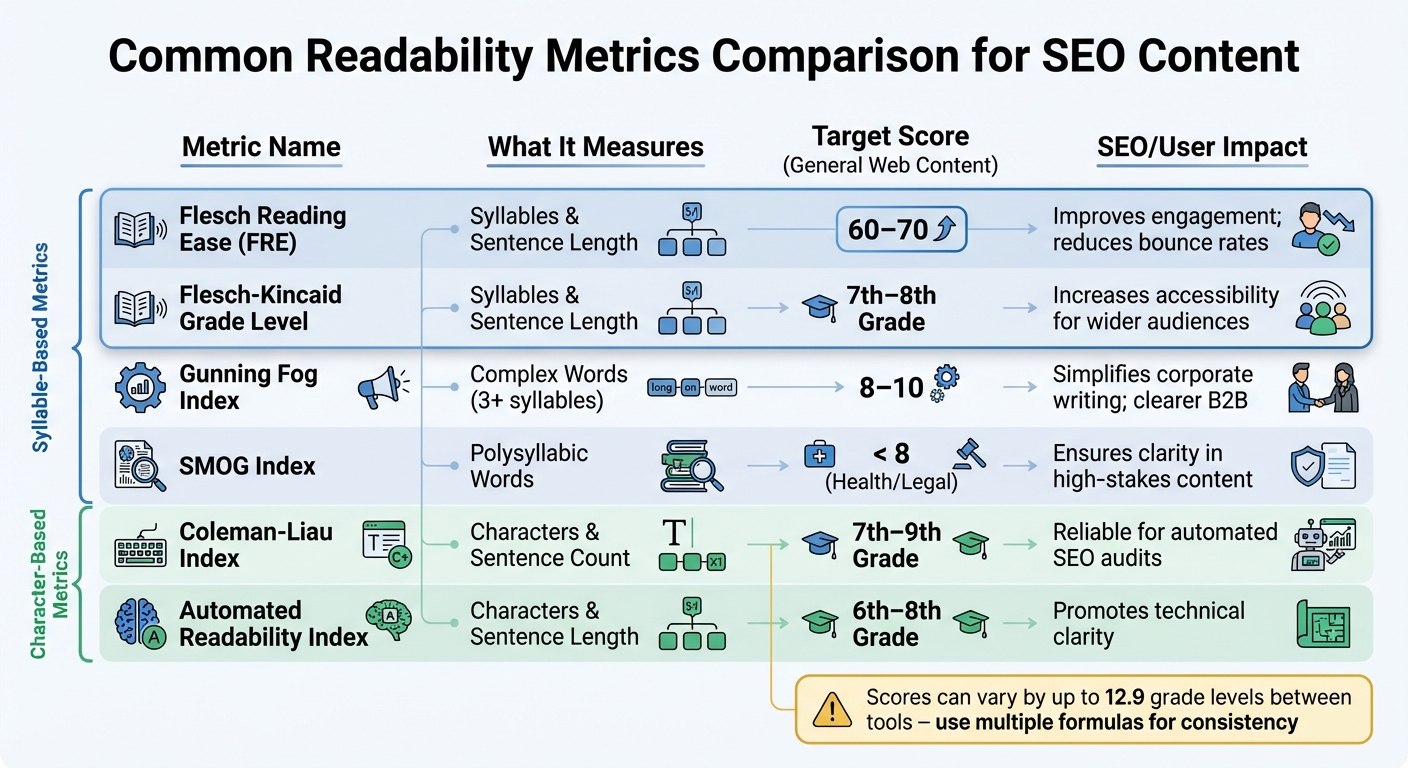
Readability Metrics Comparison Chart for SEO Content
Most Used Readability Metrics
Readability plays a key role in SEO, and understanding how readability metrics work can help improve your content's accessibility. These metrics evaluate text by analyzing factors like sentence length, syllable count, and word complexity. Essentially, they use simple text features to estimate how easy a piece of content is to read.
The most widely used metrics fall into two main groups. Syllable-based formulas, such as the Flesch-Kincaid metrics, focus on counting syllables per word. On the other hand, character-based formulas, like the Coleman-Liau Index and Automated Readability Index (ARI), rely on character counts. Character-based methods are often more reliable for automated evaluations since syllable counts can vary depending on the software used.
Here’s a breakdown of some key formulas:
- Flesch Reading Ease: This formula calculates readability with the equation:
206.835 – 1.015 × (total words ÷ total sentences) – 84.6 × (total syllables ÷ total words)
Higher scores mean the text is easier to read. - Flesch-Kincaid Grade Level: This formula translates readability into a U.S. school grade level:
0.39 × (total words ÷ total sentences) + 11.8 × (total syllables ÷ total words) – 15.59
Other notable metrics include the Gunning Fog Index, which highlights complex words with three or more syllables, making it particularly useful for clear business writing. The SMOG Index is stricter, estimating the reading level needed for 100% comprehension. This makes it ideal for fields like healthcare or legal content, where clarity is critical.
Target Readability Scores
For general web content, aim for a Flesch Reading Ease score between 60 and 70 to ensure broad accessibility and reader engagement. Similarly, targeting a Flesch-Kincaid grade level of 7th to 8th grade strikes a good balance between simplicity and respect for your audience's time.
"Targeting [7th to 8th grade] is accurate, not condescending." – Tools for Writing
This approach is especially important given that about 50% of U.S. adults struggle to read at a 9th-grade level or higher. Additionally, 6.5 million Americans with intellectual disabilities face challenges when processing complex content.
To improve readability further:
- Keep sentences under 20 words on average.
- Break up sentences longer than 30 words.
- Use short paragraphs (3–4 sentences per idea).
- Favor active voice.
Different types of content may require specific targets. For example, technical documentation often aims for a 10th–12th grade level, healthcare content works best around 6th grade, and business communication benefits from a Gunning Fog Index of 12 or below. These benchmarks not only enhance user engagement but also boost SEO performance.
Readability Metrics Comparison
Here’s a quick comparison of popular readability metrics, their methods, and their impact:
| Metric | Calculation Basis | Target Score (General Web) | SEO/User Impact |
|---|---|---|---|
| Flesch Reading Ease (FRE) | Syllables & Sentence Length | 60–70 | Improves engagement; reduces bounce rates |
| Flesch-Kincaid Grade Level | Syllables & Sentence Length | 7th–8th Grade | Increases accessibility for wider audiences |
| Gunning Fog Index | Complex Words (3+ syllables) | 8–10 | Simplifies corporate writing; clearer B2B |
| SMOG Index | Polysyllabic Words | < 8 (Health/Legal) | Ensures clarity in high-stakes content |
| Coleman-Liau Index | Characters & Sentence Count | 7th–9th Grade | Reliable for automated SEO audits |
| Automated Readability Index | Characters & Sentence Length | 6th–8th Grade | Promotes technical clarity |
It’s worth noting that readability scores can vary significantly between tools using the same formula - sometimes by as much as 12.9 grade levels for identical text. To get more consistent results, try averaging scores from multiple formulas. Standardizing your text (e.g., removing abbreviations or mid-sentence periods) can also reduce this variance to about 2.1 grade levels.
Content that's easier to read often performs better in featured snippets and voice search results, thanks to its clear and concise structure. Plus, it aligns with Google's E-E-A-T guidelines, which emphasize transparent and accessible communication. Research even shows a 0.7 correlation between readability scores and actual comprehension, proving the practical value of these metrics.
How Readability Improves User Experience
Better Accessibility for All Users
Readable content makes your website more accessible, reducing the mental effort required to understand it. By simplifying your writing, you can engage a wider range of users, including non-native English speakers and those who depend on screen readers.
Straightforward language is especially helpful for users who struggle with dense or complicated text. For example, individuals with visual impairments who use screen readers benefit greatly from content with clear headings and simple language. This kind of accessibility not only enhances user engagement but also improves key behavioral metrics, like time spent on your site.
Longer Time on Page and Fewer Bounces
Content that's easy to read encourages visitors to stay longer on your page. When users are confronted with a daunting "wall of text", they often leave quickly - a behavior called pogo-sticking, which tells search engines that your page didn’t meet their needs.
"This phenomenon - often tracked as Pogo-Sticking or rapid bounce rate - sends a lethal signal to Google: 'This page did not answer the user's query.'" - W3Ranks SEO Experts
To combat this, structure your content for easy scanning. People tend to read online in an "F-shaped" pattern, so using clear headings, short paragraphs (under three sentences), and lists can help them find information quickly. Google Analytics 4 tracks engagement based on sessions lasting 10 seconds or more, making readability a factor in improving these metrics .
Readable content also builds trust. Sergei Davidov, Growth Manager at Common Ninja, notes:
"Clear writing can convey a sense of transparency and trustworthiness, fostering a positive emotional connection with the reader."
This trust encourages users to explore more of your site instead of bouncing after a few seconds. With mobile and voice search usage growing, keeping visitors engaged has never been more important.
Voice Search and Mobile Performance
Readable content performs better on voice search and mobile devices. Voice assistants favor natural, concise language - complex sentences are harder for AI to interpret and less user-friendly when read aloud . Google Analyst Gary Illyes emphasizes this point:
"If it doesn't read nicely or sounds strange, it probably won't rank either."
Content written with simple subject-verb-object structures is more likely to appear in featured snippets, which are often used for voice search responses. On mobile, dense paragraphs and overly complex text can drive users away, leading to higher bounce rates .
Using active voice, sentences of 15–20 words, and short paragraphs (3–5 sentences) ensures your content is easy to read across all devices. This approach not only aligns with mobile and voice search trends but also strengthens your overall SEO strategy.
Conclusion
Key Takeaways on Readability and SEO
While readability scores aren't direct ranking factors, they play a crucial role in shaping user behavior - which, in turn, impacts rankings. As Devryo puts it:
"Readability is not a direct ranking factor, but it is a force multiplier for every other SEO effort you make."
Interestingly, even though many users prefer simpler language, top-ranking content often hits an 11th-grade reading level on average. This underscores the importance of striking a balance: simplifying language without sacrificing depth. Clear, scannable writing tailored to your audience not only improves user experience but also boosts the chances of appearing in featured snippets and voice search results.
Practical Tips for Better Readability
Improving readability isn't just about making text easier to read - it can directly impact engagement and conversions. For instance, adjusting content to a 7th–9th grade reading level can increase conversion rates by up to 30%, while using clear formatting can add another 20%–50%.
To achieve this, aim for a Flesch Reading Ease score between 60–70 and keep sentences concise, ideally 15–20 words long. Use short paragraphs, active voice, and clear headings to improve scannability. Tools like Hemingway Editor, Grammarly, or Microsoft Word's readability features can help you fine-tune your content. And here's a critical stat: 73% of users will abandon a webpage within 10 seconds if the content isn't easy to scan. Every tweak matters.
How SEO Werkz Supports Your Goals

SEO Werkz specializes in creating content that excels in both readability and SEO performance. Their services combine keyword research, on-page optimization, and strategic content development to craft material that appeals to readers and search engines alike. By improving metrics like bounce rates and dwell time, SEO Werkz ensures your content aligns with user expectations and search engine algorithms.
Whether you're looking for a content audit, a tailored readability strategy, or ongoing optimization, SEO Werkz has the expertise and tools to make readability a key part of your SEO approach. Visit SEO Werkz to see how they can help drive organic traffic and boost conversions through smarter, more engaging content.
FAQs
What’s the best readability score for my specific audience?
A Flesch-Kincaid Reading Ease score of 60-70 is often considered the sweet spot for readability. This score corresponds roughly to an 8th-grade reading level, making your content both easy to understand and engaging for a wide range of readers. Keeping your writing in this range ensures clarity without oversimplifying.
How can I improve readability without “dumbing down” my content?
Making your content easier to read doesn’t mean dumbing it down. It’s about clear communication and thoughtful structure. Here’s how you can achieve that:
- Keep Sentences Short: Aim for sentences under 20 words. This helps readers process information quickly.
- Break Up Paragraphs: Limit paragraphs to 2-4 sentences. This creates natural pauses and makes the text less intimidating.
- Use Subheadings: Add subheadings every 200-300 words to guide readers through the content and maintain their focus.
- Simplify Language: Replace technical jargon with plain, straightforward language. This ensures your message resonates with a wider audience.
For more complex ideas, bullet points are your friend. They help organize information in a way that’s easy to skim. Also, targeting a Flesch-Kincaid score of 60-70 strikes a good balance between professionalism and readability, keeping your content engaging and accessible.
Which readability tool should I trust if scores vary a lot?
When readability scores vary significantly, it’s best to stick with a tool that offers consistent, objective, and evidence-based results. Prioritize tools specifically built to assess readability with accuracy and transparency. Staying consistent ensures you can make well-informed decisions about your content.