B2B vs B2C Lead Scoring: Key Differences
April 12, 2026Lead scoring helps businesses prioritize prospects by assigning scores based on their likelihood to buy. But the approach differs significantly between B2B and B2C due to variations in buying behavior and decision-making processes:
- B2B Lead Scoring: Focuses on long sales cycles, logic-driven decisions, and multiple stakeholders. Key metrics include firmographic data (company size, industry) and engagement signals (webinars, pricing page visits). Scoring often involves stages like MQL, SAL, and SQL, emphasizing lead quality and long-term value.
- B2C Lead Scoring: Prioritizes fast decision-making, emotional triggers, and single buyers. It relies on real-time behavioral data (cart abandonment, pricing page visits) to identify immediate purchase intent. The process skips detailed qualification stages and focuses on quick conversions.
Quick Comparison:
| Feature | B2B Lead Scoring | B2C Lead Scoring |
|---|---|---|
| Focus | Lead quality, long-term value | Immediate purchase intent |
| Sales Cycle | Long (months/years) | Short (minutes/hours) |
| Key Metrics | Firmographics, engagement | Behavioral data, cart recovery |
| Decision-Making | Multiple stakeholders, logic-driven | Single buyer, emotion-driven |
| Tools | CRM platforms (Salesforce, HubSpot) | Automation tools, real-time analytics |
B2B systems are designed for nurturing leads over time, while B2C models act quickly to convert high-intent buyers. Both approaches rely on tailored scoring criteria to improve efficiency and ROI.
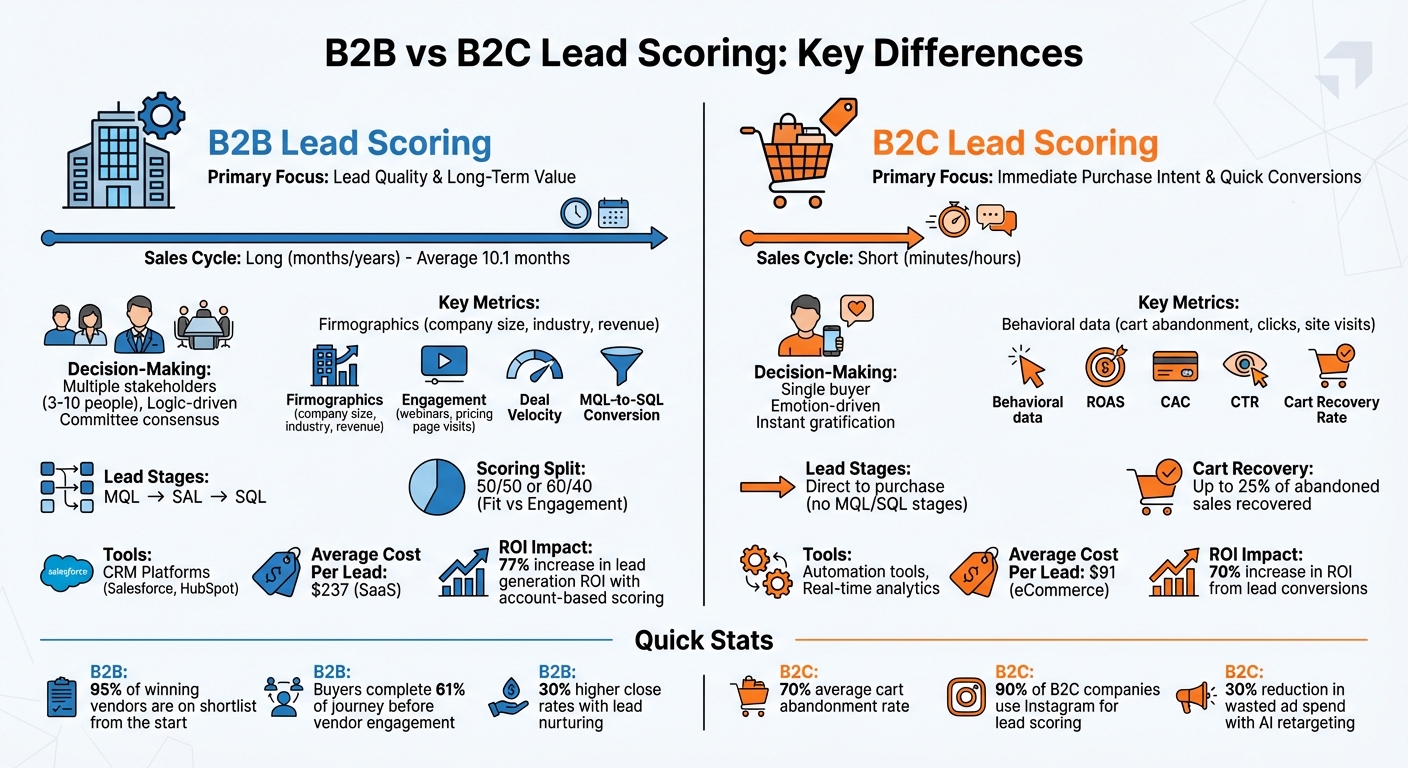
B2B vs B2C Lead Scoring: Key Differences and Metrics Comparison
048. Lead Nurturing for B2B vs B2C
sbb-itb-cef5bf6
How B2B Lead Scoring Works
B2B lead scoring focuses on evaluating entire organizations rather than individual contacts. This approach makes sense since buying decisions in the B2B world often involve multiple stakeholders. To account for this, scoring models track engagement signals from various individuals within the same company.
At its core, the scoring process relies on two main components: fit and engagement. Fit scores assess whether a prospect aligns with your Ideal Customer Profile using firmographic data (like company size, industry, and revenue) and demographic data (such as job title and seniority). Engagement scores, on the other hand, measure interest through actions like visiting pricing pages, attending webinars, or downloading content. Most B2B teams aim for a balance between these two categories, often splitting them 50/50 or 60/40.
"A company can be a perfect fit but show zero engagement. Good long-term play, not a sales-ready lead right now."
Negative scoring is another essential part of the process. It deducts points for actions that indicate disinterest, such as visiting the careers page (-15 points) or unsubscribing from emails (-30 points). This ensures sales teams focus only on leads with genuine buying potential.
Multiple Decision-Makers in B2B Sales
Because B2B purchases often involve multiple decision-makers, account-based scoring has become more common. This method aggregates engagement signals from everyone within a target company. For instance, if three executives from the same organization download case studies in the same week, the account’s score reflects this collective activity.
Role-based weighting further refines this process by prioritizing contacts based on their decision-making authority. A VP-level contact might earn +30 points for their role, while a junior analyst might only get +5. This ensures sales teams focus their efforts on individuals with the authority to approve purchases. Companies using both lead and account scoring have reported a 77% increase in lead generation ROI.
Another layer of sophistication comes from third-party intent data, which tracks when a company is researching solutions online - even before they engage directly with your content. Considering that 3 to 10 stakeholders are typically involved in B2B buying decisions, this approach provides a more comprehensive view of organizational interest.
Using Company and Contact Data
In addition to engagement signals, accurate company and contact data play a key role in refining lead scoring.
Firmographic data - such as employee count, revenue, location, industry, and funding status - helps determine if a company is worth pursuing. For example, a SaaS company targeting mid-market firms might assign +30 points to prospects with 501–1,000 employees and +50 points to companies on their target account list.
Technographic data adds another layer by revealing what software tools a prospect currently uses. If they’re using a competitor’s product, that might add +15 points, signaling potential interest in switching. Similarly, using a tool that integrates with your solution (like Salesforce) could add another +10 points.
At the contact level, demographic data like job title, seniority, and recent events (like a promotion) help differentiate decision-makers from other contacts. This is critical since only 27% of leads passed from marketing to sales are qualified. Clean, accurate data ensures unqualified prospects are filtered out early.
B2B Scoring Systems and Lead Stages
B2B scoring systems use insights from fit, engagement, and roles to organize leads into distinct qualification stages.
Most frameworks include three stages: Marketing Qualified Lead (MQL), Sales Accepted Lead (SAL), and Sales Qualified Lead (SQL). An MQL typically scores between 40–60 points, signaling readiness for marketing engagement. An SQL, with a score of 80–100 points, prompts immediate sales outreach, often within 24 hours.
There are two common scoring approaches:
- Rule-based scoring assigns points manually to actions and attributes, offering transparency.
- Predictive scoring uses AI and machine learning to analyze historical data and identify patterns in successful deals. While predictive scoring uncovers subtle patterns, it requires at least 100 closed deals to build an effective model.
"Predictive lead scoring... gets more capable the longer you rely on it. The more customer data you put in, the more its accuracy improves."
- Casey O'Connor, Yesware
To further streamline efforts, many B2B teams use a tier system to categorize accounts:
- Tier A (80–100 points): Hot prospects with strong fit and high engagement, prioritized for immediate sales action.
- Tier B (50–79 points): Enter targeted account-based marketing campaigns.
- Tier C (25–49 points): Placed in nurture programs.
- Tier D (0–24 points): Monitored passively.
Revisiting and recalibrating these thresholds every quarter helps ensure alignment with changing buyer behaviors and market trends.
How B2C Lead Scoring Works
B2C lead scoring operates at a faster pace compared to B2B models, focusing on capturing immediate consumer intent. Unlike B2B buyers, who often rely on lengthy decision-making processes involving multiple stakeholders, B2C shoppers make purchasing decisions quickly - sometimes within minutes or hours. This urgency means B2C lead scoring systems must work in real time to identify and act on fleeting buying signals.
B2C companies typically handle a much larger volume of leads, ranging from thousands to millions, compared to the smaller scale of B2B operations. Automation is key here. Without it, distinguishing serious buyers from casual browsers becomes overwhelming. Businesses that successfully implement lead scoring models report a 70% increase in ROI from lead conversions.
"The consumer buying journey moves fast. Unlike B2B's lengthy committee decisions, B2C purchases often happen in minutes. Your lead scoring must keep pace."
- Julian Alvarado, Content Lead, Coefficient
Unlike B2B's structured qualification stages (like MQL, SAL, SQL), B2C scoring often skips such formalities. A single behavioral trigger - like visiting a pricing page or adding an item to the cart - can move a lead directly to a transaction. Emotional responses and personal preferences drive these decisions, eliminating the need for detailed qualification processes.
Tracking Customer Behavior in Real-Time
B2C lead scoring relies heavily on real-time behavioral data to identify purchase intent. Actions like browsing product pages, spending time on specific sections of a website, abandoning a cart, or engaging with emails (opens and clicks) are all valuable signals. Behavioral cues often outperform demographic data in predicting whether someone is ready to buy.
Certain actions carry more weight than others. For instance, a shopper who visits a pricing page three times in a week might trigger an "intent override", signaling they’re ready to purchase regardless of their overall score. Similarly, frequent cart revisits or lingering near the checkout page are strong indicators of purchase intent.
Cart abandonment is a common challenge, with an average rate of 70% across e-commerce. However, automated reminders triggered by real-time scoring can recover up to 25% of these lost sales. Negative scoring also plays a role; for example, reduced engagement over time or spammy form submissions might lower a lead’s score, similar to how B2B models penalize visits to career pages.
| B2C Behavioral Signal | Scoring Impact | Intent Level |
|---|---|---|
| Abandoned Cart | High Positive | Very High |
| Pricing Page Visit (3x) | High Positive | High |
| Email Open/Click | Low Positive | Medium |
| Career Page Visit | Negative | Low/None |
| Newsletter Signup | Medium Positive | Medium |
These real-time signals are critical for identifying when a lead is ready to make a purchase.
Direct Path to Purchase
B2C scoring models are designed for speed and simplicity. Unlike B2B frameworks, which often involve multiple qualification stages and decision-makers, B2C scoring focuses on transactional readiness. There’s no need for detailed qualification criteria like BANT when a single shopper is making the decision. Instead, the goal is to determine whether a lead is ready to hit "buy now" in the next few minutes.
For example, in January 2025, a national solar installer improved its call center conversion rates by 33% by using predictive lead scoring. This system prioritized high-quality leads and routed them to the company’s top-performing representatives. While B2B scoring emphasizes professional roles and company fit, B2C models focus on personal demographics (like age, gender, and location) and psychographics (such as interests, lifestyle, and purchase history). One e-commerce brand increased sales revenue by 25% by prioritizing leads based on their purchase history rather than just demographic information.
This streamlined approach eliminates the complexity of B2B funnels, focusing entirely on readiness to buy.
Identifying Ready-to-Buy Customers
B2C lead scoring excels at spotting customers who are ready to purchase. By focusing on bottom-of-the-funnel signals, such as trial sign-ups, demo requests, or product comparison interactions, these models can quickly identify high-intent leads. Unlike B2B strategies, which often nurture leads over time, B2C scoring aims to convert "day-one signups" with minimal friction. Personalization based on behavioral data can further increase conversion rates by up to 8% and drive repeat purchases by 20%.
In 2025, AtHoc achieved a 141% increase in sales-qualified leads by launching targeted campaigns that engaged leads at the perfect moment. Similarly, SnackNation added over 1,200 segmented leads weekly by using on-site campaigns triggered by real-time visitor actions. AI-driven retargeting strategies, based on real-time lead scores, can reduce wasted ad spend by up to 30%. By adjusting ad bids dynamically based on a lead’s score, B2C brands can optimize marketing budgets and focus on shoppers most likely to convert.
Comparing B2B and B2C Metrics
B2B lead scoring focuses on quality and long-term value, while B2C scoring emphasizes high volume and quick conversions.
B2B transactions typically involve multiple decision-makers and longer sales cycles. In contrast, B2C purchases are often quicker and driven by emotion. These differences shape the way metrics are used in each model.
B2B Metrics: Lead Quality and Long-Term Value
In the B2B space, lead scoring prioritizes the quality of leads and their potential for long-term value over sheer numbers. The process aims to move leads from Marketing Qualified Lead (MQL) to Sales Qualified Lead (SQL), ensuring they match the Ideal Customer Profile (ICP) before significant sales efforts are allocated.
Key metrics for B2B include:
- Firmographic data: Company size, industry, revenue.
- Engagement actions: Examples include downloading whitepapers, attending webinars, or requesting demos.
- Intent signals: Indicators of genuine interest, such as visiting product pages or interacting with targeted content.
"Lead scoring also helps improve overall lead quality, which translates to improved pipeline and bottom-line metrics."
- Casey O'Connor, Yesware
Strong lead-nurturing strategies can increase close rates by 30% and boost annual revenue by up to 50%. Additionally, negative scoring - such as penalizing leads for visiting career pages or using personal email addresses - helps weed out less promising prospects.
B2C Metrics: Traffic Volume and Quick Returns
B2C lead scoring operates on speed and scale. It relies heavily on real-time behavioral data to measure metrics like customer acquisition cost (CAC), return on ad spend (ROAS), click-through rates (CTR), and abandoned cart recovery rates.
Some highlights of B2C optimization include:
- Ad spend efficiency: Regular performance reviews can improve efficiency by up to 25%.
- Cart recovery: Automated reminders can recover up to 25% of abandoned sales.
- Personalized targeting: Tailored campaigns can lead to a 20% increase in repeat purchases.
- AI-powered retargeting: This can cut wasted ad spend by up to 30%.
Unlike B2B, where the focus is on long-term relationship building, B2C scoring is all about quick wins. It identifies buyers in real time and triggers personalized outreach, such as emails, chat prompts, or discounts, to drive immediate conversions.
Side-by-Side Metrics Comparison
Here’s a quick breakdown of how B2B and B2C metrics stack up:
| Feature | B2B Lead Scoring | B2C Lead Scoring |
|---|---|---|
| Primary Focus | Lead Quality & ICP Fit | Traffic Volume & Intent |
| Key Metrics | Deal Velocity, MQL-to-SQL Conversion | ROAS, CAC, Abandoned Cart Recovery, CTR |
| Timeframe | Extended (Months/Years) | Immediate (Minutes/Days) |
| Data Types | Firmographics (Revenue, Industry) | Behavioral (Clicks, Site Repeats), Demographics |
| Measurement Tools | CRM Platforms (Salesforce, HubSpot) | Automation Tools, Real-Time Analytics |
| Buying Trigger | Logic, ROI, Committee Consensus | Emotion, Need, Instant Gratification |
This table highlights how each scoring model is tailored to suit its distinct sales processes and goals.
How Sales Cycle Length Affects Scoring
The length of a sales cycle has a direct impact on how leads are scored, and the difference between B2B and B2C timelines couldn’t be more stark. While B2B sales cycles average 10.1 months, B2C purchases often happen within minutes or hours. These contrasting timelines require entirely different approaches to lead scoring.
B2B scoring systems are designed to nurture leads over a long evaluation period, while B2C scoring systems focus on quick conversions.
B2B: Extended Sales Cycles
In B2B, the sales journey is a marathon, not a sprint. Buyers typically don’t engage with a vendor until 61% of their journey is already complete. Even more telling? 95% of the time, the eventual winning vendor is already on the buyer’s shortlist from the very beginning of the process.
The qualification process in B2B spans weeks or even months, moving leads through stages like Marketing Qualified Lead (MQL), Sales Accepted Lead (SAL), and Sales Qualified Lead (SQL). Tracking progress across multiple channels is crucial, as buyers interact with about 10 different channels before making a decision. Scoring systems assign points for key actions, such as:
- Attending a webinar (+25 points)
- Requesting a demo (+40 points)
Lead scoring in B2B isn’t just about identifying ready-to-buy prospects. It’s also about recognizing those who need more time and placing them into nurturing sequences. This strategy pays off - companies with effective nurturing processes see 30% higher close rates.
B2C: Quick Sales and Instant Purchases
B2C sales, on the other hand, move at lightning speed.
"The consumer buying journey moves fast. Unlike B2B's lengthy committee decisions, B2C purchases often happen in minutes. Your lead scoring must keep pace."
- Julian Alvarado, Content Lead, Coefficient
In B2C, there’s little room for drawn-out qualification processes. Leads either convert quickly or they don’t. Buyers expect immediate responses, and delays can mean losing the sale entirely.
Because of the high volume and typically lower transaction value, B2C scoring systems need to detect purchase intent instantly. They trigger real-time actions like:
- Personalized emails
- Live chat invites
- Discount offers
For example, if a potential buyer lingers near checkout or revisits an abandoned cart, the system must act immediately to re-engage them. This fast-paced approach aligns with the rapid nature of B2C decision-making and ensures no opportunity is missed.
Tools and Technology for Lead Scoring
When it comes to lead scoring, the tools and technology used for B2B and B2C approaches are tailored to their unique sales cycles and customer behaviors. B2B systems focus on identifying and engaging the right individuals within complex buying processes, while B2C tools emphasize quick actions to convert large volumes of leads. These differences shape the tech stacks each relies on.
B2B Tools: CRM and Enterprise Platforms
In the B2B world, lead scoring is heavily reliant on enterprise CRM platforms like Salesforce and HubSpot. These systems act as both the central database and the operational hub, helping teams manage intricate sales cycles involving multiple decision-makers. By sharing data between marketing and sales, they ensure smoother transitions and better collaboration.
These platforms combine firmographic data (like company size and industry) with behavioral signals to create a detailed picture of each lead. Tools such as Apollo.io and Prospeo provide verified contact details and firmographic insights, which feed directly into scoring models. For account-based marketing, platforms like 6sense and Demandbase use predictive scoring driven by buyer intent data to identify high-priority accounts.
Artificial intelligence also plays a growing role in B2B lead scoring. For example, AI can classify email responses in seconds or predict which accounts fit an ideal customer profile. The results? Companies using these AI-enhanced CRM systems report a 34% increase in sales productivity and a 42% improvement in forecast accuracy. On top of that, CRM software delivers an average ROI of $8.71 for every dollar spent.
While B2B tools excel at managing long, multi-stakeholder sales processes, B2C platforms are built for speed and scale.
B2C Tools: Automation and Real-Time Analytics
B2C lead scoring relies on tools designed for fast action. Marketing automation and ecommerce platforms track user behavior - like abandoned shopping carts, frequent product views, or social media interactions - and respond instantly. Instead of analyzing job titles or organizational hierarchies, these tools focus on high-volume behaviors.
The B2C tech stack prioritizes tools that enable quick lead capture and engagement. For example:
- Unbounce and OptinMonster: Used for building landing pages and capturing leads via pop-ups.
- Hootsuite: Manages social media traffic and engagement, helping brands score thousands of leads simultaneously.
Social media also plays a key role, with 90% of B2C companies identifying Instagram as a top platform for reaching and scoring leads. AI-powered features like retargeting ads can cut wasted ad spend by up to 30%, while automated cart recovery emails can reclaim up to 25% of lost sales. These tools are optimized for processing millions of leads at lightning speed, making them ideal for high-turnover environments.
Implementation Costs and Complexity
Cost and complexity are another area where B2B and B2C tools differ significantly. B2B systems often come with higher upfront costs due to the need for extensive CRM integrations and per-user pricing. For instance:
- HubSpot Professional for a 10-person team costs approximately $10,800 annually.
- Salesforce Professional starts at $80 per user/month.
Some newer platforms, like Instantly, offer more affordable options with flat-fee pricing (e.g., $47/month for unlimited email accounts), bypassing the per-user model.
On the other hand, B2C setups generally start at lower costs, especially with no-code automation tools. However, expenses can rise as data volumes and real-time processing demands increase. The complexity also varies: B2B systems require detailed customer profiling and manual workflows, while B2C tools are built to handle millions of leads in real-time. Notably, generating B2B leads costs about 2.6 times more than B2C, with an average cost per lead of $237 for SaaS compared to $91 for eCommerce.
Here’s a quick comparison of platform types:
| Platform Type | Example Tools | Starting Price | Key Capability |
|---|---|---|---|
| B2B CRM | Salesforce, HubSpot, Instantly | $15–$90/user/month | Pipeline management, multi-touch sequences |
| B2B Data/ABM | Apollo.io, Prospeo, 6sense | $49/month | Firmographic enrichment, intent data |
| B2C Capture | OptinMonster, Unbounce | $9–$90/month | High-volume lead capture, pop-ups |
| B2C Analytics | Real-time behavioral tools | Varies | Instant triggers, cart recovery |
Choosing the Right Lead Scoring Model
Selecting the right lead scoring model is all about aligning it with how your customers make buying decisions. For purchases that involve longer, multi-step decision-making processes, a B2B-focused model works best. On the other hand, quicker, more emotional purchasing decisions are better suited to a B2C model.
For B2B scenarios, where sales cycles are longer and involve multiple stakeholders, firmographic data - like company size - and engagement metrics, such as downloading white papers, are key. In contrast, a B2C approach thrives on real-time consumer behaviors, such as abandoned carts or repeated views of specific products, which signal immediate interest.
Next, focus on identifying the actions that most reliably predict purchasing behavior. Start by examining your conversion rate benchmarks and collaborate with your sales team to pinpoint high-intent actions. For example, in B2B, job titles and visits to pricing pages often indicate strong interest. In B2C, distinguishing between casual browsing and high-intent actions is critical for accuracy.
Another factor to weigh is lead volume. B2C models often deal with massive lead volumes - sometimes in the thousands or even millions - many of which are from casual shoppers. On the other hand, B2B models concentrate on smaller pools of high-value leads. When done right, lead scoring can significantly increase ROI and annual revenue.
Don’t overlook the value of negative scoring, either. Deducting points for low-intent behaviors, like visiting career pages or using personal email addresses, can help refine your model and zero in on the most promising leads.
Many businesses find success with a hybrid strategy, blending demographic data with behavioral insights. Regularly reviewing and updating your scoring criteria - ideally every quarter - ensures your model adapts to changes in buyer behavior. This approach can also improve the efficiency of your ad spend by as much as 25%.
Ultimately, tailoring your lead scoring model to fit your sales process is key. It’s this personalized strategy that companies like SEO Werkz use to deliver impactful results for their clients.
FAQs
Should I score leads or entire accounts?
When deciding between scoring accounts or individual leads, it’s all about aligning with your business model and sales strategy. In B2B scenarios, focusing on entire accounts tends to work best. Why? Because purchasing decisions usually involve multiple stakeholders, and account-level insights can provide a broader perspective on potential value. On the other hand, B2C businesses benefit more from scoring individual leads. Since decisions are made by single consumers, this approach allows for more precise and tailored targeting. The key is to match your strategy with your sales cycle and how your audience behaves.
How do I set scoring thresholds like MQL and SQL?
Creating thresholds for Marketing Qualified Leads (MQLs) and Sales Qualified Leads (SQLs) starts with building a solid lead scoring system. This system assigns points to leads based on specific factors such as demographics, behavior, and engagement. Here's how you can approach it:
- Define Clear Criteria: Identify what makes a lead valuable at each stage. For instance, consider job title, company size, or actions like downloading a whitepaper or attending a webinar.
- Determine Scoring Ranges: Assign point values to different actions or attributes. For example, opening an email might be worth 5 points, while requesting a demo could score 20.
- Set Thresholds Using Data: Use historical data and feedback from your sales team to define the point range that qualifies someone as an MQL or SQL. This ensures your thresholds align with actual buyer behavior.
Once your scoring system is ready, implement it within your CRM. Regularly review and refine the system based on performance data to keep it accurate and effective. This approach streamlines lead qualification, making the handoff from marketing to sales much smoother.
When should I switch from rule-based to predictive scoring?
Switch to predictive scoring once your data and technology setup is ready to handle AI-powered models. For this to work effectively, you'll need two key elements: a well-defined understanding of what qualifies as a sales-ready lead and access to reliable behavioral and demographic data. Predictive scoring allows you to forecast which prospects are most likely to convert, making your lead prioritization more precise and effective.