
How to Optimize Repurposed Content for SEO
February 22, 2026Repurposing content can save time and boost your SEO performance if done right. Instead of creating new material, you can transform existing content into formats like videos, infographics, or social media posts. But to maximize the impact, you need to align your repurposed content with SEO best practices. Here’s a quick summary of how to do it:
- Keyword Research: Identify relevant keywords for the new format and ensure they match current search trends and intent.
- Content Gaps: Analyze your existing content for missing topics or outdated sections and address them.
- Keyword Integration: Naturally incorporate keywords into the title, headings, and body text without overstuffing.
- Metadata Updates: Refresh meta titles, descriptions, and image alt text to reflect new keywords and improve click-through rates.
- Internal Links: Link to high-performing pages and use descriptive anchor text to guide users and search engines.
- Content Structure: Use clear headers and schema markup to improve readability and increase chances of appearing in featured snippets.
- Performance Tracking: Monitor metrics like organic traffic, rankings, and engagement to refine your strategy over time.
14 Things I Do AFTER Publishing SEO Content (to Rank #1 every time)
sbb-itb-cef5bf6
Step 1: Research Keywords for Repurposed Content
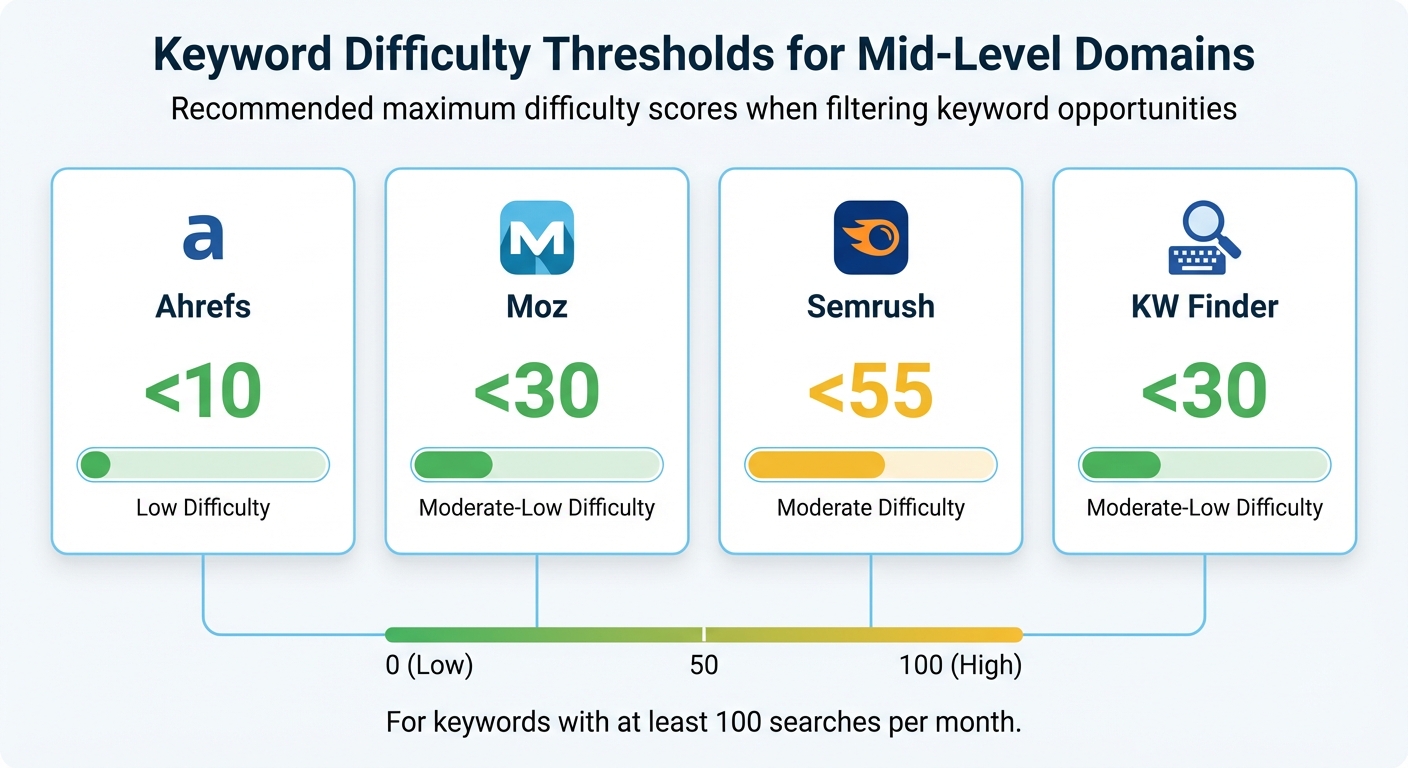
SEO Keyword Difficulty Thresholds by Tool for Mid-Level Domains
When repurposing content for SEO, everything starts with focused keyword research that aligns with your strategy. Before diving into revisions, pinpoint the keywords that will shape your updated content. Avoid relying on overused terms - look for opportunities that suit the new format and reflect current search trends. The idea is to match keywords with how people are searching today.
First, clarify your goals for the repurposed content. Are you aiming to rank for a new keyword? Regain lost rankings? Or perhaps reach a fresh audience? Each objective demands a different keyword approach. For example, if you’re turning a blog post into a YouTube video, ensure the topic has solid search volume on YouTube, not just Google.
Next, focus on search intent. Every keyword aligns with a purpose - whether it’s informational (learning something), transactional (making a purchase), navigational (finding a specific site), or commercial (comparing options). Search engines prioritize content that meets these user goals. To understand intent, search your target keyword and study the top five results. If listicles and comparison guides dominate, your content must include definitions and side-by-side comparisons to compete.
Find Gaps in Current Content
Your existing content likely has areas that could be improved - missing subtopics, outdated terms, or unanswered questions. A content gap analysis can reveal what competitors are covering that you’ve overlooked. Start by using Google Analytics to find your high-performing evergreen pages (navigate to Engagement > Pages and Screens). These pages already attract interest, so compare them against top-ranking competitors to identify missing elements.
Pay close attention to threshold keywords - terms where your content ranks between positions 6 and 29. These are within striking distance and can bring in more traffic if optimized to break into the top five. For example, Ahrefs rewrote a 2018 article on "link reclamation" in August 2024, tripling its monthly traffic from 350 visits. Similarly, HubSpot updated their "Competitive Analysis" post in April 2024, boosting its AI visibility citations from 151 to 476.
Check Google’s "People Also Ask" boxes for additional insights. These questions reveal exactly what users want to know, providing a list of subtopics to include in your updated content. Just make sure the page isn’t already ranking #1 for another valuable keyword before re-optimizing.
Once you’ve identified content gaps, use SEO tools to uncover specific keyword opportunities.
Use SEO Tools to Discover Keywords
Manual research has its limits. SEO tools can help you find keywords with high search volume and low competition that match your site’s authority. When filtering opportunities, aim for keywords with at least 100 searches per month and a manageable difficulty score. Here’s a quick guide to keyword difficulty thresholds:
| Tool | Recommended Difficulty (for mid-level domains) |
|---|---|
| Ahrefs | <10 |
| Moz | <30 |
| Semrush | <55 |
| KW Finder | <30 |
Tools like Semrush’s Keyword Magic Tool or Ahrefs’ Content Gap feature can also identify semantically related terms - secondary keywords that add depth to your topic. For instance, if your primary keyword is "content repurposing", related terms might include "content atomization", "multi-channel distribution", or "evergreen content updates."
Modern keyword research also involves considering AI-generated responses. Around 90% of AI bot activity focuses on content published or updated within the last three years, highlighting a preference for recent data. This means you should explore conversational phrasing and complete answers that mimic how users interact with AI tools like ChatGPT or Google’s AI Overviews.
"Writing for AI starts with writing for humans: concise, natural, and complete answers to real questions." – Cecilia Meis, Senior Editor and Strategist at Semrush.
Lastly, don’t underestimate the value of first-party data. Review sales calls, support tickets, or demo transcripts to identify the exact language and questions your audience uses. These can uncover long-tail keywords - phrases with lower search volume but higher conversion potential because they reflect real customer needs.
Step 2: Add Keywords Naturally Throughout Content
Once you've identified your target keywords, the next step is weaving them seamlessly into your content. This approach not only improves search relevance but also ensures a better experience for your readers. Overloading your text with forced keywords can harm readability and even send negative signals to search engines, so it's important to focus on natural placement rather than rigid keyword counts.
Start by including your primary keyword within the first 100 words of your content. This early placement helps search engines quickly identify your topic while establishing topical relevance for readers. As you continue, sprinkle keywords throughout the content, using synonyms and related terms to avoid repetition. For instance, instead of repeating "digital marketing" multiple times, you could use alternatives like "online marketing" or "internet advertising".
"If you don't see a natural place to insert your keywords, then don't because it will hurt your user experience (UX) and send a potential negative signal to search engines." – Sarah Berry, Lead Web Marketing Consultant, WebFX
You can also integrate keywords into structured sections like FAQ blocks, bulleted lists, or summaries. These areas are prime opportunities to appear in featured snippets or AI-generated summaries.
Update Titles and Headings
Your titles and headings play a vital role in reinforcing your SEO strategy. Use them as key areas for keyword placement. For title tags, place your primary keyword at the start for maximum impact, and keep them under 55 characters to avoid truncation in search results.
Incorporate keywords into headings by aligning them with common user questions or search intent. Short subsections with engaging subheadings not only improve readability but also increase the time users spend on your page. Adding descriptive, attention-grabbing adjectives like "smart" or "effective" can make your titles more clickable without appearing spammy.
When updating content, don’t forget to refresh the "Last Updated" date. Google often highlights this in search results, signaling content freshness to users.
"If you have outdated content, you can't expect that to attract users. Once they see the publish date or a sentence that dates your content, they'll return to the search results for an alternative answer. That signal can lower your rankings, which translates to less website traffic." – Sarah Berry, WebFX
Place Keywords in the Right Locations
Strategic keyword placement throughout your content can significantly boost SEO performance. Use the table below as a guide for where and how to integrate keywords effectively:
| Content Location | Best Practice for Keyword Placement | SEO Benefit |
|---|---|---|
| Title Tag | Start with the primary keyword; keep it under 55 characters. | Sends a strong relevancy signal; avoids truncation. |
| Introduction | Add core and related keywords within the first 100 words. | Establishes immediate topical relevance. |
| Headings (H2/H3) | Include primary and secondary keywords in subheaders. | Enhances scannability and keyword hierarchy. |
| Body Text | Use variations, synonyms, and lists naturally. | Improves readability and avoids keyword stuffing. |
| Conclusion | Summarize with core keywords. | Helps with featured snippets and reinforces intent. |
In your main content, aim for a conversational tone while using variations and related terms (LSI keywords) to maintain relevance without sounding mechanical. For example, if your primary keyword is "content repurposing", you might also use phrases like "content atomization", "multi-channel distribution", or "evergreen content updates."
Wrap up your content with a concise conclusion or "TL;DR" summary that reinforces your primary keywords. This can improve user engagement and boost the chances of appearing in featured snippets. Additionally, don't forget to include keywords in image alt text and anchor text for internal links, as these elements help search engines understand your site's structure and improve visibility in image searches.
With your keywords naturally integrated, you're ready to move on to refining metadata and technical SEO elements for even better results.
Step 3: Update Metadata and Technical SEO Elements
Once you've integrated your keywords, it’s time to refresh your metadata and technical SEO elements. These updates are crucial because they not only help search engines understand your content but also shape how users perceive it. Neglecting metadata can diminish the impact of even the most well-executed content refresh.
Search engines and modern AI tools are increasingly drawn to freshness signals when determining content relevance.
"Large language models have a recency bias, meaning they prioritize newer, frequently updated content because it signals relevance and authority" - Ragheed Akeel, SEO Specialist at seoplus+
By updating these elements, you'll improve how search engines evaluate and rank your updated content.
Rewrite Meta Titles and Descriptions
Once you've optimized your content with keywords, ensure your metadata aligns with your updated strategy. Meta titles and descriptions are often your content's first impression in search results, so they need to stand out. Aim for meta titles around 55 characters to prevent truncation, and consider including the current year or month to highlight relevance and timeliness.
For example, if you're revising a 2022 article on social media marketing, update the title from "Social Media Marketing Tips" to something like "Social Media Marketing Tips for 2026."
Meta descriptions should fall between 120 and 160 characters and use action-driven language such as "Discover", "Learn", or "Find out how" to encourage clicks. Tailor your descriptions to match evolving search behavior. For instance, if users now search for "smartphones" instead of "cellphones", your metadata should reflect that shift.
Add Alt Text to Images
Alt text plays a dual role: it enhances accessibility for the 12 million internet users with visual impairments and serves as a key ranking signal for Google Image Search. When refreshing your content, review all images and add descriptive alt text that naturally incorporates your target keywords.
To ensure compatibility with screen readers, keep alt text under 125 characters. Focus on describing the image's purpose and context. For example, instead of writing "screenshot of dashboard", try "SEO analytics dashboard showing organic traffic growth metrics." Avoid starting with phrases like "image of" or "picture of", as screen readers already recognize the element as an image.
"Alt text is a ranking factor for Google Image Search. It helps Google understand and rank images" - John Mueller, Senior Search Analyst at Google
For purely decorative images, use an empty alt attribute (alt="") to prevent unnecessary distractions for screen readers.
With your metadata and alt text updated, the next step is to strengthen your content further by adding strong internal links to enhance SEO.
Step 4: Build Internal Links
After refreshing your metadata, the next step is to establish strong internal links. These links act as pathways that help both search engines and users navigate your site, transferring authority from your top-performing pages to your newly updated content. As Google's John Mueller explains:
"Internal linking is super critical for SEO. It's one of the biggest things you can do on a website to guide Google and visitors to the pages that you think are important."
By adding contextual links from high-traffic pages to your refreshed content, you give it an immediate boost. A good rule of thumb is to include 5–10 internal links for every 2,000 words of content.
Link to High-Performing Pages
Start by pinpointing your site’s power pages - those that draw the most traffic, have strong backlink profiles, or drive conversions. Linking from these pages can significantly enhance the visibility of your repurposed content. Pay particular attention to pages ranking in positions 6–29 (the lower half of Page 1 or Page 2), as they stand to gain the most from added link equity [18, 36].
Don’t overlook your money pages, such as pricing pages, product demos, or key category pages that directly contribute to revenue [36, 38]. By connecting your updated content to these high-value pages, you create a network where each piece strengthens the others.
To avoid isolating content, organize your links using a 3-layer architecture. This setup includes:
- Hubs: Pillar pages that cover broad topics.
- Spokes: In-depth supporting articles linked to the hubs.
- Bridges: Links that connect related clusters.
Additionally, make sure all important pages are accessible within three clicks from your homepage to improve both user experience and crawl efficiency.
Write Descriptive Anchor Text
Anchor text matters. Instead of using generic phrases like "click here", opt for keyword-rich, descriptive text that sets clear expectations and supports SEO. For example, rather than saying, "Check out this article for more tips", use something like "SEO analytics dashboard showing organic traffic growth metrics." This approach not only improves user clarity but also signals relevance to search engines.
To maintain natural language, vary your anchor text while keeping it descriptive. Place key links near the top of your content to maximize their impact. And when updating older content, refresh outdated anchor text to align with current keywords.
Once your internal linking strategy is in place, the next step is to organize your content effectively with clear headers and schema markup.
Step 5: Structure Content with Headers and Schema Markup
Once you’ve established strong internal links, the next step is to focus on organizing your content for both readers and search engines. A well-structured layout, featuring clear headers and schema markup, makes your content easier to navigate, boosts visibility, and enhances engagement.
Use Clear Headers to Organize Content
Headers are essential for breaking down your content into digestible sections. They not only help readers locate key information quickly but also provide search engines with a clear understanding of your content’s structure. As Gracie Baids, Team Lead on the Client Success Team at seoClarity, explains:
"Headlines give context to search engines and readers alike."
Start with a single H1 for your main title. Use H2 tags for major sections and H3 tags for supporting points. This hierarchy signals the importance of each topic to search engines while improving the user experience. When updating older content, adjust your subheadings to align with current search intent. For example, include phrases like "What is", "How to", or "Benefits" to match popular search queries.
This strategy not only strengthens your keyword optimization but also complements updated metadata, creating a cohesive SEO plan. Considering that 42% of marketers report success from updating and repurposing content, investing in a solid header structure can deliver long-term benefits.
Add Schema Markup for Better Visibility
Schema markup is a type of structured data that helps search engines - and even AI tools like ChatGPT and Gemini - better understand and reference your content. By applying formats like FAQ or How-To schema, you increase the chances of your content appearing in featured snippets or conversational search results.
For example, you can add FAQ schema to popular articles by turning common questions into clear Q&A sections. Use tools like numbered lists, data tables, or step-by-step instructions to make your content easier for both readers and machines to interpret. With 46% of marketers believing that repurposing content is more effective than creating new material, structuring your updates with schema markup gives your content a competitive edge.
Once your content is well-organized, keep an eye on its performance and refine it based on the data you gather. This continuous improvement ensures your content stays relevant and valuable over time.
Step 6: Track Performance and Make Improvements
Once your content is structured, it's time to monitor how it's performing. This helps you avoid guesswork and ensures your optimization efforts are on the right track.
Monitor Key Metrics with SEO Tools
Start by keeping an eye on core SEO metrics like organic traffic, keyword rankings, and click-through rate (CTR) [42,43]. Tools such as Google Analytics 4 and Google Search Console are essential for tracking how many users find your content through search and identifying which keywords are driving impressions and clicks [41,42].
But don’t stop there. AI visibility is becoming increasingly important. This refers to how often your content appears in AI-generated answers from platforms like ChatGPT, Gemini, or Google's AI Overviews. With AI favoring fresh content, regularly updating your repurposed material can give you an edge.
Engagement metrics like average engagement time and bounce rate also provide insights into whether visitors find your content useful [42,43]. For instance, in 2025, Fluentica's partnership with ABA Matrix revealed that "how-to" guides and training resources significantly outperformed compliance-heavy articles in rankings and conversions. This strategy led to over 34,000 monthly organic visits.
These insights can help you refine your content and guide timely updates.
Update Content Based on Data
After tracking your metrics, give search engines 3–4 months to re-crawl and re-index your pages before making any major evaluations.
Pay special attention to mid-range keywords - those ranking in positions 6–29. These keywords are close to breaking into high-traffic positions, making them easier to boost with strategic updates. Also, identify pages that have experienced a 10% or more drop in traffic over the last six months; these are prime candidates for refreshing.
For larger sites, aim to conduct content audits quarterly. Smaller sites can stick to annual reviews. During these audits, compare your content with top-ranking competitors to spot shifts in search intent. Adjust your strategy as needed to stay competitive. Interestingly, 42% of marketers have found that updating and repurposing old content plays a key role in achieving marketing success.
Conclusion
Revamping your existing content can breathe new life into it, helping you attract fresh traffic and improve search visibility. By zeroing in on threshold keywords (those ranking between positions 6–29), updating metadata, adding internal links, and monitoring performance, you can see noticeable improvements. Plus, refreshing an older blog post often takes about half the time it would to create a brand-new one.
The process of repurposing content blends technical precision with creativity. From updating metadata and naturally incorporating keywords to reformatting content for today's user preferences, every update should reflect relevance and value. For example, turning a blog into a video script or implementing FAQ schema to enhance AI Overview visibility can signal freshness to search engines while meeting your audience's needs. This approach also strengthens your site's structure and preserves link equity.
To avoid pitfalls like internal competition, ensure each repurposed piece addresses a unique search intent. Retain the original URL to maintain link equity, update the publish date to signal freshness, and link to high-performing pillar pages to bolster your site's overall structure.
If the technical side feels daunting, teaming up with experts can simplify the process. SEO Werkz offers a range of digital marketing services, including SEO optimization, content creation, and technical audits, to help businesses maximize their repurposed content's potential. With their expertise, specialized tools, and data-driven strategies, they can pinpoint impactful opportunities and execute updates that deliver measurable results. Reach out to SEO Werkz today and turn your repurposed content into a reliable driver of traffic and growth.
FAQs
Will repurposing content hurt my rankings?
Repurposing content can be a smart move for your SEO - if you do it right. The key is to update the material, switch up the format, or introduce fresh ideas to make it stand out and feel useful. Simply copying content without meaningful updates? That’s where you risk penalties. To stay on the safe side, aim for refreshed, distinct versions that offer new angles and align with SEO best practices.
Should I keep the same URL when updating old content?
When updating older content, it's usually a smart move to stick with the same URL. Why? It helps retain your current rankings and keeps those valuable backlinks intact, preventing any dips in traffic or authority. Instead of changing the URL, put your energy into refreshing the content, fine-tuning keywords, and improving the overall structure. This approach not only boosts your SEO efforts but also ensures a smoother experience for your visitors, while keeping your performance in search results strong.
How long should I wait to see SEO results after a refresh?
It usually takes 3 to 6 months to notice any meaningful SEO improvements after updating content. Search engines like Google value fresh content, and these updates signal relevance, which can gradually boost rankings. That said, the timeline can vary based on factors such as the competitiveness of the targeted keywords and how extensive the updates are. Remember, SEO is a long-term game - immediate results are rare, so patience is essential.