How Local Events Boost SEO for Small Businesses
March 9, 2026Local events can be a game-changer for small businesses trying to stand out in local search results. By hosting or participating in community events, businesses send strong "local relevance signals" to Google, improving visibility and rankings. Here's why this works:
- Backlinks: Events generate links from local news, directories, and partner websites.
- Branded Searches: Increased visibility encourages more people to search for your business by name.
- Google Business Profile Activity: Updates with event-related content signal engagement to search engines.
- Community Trust: Events build local credibility, leading to positive reviews and social mentions.
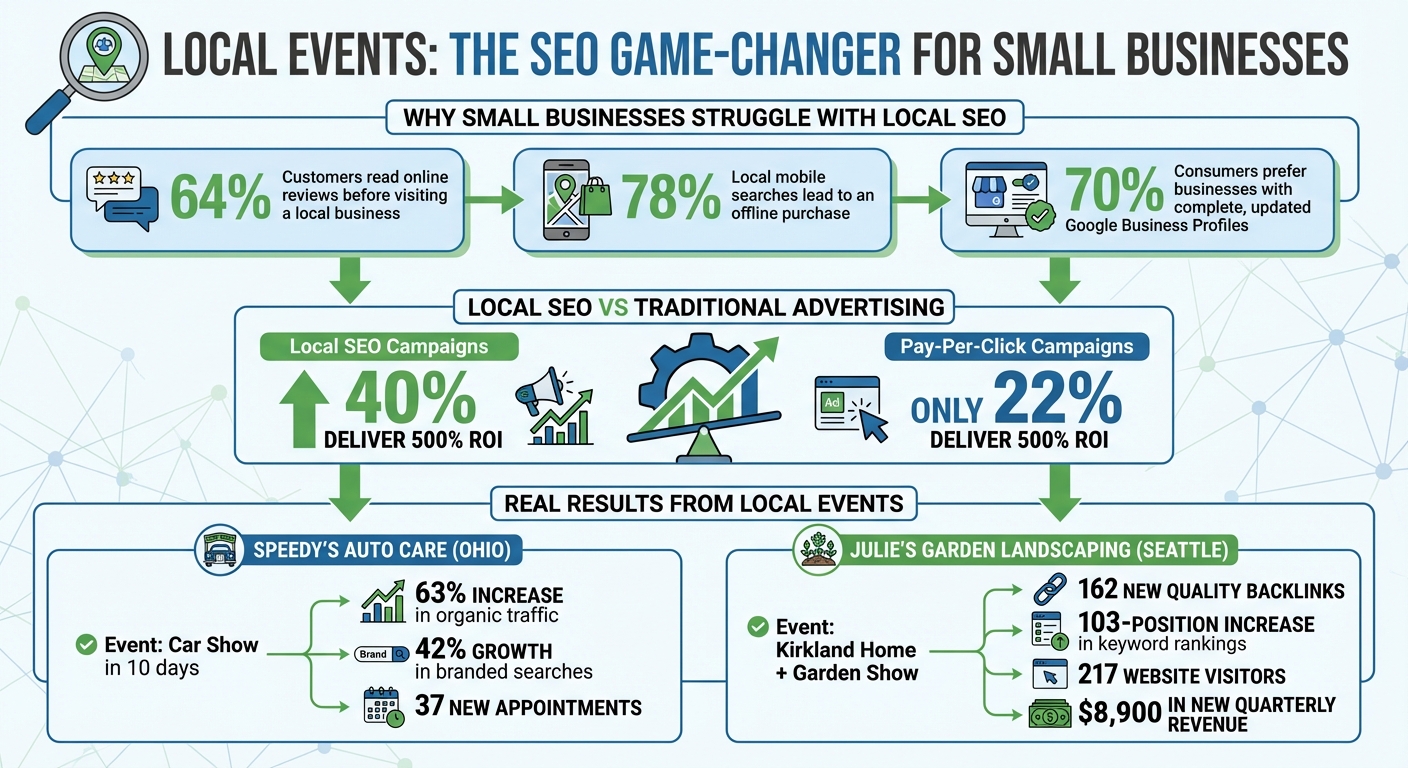
For example, Speedy’s Auto Care in Ohio hosted a car show, leading to a 63% traffic boost and 37 new appointments in just 10 days. Similarly, Julie’s Garden Landscaping secured 162 backlinks and $8,900 in new revenue after sponsoring a local event.
Local events aren’t just about SEO - they help businesses build real connections with their communities while improving online visibility. Start small, track results, and grow your presence both online and offline.
Local Events SEO Impact: Key Statistics and Results for Small Businesses
Google Business Profile EVENT POSTS for Local SEO & Lead Generation
sbb-itb-cef5bf6
Common SEO Problems Small Businesses Face
Small businesses often struggle to compete in local search results due to three key challenges. These issues reveal why standard SEO strategies often fall short and how participating in community events can help address these obstacles.
Poor Rankings in Local Search Results
Competing with large national chains is a steep uphill battle. Big companies dominate local search results thanks to their higher domain authority, leaving small businesses with little room to shine on broad search terms.
Adding to the problem, many small businesses unknowingly hurt their own rankings by having inconsistent NAP (Name, Address, Phone) data. For example, a coffee shop might list "123 Main St." on Google Business Profile but "123 Main Street" on Yelp. Such discrepancies signal unreliability to search algorithms. On top of this, a lack of local trust signals - like backlinks from community websites, local citations, or active social media presence - further weakens their credibility. According to Moz’s Local Search Ranking Factors study, these elements are among the most important for appearing in the Google Map Pack.
Another common issue? Many small businesses don’t create geographically specific content, like blog posts about local events or news. Without this, they appear less relevant to local searchers, making it harder to build visibility.
Low In-Person Customer Traffic
Declining foot traffic has a ripple effect on online visibility. Here’s the reality: 64% of customers read online reviews before visiting a local business. If foot traffic is low, there are fewer opportunities to gather fresh reviews, which impacts how legitimate a business appears in search results.
The stakes are even higher when you consider that 78% of local mobile searches lead to an offline purchase. For businesses struggling to draw people in, search engines may interpret this as a sign that they’re not a vital part of the local community. Without new reviews or updated photos, their profiles seem inactive, further reducing their visibility. This inactivity is especially damaging when 70% of consumers are more likely to visit a business that has a complete and regularly updated Google Business Profile.
As foot traffic dwindles, businesses often turn to traditional advertising, which offers little in terms of long-term local impact.
Expensive Traditional Advertising Costs
Traditional advertising is costly and offers little lasting value. While these ads might provide short-term visibility, they don’t build the digital authority or community trust that fuels sustainable growth. They’re transactional - bringing in some customers today but failing to create the backlinks, social mentions, or branded searches needed for organic success.
The numbers paint a clear picture: 40% of local SEO campaigns deliver a 500% return on investment, compared to just 22% for Pay-Per-Click campaigns. Local SEO connects small businesses with high-intent customers actively searching for nearby solutions, while traditional ads take a broader, less targeted approach.
Community-focused SEO strategies, like those driven by local events, offer a cost-effective alternative. They generate backlinks from local news outlets, fresh content, and social engagement - all without the hefty price tag of traditional advertising. While big brands dominate general search terms, they often overlook the hyper-local opportunities that small businesses can capitalize on.
How Local Events Improve SEO Performance
Local events can significantly boost your search rankings by showing Google that your business is deeply connected to the local community. Hosting or sponsoring events can trigger several ranking factors, from fresh content and backlinks to increased branded searches and social activity. Let’s explore how these events help improve local visibility, earn backlinks, and build trust within the community.
Increasing Local Search Visibility Through Events
Local events are a direct way to improve visibility by engaging nearby audiences. Search engines reward businesses that actively participate in their local communities. Creating a dedicated event page on your website and promoting it through your Google Business Profile adds fresh, location-specific content optimized with local keywords like "[City] [Industry] Event."
The results of such efforts can be impressive: businesses have reported a 63% increase in organic traffic, a 42% growth in branded search volume, and noticeable improvements in conversions within weeks of promoting an event. Using event schema markup, you can make your event details - like dates, locations, and ticket links - stand out in search results. Regularly updating your Google Business Profile with event-related content keeps it active, signaling to Google that your business is relevant and engaged locally. This can improve your chances of appearing in the coveted Map Pack.
"Google's AI loves to move things up that are local to you and the timing on them is close to the near future." - Dan Gudema, SEO Turbo Booster
Getting Backlinks and Citations from Event Partnerships
Event partnerships are a goldmine for earning high-quality local backlinks, which are crucial for competing with larger brands. Collaborating with event organizers, sponsors, and other local businesses naturally generates backlinks and citations. When your business’s Name, Address, and Phone Number (NAP) appear on partner websites, it signals to search engines that you’re an integral part of the community.
Take the example of Julie's Garden Landscaping in Seattle. By sponsoring a booth at the Kirkland Home + Garden Show, Julie created an optimized event page with schema markup and submitted listings to over 20 local directories. The campaign resulted in 162 new quality backlinks, a 103-position increase in organic keyword rankings, and 217 website visitors tracked using UTM parameters. Even better, five new recurring clients signed on, adding $8,900 in quarterly revenue.
| Event Promotion Channel | Primary SEO Benefit | Target Metric |
|---|---|---|
| Local Directories (Eventbrite, Yelp) | Citations & Backlinks | Referral Traffic |
| Google Business Profile Posts | Local Map Visibility | Directions/Call Requests |
| Website Event Landing Page | Keyword Rankings | Organic Search Traffic |
| Social Media (Hashtags/Tags) | Social Signals & Engagement | Branded Search Volume |
| Local News/PR Outreach | High-Authority Backlinks | Domain Authority |
By promoting your event effectively, you can secure backlinks from authoritative local sources like Chamber of Commerce websites, community calendars, and local news outlets. One well-executed local event can generate over 160 high-quality backlinks, boosting your domain authority and overall SEO performance.
Building Community Trust and Recognition
The benefits of local events go beyond technical SEO. They help build trust with the community, which search engines take into account. When your business actively participates in local events, it becomes more than just a name on a search results page - it becomes a trusted part of the community. This trust often translates into online behaviors that positively impact your rankings.
Attendees at your events often share their experiences on social media, tag your business, and post photos. These social signals show search engines that your business is active and popular. Additionally, happy attendees frequently leave positive reviews mentioning the event, further reinforcing your local relevance.
"When your business becomes part of the digital conversations around local events... you send strong signals that your shop is active, local, and trusted." - Dan, Author at Shop Dog Marketing
Strategic participation in events can lead to higher rankings for over 100 localized search queries within six months. As branded searches increase, Google interprets this as a sign of high authority, boosting your visibility and helping you stand out in local search results.
Steps to Use Local Events for Better SEO
Follow these steps to create event pages that rank well in search engines, engage your local audience, and measure results effectively.
Creating and Promoting Event Pages
Always create a dedicated landing page for each event instead of burying details in a blog post. A standalone page is easier for search engines to index and rank. For recurring events, stick with an evergreen URL like "/austin-food-festival" rather than a year-specific one. This approach helps maintain link authority over time.
Make sure to include the event name, location, and date in key places: your page title, H1 header, meta description, and image alt text. For example, if you're hosting a "Classic Car Show in Elyria, OH", optimize your copy around that phrase to target local searches.
Take advantage of Event Schema markup (JSON-LD) to enable rich snippets in search results. Embedding a Google Map on your page can further reinforce the event's location. Also, ensure your NAP (Name, Address, Phone) details are consistent across your site, Google Business Profile, and event directories.
Promote your event through your Google Business Profile and reputable local event directories like Eventbrite, Yelp, or your local Chamber of Commerce. This not only increases visibility but also builds backlinks. Use UTM parameters in your shared links (e.g., "?utm_source=EventName&utm_medium=social&utm_campaign=Spring2026") to track traffic sources accurately.
For example, Speedy's Auto Care saw impressive results after optimizing their event page: a 63% increase in organic traffic, a 42% jump in branded search volume, and 37 new appointments within just 10 days.
Once your event page is live, involving the local community can amplify its reach.
Getting the Community Involved
Collaborate with non-competing local businesses like hotels, restaurants, or transportation companies. These partnerships can earn you natural backlinks when they promote your event on their websites. You can also reach out to local bloggers or influencers, offering VIP access in exchange for coverage and links.
Hosting events like charity fundraisers, workshops, or food drives can deepen community ties. Create a unique hashtag for your event and include it on all promotional materials. Encourage attendees to tag your business in their posts - this user-generated content boosts engagement and visibility.
After the event, ask attendees for reviews that highlight local details. Update your event page with photos, videos, and a recap to keep the page active and engaging. This not only extends the event's lifespan but also signals to search engines that your business is actively involved in the community.
"Nothing beats real community involvement for building local authority that search engines (and people) trust." – Jen Ruhman, Owner, Jen Ruhman SEO
These efforts can significantly enhance your event's visibility, but tracking the results is just as important.
Measuring Event SEO Results
Keep an eye on key metrics before, during, and after the event. Use tools like Google Analytics to monitor total visitors, bounce rate, and time-on-site for your event page. The UTM parameters you added earlier will help isolate event-related traffic. Additionally, check Google Business Profile Insights for increases in discovery searches, direction requests, or phone calls.
Track branded search volume to gauge your business's growing authority. Google Search Console is great for monitoring ranking changes for geo-targeted keywords like "[Service] in [City]." Meanwhile, tools like Moz, Semrush, or Ahrefs can help you track new backlinks from event directories, local news sites, and partner websites.
For example, Julie's Garden Landscaping in Seattle used UTM-tagged links to track their participation in the Kirkland Home + Garden Show in August 2024. The campaign brought 217 website visitors, boosted rankings for 103 organic keywords, earned 162 new backlinks, and generated $8,900 in quarterly revenue from five new clients.
| Metric Category | Specific Metrics to Track | Recommended Tools |
|---|---|---|
| Website Traffic | Total visitors, bounce rate, time-on-site | Google Analytics (with UTMs) |
| Local Visibility | Discovery searches, direction requests, calls | Google Business Profile Insights |
| SEO Authority | Domain authority, new backlinks, local citations | Moz, Semrush, Ahrefs, Linkody |
| Search Performance | Keyword ranking changes, click-through rates (CTR) | Google Search Console |
| Engagement | Social shares, hashtag usage, attendee reviews | Social Media Analytics, Yelp, Facebook |
Finally, conduct a thorough audit 1–3 months after your event to assess long-term ranking improvements. While traffic spikes might happen immediately, meaningful SEO gains often take weeks or months to fully materialize.
Wrapping It Up
This article has highlighted how local events tackle common SEO hurdles while fostering trust within the community. For small businesses, local events present an affordable way to not only improve search rankings but also build stronger connections with their audience. By hosting or taking part in community activities, you create opportunities that lead to impactful results.
Participating in events can drive up organic traffic and increase branded searches. The best part? These benefits don’t require huge budgets. Even small initiatives - like organizing a workshop or being a drop-off point for donations - can spark local interest and earn quality backlinks.
"The overwhelming majority of the value from hosting events comes from the event itself, so don't get lost in the link building aspects of the strategy. You should be hosting events because that's the type of sh*t real businesses do." – Kane Jamison, Founder, Content Harmony
Start with smaller events, track your progress, and build genuine local credibility. Events not only bring a human touch to your brand but also create a level of trust that’s hard to achieve through digital strategies alone. Take these steps today to strengthen your local presence and see long-term SEO benefits.
FAQs
What local event should my business start with?
Hosting or participating in a local event is a fantastic way to connect with your community while enhancing your online presence. Think about organizing something that ties into your industry or local interests - like a charity fundraiser, a community service project, or a free workshop showcasing your products or services. Events like these not only foster stronger community relationships but also create opportunities for valuable local media coverage.
Why does this matter for SEO? These events can lead to citations, backlinks, and social media buzz. For example, local news outlets might mention your event, linking back to your website. Attendees could leave glowing reviews or share their experiences on social media, further amplifying your reach. All of this activity helps build your local SEO, making your business more visible in search results.
How do I turn an event into local backlinks?
To build local backlinks through events, consider sponsoring or hosting one. This approach can earn your business mentions on community calendars, local news websites, and social media platforms. To maximize the impact, share engaging content like blogs, photos, and videos related to the event. Actively participate in discussions with local media and online communities to amplify your presence. These combined efforts can inspire others to link to your site, helping improve your SEO with relevant, high-quality local backlinks.
How long until event-driven SEO results show up?
Event-driven SEO efforts typically start showing results within 6 to 12 weeks. The exact timeline can vary based on factors such as the nature of the event, the industry you're targeting, and the strategies you use. By maintaining consistent efforts and ensuring your optimizations are on point, you can often see progress sooner.