How to Optimize Landing Pages for SEO in 2026
April 28, 2026Search behavior in 2026 has changed dramatically, with AI-driven results dominating over 25% of searches and zero-click searches exceeding 60%. This makes optimizing landing pages for SEO more challenging but also more critical. Here’s what you need to know:
- Google’s 2026 E-E-A-T framework rewards first-hand expertise and original content, making depth and authority essential.
- Keyword research should focus on user intent (commercial and transactional queries) rather than search volume alone.
- AI tools like Semrush, Clearscope, and Ahrefs help uncover actionable keyword opportunities.
- On-page elements like title tags, meta descriptions, and schema markup remain key for visibility and CTR.
- Core Web Vitals (LCP, INP, CLS) directly impact rankings and conversions, with fast-loading, mobile-friendly pages performing best.
- AI personalization tailors content dynamically to user context, improving engagement and conversions.
In short, success in 2026 requires landing pages that balance technical SEO, user intent, and real-world expertise to stand out in an AI-dominated search landscape.
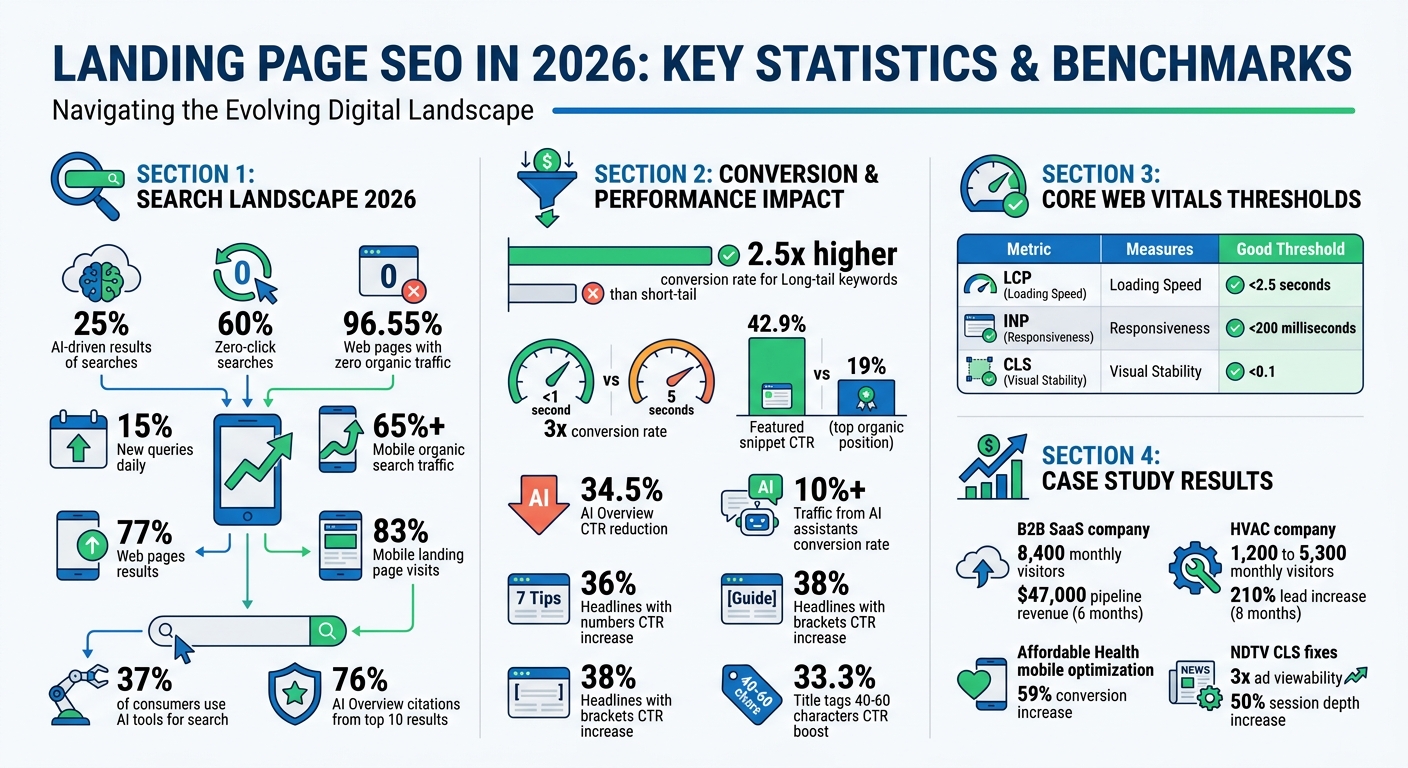
Landing Page SEO Statistics and Core Web Vitals Benchmarks 2026
7 Hacks To Skyrocket Your Landing Page SEO (Search Engine Optimization)
sbb-itb-cef5bf6
Keyword Research Based on User Intent
Keyword research in 2026 is all about understanding why users are searching, not just chasing high search volumes. With 96.55% of web pages getting zero organic traffic from Google, success hinges on aligning your keywords with user intent rather than just targeting big numbers.
To do this, keywords should be categorized into four main intents: Informational, Commercial, Navigational, or Transactional. For landing pages, commercial and transactional keywords are especially valuable because they attract visitors who are ready to make decisions. Even if a long-tail keyword has just 10–50 monthly searches, grouping 20 related terms on a single, well-optimized landing page can bring in 500–1,000+ visits per month.
The search results themselves (SERPs) reveal intent. For example, if the top results for a keyword are comparison articles, the intent is commercial. If the results are guides or definitions, the intent is informational. Matching your content format to what Google sees as the "right" answer is crucial. A blog post, no matter how well-written, won’t rank for a keyword dominated by product pages or tools. By analyzing these SERP patterns, you can create focused, high-conversion landing pages.
"SEO is more about specificity & depth than just checking things off a to-do list or hitting a word count." - Tedi Bezna, Searchlight Digital
Start with broad "seed" keywords (1–2 words) and refine them using Google Autocomplete suggestions like "how", "best", "vs", or "for beginners". The "People Also Ask" section is another goldmine for discovering natural language queries. These questions can serve as H2 headings or FAQ sections, which not only improve your chances of being cited by AI search engines but also help target featured snippets. With a 42.9% click-through rate compared to 19% for the top organic position, featured snippets are a powerful way to boost traffic.
Using AI Tools to Find Keywords
AI tools have transformed keyword research, making it easier to find and prioritize opportunities. Here are some standout tools for 2026:
- Semrush: With a database of over 26 billion keywords, it offers a "Personal Keyword Difficulty" (PKD) feature that tailors ranking difficulty to your domain's authority. This means you can focus on keywords that are realistic for your site to rank for.
- Surfer SEO: Rated 8.4/10 for its real-time NLP term suggestions, it helps identify semantic keywords Google expects to see in your content.
- Clearscope: Uses IBM Watson NLP to group related terms into clusters, making it easier to decide which concepts should go on the same page.
- Frase: Ideal for budget-conscious teams, it generates SERP-based content briefs in under 60 seconds and pulls user questions from Reddit, Quora, and "People Also Ask".
- Ahrefs' AI Search Intents metric: This identifies which keywords are likely to be dominated by AI Overviews rather than traditional search results. Since AI Overviews reduce click-through rates by 34.5%, this feature helps you avoid wasting effort on low-potential keywords.
About 15% of daily searches are completely new queries, meaning traditional search volume metrics often miss opportunities. Using Google Search Console's regex filters, you can uncover queries where you're ranking on Page 2 but lack a dedicated landing page. These "hidden gems" often convert better than high-volume keywords. Additionally, targeting "Zero Search Volume" (ZSV) terms - like those found in customer support logs or niche forums - can lead to significant traffic gains. Grouping keywords by SERP overlap and clustering related terms ensures your content aligns with user needs while avoiding keyword cannibalization.
Targeting Search Intent Over Search Volume
Once you've identified keywords, focus on intent rather than sheer numbers. Long-tail keywords convert at 2.5 times the rate of short-tail keywords. A keyword with 1,000 monthly searches and 50% annual growth is often more valuable than a stagnant one with 5,000 searches - especially since content can take 3–6 months to rank. By 2026, users often land on your site after researching extensively through AI assistants, meaning they’re closer to making decisions.
For example, a B2B project management SaaS company discovered that "project management for remote teams" had over 12,000 combined monthly searches with a Keyword Difficulty of 28, compared to the broader term "project management software", which had a KD of 72. By creating a pillar page and eight supporting articles for the remote-specific cluster, they drove 8,400 monthly organic visitors and $47,000 in monthly pipeline revenue within six months. This case highlights the importance of prioritizing intent and business relevance over raw search volume.
Finally, look at SERP ad density to confirm whether your target keywords indicate strong commercial or transactional intent. Many SERPs now show "fractured intent", where a single keyword serves multiple purposes. For instance, a search for "Python" might split between coding documentation, software downloads, and online courses. Your content must align with the dominant intent segment to compete effectively.
"If you are still categorizing keywords solely into 'Informational,' 'Navigational,' 'Commercial,' and 'Transactional,' you are optimizing for a search engine that no longer exists." - SEZ Technical Review Board
Keyword clustering by SERP overlap is another essential tactic. If two keywords share three or more URLs in the top 10 results, they should be targeted on the same page. This avoids cannibalization and strengthens your ranking potential. For instance, an HVAC company in Denver used this method in 2025, shifting from random topics to a "furnace problems and solutions" cluster. By targeting queries like "Why is my furnace blowing cold air?" (6,600 searches, KD 12) and "Furnace maintenance checklist" (1,900 searches, KD 18), they grew organic traffic from 1,200 to 5,300 monthly visitors and increased lead submissions by 210% within eight months.
Optimizing On-Page Elements and Meta Tags
Once you've nailed down your keywords, the next step is to make your content crystal clear to both users and search engines. On-page elements like headlines, meta tags, and schema markup are essential for signaling your page's purpose. By 2026, these features also play a role in how AI-powered search engines extract and reference your content.
The title tag remains one of the strongest on-page ranking factors, directly influencing both rankings and click-through rates (CTR). While meta descriptions don’t directly impact rankings, they are key for boosting CTR and providing structured summaries for AI systems. To maximize your site's performance, ensure each page has unique title tags and meta descriptions. This avoids confusion and opens up more ranking opportunities. Adding schema markup gives search engines extra context, increasing your chances of earning rich snippets or being cited by AI systems. Together, these elements work with your keyword research to draw both algorithmic and user attention.
Writing Effective Headlines
Your headlines serve two audiences: the H1 tag speaks to users, while the title tag targets search engines and appears in search results. Both need to be clear and optimized. For H1 tags, start with your primary keyword to improve SEO and align with how users naturally scan content. For example, instead of saying "Welcome to Our Guide", try "How to Optimize Landing Pages for SEO in 2026."
Using numbers in headlines can increase CTR by 36%, and adding brackets or parentheses (like "[2026 Update]") can boost it by up to 38%. "How-to" and question-based headlines also tend to perform well, increasing CTR by about 14%. Here are some headline formulas to try:
- Number + Keyword + Promise: "10 Meta Tag Mistakes That Kill Your Rankings"
- How-to + Keyword + Outcome: "How to Write Headlines That Double Your CTR"
Mix in power words like "Complete", "Ultimate", or "Step-by-Step" to highlight the value of your content. However, steer clear of over-the-top terms like "insane" or "powerful", which can erode trust. Use a single H1 per page, and organize your content with H2–H4 tags to create a logical structure for users and search engines. Replace generic subheadings like "Step 1" with specific titles such as "How to Set Up GA4 for Content Tracking." Clear headings make it easier for AI systems and users to understand and reference your content.
"Title tags are the highest-ROI optimization in all of SEO. I have seen sites double their organic click-through rate by simply rewriting title tags with a number, a year, and a clear value proposition."
– Atilla Kuruk, SEO & AI Search Specialist
Once your headlines are in place, shift your focus to refining meta tags for even better results.
Creating Better Meta Titles and Descriptions
For title tags, aim for 50–60 characters (or under 600 pixels) and place your primary keyword at the beginning - front-loaded keywords carry more weight. Title tags within the 40–60 character range can achieve a 33.3% higher CTR compared to shorter or longer alternatives. Add your brand name at the end, separated by a pipe (|) or dash (–), and include modifiers like the current year or descriptive terms to target long-tail queries.
Meta descriptions should be 150–155 characters for desktop and about 120 characters for mobile to ensure they display fully. While Google often rewrites meta descriptions to better fit user searches, a well-crafted description can still influence CTR and provide structured summaries for AI systems. Include a call to action like "Learn more", "Get started", or "Shop now" to create urgency. Google also bolds keywords in meta descriptions that match the user’s query, naturally drawing attention and encouraging clicks. Write naturally - don’t overdo the keywords, as stuffing them can make your content seem spammy to both users and AI algorithms.
Interestingly, AI Overviews can reduce organic CTR by up to 61% for queries where they appear. However, only 38% of AI Overview citations come from traditional top-10 search results, meaning well-optimized meta tags can still earn citations even if your page isn’t ranking at the top. This makes meta tag optimization more important than ever.
Adding Schema Markup for Better Crawlability
Schema markup acts like a translator, helping search engines understand your content more clearly. It provides context, making it easier for search engines to match your page with specific user queries. While schema itself doesn’t directly improve rankings, it can lead to rich snippets - enhanced search results that include images, ratings, or price ranges, all of which can improve CTR.
Focus on these schema types to boost your visibility:
- Product schema: Displays ratings and pricing.
- Organization schema: Helps generate knowledge panels.
- Review schema: Builds credibility.
After implementing schema, validate it using the Schema Markup Validator to ensure everything is set up correctly and eligible for rich results. Structured data also helps large language models (LLMs) understand your content, increasing the chances of being featured in AI-generated answers or AI Overviews. Pages mentioned in AI Overviews tend to receive more organic and paid clicks than those that aren’t.
"Schema seems to help AI systems interpret your content's structure and meaning. Using it may boost your chances of being featured in traditional SERPs and AI-generated answers."
– Backlinko
Keep in mind that as of 2026, Google has largely stopped supporting rich results for FAQ Schema markup, so it’s better to focus on other structured data types. Write clear and authoritative content within structured sections to make it easier for LLMs to extract and summarize your information.
Improving Core Web Vitals and Technical Performance
Once you've tackled on-page optimization, the next step is ensuring your website delivers fast load times and smooth performance. Google uses three Core Web Vitals to measure page experience: Largest Contentful Paint (LCP), Interaction to Next Paint (INP), and Cumulative Layout Shift (CLS). These metrics focus on loading speed, responsiveness, and visual stability - key factors that influence both rankings and user conversions. For example, pages that load in under 1 second convert at about three times the rate of pages that take 5 seconds to load. With mobile devices expected to account for over 65% of organic search traffic by 2026, optimizing for mobile performance is more critical than ever.
To pass Core Web Vitals, 75% of real user visits must meet the "good" threshold for each metric. Google relies on real-world field data from the Chrome User Experience Report (CrUX), which reflects actual user experiences rather than lab-generated scores like those from Lighthouse. This means your optimizations need to work across a variety of devices and network conditions.
| Metric | What it Measures | "Good" Threshold |
|---|---|---|
| LCP | Loading Speed (Main Content) | < 2.5 seconds |
| INP | Responsiveness (Interaction Delay) | < 200 milliseconds |
| CLS | Visual Stability (Layout Shifts) | < 0.1 |
"The practical impact [of CWV] is strongest when two pages are roughly equal in content quality - good CWV can be the tiebreaker that wins the position."
– Guy Sheetrit, Author, OverTheTopSEO
Let’s dive into how to improve LCP by reducing page load time.
Increasing Page Load Speed
LCP measures how long it takes for the largest visible element - usually a hero image or headline - to appear on the screen. To improve LCP, you can:
- Optimize images by adding
fetchpriority="high"and using<link rel="preload">for the LCP element. Avoid lazy-loading this critical asset. - Switch to modern image formats like AVIF, which are 30–50% smaller than WebP while maintaining quality.
- Use responsive images with the
srcsetandsizesattributes to serve appropriately-sized files for different devices.
Server performance also plays a big role in LCP. Reduce Time to First Byte (TTFB) by using a content delivery network (CDN), enabling server-side caching with tools like Redis or Varnish, and upgrading to HTTP/3 for faster connections. Platforms like Cloudflare Workers or Vercel Edge can help you achieve TTFB under 600ms.
For INP, which replaced First Input Delay (FID) in 2024, focus on minimizing JavaScript execution time. Break up long tasks (over 50ms) using scheduler.yield() or setTimeout, move heavy computations to Web Workers, and use code splitting to defer non-essential scripts. Unlike FID, INP measures interaction latency throughout the entire session, making it more challenging to optimize.
After addressing speed, it’s essential to ensure your pages perform well on mobile devices.
Making Pages Mobile-Responsive
Mobile devices account for about 83% of landing page visits. Yet, many websites still struggle with mobile performance. Google evaluates Core Web Vitals separately for mobile and desktop, but mobile optimization is crucial because of slower processors and inconsistent network conditions.
Use PageSpeed Insights to test your pages on actual mobile devices and analyze real user data. Key improvements include:
- Ensuring touch targets are at least 48×48 pixels for better usability.
- Simplifying forms for smaller screens.
- Implementing mobile-specific features, like sticky CTAs. For instance, in 2026, Affordable Health saw a 59% increase in conversion rates by pre-filling address fields dynamically and adding a sticky mobile footer for their primary CTA.
Once speed and mobile responsiveness are covered, it’s time to tackle layout shifts.
Fixing Layout Shift Issues
CLS measures how stable a page's layout is by tracking unexpected content shifts. A "good" CLS score is 0.1 or less, while scores above 0.25 are considered "poor". Layout shifts can frustrate users - for example, when a button moves just as someone tries to click it.
To reduce CLS:
- Set explicit
widthandheightattributes on<img>and<video>elements to reserve space before they load. - Use the CSS
aspect-ratioproperty for responsive elements and third-party embeds. - For web fonts, combine
font-display: swapwith thesize-adjustCSS descriptor to prevent reflow when fonts load. - Reserve space for dynamic content using CSS
min-heightor fixed positioning for overlays.
When animating elements, stick to animating transform and opacity properties. Avoid animating width, height, or margin, as these trigger layout recalculations. In 2026, NDTV improved ad viewability by 3x and increased session depth by 50% by addressing CLS issues on their article pages. Their fixes included adding explicit dimensions to all image and ad containers.
"Cumulative Layout Shift destroys user experience and tanks your Core Web Vitals scores."
– White Label SEO Service
Using AI Personalization and Improving User Experience
Personalization has become a cornerstone of creating a seamless online experience, ensuring visitors find content that aligns with their needs. Today, landing pages can adjust dynamically to match a user’s context, thanks to AI-driven technology. This is especially important because many visitors arrive at your site through AI assistants, having already researched your brand. These users aren’t aimlessly browsing - they’re here to confirm if your offerings live up to their expectations.
AI personalization goes far beyond simply addressing users by name. Advanced edge rendering pipelines can modify on-page elements in real time based on factors like referral source, device type, time of visit, and past interactions. For instance, someone arriving via an AI-generated response will expect a different experience than a visitor from a social media platform. The goal is to attract fewer but higher-quality visitors who are ready to take action, creating a more targeted and efficient user journey.
"The funnel didn't shrink - it compressed. Someone clicking through from an AI-generated answer isn't browsing. They're checking if the reality matches what they were told."
– Bardhyl Bytyqi, Founder, Landdding
Adding Dynamic Content
Dynamic content adapts to each visitor’s unique context, creating a highly personalized experience. AI tools, using frameworks like Vercel and React Server Components, can generate custom interfaces on demand. This approach ensures that every visitor encounters content tailored to their stage in the customer journey.
A critical element of personalization is maintaining consistency across touchpoints. An AI spine architecture can help achieve this by preserving intent and design coherence as users navigate between platforms like Google Business Profile, Maps, and your landing page. Adaptive calls-to-action (CTAs) can also adjust based on visitor context, using progressive disclosure to reveal only the most relevant options. Additionally, semantic image SEO - through locale-aware naming and descriptive alt text - keeps media relevant across devices and regions, further enhancing the experience.
Placing Call-to-Action (CTA) Buttons Effectively
Where you place your CTA buttons can make or break your conversion rates. For high-intent visitors, position the primary CTA prominently above the fold, where conversion rates can exceed 10%. For others, follow up with supportive CTAs after showcasing key benefits.
Make sure the primary CTA is always visible, no matter the rendering or device. On mobile, where most traffic originates, the layout should ensure the CTA remains easily accessible as users scroll. Regular A/B testing can help refine the button’s color, copy, and placement to maximize its impact.
Using Behavioral Analytics to Improve UX
In 2026, behavioral analytics focus on confirming user intent rather than persuading users to act. Analyze whether your landing page meets visitor expectations by tracking how they discover your site across platforms like TikTok, Reddit, YouTube, and AI assistants.
With conversational and longer queries becoming the norm on AI platforms, incorporating FAQ sections with schema markup is a smart move. This not only captures those queries but can also attract AI-generated summaries. Additionally, monitor device-specific interactions - while mobile dominates, certain scenarios might see more desktop engagement. Using real-time telemetry and AI-assisted testing ensures that personalization features remain fast and efficient. The trend toward "invisible interfaces" emphasizes reducing user friction, streamlining decision-making, and enhancing the overall experience.
"AI has changed the way people are interacting with websites, so prioritizing your user experience + fine-tuning your high performing content is where the SEO gold is at this year."
– Amber Johnson, Maevan Marketing
How SEO Werkz Can Help Optimize Your Landing Pages
Optimizing landing pages in 2026 requires a mix of technical know-how, strategic content planning, and continuous performance monitoring. SEO Werkz provides all of this through campaigns tailored to elevate your online visibility. With a track record of ranking over 100 websites and securing more than 1,000 keywords on the first page of search results, their expertise speaks for itself.
Transparency and accountability are at the heart of SEO Werkz’s approach. They offer detailed reports and hold monthly meetings with dedicated account managers to review progress and fine-tune strategies. Operating on a month-to-month basis with no long-term contracts, they focus on delivering consistent results that earn client loyalty. This flexible, results-driven model aligns perfectly with the goal of optimizing landing pages for both user engagement and search engine performance.
"Our goal is to establish a positive return on investment (ROI) within months of working with us." – SEO Werkz
These principles guide every service SEO Werkz provides, ensuring measurable outcomes and ongoing improvements.
SEO Werkz Advanced SEO Plan Features
The Advanced SEO Plan is designed for in-depth landing page optimization. It includes advanced keyword research, targeting terms with transactional and commercial intent. By focusing on middle-of-funnel and bottom-of-funnel keywords, this plan attracts visitors who are ready to take action. On-page optimization covers critical elements such as headlines, meta tags, schema markup, and Core Web Vitals, all of which are essential for improving user experience and search rankings.
The plan also prioritizes link-building efforts, securing high-quality backlinks to boost domain authority and organic visibility. Additionally, online reputation management highlights positive aspects of your brand, building trust with visitors. One client reported a noticeable increase in traffic after implementing SEO Werkz’s strategies.
"Blake, our account manager, talks to us every month and goes through all data. He shows us where we are at and what he and his team are doing to increase our presence online." – Vibeke Wren, Courts Unlimited
Full-Service Plan for Complete Optimization
The Full-Service Plan takes optimization to the next level by combining SEO with paid search (PPC), social media marketing, and professional web design. This integrated approach is especially valuable in 2026, as users often interact with brands across multiple platforms before landing on a page. By diversifying traffic sources, this plan strengthens both immediate and long-term online visibility.
Content creation is another key element, with clear, actionable copy that addresses user needs and encourages conversions. Meanwhile, technical SEO ensures fast loading times, mobile-friendly designs, and an organized site structure. Together, these services create a seamless experience that resonates with today’s savvy, AI-assisted users.
Conclusion
Optimizing landing pages for SEO in 2026 requires a careful blend of strategic keyword research, technical know-how, and AI-powered personalization. The digital landscape is evolving fast - over 37% of consumers now begin their searches with AI tools like ChatGPT instead of traditional search engines. Additionally, 76% of sources cited in Google AI Overviews already rank in the top 10 search results. This means your landing pages must cater to both human users and AI systems to stay competitive.
Technical precision is a must. Tools like Core Web Vitals, schema markup, and structured data are no longer optional - they help AI systems understand and recommend your brand.
Beyond technical elements, every detail of your landing page needs to work toward one goal: attracting the right audience. The focus is shifting from sheer traffic volume to traffic quality. While AI-driven overviews might lower overall click-through rates, the visitors who do land on your page often have stronger intent and higher conversion potential. In fact, traffic from AI assistants can achieve conversion rates of over 10%, far surpassing traditional organic traffic. As mentioned earlier, success hinges on elements like precise keyword targeting and well-placed CTAs, ensuring that every visitor interaction counts.
"The brands that win in 2026 will be the ones that stop trying to 'game' the algorithm and start feeding the entire digital ecosystem with genuine, authoritative, and reputation-backed value." – Kenzie Austin, Director of SEO, Envisionit
For businesses ready to adapt, expertise and precision are key. SEO Werkz offers tailored solutions that combine technical optimization, smart content strategies, and continuous performance tracking. With over 1,000 first-page keyword rankings and more than 100 successfully ranked websites, their proven, transparent approach can help you navigate the challenges of AI-driven search and turn your landing pages into conversion machines.
FAQs
How do I pick landing page keywords in 2026?
When picking landing page keywords in 2026, zero in on high-intent keywords that directly align with what your audience is searching for. These are terms that reflect a user's intent to take action, whether that's making a purchase, signing up, or learning more.
To get started, research the phrases your target audience frequently uses. Look at search volume, competition levels, and - most importantly - how relevant the keywords are to your landing page's goals. Incorporating long-tail keywords or local SEO terms can help you connect with specific needs or regional audiences, giving you a more precise way to reach potential customers.
The key is to ensure your chosen keywords not only help your page rank but also drive meaningful actions. When your keywords align with the purpose of your landing page, you’re more likely to boost both visibility and conversions.
What on-page SEO elements matter most for landing pages?
When it comes to optimizing landing pages, there are a few key elements you can't afford to overlook: keyword optimization, meta tags, and content depth.
- Keyword Optimization: Focus on using keywords that match what your audience is searching for. These should align with their intent - whether they're looking for information, comparing options, or ready to make a purchase.
- Meta Tags: Write meta titles and descriptions that grab attention. These are often the first things users see on search engine results pages, so make them clear, engaging, and relevant.
- Content Depth: Offer content that’s thorough and genuinely useful. Address your audience’s questions and provide value, which not only helps with rankings but also keeps users engaged and more likely to convert.
By nailing these elements, you’re not just improving your page’s visibility in search engines - you’re also creating a better experience for your visitors.
How can I improve Core Web Vitals without breaking UX?
To improve Core Web Vitals without sacrificing user experience, prioritize three key areas: loading speed, visual stability, and responsiveness.
- Optimize images: Compress images effectively without overdoing it, and use modern formats like WebP to maintain quality.
- Prevent layout shifts: Reserve space for ads and images to avoid unexpected movements on the page.
- Reduce blocking resources: Minimize JavaScript and CSS that delay rendering.
Be cautious with techniques like lazy loading - overuse can harm usability. Always test updates with real user data to ensure your site remains accessible and easy to use.