Geotargeting for Trade Shows: Tips for Success
March 6, 2026Trade shows are bustling with potential leads, but did you know that 60% of attendees at large events never visit your booth? Geotargeting solves this by delivering personalized ads to attendees based on their real-time location. This strategy works before, during, and after trade shows to boost engagement and ensure you're connecting with the right audience. Here's what you need to know:
- Before the event: Use intent-based filters to target decision-makers planning their visits. Ads tailored to their interests can increase registrations by up to 75%.
- During the event: Set up geo-fenced zones around the venue or competitor booths to deliver location-specific ads. These can achieve click-through rates as high as 7.5%.
- After the event: Retarget attendees within 48 hours to nurture leads and keep your brand top of mind.
Geotargeting not only drives booth traffic but also provides measurable results, like impressions, clicks, and conversions. By combining it with tools like identity resolution and lookalike audience targeting, you can maximize ROI and turn trade show interactions into long-term business opportunities.
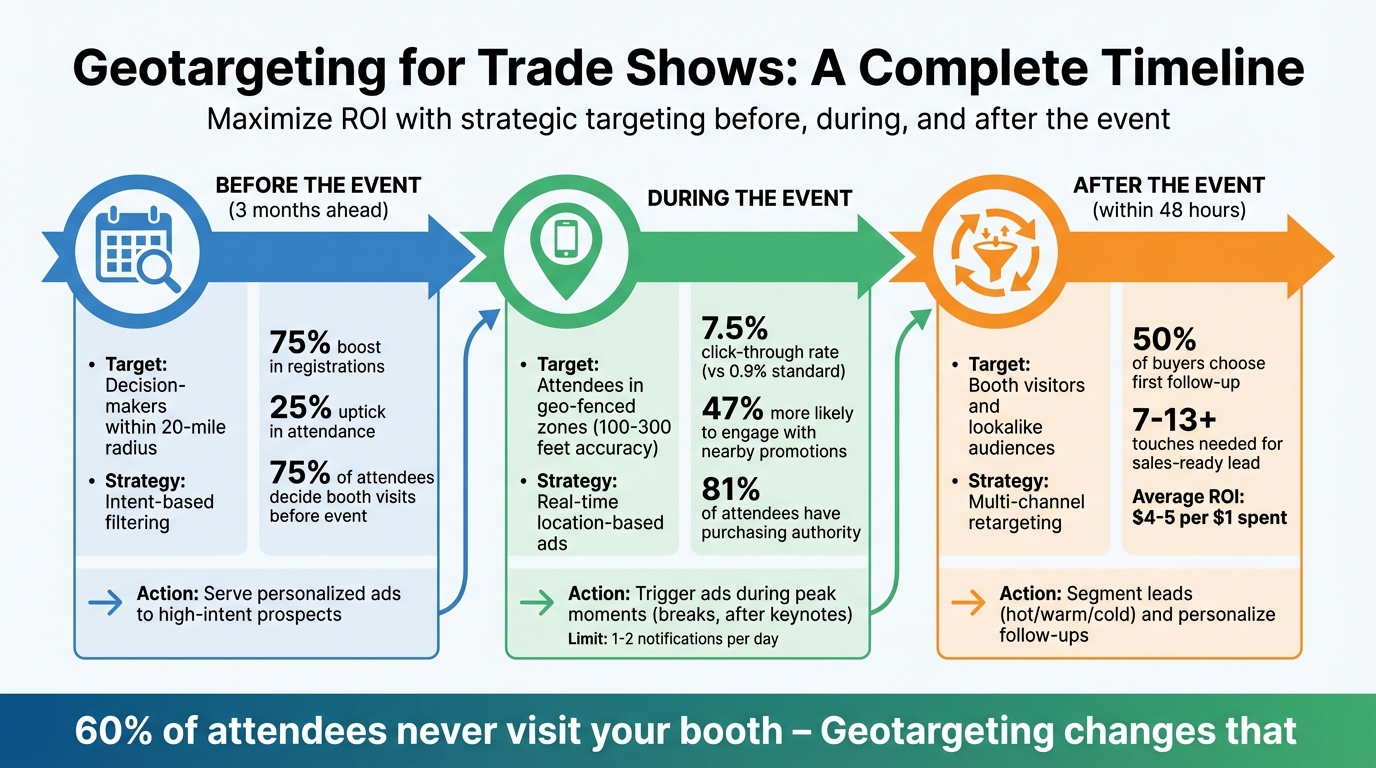
Geotargeting Strategy Timeline for Trade Shows: Before, During, and After Event
How to Geofence Trade Shows and Other Events for Facebook Ads
sbb-itb-cef5bf6
1. Target Attendees Before the Event with Intent-Based Filtering
Intent-based filtering is a method that identifies potential attendees by analyzing their online behavior and search patterns. It helps pinpoint professionals actively researching solutions similar to yours. By tracking search habits, content downloads, and social media activity, you can identify prospects and serve them targeted ads at least three months in advance.
This approach is crucial for effective geotargeting, ensuring your pre-event ads are seen by those most likely to engage.
Since many attendees finalize their event plans early, reaching them ahead of time is critical. Combining intent data with firmographic filters - like job titles, company size, and industry - helps you focus on decision-makers rather than casting a wide, unfocused net. For example, you could target CIOs or IT directors who have recently interacted with related content. Use these insights right away to craft personalized outreach campaigns before the event.
"You can use [intent data] to find the right audience for your events. If you have a big event coming up and you want to know who's interested, that's a way to use Intent that people might not think about."
- Erin Scheller, Sr. Director of Demand and Revenue Marketing, Bombora
Focus your efforts on prospects within a 20-mile radius of the event location who demonstrate high intent scores. Pay attention to event-specific hashtags and engagement with industry-related ads on platforms like LinkedIn and Facebook. Use this data to personalize your outreach - invite them to schedule demos ahead of time or mention topics they’ve been researching. When done right, leveraging intent data for event promotion can result in a 75% boost in registrations and a 25% uptick in attendance, making it one of the most impactful strategies for pre-event marketing.
2. Serve Real-Time Ads During the Event with Geo-Fenced Zones
Geo-fencing uses GPS, Wi-Fi, or RFID technology to create a virtual boundary around your trade show venue. Once an attendee's device enters this perimeter, your ads are instantly delivered through mobile apps, browsers, or push notifications, offering a direct channel to connect with event-goers.
Instead of casting a wide net, focus on targeting specific areas within the venue. Use building contours to pinpoint zones like individual exhibition halls or even competitor booths. For example, you could send a message like, "Looking for an alternative? Visit us at Booth #678!" to attendees near a rival's location. This level of precision is possible because geo-fencing technology typically has an accuracy range of 100–300 feet.
Timing your ads is just as important as their placement. Peak moments - like coffee breaks, lunch hours, or right after keynote sessions - are ideal since attendees are more likely to check their phones. For instance, triggering ads immediately after a major keynote can help you reach an audience that's energized and ready to explore. Geo-fenced campaigns often outperform standard digital ads, with click-through rates as high as 7.5%, compared to the 0.9% average for typical Facebook ads.
Make sure your ad creative encourages immediate action. Include clear details like your booth number and time-sensitive offers. For example, an ad saying, "Stop by Booth #117 in the next 30 minutes for a free demo and gift!" can drive traffic effectively. In fact, 47% of consumers are more likely to engage with businesses offering nearby promotions.
Don’t limit your geo-fencing to just the venue. Expand the perimeter to include nearby hotels, airports, or popular dining spots to catch attendees during their downtime. To avoid overwhelming users, keep notifications to a maximum of 1–2 per day.
3. Use Precision Targeting to Reach Decision-Makers
Trade shows are a goldmine for connecting with decision-makers. In fact, 81% of attendees hold purchasing authority, and 92% attend these events to explore new products and services. The real challenge? Making sure your message reaches the right people - the ones who have the power to sign contracts.
Geofencing is a good starting point, as it captures device signals from everyone at the event. But to focus on high-value prospects, you need to go further. By combining geofencing with firmographic filters and identity resolution, you can zero in on decision-makers like VPs or C-suite executives in large tech firms. This way, your ad spend is directed toward the people who can actually impact your bottom line.
Identity resolution tools take it up a notch by linking anonymous device data from your geofence to enriched contact records. This means you can create a detailed list of on-site decision-makers, giving your sales team a clear priority list for follow-ups. With this enriched data, you can refine your targeting even more by focusing on specific areas where decision-makers are likely to gather.
Instead of casting a wide net over the entire venue, set up smaller geofences in strategic zones. Think VIP lounges, executive sessions, or even competitor booths. This approach ensures your ads are seen by the decision-makers actively seeking solutions, not just by general attendees.
"Geofencing captures intent signals that traditional ABM can't see. Then, ABM turns those signals into coordinated sales and marketing action." - Propensity
Timing is also key. Schedule your ads during high-traffic times, like morning coffee breaks, lunch, or when attendees are back at their hotels. These are prime moments to grab the attention of decision-makers.
4. Create Booth-Specific Offers and Promotions
Booth-specific promotions combined with geotargeting can turn digital interactions into physical visits. With 75% of attendees deciding on their booth stops before the event even starts, there's a small but crucial window to capture the attention of those still undecided. The key? Timely, location-based offers that stand out.
Here’s how it works: craft exclusive, event-only deals that attendees can only claim by visiting your booth. Think flash sales, live product demonstrations, or giveaways that require them to show your ad at the booth. For instance, you might create an ad that says, "Show this message at Booth #247 for a free consultation" or "Stop by Booth #247 within the next hour for 20% off." These incentives give attendees a clear reason to leave the digital space and visit your booth in person.
Timing is everything. Schedule these ads during high-traffic moments - like coffee breaks, lunch hours, or right after major keynotes. But don’t overdo it; limit yourself to one or two notifications per day to avoid overwhelming attendees. Also, make sure your booth number is front and center in your ad design - nobody wants to waste time searching for your location.
"A well-placed geofencing ad that offers attendees a freebie or exclusive experience can send foot traffic your way." - Results Repeat
Another smart move? Set up geofences around competitor booths. This allows you to serve ads to attendees who are already exploring similar products. A timely offer, like a better deal or a unique feature, could convince them to pivot and check out your booth instead. Not only does this strategy boost immediate traffic, but it also lays the groundwork for meaningful connections after the event.
5. Retarget Attendees After the Event Ends
Just because the trade show is over doesn’t mean your work is done. The key is to act fast - launch retargeting efforts within 48 hours while your brand is still fresh in attendees' minds. This is critical, especially since half of buyers tend to go with the first follow-up they receive, yet fewer than 70% of exhibitors actually have a formal post-event plan in place.
Start by uploading your booth visitor list to platforms like Facebook, LinkedIn, or Google Ads for list-based retargeting. Another smart move? Use tracking pixels on your QR code or event landing pages. Why? Because up to 97% of visitors leave your page without converting.
Here’s a real-world example: A precision plastics manufacturer in Ohio used this strategy during an industry expo in June 2025. They directed 42 booth visitors to a pixel-tagged landing page and launched retargeting ads on LinkedIn and YouTube within 24 hours. The result? 19 additional engagements, 11 exploratory calls, and 3 major contracts that added up to a $900,000 sales pipeline.
To maximize your efforts, segment your leads:
- Hot leads: Follow up with immediate phone calls.
- Warm leads: Send personalized emails.
- Cold leads: Invite them to a post-show webinar.
Make your ads memorable. Include visuals like a photo of your actual booth to help attendees recall your brand amidst the sea of exhibitors they encountered. These tailored follow-ups help transform fleeting trade show encounters into meaningful, long-term relationships.
"Retargeting ads are meant to keep your brand on the top of mind, so an ambiguous ad will not ring the bells in your potential attendees' mind." – Kerri Moore, Senior Content Marketing Manager, Bizzabo
Consistency is key. Keep your post-event messaging clear and branded. Combine retargeted display ads with personalized emails and even LinkedIn outreach. Remember, it often takes 7 to 13+ touches to turn a lead into a sales-ready prospect. Mention the trade show by name in your follow-ups, and personalize them further by having the outreach come from a specific sales rep, complete with their photo and direct contact information.
6. Expand Reach with Lookalike Audience Targeting
Once you've gathered valuable attendee data, you can take your campaign further by reaching beyond those who stopped by your booth. Lookalike audiences help you find online users who share similar characteristics and behaviors with your top customers. This means you’re not just targeting booth visitors - you’re connecting with thousands of prospects who closely align with your ideal customer profile. Combined with retargeting, lookalike audience targeting significantly broadens your reach.
To get started, focus on creating a high-quality seed audience. This involves filtering your CRM data to include only high-value clients or past attendees who showed strong engagement. Keep in mind that platforms like Facebook typically require a minimum of 1,000 people in your seed audience to build an effective lookalike group. To meet this threshold, consider pulling data from tools like HubSpot, Salesforce, website analytics, or even attendee lists from previous webinars.
"Think of it like this: garbage in, garbage out. If your seed audience isn't representative of your ideal customer profile (ICP), your lookalike audience will be off too." – Deepak Gupta, Co-founder/CEO, Gracker
For B2B trade shows, take it a step further by layering lookalike targeting with firmographic filters - like job titles (e.g., C-suite executives, VPs), company size, or industry type. You can also experiment with different lookalike audience sizes. A 1% similarity audience offers more precision, while a 5% audience provides a broader reach.
Use these lookalike audiences to build awareness before your event, targeting them in the weeks leading up to the show. After the event, continue engaging these audiences to maintain your brand’s visibility. This strategy not only extends your campaign’s lifespan but also ensures your brand stays top of mind long after the event wraps up.
7. Measure Performance with Key Metrics
Tracking your geotargeting campaigns is essential. Without it, you could be wasting money and missing out on critical insights. The right metrics help you determine if your ads reached the right audience, brought them to your booth, and delivered qualified leads.
Start by focusing on advertising engagement metrics like impressions, reach, and click-through rates (CTR). For example, geofenced audiences often achieve CTRs as high as 7.5%, compared to just 0.9% for standard Facebook ads. To measure booth traffic, you can use tools like QR code scans, badge scanners, or even Wi-Fi signals. Additionally, identity resolution tools that connect anonymous device IDs to real contact records are becoming increasingly valuable for precise measurement.
Once you've engaged attendees through geotargeting, measuring performance is critical for improving your strategy. Keep an eye on conversion rates, such as lead-to-MQL (25%–35%) and MQL-to-SQL (13%–26%). To calculate your cost per lead (CPL), divide your total event spend by the number of qualified leads - typically averaging around $840. If your CPL is much higher, it might be time to adjust your targeting filters or shrink your geofence radius.
Finally, assess the overall impact by tracking metrics like event-sourced pipeline value and ROI. On average, companies generate $4 in revenue for every $1 spent on trade shows, with top performers aiming for $5 per $1. Use custom tracking links and dedicated landing pages for your geotargeted ads to tie conversions back to specific campaigns. This data will guide your future campaigns, showing you which zones, ad formats, and targeting strategies deliver the best results.
8. Optimize Ad Creative for Mobile Devices
When targeting trade show attendees, making your ad creative stand out on mobile devices is non-negotiable. Why? Because most people will see your geotargeted ads on their smartphones, and mobile users decide whether to engage with an ad in just two seconds. That means your creative has to grab attention immediately.
Start with concise ad copy - five words or fewer can increase visitation rates by 67%. Pair this with high-quality visuals, as images can be processed in as little as 13 milliseconds. For example, instead of a generic message like "Visit our booth to learn about our innovative solutions", go for something punchier like "Booth 312 - Free Demo."
Adding subtle GIF animations can further boost engagement. These animations improve click-through rates by 25% and visitation rates by 44%, without the slow load times of full videos. For trade shows, consider using a dynamic distance overlay to show how close attendees are to your booth. A simple message like "Our booth is just 500 feet away" can increase visitation rates by 53%.
Your call-to-action (CTA) should feel natural for mobile users. Swap "Click Here" for "Tap Here" or "Discover". Including a "buy now" CTA can also improve visitation performance by 51%. And don’t forget to make your booth number prominent and easy to spot - attendees shouldn’t have to search for it in tiny print.
Finally, design your ads for vertical viewing. Use common mobile banner sizes like 300x50 or 320x50 pixels, high-contrast colors, and large fonts. Keep file sizes small to avoid delays and ensure smooth performance. This combination of clear messaging, sharp visuals, and mobile-friendly formatting ensures your ad stands out on even the smallest screens.
Conclusion
Geotargeting opens the door to new opportunities at trade shows, helping businesses connect with the 60% of potential leads who might otherwise never visit their booth. By combining pre-event campaigns, real-time geo-fenced ads, and post-event retargeting, companies can create an engagement strategy that goes far beyond the show floor.
The numbers speak for themselves: geofenced campaigns can achieve click-through rates (CTR) as high as 7.5%. In 2023, HawkSEM demonstrated the power of geotargeting by driving a 588% increase in form submissions for Nava Health through data-focused campaigns. As Sam Yadegar, Co-founder and CEO of HawkSEM, explained:
"By utilizing geotargeting campaigns, HawkSEM's digital marketing strategies, and ConversionIQ, we were able to garner a whopping 588% more form submissions for Nava Health".
These results highlight the importance of technical expertise. Success in geotargeting requires precise execution, from setting up virtual boundaries to managing identity resolution, while also ensuring compliance with GDPR and CCPA regulations. Partnering with professional digital marketing agencies can simplify this process, as they handle crucial tasks like A/B testing, real-time optimizations, and data refinement to turn anonymous impressions into actionable leads.
If you're ready to implement these strategies, SEO Werkz offers tailored digital marketing services, including paid search, retargeting, and custom campaigns, to help turn trade show attendees into qualified leads.
FAQs
What budget do I need for trade show geotargeting?
When it comes to trade show geotargeting, there’s no one-size-fits-all price tag. Costs can vary widely depending on factors like the size of the event, the geographic range you’re targeting, and the specific tools or platforms you choose to use.
To keep things organized, it’s smart to roll geotargeting expenses into your overall trade show marketing budget. For some, this might mean spending a few hundred dollars, while others could allocate several thousand. If you’re looking for a more accurate estimate tailored to your needs, it’s worth consulting a digital marketing professional with experience in geofencing and location-based advertising.
How do I track booth visits from geofenced ads?
Tracking booth visits through geofenced ads involves using location-based marketing tools to define virtual boundaries around your event space. When attendees' mobile devices cross into this geofenced zone, these tools can tag the devices, allowing for real-time ad targeting and engagement.
To take it a step further, foot traffic tracking technologies can measure how many tagged devices actually entered your booth. This approach gives you a clearer picture of your campaigns' performance, offering more precise insights than traditional methods like badge scans.
How can I run geotargeting and stay GDPR/CCPA compliant?
When running geotargeting campaigns, staying compliant with GDPR and CCPA regulations requires careful attention to user privacy. Start by obtaining clear, informed consent before collecting or using location data. Be upfront about how you plan to use this data and ensure users fully understand your practices.
It's equally important to prioritize data security. Protect any collected information against unauthorized access. Additionally, always provide users with an opt-out option for location tracking, giving them control over their data.
If you're using tools like GPS or IP-based geolocation, handle them responsibly. Incorporate privacy notices that clearly explain your geotargeting methods and ensure all practices align with legal requirements. Transparency and respect for user privacy are key to maintaining compliance.