Ultimate Guide to Content Marketing for Financial Advisors
March 4, 2026Content marketing helps financial advisors attract clients by building trust and showcasing expertise. It’s not about selling - it's about educating and addressing specific financial challenges. Here’s what works:
- Targeted Content: Focus on niche topics like tax strategies for stock options or retirement planning for business owners.
- Content Formats: Use blog posts, webinars, and short videos to educate and engage.
- Consistency: Create a 90-day content calendar that aligns with financial seasons (e.g., tax planning in January).
- SEO: Optimize for search engines with specific, long-tail keywords like “retirement planning for dentists.”
- Distribution: Share content on LinkedIn, email, and platforms relevant to your audience.
Key Stats:
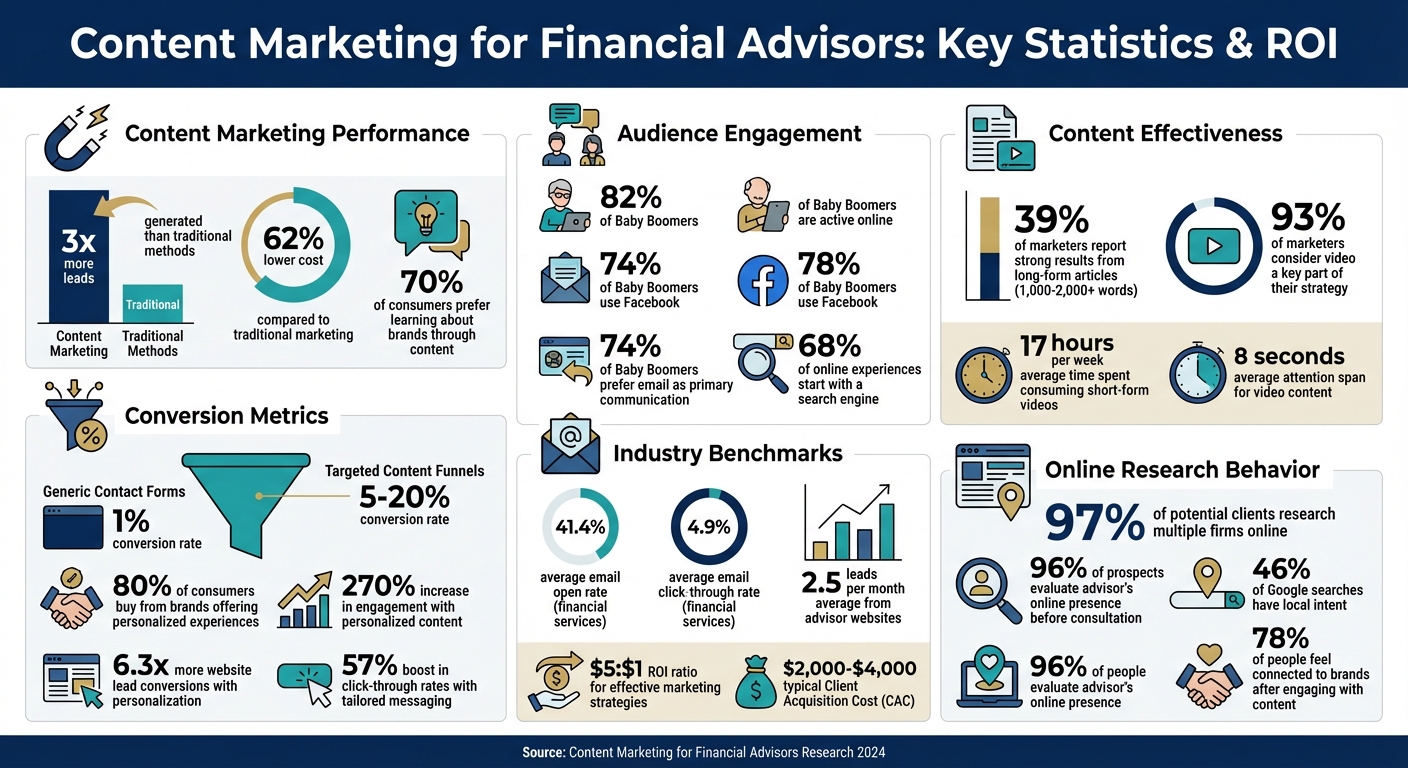
- Content marketing generates 3x more leads than traditional methods at 62% lower cost.
- 70% of consumers prefer learning about brands through content.
- Baby Boomers (82%) and Millennials are active online, making digital content vital.
A well-planned strategy ensures your expertise reaches the right audience, turning prospects into loyal clients.
Content Marketing Statistics and ROI for Financial Advisors
Content Marketing for Financial Advisors: Part 1
sbb-itb-cef5bf6
Building Your Content Marketing Strategy
A content strategy isn't just about posting randomly - it’s about having a clear plan that aligns with your goals, targets the right audience, and delivers consistent value over time.
Start by setting measurable goals. Are you aiming to generate more qualified leads? Establish yourself as a go-to expert in your field? Or maybe build brand recognition in your community? Your goals will determine the type of content you create and how you gauge its success. For instance, a financial advisor focused on generating leads might prioritize gated content like white papers or webinars, while someone aiming for thought leadership might focus on in-depth articles or speaking engagements. This structured approach ensures your content consistently addresses your audience’s needs.
Effective content speaks directly to specific groups, not vague demographics. Instead of targeting "pre-retirees", narrow it down to groups like Fortune 500 employees handling stock options or tech executives managing liquidity events.
"Content stands out when it speaks to one particular group, not broad segments... these groups have unique financial questions, and your content becomes far more meaningful when you focus on topics they care about most." – Steven Cherucheril, Head of Marketing, Savvy Wealth
Identifying Your Niche and Target Audience
The secret to creating content that converts? Specificity. A 45-year-old executive worried about the tax implications of stock options has entirely different concerns than a 65-year-old focused on not outliving their savings. When you understand these unique challenges, you can craft content that feels personal - because it is.
Start by analyzing your current client base. What questions come up repeatedly in meetings? What problems have you solved successfully? These patterns can guide your content topics. For example, if you’ve helped multiple startup founders navigate liquidity events, that’s a clear signal to create content around that scenario.
Develop ideal client personas that go beyond basic demographics. Sure, include age, income, and location, but also dig deeper into their values, interests, and financial goals. The more detailed your personas, the easier it becomes to create content that truly resonates.
Once you’ve defined your target audience, the next step is to organize your content efforts for maximum impact.
Planning Your Content Calendar
Consistency is key. Publishing one quality blog post every week beats sporadic posting every time. A content calendar helps you stay organized, ensures you’re addressing client needs year-round, and builds in time for compliance reviews.
Start with a 90-day roadmap that outlines specific topics, formats, and publication dates. Align your content with seasonal financial events: tax planning in January, college savings in September, and charitable giving strategies in December.
Balance evergreen topics (like "Estate Planning Basics") with timely pieces that respond to current market trends or seasonal needs. A simple calendar might include columns for dates, titles, formats (blog, video, email), authors, distribution channels, status, and calls-to-action.
Maximize your efforts by repurposing content. For example, a single webinar can be transformed into a blog post, social media snippets, a newsletter highlight, and even a downloadable guide. Many advisors batch their content creation - dedicating one day a month to record multiple videos or write several articles - so they can focus on client work the rest of the time.
Don’t forget compliance. Build review steps into your process. Assign specific team members to approve drafts, create checklists for sensitive phrases, and allow enough lead time to avoid delays.
| Frequency | Format Type | Primary Goal |
|---|---|---|
| Weekly | Blog posts / Social snippets | Boost SEO and maintain engagement |
| Monthly | Webinars / Podcasts / Newsletters | Build authority and connect on a personal level |
| Quarterly | White papers / In-depth guides | Generate leads through gated content |
Since 68% of online experiences start with a search engine, your calendar should include SEO-optimized topics. Use tools to find the exact phrases your audience is searching for, like "How much do I need to retire at 60?" or "Should I pay off my mortgage early?".
Finally, make sure every piece of content includes a clear call-to-action. Whether it’s downloading a guide, booking a consultation, signing up for a webinar, or subscribing to your newsletter, give your audience a next step. Without it, even the best content won’t drive results.
Types of Content That Work for Financial Advisors
Choosing the right content formats is crucial for connecting with your audience and guiding them through their decision-making journey. For financial advisors, it's all about balancing educational value with engaging delivery. The goal? To inform rather than sell outright.
Successful advisors often mix various content types, each serving a unique purpose. Blog posts educate and enhance SEO. Lead magnets like webinars and whitepapers provide in-depth insights while capturing leads. Short-form videos humanize your brand and meet your audience where they already spend their time.
Here’s a closer look at the formats that work best:
Educational Blog Posts and Articles
Blog posts are the cornerstone of content strategies for financial advisors. They address specific questions prospects are searching for, showcase your expertise, and boost your website’s visibility. A well-written blog post can continue to attract qualified leads for years.
The most effective blog posts are detailed and focused. Instead of broad topics like "retirement planning", zero in on niche questions like "How to minimize taxes when selling a medical practice" or "Should I convert my 401(k) to a Roth IRA after a job change?" As Steven Cherucheril, Head of Marketing at Savvy, puts it:
"The goal is simple: answer the exact questions your ideal clients type into search engines. When you do, you create content that is precise, relevant, and built for the people you want to work with."
Long-form posts, typically 1,000 to 2,000+ words, tend to perform best. In fact, 39% of marketers who publish long-form articles report strong results. Structuring your posts using the Problem-Agitate-Solution framework can make them even more impactful. For example, highlight a financial challenge, explain the risks of ignoring it (e.g., hefty tax bills), and offer a clear solution.
Make your posts easy to read with short paragraphs, bullet points, and clear subheadings. Adding real-world examples or anonymized case studies helps simplify complex topics. For instance, instead of saying, "Estate planning is important for business owners", share a relatable story:
"When a manufacturing company owner passed away without a succession plan, his family faced a $2 million tax bill and had to sell the business within six months."
To optimize for search engines, explore Google’s "People Also Ask" section and use those questions as subheadings. This approach not only improves SEO but also brings in readers who are searching for specific answers.
Lead Magnets: Webinars and Whitepapers
While blog posts attract visitors, lead magnets turn them into prospects. Resources like whitepapers, eBooks, webinars, and checklists offer valuable insights in exchange for contact information. By gating these resources behind a form, you can build a list of potential leads.
Only about 1% of website visitors fill out generic contact forms, but targeted content funnels can achieve lead rates of 5% to 20%. Whitepapers and eBooks are ideal for diving into complex topics, while webinars create opportunities for real-time interaction. This format is particularly effective for older audiences, as 74% of Baby Boomers prefer email as their primary communication channel.
Interactive tools like retirement calculators or tax estimators also work well, offering personalized insights that engage prospects immediately. The key to a successful lead magnet is solving a specific problem for a clearly defined audience. For example, a whitepaper titled "Estate Planning Strategies for Business Owners with $5M+ in Assets" will resonate more than a generic guide.
Short-Form Video Content on YouTube Shorts and TikTok
Video content is no longer optional - it’s essential. 93% of marketers consider video a key part of their overall strategy. Platforms like YouTube Shorts and TikTok are especially effective because their algorithms promote content beyond your existing followers. On average, people spend 17 hours a week consuming short-form videos.
With attention spans as brief as 8 seconds, it’s crucial to grab viewers right away. Start with an engaging hook like, "Thinking about retiring early? Here’s the biggest mistake I see 50-year-olds make", and deliver actionable insights within 30 to 90 seconds.
"Short-form content has the potential to skyrocket your success online, helping you build trust with prospective clients across multiple platforms." – Laura DeGraff, Advisor Practice Management
Short videos let potential clients get a feel for your communication style and expertise before reaching out. This format is particularly appealing to Millennials and Gen Z, who often turn to platforms like TikTok to find advisors who understand their goals.
While professional production can enhance quality, authenticity is what really connects with viewers. Many advisors successfully use smartphones to film in natural settings. Repurpose these videos into blog posts, social media snippets, or email newsletters. Don’t forget to add captions - many viewers browse with the sound off, and captions ensure your message still lands effectively.
How to Distribute Your Content
Creating great content is just the first step - getting it in front of the right people is where the magic happens. Even the most insightful piece won’t make an impact without a solid distribution plan. For financial advisors, this means carefully choosing where and how to share their content to connect with their target audience effectively.
The best distribution strategies combine owned channels (like your website and email), earned channels (organic search and media coverage), and shared platforms (such as LinkedIn or other social media). Consistency is key here. In fact, 70% of consumers prefer learning about a brand through content rather than traditional ads. This highlights the importance of being visible to potential clients multiple times before they’re ready to engage. To make this happen, many advisors rely on tools like email marketing platforms and social media schedulers, which help maintain a steady presence without requiring constant manual effort.
But don’t spread yourself too thin - focus on where your audience spends time. For instance, if you work with retirees, prioritize email and Facebook, as 78% of Baby Boomers are active on Facebook. On the other hand, if your audience includes business owners, LinkedIn and search engine optimization (SEO) might be your go-to tools. The key is understanding your audience and tailoring your approach to meet them where they are.
Email Marketing for Content Distribution
When it comes to reaching your audience directly, email is hard to beat. Unlike social media, where algorithms can limit who sees your posts, emails land straight in your subscribers’ inboxes.
Start by building a strong, permission-based email list. One way to grow your list is by offering gated content on your website, like a free guide or checklist. This approach can significantly boost conversions - while only 1% of visitors typically fill out a standard contact form, a well-designed sales funnel can increase that number to 5%-20%.
Once you’ve built your list, nurture your subscribers with regular newsletters. Aim for an 80/20 split between educational and promotional content. For example, share blog posts, market updates, or quick financial tips while keeping the sales pitches to a minimum. Automated email sequences are especially helpful for new subscribers - set up a welcome series that introduces your expertise and delivers valuable content over time.
Take it a step further by segmenting your email list. Group subscribers based on their interests or life stages. Someone nearing retirement will need different advice than a young professional just starting out. Many email platforms allow you to tag subscribers and send targeted messages. Adding personal touches, like acknowledging milestones or financial achievements, can help build stronger connections.
Sharing Content on LinkedIn
LinkedIn is a goldmine for financial advisors, especially those targeting professionals, business owners, or high-net-worth individuals. Unlike casual platforms, LinkedIn users expect professional, educational content - perfect for showcasing your expertise.
Start by optimizing your LinkedIn profile. Use a professional photo, write a headline that clearly states who you help (e.g., "Helping Business Owners Plan for Retirement"), and include a detailed summary of your experience. Think of your profile as a landing page - make sure it includes a clear call-to-action, like a link to your website or a free resource.
When sharing content, don’t just post a link. Add a short introduction that highlights the key takeaway or asks a thought-provoking question. Native content, like text posts or videos uploaded directly to LinkedIn, often performs better than external links. You can also repurpose blog posts into LinkedIn articles or break them into shorter updates that focus on individual insights.
Engagement is just as important as posting. Take time to comment on others’ posts, join relevant groups, and answer questions from peers or prospects. By consistently contributing value to discussions, you’ll build trust and attract people who are genuinely interested in your services.
Optimizing Content for Search Engines
SEO is like having a 24/7 marketing assistant - it ensures your content works for you even when you’re not actively promoting it. For example, if someone searches “retirement planning for dentists” and finds your blog post, you’ve just connected with them at the perfect moment.
Start with keyword research using tools like Google Keyword Planner or Ubersuggest. Focus on specific, long-tail keywords like “how to minimize taxes when selling a medical practice” rather than broad terms like “financial advisor.” These targeted phrases often have less competition and attract users who are closer to making a decision.
Next, fine-tune your on-page SEO. Use concise, keyword-rich title tags (under 60 characters) and meta descriptions (under 160 characters). Structure your content with clear headings - H1 for the main title, H2 for sections, and H3 for subsections. Naturally weave your primary keyword into the opening paragraph, a few headers, and throughout the body without overloading it. Also, keep your URLs short and descriptive, like “yoursite.com/retirement-planning-dentists.”
Don’t overlook the technical side. Ensure your website is mobile-friendly, loads quickly, and uses HTTPS for security. Local SEO is also crucial - claim and optimize your Google Business Profile with accurate details like your address, hours, and client reviews. This makes it easier for people searching “financial advisor near me” to find you in local map results.
As Ryan Kemp, Chief Marketing Officer at ZuluShack Creative, wisely puts it:
"Content Without E-EAT Is Just Noise & No One Will See It Or Care About It."
E-EAT stands for Experience, Expertise, Authoritativeness, and Trustworthiness. Demonstrate these traits by showcasing your credentials, sharing client success stories (with permission), and linking to credible sources. Internal links between your pages also help guide both readers and search engines through your site.
Finally, with the rise of voice search, especially among older users, it’s worth optimizing for conversational queries. Incorporate question-based keywords like “Where can I find a retirement advisor in Cincinnati?” Adding FAQ sections to your posts can also increase your chances of appearing in Google’s featured snippets.
Personalizing Content and Measuring Results
Creating content that feels tailored to your audience - and tracking how it performs - can transform your business. When you align your messaging with your clients' needs and measure what works, you trade guesswork for a strategy that drives consistent growth.
Leveraging Client Data and CRM Systems
Your CRM is a goldmine for creating personalized content. By tapping into client data, you can craft messages that feel like they were made specifically for them. For instance, if your CRM indicates a client has tech stock options, you could share an article on ISO tax strategies with a personalized note: "This insight applies directly to your equity package." This approach matters - 80% of consumers are more likely to buy from brands that offer personalized experiences. Advisors who use personalized content report a 270% increase in engagement and 6.3 times more website lead conversions.
Start by segmenting your audience. Life stage and profession play a big role in tailoring your message. A tech professional managing stock options will need entirely different advice than a retiree focused on securing steady income. Using the right tone and language for each group can make a significant difference - advisors have seen a 57% boost in click-through rates by taking this approach. Automated email sequences can also help nurture prospects over time.
"Personalized content relies on personal data to create and/or curate highly relevant information for the end-user."
– Joel Goobich, Head of Sales & Marketing at Vestorly Inc.
By addressing specific client concerns - like ISO tax implications or the fear of outliving savings - you build trust far more effectively than with generic updates.
Monitoring Lead Generation and Engagement Metrics
Once you've personalized your content using CRM insights, it’s time to measure its effectiveness. Focus on metrics that reveal real progress, like lead magnet downloads, email sign-ups, and booked consultations, rather than vanity stats. These numbers show whether your content is successfully moving prospects closer to becoming clients.
Email performance is a great place to start. In the financial services industry, the average open rate is 41.4%, with a click-through rate of 4.9%. If your results are falling short, experiment with new subject lines or refine your audience segmentation. On your website, track actions like form submissions and consultation bookings - on average, advisors generate 2.5 leads per month from their site. For social media, prioritize engagement rates over follower counts: LinkedIn averages 1.28%, Instagram 1.68%, and Facebook 0.86%.
ROI is the ultimate measure of success. A solid marketing strategy should yield $5 in sales for every $1 spent - a 5:1 ratio. Keep an eye on your Client Acquisition Cost (CAC), which typically ranges from $2,000 for newer advisors to over $4,000 for established firms. Compare this to the lifetime value of clients gained through your content. Your CRM can help you identify which pieces of content - like a blog post followed by a webinar - are driving the most conversions.
Working with SEO Werkz for Content Marketing
Building a successful content marketing strategy requires expertise, a deep understanding of regulations, and scalable systems. For financial advisors aiming to strengthen their online presence, teaming up with a digital marketing agency like SEO Werkz can make a big difference. Here's how SEO Werkz puts its strategies into action through a range of comprehensive services.
Complete Content Marketing Solutions
SEO Werkz offers customized content marketing services that include strategy development, content creation, SEO, and distribution. Their offerings span blog articles, social media posts, eBooks, and even webinar scripts.
What sets them apart is their strict adherence to regulatory standards. They ensure that every piece of content complies with FINRA and SEC regulations, including all necessary disclosures. This attention to compliance is crucial, especially since 80% of financial advisors lack a well-defined marketing strategy.
Their approach includes creating pillar pages and cluster content models to establish authority on specific topics. For example, they might build a detailed pillar page on retirement planning, supported by blog posts covering related subjects like Social Security timing, Roth conversions, and Medicare planning. This type of structure improves search visibility, which is critical when 97% of potential clients research multiple firms online and 96% evaluate an advisor's online presence before scheduling a consultation.
SEO Werkz also focuses on local SEO by optimizing Google Business Profiles and crafting local landing pages to capture "near me" searches. With 46% of Google searches carrying local intent, this strategy helps financial advisors connect with nearby prospects.
Beyond content marketing, they provide services like paid search (PPC), retargeting, reputation management, and social media marketing. These offerings work together to create a robust digital presence, turning online visibility into booked consultations and new client relationships. By integrating these solutions, SEO Werkz ensures measurable results for your marketing efforts.
Conclusion
Content marketing plays a crucial role for financial advisors by building trust even before a prospect picks up the phone. In fact, 78% of people say they feel a connection with a brand after engaging with its content. By consistently offering valuable information through blog posts, videos, and lead magnets, you position yourself as a reliable authority in your field.
The secret to success lies in consistency and focus. As Dan Biagini, Chief Distribution Officer at Foundations Investment Advisors, wisely notes:
"The worst thing an advisor can do is send out good content for a few weeks or months, then discontinue it".
To achieve long-term success, it’s important to have a clear, targeted content strategy. Instead of chasing vanity metrics, prioritize conversion-focused goals like growing your email list and driving consultations.
If juggling content creation while serving clients feels like too much, professional help might be the answer. SEO Werkz offers end-to-end support, from research and content creation to compliance management. They ensure your content aligns with FINRA and SEC regulations while boosting your online visibility and turning prospects into loyal clients. Let them handle the heavy lifting so you can focus on what you do best - helping your clients.
FAQs
How do I pick a profitable niche for my content?
To pick a niche that brings in profits, start by pinpointing the unique needs of your target audience and matching them with your own skills or knowledge. Zero in on a specific group - like pre-retirees or business owners - and focus on delivering content that directly addresses their challenges. When you position yourself as an expert in this area and customize your approach to serve their needs, you’ll not only draw in the right audience but also earn their trust along the way.
What should I publish in my first 90 days?
In your first 90 days, focus on laying the groundwork with content that establishes trust and highlights your expertise. Begin by creating a content calendar to keep your efforts organized and consistent. Share meaningful content like market updates, retirement planning advice, or educational pieces that resonate with your audience. Mix up your formats - consider blogs, videos, and webinars - to keep things engaging and cater to different preferences.
Track how your content performs and adjust your approach based on audience feedback. This will help ensure your efforts stay relevant and impactful.
How can I track which content attracts new clients?
Financial advisors aiming to track which content brings in new clients can leverage tools like Google Analytics. This platform helps monitor visitor behavior and enables conversion tracking for specific actions, such as form submissions or appointment bookings.
To pinpoint the source of inquiries, consider using methods like unique landing pages, call-to-action links, or UTM parameters. These techniques make it easier to connect client inquiries to the exact content that prompted them.
Additionally, keep an eye on metrics like time spent on a page and lead conversion rates. Regularly analyzing these numbers will help you fine-tune your approach and double down on the content that performs best.