10 Best Segmentation Tools for 2026
April 2, 2026In 2026, successful marketing depends on AI-powered segmentation tools that use real-time data and predictive analytics to personalize campaigns. These tools help businesses identify customer behaviors like churn risk, purchase likelihood, and engagement patterns, leading to higher conversion rates and increased revenue. With third-party cookies gone, first-party data and machine learning are essential for creating dynamic, updated segments. Here's a quick look at the top tools:
- Insider One: Advanced behavioral predictions and real-time updates; best for large enterprises.
- Braze: Predictive models and real-time automation; ideal for mobile-first brands.
- Klaviyo: Ecommerce-focused with predictive customer metrics; great for small to mid-sized businesses.
- HubSpot Marketing Hub: Combines CRM with AI-powered segmentation; perfect for B2B teams.
- Salesforce Marketing Cloud: Enterprise-level AI tools with extensive integrations.
- ActiveCampaign: Flexible automation and predictive features; affordable for small businesses.
- Mixpanel: Action-driven segmentation and real-time analytics; strong for product teams.
- Amplitude: Predictive audiences and seamless integrations; favored by digital product teams.
- Saras Pulse: AI-driven retention and LTV predictions; tailored for eCommerce brands.
- Adestra: User-friendly automation and centralized customer data; good for email campaigns.
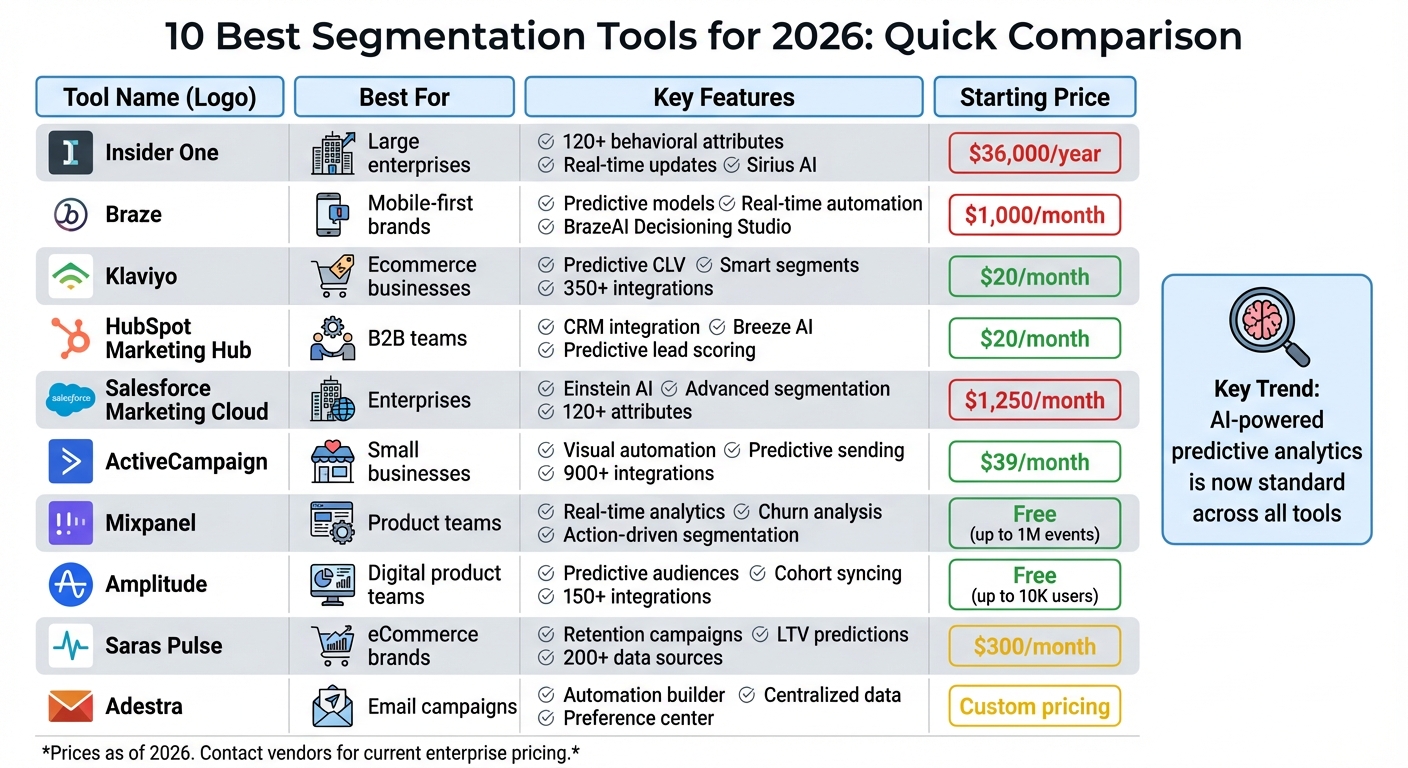
These tools vary in features, pricing, and scalability, catering to different business sizes and goals. Below is a quick comparison.
Quick Comparison
| Tool | Best For | Key Features | Starting Price |
|---|---|---|---|
| Insider One | Large enterprises | 120+ behavioral attributes, real-time updates | $36,000/year |
| Braze | Mobile-first brands | Predictive models, real-time automation | $1,000/month |
| Klaviyo | Ecommerce businesses | Predictive customer metrics, smart segments | $20/month |
| HubSpot Marketing Hub | B2B teams | CRM integration, predictive lead scoring | $20/month |
| Salesforce Marketing Cloud | Enterprises | Einstein AI, advanced segmentation | $1,250/month |
| ActiveCampaign | Small businesses | Visual automation, predictive sending | $39/month |
| Mixpanel | Product teams | Real-time analytics, churn analysis | Free (up to 1M events) |
| Amplitude | Digital product teams | Predictive audiences, cohort syncing | Free (up to 10K users) |
| Saras Pulse | eCommerce brands | Retention campaigns, LTV predictions | $300/month |
| Adestra | Email campaigns | Automation, centralized data | Custom pricing |
Choose the tool that aligns with your business size, customer data needs, and marketing goals for maximum impact.
Top 10 Segmentation Tools Comparison 2026: Features, Pricing & Best Use Cases
Supercharge Your Segmentation: HubSpot AI Tools in Action
sbb-itb-cef5bf6
1. Insider One
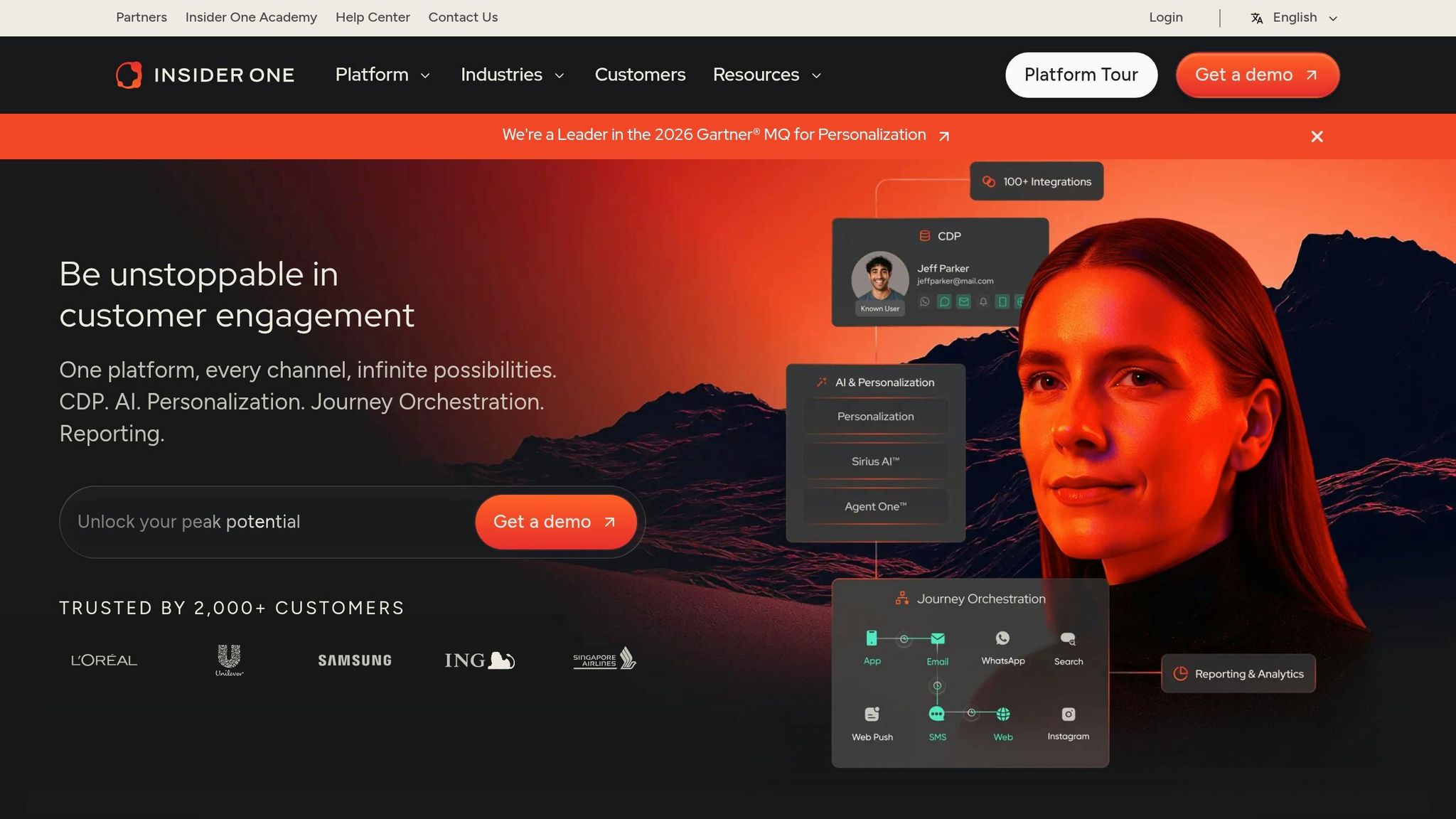
Insider One offers a powerful way to analyze customer behavior, processing over 120 behavioral attributes per user. This allows businesses to create highly detailed segments that go beyond basic demographics. It predicts factors like churn risk, purchase likelihood, lifetime value, and even more specific traits, such as discount sensitivity and preferred communication channels (email, SMS, or push notifications). With the introduction of Sirius AI in late 2025, the platform has taken segmentation to the next level by automatically generating segment descriptions and suggesting journey strategies. This reduces the time marketers spend on manual setup. Additionally, its predictive features work seamlessly with real-time segmentation, ensuring customer data stays up to date.
Segments are updated continuously, meaning membership is adjusted instantly, and messages are triggered across platforms like web, app, email, SMS, or WhatsApp. For example, if a customer abandons their cart or browses a specific product category, Insider One reacts immediately. A Digital Marketing Manager from a global department store highlighted its impact:
It enables tailored onsite experiences that resonate with individual customer interests.
Scalability for Businesses of All Sizes
Insider One is designed to handle enterprise-level operations, managing millions of user profiles across various regions without compromising performance. Pricing starts at $36,000 per year for mid-market plans, while enterprise solutions range from $100,000 to over $500,000 annually. The platform's capabilities have earned it recognition as a 2026 Gartner® Magic Quadrant™ Leader for Personalization Engines and the top spot in 11 categories in G2's Winter '26 reports.
Brands leveraging Insider One have reported impressive results, including a 259% boost in Average Order Value and an 18.8% increase in revenue per user after adopting its personalized recommendations. That said, the platform's deep segmentation features and robust capabilities come with a price tag and complexity that make it a better fit for large-scale businesses. As one analyst noted, while the 120+ attribute segmentation is a standout feature, it’s most valuable for companies with the resources and scale to maximize its potential. For smaller businesses or those just beginning to explore segmentation, the costs might outweigh the benefits.
2. Braze
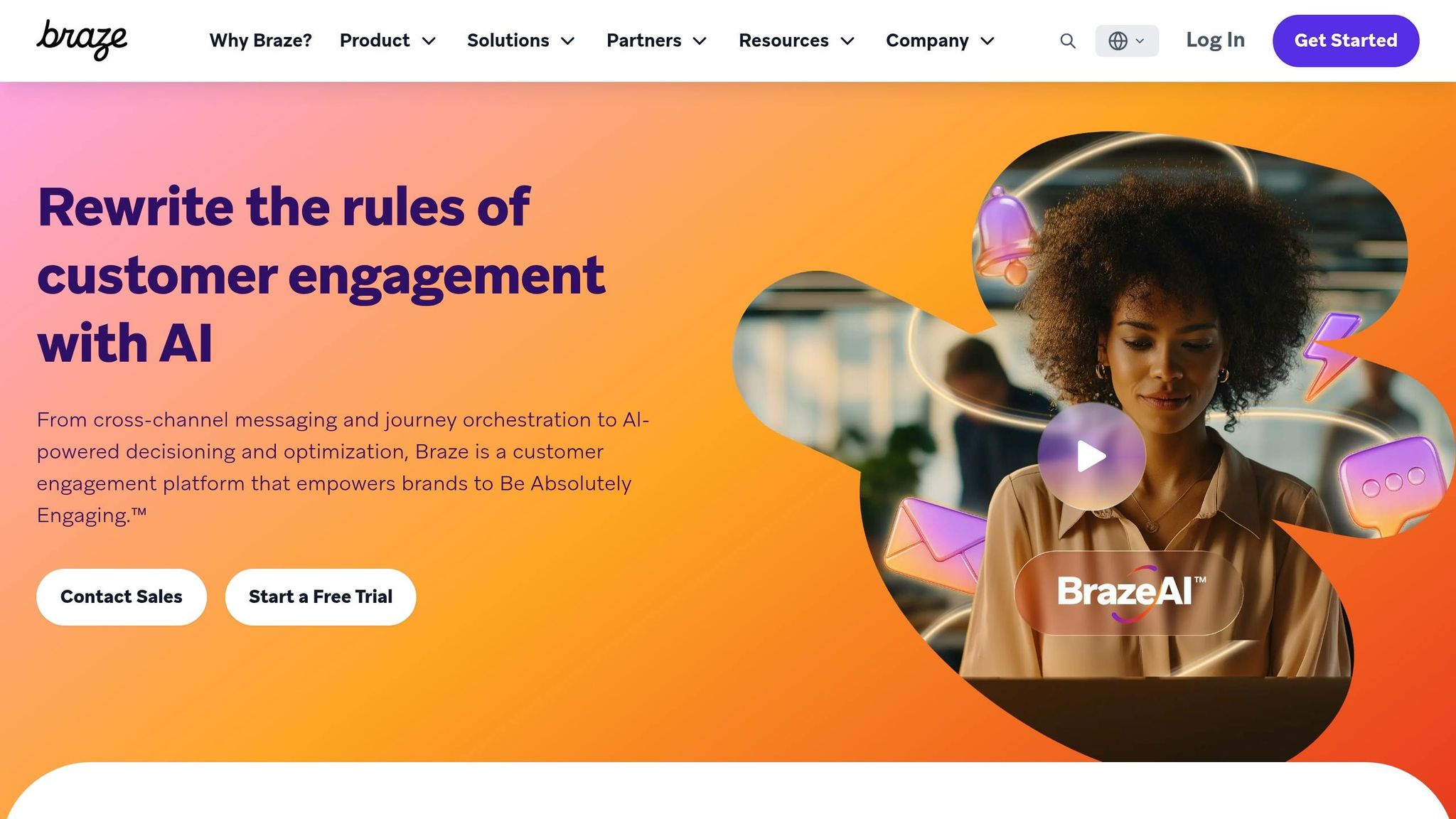
Braze equips marketers with its Predictive Suite, which includes three built-in models: Predictive Churn, Predictive Purchases, and Predictive Events. These models help forecast customer disengagement, buying intent, and specific actions like plan upgrades. The platform also features the BrazeAI Decisioning Studio, which uses reinforcement learning to optimize the channel, message, offer, timing, and frequency for each individual customer. This replaces static rules with insights derived from behavioral data. Let’s explore how Braze enhances segmentation through predictive insights, real-time automation, and seamless integrations.
Predictive Segmentation Capabilities
Braze's Intelligent Selection feature identifies the best-performing campaign variants for different sub-groups within a segment and dynamically adjusts traffic to favor the winning options. This AI-driven segmentation creates audiences based on real behavior and intent signals rather than relying on static rules. The results speak for themselves: AI-segmented campaigns have shown revenue increases of 20-40% per recipient compared to generic campaigns. For instance, Wyze experienced a 56% boost in conversions for its Cam Plus subscription by leveraging behavioral segmentation during onboarding. These tools allow marketers to target highly specific micro-segments with precision, improving overall campaign effectiveness.
Real-Time Updates and Automation
Braze processes events in milliseconds, enabling instant messaging and real-time segment updates. Sarah Mitchell from ProPicked highlighted this capability:
Real-time data processing in milliseconds enables truly instantaneous triggered messaging at massive scale.
Showmax demonstrated the power of this approach, achieving a 204% increase in subscribers and a 12% improvement in win-back rates by using lifecycle segmentation with dynamic updates. The platform's Canvas Flow visual journey builder automates cross-channel orchestration, allowing marketers to use segments as entry points, decision nodes, and split paths within customer journeys. This ensures segmentation remains accurate and responsive as customer behavior evolves.
Integration with Marketing Tools
Braze integrates effortlessly with data warehouses like Snowflake, Azure, and Amazon via Cloud Data Ingestion (CDI), enabling marketers to query data directly without duplication. Its "Currents" feature streams real-time engagement data back to analytics tools for closed-loop reporting. Additionally, Braze connects to thousands of applications through Zapier, while its native Shopify integration supports real-time catalog syncing and pre-built cart abandonment templates. Through its Segment integration, Braze unifies data from 700+ sources into detailed customer profiles. These integrations provide a comprehensive view of customer interactions by consolidating data from multiple platforms.
Scalability for Businesses of Different Sizes
Braze supports over 7.2 billion monthly active users across 2,300+ brands worldwide. Pricing starts at $1,000 per month, with mid-market plans ranging between $50,000 and $80,000 annually, and enterprise-level solutions exceeding $150,000 per year. For startups, Braze offers a special program with discounted rates for qualifying early-stage companies. The platform received a 9.0/10 rating from ProPicked in March 2026. However, reviewers note that initial setup requires significant engineering resources, and the enterprise pricing can be steep.
3. Klaviyo
Klaviyo is at the forefront of using AI to shape personalized marketing strategies. Its AI tools calculate key customer metrics like predicted customer lifetime value (CLV), churn risk, and the expected date of the next order. These insights power "smart segments" such as "VIP at risk" or "winback ready", which trigger automated and personalized messages across email, SMS, and mobile push notifications. With its Segments AI feature, marketers can simply describe their target audience in plain English, and the platform will create complex, data-driven segments. Brands using these predictive segments have reported a 35% increase in revenue per email compared to traditional methods.
Predictive Segmentation Capabilities
Klaviyo handles an impressive 2.5 billion daily events while retaining event-level data indefinitely, enabling detailed segmentation based on years of customer behavior. This allows the platform to generate predictive traits like churn risk, CLV, total expected future orders, and average time between purchases for every customer. Ben Zettler, Founder of Zettler Digital, highlights its ecommerce-focused design:
Klaviyo's advantage is that it was built for ecommerce from day one. Every SKU, order, and signal feeds back into segmentation and personalization automatically.
This deep data processing ensures that brands can build precise and effective marketing campaigns.
Real-Time Updates and Automation
Klaviyo’s segments are constantly updated in real time, adapting to changes in customer behavior to keep messaging relevant. Automation triggers, or "flows", activate immediately based on predictive signals. For instance, the platform can send a retention offer when a customer's churn risk reaches a certain point. Its omnichannel campaign builder seamlessly coordinates email, SMS, push notifications, and WhatsApp, all on a unified dashboard with combined reporting. Brands transitioning to Klaviyo often see an average ROI of 48× after consolidating their marketing tools, according to the platform's data.
Integration with Marketing Tools
Klaviyo integrates with over 350 tools and offers flexible APIs to pull data from various sources. Native integrations with Shopify, WooCommerce, and BigCommerce enable detailed segmentation at the SKU level and product-based triggers. The platform also syncs segments directly with advertising platforms like Facebook and Google Ads, making it easy to create lookalike audiences, retarget existing customers, and exclude recent buyers from acquisition campaigns. Additionally, it connects with loyalty tools like Recharge and Rebuy, as well as helpdesk solutions, linking support tickets to customer profiles. Mike Tatum, Lifecycle Marketing Lead at Prismfly, explains:
When brands switch marketing automation platforms, the biggest gains usually come from better deliverability and smarter segmentation, not just flashy features.
These integrations make it easier to scale and optimize marketing efforts.
Scalability for Businesses of Different Sizes
Klaviyo offers a free tier for businesses with up to 250 contacts and 500 email sends per month, making it a great option for startups. The paid Email Plan starts at $20/month for 251–500 contacts, scaling up to $350/month for 20,000 contacts and $700/month for 50,000 contacts. All pricing tiers include access to predictive analytics and smart segments. Klaviyo has earned an impressive 4.6/5 rating on both G2 and Capterra, with users praising its ecommerce integrations and advanced segmentation tools. However, some reviewers mention a steep learning curve for new users and quickly rising costs as contact lists grow.
4. HubSpot Marketing Hub

HubSpot Marketing Hub combines CRM capabilities with AI-powered segmentation through its Breeze AI layer. This feature assigns engagement ratings - categorized as "High", "Medium", "Low", or "Unknown" - to audience segments before campaigns are launched. This allows marketers to tailor their strategies for less-engaged groups rather than applying a blanket approach. The platform’s predictive lead scoring evaluates hundreds of data points, such as firmographic details and behavioral patterns, to pinpoint which contacts are most likely to convert. According to HubSpot research, 78% of marketers rank subscriber segmentation as one of the most effective tactics for email campaigns.
Predictive Segmentation Capabilities
HubSpot's smart lists operate dynamically, using real-time data like website activity, email interactions, and form submissions to update contact lists automatically. These lists are refreshed hourly, ensuring segmentation remains accurate and relevant. The platform’s AI models predict metrics like open rates, click-through rates, and conversion probabilities, which can lead to a 35% increase in revenue per email. Sarah Chen, Marketing Tech Editor, highlights HubSpot's strengths:
HubSpot is the strongest choice for B2B teams that want segmentation powered by the full sales + marketing context.
Integration with Marketing Tools
HubSpot’s App Marketplace offers over 1,500 native integrations, enabling seamless data sharing across marketing tools. The platform directly connects with major advertising platforms like Google Ads, Facebook Ads, LinkedIn Ads, and Instagram Ads, allowing marketers to sync audiences for precise ad targeting. For ecommerce, integrations with Shopify and WooCommerce let users harness real-time product and behavioral data to refine segmentation. Cassie Wilson Clark from HubSpot explains:
CRM-native platforms like HubSpot's email marketing software offer the strongest advantage. They eliminate data syncing issues and reduce tool fatigue.
With its built-in CRM, HubSpot ensures sales and marketing data remain unified. This integration underscores the platform’s focus on dynamic segmentation and streamlined workflows - key features that set it apart in 2026.
Scalability for Businesses of Different Sizes
HubSpot's scalability is another standout feature, accommodating businesses with contact lists ranging from 500 to over 50,000 without the need for platform migration. The Free tier supports up to 1,000,000 contacts with basic forms and email tools, while the Starter tier starts at $20/month for 1,000 marketing contacts and includes basic automation. The Professional tier, priced at $890/month for 2,000 marketing contacts, offers advanced features like predictive lead scoring, smart content, A/B testing, and 300 active workflows. For larger enterprises, the Enterprise tier costs $3,600/month for 10,000 marketing contacts and includes custom behavioral events, multi-touch attribution, and 1,000 active workflows.
HubSpot’s "marketing contacts" model ensures businesses only pay for actively targeted contacts, while additional contacts can remain in the CRM for free. In 2026 testing, the platform scored 9.4/10 overall, with users praising its "best-in-class CRM + marketing integration" and "most intuitive visual workflow builder." However, some reviewers pointed out that the Professional and Enterprise tiers can become costly as contact lists expand.
5. Salesforce Marketing Cloud
Salesforce Marketing Cloud stands out as a tool that combines advanced AI capabilities with enterprise-level campaign management. Its Einstein AI technology is at the core, analyzing customer data to predict behaviors like purchase likelihood, churn risk, and engagement tendencies. Features like Einstein Engagement Scoring help marketers understand how likely customers are to open emails, click links, or convert. Meanwhile, Einstein Studio uses the Data Cloud to anticipate actions such as unsubscribes or purchases. For B2B teams, Einstein Lead Scoring dives into historical CRM data - examining factors like lead source, industry, and company size - to pinpoint the most promising prospects. According to Salesforce, 74% of marketers using AI report better segmentation outcomes.
Predictive Segmentation Capabilities
The platform’s Generative Segmentation feature allows users to create audience segments with simple natural language prompts, such as "Find users who interacted with recent launches but haven’t made a purchase." This eliminates the need for technical expertise or SQL queries. Additionally, Einstein Attribution evaluates how different marketing touchpoints contribute to conversions, helping teams fine-tune their strategies. With the ability to analyze over 120 behavioral attributes per user, Salesforce Marketing Cloud is particularly well-suited for enterprises managing extensive customer databases. These predictive tools enable real-time, data-driven adjustments to audience targeting.
Real-Time Updates and Automation
Salesforce also enables real-time audience updates through its Agentforce module, ensuring that smart lists automatically refresh based on behavioral triggers. However, the implementation process can be complex and typically requires significant IT support. Some users have noted a syncing delay of about 15 minutes when integrating with Pardot.
Integration with Marketing Tools
The platform’s Marketing Cloud Intelligence consolidates data from a wide variety of sources - advertising platforms, social media, email campaigns, and even offline interactions - into unified customer profiles. This Customer Data Platform (CDP) creates a single, unified view by combining data from websites, apps, loyalty programs, and connected devices. Salesforce has been recognized as a Leader in the Gartner Magic Quadrant for Multichannel Marketing Hubs for eight consecutive years as of 2025, and it has also held Leader status for Customer Data Platforms for two years.
Scalability for Businesses of Different Sizes
Salesforce Marketing Cloud is designed to handle large-scale operations, making it ideal for enterprises. Pricing begins at $1,250 per month for Marketing Cloud Engagement, $3,000 per month for Marketing Cloud Intelligence, and approximately $108,000 annually for Data Cloud for Marketing. Implementation costs can range from $10,000 to over $100,000, with setup taking several months. While the platform received a 7.7/10 rating on TrustRadius - earning high marks for its features (93% satisfaction) and value (89%) - its implementation rating was only 3.0/10 due to the technical expertise required. For smaller teams, the steep costs and technical demands might pose challenges.
6. ActiveCampaign
ActiveCampaign uses AI-powered predictive segmentation to help small and mid-sized businesses target their audiences more effectively. By analyzing past behaviors, demographics, and purchase history, it predicts which content will resonate with specific customer segments. This forward-thinking approach allows marketing teams to anticipate customer needs instead of reacting to them. Its AI-Suggested Segments feature identifies audience groups based on patterns in customer data, saving teams hours of manual work. For businesses looking for data-driven marketing solutions, this tool offers a powerful way to refine audience targeting.
Real-Time Updates and Automation
ActiveCampaign also shines when it comes to automation. Its visual automation builder is highly flexible, letting marketers create workflows based on almost any condition, from custom event data to predictive sending. The Goals feature speeds up the customer journey, cutting average nurture times by 30% to 40% by advancing contacts as soon as they convert, rather than waiting for set time intervals. The platform’s Active Intelligence system provides real-time tracking of site visits, link clicks, and custom events, enabling instant responses to user behavior. With over 950 pre-built automation recipes, teams can launch complex campaigns with minimal setup time.
Integration with Marketing Tools
ActiveCampaign integrates seamlessly with over 900 tools, including Salesforce, Shopify, WooCommerce, WordPress, Facebook, and Google Ads. This ensures that customer data flows smoothly across platforms, enabling the creation of unified customer profiles for better segmentation. The platform has earned a 4.5/5 rating from over 14,000 customer reviews and is ranked #2 in market presence on G2’s 2025 Marketing Automation Grid.
Scalability for Businesses of Different Sizes
Pricing is accessible, starting at $39/month for the Lite plan. The Plus plan, which includes AI-driven segmentation and personalized outreach, costs $79/month. For businesses managing 10,000 contacts, the Plus plan is priced at roughly $179/month - less than 20% of the cost of HubSpot's equivalent tier. All plans include a 14-day free trial and a 30-day results guarantee. While the platform’s advanced automation features may take some time to master, it’s designed to scale seamlessly, accommodating both small businesses and mid-market companies with more complex needs.
7. Mixpanel
Predictive Segmentation Capabilities
Mixpanel uses an action-driven method for segmentation, relying on AI to create groups based on user behaviors - like frequent visits to pricing pages or abandoning carts. Its Metric Trees help align these behaviors with specific business objectives.
The platform's Churn and Retention Analysis feature tracks user groups over time, identifying what keeps users engaged and spotting behaviors that might lead to churn. Drew Ashlock, Senior Product Manager, shared:
Mixpanel helps us enable our customers for success. What started as a need for simple marketing metrics turned into custom product metrics for more than 100 different stakeholders across the company.
These predictive tools are designed to facilitate timely, data-driven actions.
Real-Time Updates and Automation
Mixpanel provides real-time analytics through customizable dashboards and AI-powered workflows. These tools surface actionable insights instantly, eliminating the need for SQL expertise. Its funnel tracking feature pinpoints where users drop off in their journey, enabling businesses to launch re-engagement campaigns at the right time. Additionally, automated insights continuously highlight opportunities for segmentation and outreach.
Integration with Marketing Tools
Mixpanel integrates smoothly with various marketing tools. Warehouse Connectors allow data syncing from platforms like BigQuery, while connections with Segment and reverse ETL solutions ensure seamless data flow across systems. This interoperability eliminates data silos and enables behavioral insights to power actions in email platforms, ad networks, and CRM systems.
Scalability for Businesses of Different Sizes
Mixpanel caters to businesses of all sizes, offering a free tier that supports up to 1,000,000 monthly events and 10,000 session replays. The Growth plan starts at $20 per month, with an additional charge of $0.00028 per event beyond the first million. For enterprises managing billions of monthly events, the Enterprise tier offers unlimited events along with advanced features like governance tools, SOC 2 Type II and ISO 27001 compliance, and SSO/SAML integration. The platform also supports a thriving community of over 12,000 analytics professionals for peer collaboration.
8. Amplitude
Predictive Segmentation Capabilities
Amplitude leverages propensity models to forecast user behaviors like conversions, churn, or feature engagement. These models drive what the platform calls "Predictive Audiences", enabling marketers to focus on high-potential customers with personalized reminders or win back at-risk users through tailored campaigns. Once these dynamic segments are created, Amplitude seamlessly integrates them into marketing tools for immediate campaign execution.
Damien Delautier, Chief Product Officer at Groupe Canal+, highlighted the platform's impact:
I sold the philosophy internally for a new way to do product. … We quickly realized there is only one tool that works for this, and it's Amplitude.
Real-Time Updates and Automation
Amplitude's predictive segmentation is paired with real-time automation for swift action. Using AI-powered agents, the platform processes data instantly, monitoring user activity and streaming events to trigger actions in tools like Appcues or Sprig. This rapid data transfer ensures marketing campaigns can be activated without delay.
Integration with Marketing Tools
With connections to over 150 tools, Amplitude simplifies the process of syncing behavioral cohorts with email platforms, ad networks, and messaging systems. Its "Cohort Syncing" feature exports specific user groups - such as those who abandoned their cart but watched a demo - to platforms like Braze, Facebook Ads, or HubSpot for automated, highly-targeted campaigns. Additionally, Amplitude works seamlessly with major customer data platforms like Twilio Segment, mParticle, and Tealium, ensuring customer data is unified across the tech stack.
Madison Lukaczyk, Senior Manager of Business Intelligence, shared her perspective:
Amplitude allows us to really action our data. Going beyond just the insights, we're now able to engage users in ways that are most meaningful to them.
Scalability for Businesses of Different Sizes
Amplitude supports over 11,000 digital products across various industries, including retail and healthcare. For startups, the platform offers a free plan that tracks up to 10,000 users per month - no credit card required. For larger enterprises, Amplitude provides a compelling ROI of 217% over three years, with an average payback period of just six months. It's no surprise that Forrester recognized Amplitude as a "Leader" in Digital Analytics Solutions in its Q3 2025 report, awarding it top scores in 21 different criteria.
9. Saras Pulse
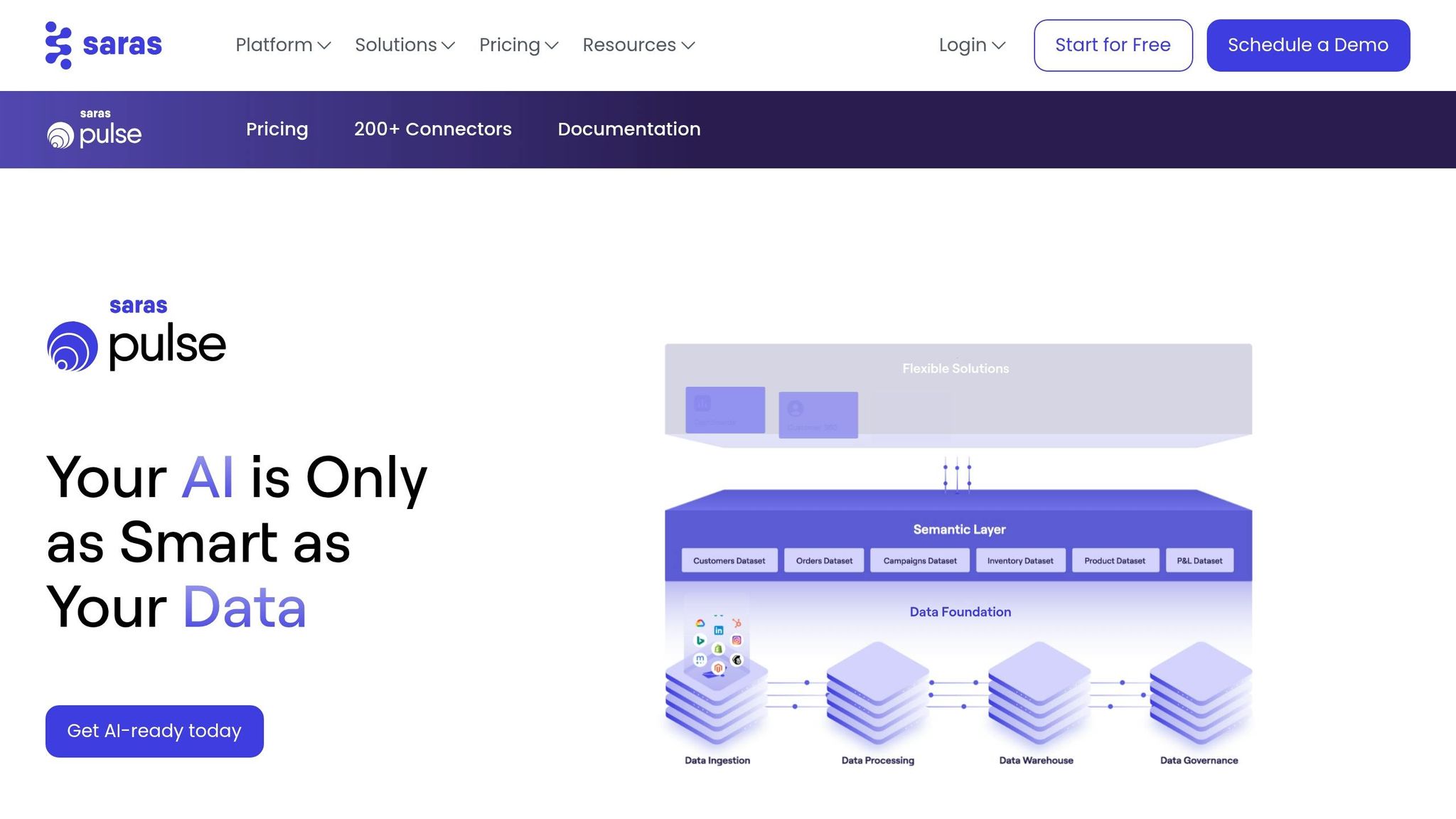
Predictive Segmentation Capabilities
Saras Pulse leverages AI and machine learning to predict customer lifetime value (LTV) and assess churn risk. This allows marketing teams to pinpoint high-value customers and identify those at risk of leaving, triggering automated retention campaigns to keep them engaged. Saras Analytics reports that using AI-driven segmentation can lead to a 25% increase in LTV, with companies seeing a 15% rise in sales compared to traditional segmentation methods.
In 2025, brands like HexClad (cookware) and Ridge (accessories) implemented Saras Pulse to move beyond static data analysis. By tapping into AI-powered insights and gaining daily updates on customer cohorts, these companies fine-tuned their strategies to better connect with high-value audiences. This predictive approach laid the groundwork for ongoing, dynamic segmentation, leading into the next evolution of customer engagement.
Real-Time Updates and Automation
Saras Pulse’s dynamic segmentation engine ensures that audience cohorts are updated in real time as new data flows in. Every customer interaction - whether it’s a click, purchase, or message - automatically updates segments through Saras Daton. With over 200 data sources integrated, this eliminates the need for manual exports or complex SQL queries.
This automation has proven highly effective for brands. For example, companies using Saras Pulse have cut Klaviyo data costs by 95% by centralizing their data within the Saras ecosystem. True Classic saved over 1,000 hours of manual work, while another brand using a Customer 360 strategy achieved a 12% re-purchase rate from previously churned customers.
Integration with Marketing Tools
As segmentation strategies evolved in 2026, Saras Pulse expanded its integrations to streamline data synchronization for marketers. With over 200 connectors, the platform centralizes data from tools like Shopify, Amazon, Klaviyo, Meta Ads, and Google Analytics 4. Saras Daton powers this process, running more than 10 million jobs daily to ensure smooth data flow across platforms. Its ELT engine syncs live data with CRMs, analytics tools, and ad platforms, creating a unified and efficient data ecosystem. Marketers can also use the platform’s no-code segment builder to quickly design and activate audience segments.
Scalability for Businesses of Different Sizes
Saras Pulse is designed to meet the needs of mid- to large-scale eCommerce and direct-to-consumer brands, offering flexible pricing to suit different business sizes. The Growth Plan starts at $300/month (or $250/month with annual billing) and includes all core features, over 200 integrations, and support for up to 10 users. For larger operations, the Enterprise Plan offers custom pricing, unlimited user access, advanced data support, and enterprise-level security features like encryption, role-based access, and PII masking.
10. Adestra
Automation and Behavioral Segmentation
Adestra's Automation Program Builder makes it easy for marketers to design customer journeys that react to user behaviors. For instance, you can set up automated welcome emails for new subscribers or create nurture campaigns triggered by specific actions, like downloading a resource or leaving items in a shopping cart.
It also features a preference center, where subscribers can choose how they want to hear from you. This helps maintain a clean contact list and minimizes widespread unsubscribes.
Centralized Customer Data
Adestra simplifies data management by offering a single customer view, pulling information from various systems through automated imports. With all customer data in one place, marketing teams can create better-targeted segments and run campaigns with greater accuracy.
Integration with Marketing Tools
Adestra's segmentation features are complemented by its ability to integrate with popular marketing platforms. It connects with Salesforce and Shopify, allowing teams to manage lists, launch campaigns, or trigger automated email sequences tied to store activity - all without leaving these platforms.
It also works with BlueConic for multi-channel orchestration in enterprise-level campaigns. Through its partnership with ONEcount, Adestra leverages unified data and AI to send personalized emails to specific audience segments at the best times. These integrations make Adestra a standout choice for marketers looking to optimize segmentation and automation efforts in 2026.
Wrapping It Up
When it comes to choosing a segmentation tool for 2026, the key is to match the platform to your specific business needs and goals. For e-commerce brands, tools like Klaviyo shine with their focus on purchase behavior and customer lifetime value predictions. On the other hand, B2B teams will benefit more from platforms like HubSpot, which excel in lead scoring and seamless CRM integration. If your company is mobile-first, real-time tools like Braze - offering instant push notifications and in-app messaging - are a perfect fit.
Why Predictive Analytics Matters
Predictive analytics has shifted from being a nice-to-have to an absolute must. These tools can pinpoint high-value customers and identify potential churners with incredible accuracy, fueling higher conversions and revenue. But the real game-changer? Combining predictive insights with real-time responsiveness.
The Power of Real-Time Segmentation
Today’s customers demand personalization based on their most recent actions - not what they did yesterday. That’s why batch segmentation, which updates overnight, is no longer sufficient. Platforms offering dynamic membership - where users move in and out of segments instantly - ensure your messaging stays relevant to what someone did just minutes ago.
Scalability Is Key
As your business grows, scalability becomes non-negotiable. Enterprise-level tools like Insider are built to handle millions of user profiles and hundreds of behavioral attributes per person. Smaller platforms, however, may struggle to keep up. If your customer data is scattered across multiple platforms, consider starting with a foundational tool like Segment before diving into activation platforms.
Match the Tool to Your Goals
Your primary objective should guide your choice. If retention is your focus, opt for platforms designed to boost customer loyalty. For acquisition-heavy strategies, tools like HubSpot offer a more comprehensive approach. And if your team lacks technical expertise, prioritize no-code platforms with visual builders to ensure smooth adoption.
Ultimately, the right segmentation tool transforms raw data into actionable decisions, enabling you to create campaigns that are hyper-personalized, scalable, and driven by both predictive and real-time insights. The future of segmentation is here - make sure your business is ready to embrace it.
FAQs
What data do I need for AI segmentation in 2026?
AI segmentation in 2026 thrives on analyzing data such as customer behavior patterns, real-time activity, engagement scores, and purchase history. These dynamic factors allow AI to pinpoint micro-segments, anticipate future actions, and adjust segment memberships automatically. To get the most out of this approach, prioritize gathering insights that can directly inform and refine segmentation strategies.
How do I choose the right tool for my business size?
Choosing the right segmentation tool hinges on factors like your business size, the amount of data you handle, and your specific objectives. If you're running a smaller business, look for platforms that are easy to use and offer automation to simplify processes. On the other hand, larger companies often need tools powered by AI to manage complex, unstructured data effectively. Think about whether you need features like real-time insights, in-depth behavioral analysis, or advanced segmentation capabilities. The tool you pick should match your growth ambitions and work seamlessly with your existing systems.
How do real-time segments work without cookies?
Real-time segments work without cookies by using AI-driven behavioral data, predictive analytics, and contextual signals. Instead of relying on stored cookie data, these tools group users dynamically based on their current actions and patterns.