Best Practices for Real-Time Cart Abandonment Recovery
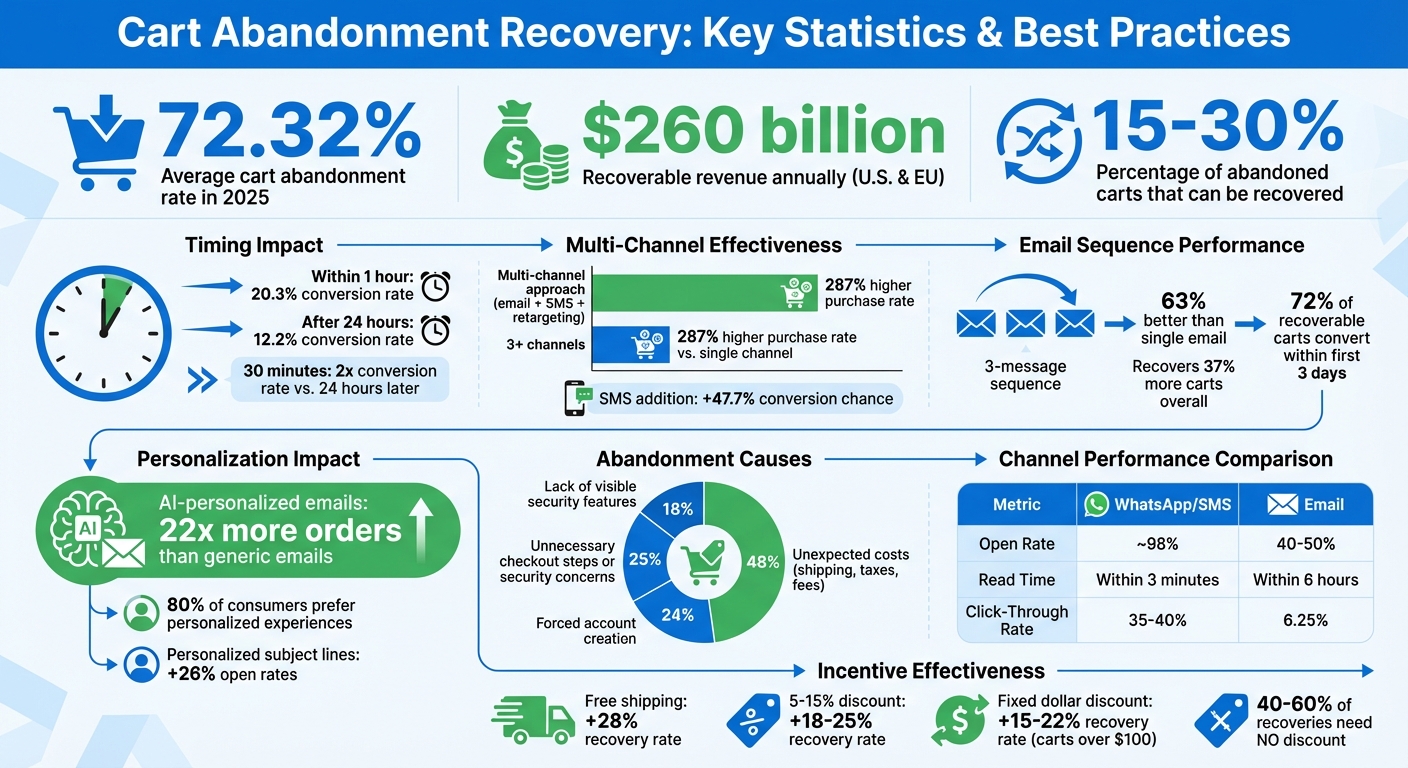
April 4, 2026Cart abandonment is a big challenge for online stores, with 72.32% of shoppers leaving without completing their purchases as of 2025. This results in $260 billion in recoverable revenue annually in the U.S. and EU. However, businesses can reclaim 15–30% of abandoned carts by acting quickly and using targeted strategies.
Key takeaways:
- Act fast: Recovery messages sent within 1 hour convert at 20.3%, compared to 12.2% after 24 hours.
- Personalize communication: Tailored emails using customer behavior data boost conversions by 22x compared to generic ones.
- Multi-channel approach: Combining email, SMS, and retargeting leads to a 287% higher purchase rate.
- Offer incentives wisely: Free shipping or discounts can increase recovery rates while protecting margins.
- Optimize checkout: Simplify the process to reduce the 25% of abandonments caused by unnecessary steps or security concerns.
Cart Abandonment Recovery Statistics and Best Practices 2025
Set Up Real-Time Tracking for Abandoned Carts
How Real-Time Tracking Works
Real-time tracking acts as a live dashboard, keeping tabs on how customers interact with your site. It tracks actions like viewing products, adding items to carts, calculating shipping costs, and even how long they linger on certain pages.
The system detects abandonment through behavioral cues. For example, it might flag someone moving their cursor toward the browser's close button, staying inactive on a checkout page too long, or switching tabs. Using exit-intent detection, algorithms pick up on these signals and can trigger immediate responses, such as a popup offering free shipping or a discount code.
"The attractiveness of using real-time technology in e-commerce lies in its ability to capture and analyze customer behaviors, preferences, and interactions across touchpoints as they occur."
- Michelle Krasniak, PubNub
Advanced systems even capture customer details, like email addresses, as they're entered into forms. Once abandonment is flagged, the system sends recovery messages - via email, SMS, or push notifications - while the customer’s intent to buy is still fresh. This kind of quick, personalized response can make a big difference in recovering lost sales.
Now, let’s dive into what features a tracking tool should have to make this process work effectively.
What to Look for in Tracking Tools
A reliable tracking tool should include session monitoring, instant cart data capture, behavioral triggers, and smooth marketing integration.
- Session monitoring gives you real-time insights into user activity, like movement across pages and inactivity.
- Cart data capture records details like items added, total cart value (often tracked in cents for accuracy), and product IDs.
- Behavioral triggers automate responses based on actions, such as a cursor nearing the close button.
- Marketing integration ensures the tool connects seamlessly with email, SMS, and social media platforms for multi-channel recovery efforts.
Some advanced tools even pick up subtle signals of hesitation, like highlighting text to compare prices, in addition to standard behaviors. They also distinguish between different types of abandonment: implicit abandonment (e.g., a session times out after 30 minutes of inactivity) and explicit abandonment (e.g., the user actively closes the tab or encounters an error).
Another must-have feature is cross-device syncing. With 80% of mobile shoppers abandoning their carts compared to under 70% on desktops, a system that tracks carts across phones, tablets, and desktops can help you reach customers wherever they are.
The best tools also include live activity feeds, showing every page view, product search, and cart addition as they happen. These feeds can send instant alerts for high-value carts at risk, giving your team a chance to step in with personalized support to save the sale.
sbb-itb-cef5bf6
The 8-Figure Cart Abandon Email Flow That Recovers 300% More Lost Sales (Klaviyo Email Marketing)
Time Your Recovery Messages Correctly
Using real-time data allows you to send recovery messages at the perfect moment - when customers are most likely to act. Timing is everything here. Emails sent within 60 minutes of cart abandonment boast conversion rates of 20.3%, compared to just 12.2% for those sent after 24 hours. That’s nearly double the success rate.
The first hour after abandonment is critical. During this time, customers still feel a sense of ownership over the items they’ve added to their cart. A well-timed, helpful nudge can make all the difference. For instance, recovery emails sent 30 minutes after abandonment convert at twice the rate of those sent 24 hours later. The focus should be on easing concerns and answering questions - not pushing for an immediate sale. Below, we’ll dive into the best timing strategy for recovery messages.
Best Timeframes for Sending Messages
The most effective approach? A three-message sequence spread across the first three days. This method outperforms single-email campaigns by 63% and recovers 37% more carts overall.
- First message (30–60 minutes): Keep it light and helpful. A message like, “Need help completing your order?” works better than a hard sell. This timing captures fresh intent while respecting the customer’s decision-making process. For SMS, sending within the first 30 minutes adds a personal touch, though waiting 2–4 hours can prevent it from feeling too immediate.
"Shorter is better for the first send. For low-AOV products, we've triggered in as little as 15 minutes. For higher-ticket items, it could be a few hours."
- Marina Carroll, Head of CRM Strategy, New Standard Co.
- Second message (18–22 hours): This timing aligns with when many shoppers check their inbox again, offering up to a 25% boost in conversions. Use this opportunity to include social proof, like reviews or testimonials, to reinforce the value of their potential purchase.
- Third message (48–72 hours): By Day 3, introduce urgency or a final incentive, such as a limited-time discount or a low-stock alert. This is particularly effective for price-sensitive shoppers. Since 72% of recoverable carts convert within the first three days, extending recovery efforts beyond this window usually isn’t worth it.
| Message Stage | Timing | Strategy |
|---|---|---|
| 1: Soft Reminder | 30–60 Minutes | Offer help, resolve friction, direct link |
| 2: Social Proof | 18–22 Hours | Share reviews, testimonials, and value |
| 3: Final Incentive | 48–72 Hours | Create urgency with discounts or alerts |
While these timeframes are proven to work, balance is key. Overloading customers with messages can backfire.
Don't Send Too Many Messages
Three messages are ideal, but sending more than four often leads to diminishing returns and risks annoying your audience. Too many reminders can hurt your conversions and tarnish your brand image.
One major pitfall to avoid? Continuing to send recovery messages after a customer has already made a purchase. Always set up auto-suppression rules to stop the sequence once a purchase is completed. Few things frustrate customers more than receiving "You forgot something!" emails for items they’ve already bought.
"You can end up annoying potential customers and causing them never to come back by being too aggressive with cart recovery efforts."
- Jon Tucker, CEO, HelpFlow
If you’re using multiple channels like email, SMS, and push notifications, stagger your messages. This makes your follow-up feel natural rather than overwhelming. Additionally, for very low-value carts (under $25), consider skipping full recovery sequences altogether to avoid over-messaging customers who may have just been browsing.
Personalize Messages with Customer Data
When it comes to recovery efforts, generic messages just don’t cut it. Personalized communication is what truly connects with customers. In fact, 80% of consumers are more likely to buy from brands that offer personalized experiences. And the numbers don’t lie - recovery emails powered by AI generate 22x more orders than generic promotional blasts. The secret? Using real customer data to craft messages that feel relevant and timely.
The trick is knowing what data to use and how to use it effectively. It doesn’t have to be overly complex. Focus on behavioral cues like browsing history, cart contents, and purchase history. This approach turns a simple reminder into a well-timed, personalized nudge that encourages action.
Use Customer Behavior Data
Start by tapping into real-time behavioral data. This includes browsing activity, time spent on specific pages, and interactions like scroll depth or exit intent [17,27]. For example, if a customer spends a lot of time on your returns policy page but abandons their cart, they’re likely concerned about returns. Address this directly in your recovery email by emphasizing your hassle-free return policy. Similarly, if they filtered by a specific color or size, use that exact product variant in your email visuals.
Transactional data is just as essential. Include details like the product name, image, price, and options (e.g., size, color) in your emails [24,27]. This helps customers instantly recall what they were considering, reducing their mental effort. For instance, Ryderwear, a global fitness apparel brand, used SAP Engagement Cloud to create recovery sequences tailored to first-time and repeat cart abandoners. This strategy boosted their email revenue from 5% to nearly 20% of total revenue, a 300% increase.
Customer profile data can also add depth. Past purchases, loyalty status, and location can help you strike the right tone and choose the best incentive [27,28]. A loyal customer might just need a gentle reminder, while a first-time visitor might respond better to a discount.
"Most retailers fail because they talk at the shopper. Real-time automation allows a two-way discussion while purchase intent is fresh, turning a lost lead into a loyal customer."
An example of this in action: BlaBlaCar used behavior-triggered flows with Braze to send emails pre-filled with booking details tailored to user data. The result? A 30% increase in bookings and a 48% boost in click-through rates.
Write Personalized Subject Lines and Content
Your subject line is the first hurdle. It determines whether your email gets opened at all. Personalized subject lines can increase open rates by up to 26%. But personalization goes beyond just adding a first name. Match the subject line to the customer’s mindset and intent [30,32]. For instance:
- For distracted shoppers: "Anna, your cart is waiting..."
- For those researching products: "What 129 customers said about [Product]"
- For price-conscious buyers: "Free shipping on your [Product Name]!"
Interestingly, the subject line "Your [BRAND NAME] Basket" had the highest conversion rate at 32.73% in a study of 7 million emails, outperforming curiosity-driven approaches.
In the email body, include specific product details like the name, image, price, and options [22,24]. If the customer spent time reading reviews, highlight testimonials or star ratings that address common concerns like durability or sizing. Total Tools, a major tool retailer in Australia, unified its customer data with SAP Engagement Cloud, enabling over 20 automated workflows and achieving a 2x increase in click-through rates.
Focus your content on benefits, not just products. Instead of saying, "Your Memory Foam Pillow is waiting", try something like, "Sleep deeper tonight". Use action-driven calls-to-action (CTAs) like "Complete your purchase" or "Claim your items" instead of passive ones like "Return to cart" [2,22]. And since over 60% of cart abandonment emails are opened on mobile devices [29,30], ensure your design is mobile-friendly. This means using a minimum 14px font size and tap-friendly buttons sized at least 44×44 pixels.
"The best subject line isn't about your brand voice - it's about matching the customer's mindset."
- Sirazum Monir Osmani, Markopolo AI
Next, explore how incentives and multi-channel strategies can further improve your recovery rates.
Offer Discounts and Incentives
Strategic incentives can be the nudge that hesitant shoppers need to complete their purchases. By combining real-time analytics with tailored messaging, you can deploy the right incentive at the right moment. Why does this matter? Because unexpected costs like shipping, taxes, and fees are the top reason for cart abandonment - 48% of shoppers cite this as their main deterrent. Addressing these concerns with well-timed offers can make all the difference.
That said, offering discounts too frequently or too soon can backfire. Blanket discounts, for instance, can lead to a 30–50% increase in intentional abandonment over six months. The key is to use incentives sparingly and personalize them based on customer behavior and cart value.
Types of Incentives That Work
Different incentives produce different results, and choosing the right one can influence recovery rates significantly:
- Free shipping: This option boosts recovery rates by 28% and has a relatively low impact on margins. It’s especially effective when high shipping costs are the reason for abandonment.
- Percentage discounts (5–15%): These can increase recovery rates by 18–25%, but they come with a medium-to-high margin impact. Reserve these for price-sensitive customers.
- Fixed dollar discounts: For carts over $100, offers like "$10 off" can provide a 15–22% lift in recovery rates.
Non-monetary incentives can also work wonders with minimal impact on your margins:
- Free gifts with purchase: These generate a 12–18% lift and are particularly effective in industries like fashion, beauty, and consumables.
- Loyalty point bonuses: With a 8–15% lift, these are ideal for loyalty program members and have very low margin impact.
Interestingly, not all recoveries require an incentive. In fact, 40–60% of recoveries come from simple reminder emails without any discount at all. Sometimes, a gentle nudge is all it takes.
"Margin-aware AI determines the minimum effective discount per customer rather than blanket 10% codes that train buyers to always expect deals."
- Digital Applied
Timing is just as important as the type of incentive. Save offers for the second or third recovery email, typically sent 24 hours to 3 days after abandonment. Research shows that only 18% of brands include an offer in their first email, but 59% include one by the third email. Offering discounts too soon can encourage shoppers to abandon carts intentionally. For higher-value carts, consider offering a "concierge" service or quick support call instead of a discount. These shoppers may be hesitant due to technical questions or security concerns.
Protect Your Profit Margins
While incentives can drive conversions, they must be balanced with protecting your margins. Personalization and control are key to avoiding unnecessary margin erosion. AI-optimized incentive programs can limit margin loss to 2–4% on recovered orders, compared to the 8–12% loss seen with blanket discounts.
Here’s how you can protect profitability while still offering value:
- Threshold-based free shipping: Offers like "Free shipping on orders over $50" not only address the top reason for cart abandonment but also encourage higher cart values.
- Bundle discounts: Promotions like "Buy 3, Save $50" increase Average Order Value (AOV) while offsetting the cost of the discount.
- Frequency capping: Ensure customers don’t receive multiple discount codes within a short timeframe to prevent them from gaming the system.
"While discounts can drive short-term conversions, don't use them too frequently, as they may train customers to abandon carts on purpose."
For high-margin products or luxury items, consider offering perks like extended warranties, free gift wrapping, or priority processing instead of direct discounts. These extras often have a higher perceived value and a lower cost than a percentage discount. Additionally, always use one-time-use codes to prevent them from being shared on coupon sites.
Use Multiple Communication Channels
Reaching customers through multiple channels can significantly boost your chances of recovering abandoned carts. Sticking to just one channel, like email, leaves a lot of potential on the table. In fact, campaigns that utilize three or more channels see a 287% higher purchase rate compared to single-channel efforts. People engage with different platforms throughout the day, so connecting with them where they’re most active greatly increases the odds of success.
The key is to stagger your messages to avoid overwhelming your audience. A well-planned sequence might look like this: start with an email 30–60 minutes after the cart is abandoned (include product images for a gentle reminder). Follow up with an SMS or WhatsApp message 4–6 hours later, offering a quick link to checkout. At the 24-hour mark, send another email that incorporates social proof, like reviews. Finally, send a last push - via email or SMS - at 48–72 hours, emphasizing urgency or an incentive. This approach ensures your messages feel timely and relevant, rather than intrusive.
"Don't send SMS and email at the same time. Stagger them so each touch feels like a natural follow-up rather than a bombardment."
Each channel serves a unique purpose. Emails are great for providing detailed information like product images, reviews, and FAQs. SMS and WhatsApp are perfect for quick, urgent nudges that include direct checkout links. Social media retargeting can help re-engage shoppers who didn’t provide contact details, using tools like "Click-to-WhatsApp" or "Click-to-Messenger" ads. Adding SMS to your strategy can increase conversion chances by 47.7%.
Combine Email, SMS, and Social Media
Using multiple channels effectively isn’t about sending the same message everywhere - it’s about playing to the strengths of each platform. For example:
- Email: Ideal for showcasing product images, reviews, FAQs, and shipping details. It’s where customers can get answers to more complex questions.
- SMS/WhatsApp: Great for quick, mobile-friendly nudges like "Still interested?" messages with one-tap checkout links. WhatsApp, in particular, delivers impressive results, with recovery rates 20–30% higher and click-through rates of 35–40%, compared to email's 6.25%. It’s especially effective in regions like India, Brazil, and the Middle East, while SMS remains dominant in North America.
- Social Media Retargeting: Helps reach anonymous shoppers or those who didn’t finish the checkout process. Ads featuring user-generated content or reviews can address lingering doubts and bring them back to the purchase.
Timing matters, too. Send your first email within the first hour while the shopping intent is still fresh. If there’s no response, follow up with an SMS 4–6 hours later to catch mobile users during their natural phone-checking moments. At 24 hours, send an email that highlights social proof, and for the final push at 48–72 hours, use email or SMS to deliver your best incentive. Make sure your incentives are consistent across all channels to avoid confusion.
| Channel | Open Rate | Read Time | Click-Through Rate | Ideal For |
|---|---|---|---|---|
| WhatsApp/SMS | ~98% | Within 3 minutes | 35–40% | Urgency & instant nudges |
| 40–50% | Within 6 hours | 6.25% | Detailed info & social proof |
To make SMS and WhatsApp work for you, collect phone numbers early in the process. For instance, include a "Get updates via WhatsApp" checkbox during checkout or make phone numbers a required field.
Keep Your Branding Consistent
Once you’ve set up your multi-channel strategy, it’s important to maintain a consistent brand identity across all platforms. Switching between email, SMS, and social media shouldn’t feel disjointed. Aligning your fonts, colors, and layouts with your website builds trust and ensures customers instantly recognize their abandoned items.
"Your emails should look and feel like your website or app. From fonts to colors to tone, consistency builds trust and recognition."
- Team Braze
Your brand voice also needs to stay consistent. If your website uses a friendly, conversational tone, your SMS messages should reflect that same personality - avoid robotic-sounding alerts. Use high-quality product images, accurate pricing, and specific product names to help customers pick up right where they left off.
For example, Total Tools, a leading Australian retailer, partnered with SAP Engagement Cloud to unify customer data across email, SMS, and online search. By integrating their data and automating workflows, they doubled their click-through rates while reducing reliance on email. Similarly, BlaBlaCar used behavior-triggered abandoned cart flows with Braze, combining email, push notifications, and webhooks to achieve a 30% increase in bookings and a 48% rise in click rates.
Finally, implement suppression logic to stop recovery messages once a customer converts. This prevents redundant messaging and keeps the experience smooth.
Track Performance and Test Your Strategies
Creating campaigns is just the beginning; the real progress comes from tracking performance and testing strategies. Regular analysis replaces guesswork with actionable insights. By diving into the data, you can uncover which messages strike a chord, the best timing for follow-ups, and where potential customers drop off in your recovery flow.
Start by setting a baseline. With the average ecommerce cart abandonment rate at 72.32% in 2025, a good recovery rate usually falls between 5% and 15%. Even small gains in these numbers can translate into meaningful revenue increases.
Focus on testing one variable at a time - whether it’s subject lines, timing, or incentives - to gain clear and actionable insights. This methodical approach ensures that adjustments to your messaging and offers are based on reliable data.
Metrics to Monitor
To fine-tune your strategy, keep an eye on key performance indicators. The recovery rate - the percentage of abandoned carts that turn into completed purchases - is your primary success metric. Another important measure is revenue per email (RPE), which tracks the average revenue generated by each recovery email. This figure typically ranges between $1 and $3.
Engagement metrics are equally crucial. Abandoned cart emails often achieve open rates of 40% to 50%, with about 21% of those opened emails leading to clicks. These numbers reflect how effective your subject lines and email content are at re-engaging shoppers. Also, watch your unsubscribe rate closely. If it exceeds 1%, it could mean your email sequence is coming across as too pushy. As Mike Arsenault, Founder & CEO of Rejoiner, explains:
"If your abandoned cart series annoys people into unsubscribing, you can't market to them with any other promotional emails. So, too many abandoned cart emails can hurt your overall email marketing revenue."
Another key metric is time to purchase, which measures how long it takes for a customer to complete their purchase after abandoning their cart. This can help you fine-tune the timing of your follow-up emails.
Run A/B Tests
Once you’ve established a multi-channel strategy, testing individual elements can further improve your results. Start with subject lines, as they play a major role in open rates. For instance, compare straightforward options like "You left items in your cart" with curiosity-driven ones like "Did you forget something?" Even minor adjustments can increase open rates by as much as 26%.
Timing is another critical factor. Studies show that sending the first recovery email within one hour of cart abandonment leads to the best results. Delaying it beyond four hours can reduce recovery rates by nearly 50%. For more expensive items, where buyers may need extra time to decide, consider spacing the second email 48 hours after the first.
Discounts aren’t always necessary. Test sending a simple reminder email against offers like free shipping or small discounts to see what drives conversions while preserving your margins. Similarly, experiment with different calls-to-action (CTAs). Compare softer approaches like "Take another look" with more direct ones like "Complete your order" to determine which resonates better.
For example, Gymshark’s personalized emails achieved a 40% open rate, while ASOS’s retargeting ads delivered a 5x ROI. These examples highlight the importance of testing and refining your approach.
Evaluate the effectiveness of each email in your recovery sequence. Research indicates that a series of three recovery emails can recover 37% more carts than sending just one. However, if your third email isn’t generating much revenue, it might be worth cutting it to avoid increasing your unsubscribe rate. As Mike Arsenault points out:
"Sending a series of abandoned cart emails recovers more abandoned carts at a better ROI and makes your abandoned cart email program better than 52% of the competition."
Improve Your Checkout Process
Recovering lost sales in real time is great, but wouldn’t it be better to avoid losing them in the first place? That’s where an optimized checkout experience comes in. With 70% of carts abandoned, even small improvements to your checkout process can make a big impact on revenue. Every extra step or confusing field is a potential reason for a shopper to leave.
A smooth, simple checkout not only makes the process easier but also builds trust. Reducing unnecessary steps and adding visible security features can address common concerns - like the fact that 25% of customers abandon their carts due to security worries. As Randy Wattilete, CRO Expert and Founder of Kirro, aptly puts it:
"Most stores spend weeks tweaking their homepage and ignore the checkout page entirely. That's like remodeling the lobby while the cash register is broken."
Simplify the Checkout Flow
Here’s a surprising stat: the average checkout process includes 14.88 form fields - nearly double the 6–8 fields most orders require. Each unnecessary field increases the chance of abandonment. So, skip fields like "Title" or "Company Name" unless absolutely necessary, especially for B2C transactions.
Another major factor? Guest checkout. Forcing shoppers to create an account leads to a 24% abandonment rate. Instead, make guest checkout the default option and encourage account creation after the purchase is complete - like ASOS did. By eliminating mandatory account creation and introducing a one-page checkout, ASOS cut their checkout abandonment rate by 50%.
Speaking of one-page checkouts, they’re a game-changer. They can reduce abandonment by an average of 20% by minimizing “progress anxiety” and the risk of users dropping off when navigating back and forth. If you prefer a multi-step checkout, include a clear progress indicator (e.g., "Step 2 of 3") to keep shoppers reassured.
With mobile shopping on the rise, optimizing for smaller screens is critical - especially since mobile abandonment rates are around 80%. Use mobile-friendly design elements like proper HTML attributes (type="email", type="tel", etc.) and buttons that are at least 44×44 pixels for easy tapping.
Speeding up the form-filling process is another must. Features like address autocomplete can cut completion time by 30% and reduce errors by 20–25%. Tools like the Google Places API can make this seamless. Inline validation is also helpful, providing instant feedback to correct mistakes without slowing users down.
While simplifying the checkout process is crucial, building trust is equally important.
Add Security Features to Build Trust
For 18% of shoppers, visible security indicators are non-negotiable before they’ll enter their payment details. Including trust signals near payment fields can increase completion rates by 18%. But placement matters - keep these indicators close to where users input sensitive information, not buried in the footer.
Showcase SSL padlock icons and add a “Secure checkout” label near payment fields to reassure shoppers. Similarly, include well-known payment processor logos (like Visa, Mastercard, Amex, and PayPal) near the “Pay” button. Stick to 2–3 recognizable trust seals (e.g., Norton, McAfee, or BBB) to avoid overwhelming customers.
Adding a short security message - like “Your card details are encrypted” - next to the “Place Order” button can further ease concerns. Another trust-building move? Link to a clear, easy-to-understand return and refund policy near the final call-to-action. Highlighting a “Money-Back Guarantee” or “Free 30-Day Returns” badge near the order total can also boost confidence.
Finally, be upfront about costs. 48% of shoppers abandon their carts because of unexpected fees like shipping or taxes. To avoid this, show shipping estimates on product pages or provide a running total in a sticky sidebar throughout checkout. And make sure the final price isn’t more than 5% higher than what was displayed on the product page.
Conclusion
By focusing on real-time tracking, strategic timing, and personalized messaging, you can turn cart abandonment into a revenue opportunity. With 70% of shoppers leaving their carts behind, a well-executed recovery strategy can help you reclaim 15%–30% of those lost sales. The secret lies in acting quickly - engaging shoppers within the first hour - and tailoring your messages to address their specific concerns.
Skip the temptation to offer blanket discounts right away. Instead, use dynamic, personalized incentives that maintain your profit margins. Save discounts for your third email, not the first. Create a seamless experience by combining efforts across email, SMS, and retargeting ads, while also ensuring your checkout process is as smooth as possible to avoid unnecessary barriers.
Rejoiner offers a great perspective on cart abandonment:
"What we can do is change our perspective and see shopping cart abandonment as a conversion rate optimization and customer service opportunity for us as eCommerce professionals".
This mindset highlights how every piece of your strategy - from recovery emails to checkout design - works together to maximize revenue recovery.
To stay ahead, make A/B testing a regular part of your process. Test your messaging, timing, and incentives to see what resonates most with your audience. Use holdout groups to measure the true impact of your recovery efforts and ensure you're driving new sales, not just capturing purchases that would have happened anyway. As consumer behavior evolves, so should your approach.
FAQs
What does “real-time” cart abandonment mean?
Cart abandonment in "real-time" occurs when a shopper exits the checkout process without finishing their purchase. Recovery strategies kick off right away, using tools like tracking and personalized follow-ups. Acting quickly can re-engage potential buyers and boost conversion rates.
How do I choose the best channel (email, SMS, retargeting) for my store?
Choosing the right communication channel depends on your audience's preferences and how quickly you need to engage them. Email is great for delivering personalized messages and fostering long-term engagement, though it often struggles with lower open and conversion rates. On the other hand, SMS and platforms like WhatsApp excel in grabbing attention quickly, thanks to their higher open rates and faster response times. If your audience isn't responding to direct messages, retargeting ads can be a smart way to re-engage visitors who might have ignored other outreach efforts. Often, a multi-channel strategy works best, blending instant engagement with follow-up tactics to maximize your chances of success.
How can I offer incentives without hurting profit margins?
To maintain profit margins while still offering incentives, it's all about being strategic and personalized. Leverage customer data to craft offers like discounts, free shipping, or exclusive deals tailored to their cart value or shopping behavior. Timing plays a huge role here - sending retargeting emails or SMS messages soon after a cart is abandoned can significantly boost your chances of conversion. The key is to keep these incentives appealing but still budget-friendly, ensuring you recover lost sales without cutting too deeply into your profits.