
AI Video Ads: 5 Best Practices for 2026
May 2, 2026In 2026, AI has completely reshaped video ad production. Costs have dropped by up to 95%, and production times have shrunk from weeks to just hours. Nearly 90% of advertisers now use generative AI for creating video ads, enabling brands to produce and test 8–15 ad variations for the same budget that used to cover only two. Success in this competitive space depends on using precise inputs, tailoring ads to specific audiences, and leveraging real-time data to optimize results.
Here are the five key practices to make the most of AI in video ads:
- Write clear prompts: Detailed prompts lead to better AI outputs, ensuring high-quality visuals and fewer errors.
- Personalize for audience segments: Modular AI tools make it possible to create hundreds of ad variants tailored to specific demographics or user behaviors.
- Use performance data: Monitor metrics like Hook Rate and Cost Per Acquisition to quickly adjust underperforming ads.
- Create platform-specific versions: Each platform requires unique formats and styles to maximize engagement.
- Maintain brand consistency: Use templates, brand kits, and human oversight to ensure all AI-generated content aligns with your identity.
AI has made video ads faster, cheaper, and more scalable than ever. By following these practices, you can maximize ROI and stay ahead in 2026’s evolving advertising landscape.
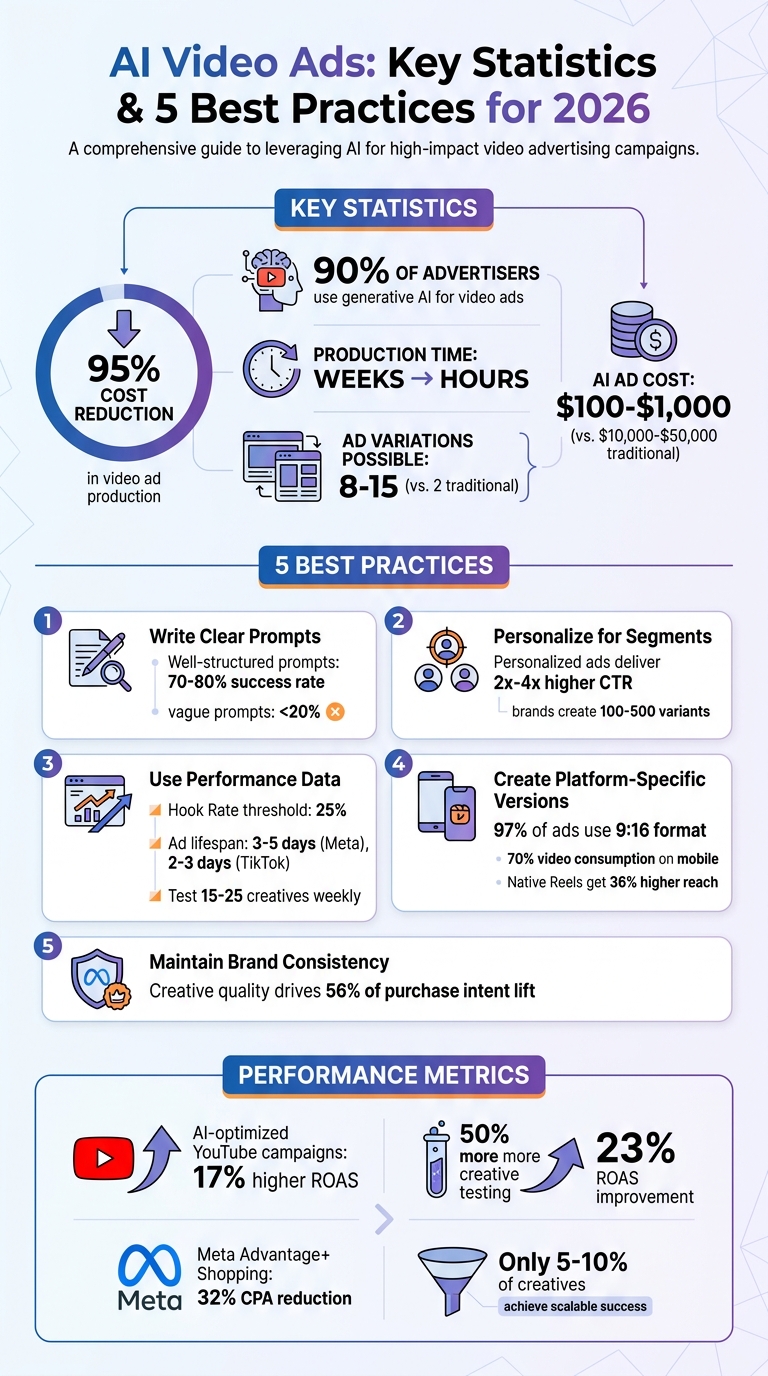
AI Video Ads Statistics and Best Practices for 2026
How to Create UNLIMITED High Converting Ads With AI (2026)
sbb-itb-cef5bf6
1. Use Clear Prompts to Get Better AI Results
Crafting clear and specific prompts is the key to generating high-quality AI content. Research shows that well-structured prompts result in usable output 70–80% of the time, while vague prompts succeed less than 20% of the time. That difference can make or break your creative efforts - and your budget.
"The quality of your AI-generated video ad is determined before a single frame is rendered. It is determined by the prompt." – AdCreate Team
To create effective prompts in 2026, focus on six essential elements: subject and action, camera angle and movement, lighting and color, style and aesthetic, environment, and technical specifications. For instance, a generic prompt like "woman using phone" will lead to uninspired results. Instead, something like "woman in her late 20s, cream linen blouse, smiling while scrolling an iPhone at a sunlit cafe, slow dolly-in at eye-level, warm golden-hour light from camera left" can produce ad-ready content.
The best workflow for 2026 involves breaking down your ad into smaller segments, focusing on 3 to 8-second shots rather than trying to capture the entire ad in one prompt. This modular approach ensures clarity and avoids common AI artifacts. Use a timeline structure, such as "0–2 sec: hook, 2–5 sec: product reveal, 5–9 sec: solution demonstration", to guide the process.
Another important tool is negative prompting, where you specify what to exclude. Phrases like "no text overlays", "no extra fingers", or "no watermarks" help eliminate unusable frames and keep the output clean. If your brand requires consistent visuals, you can use an existing product image as a reference for image-to-video generation, ensuring uniformity across different ad variations.
2. Personalize Video Content for Different Audience Segments
In 2026, personalization is the driving force behind successful video ads. Gone are the days when generic ads could deliver results. With AI making dynamic, modular personalization possible, brands can now treat video elements - like hooks, product demos, CTAs, voiceovers, and music - as interchangeable pieces. This allows for the creation of thousands of unique ad variants from just one creative brief, tailored to specific combinations of location, industry, funnel stage, or content preferences.
The results speak for themselves: personalized AI video ads deliver 2×–4× higher click-through rates and resonate with 55% of consumers compared to generic ads. Companies are no longer aiming for broad demographics; instead, they’re diving into micro-segmenting, producing anywhere from 100 to 500 tailored ad variants for precise audience slices. For instance, a SaaS company could deliver a completely different hook to a first-time visitor than to someone who has already explored its pricing page. They might even use an AI-generated avatar that aligns with the viewer’s profile.
"The question is no longer 'should we personalize?' but 'how many segments can we serve simultaneously?'" – Henry, Creative Technologist, Bonega.ai
This shift is already proving effective. Take the Ukrainian edtech startup Headway, for example. In the first half of 2024, they used AI tools like HeyGen and D-ID to create video ads featuring AI avatars tailored to specific audience segments. The result? A 40% boost in video ad ROI and a 60% increase in engagement compared to traditional advertising. Plus, AI-powered ads are significantly more cost-effective, ranging from $100 to $1,000 per ad, compared to the $10,000 to $50,000 price tag of traditional 30-second commercials.
To get started, experiment with changing a single element - like the hook or CTA - and track its performance. Build a library of 3–5 six-second hooks (visual-first, text-heavy, UGC-style) and multiple value propositions for your AI tools to mix and match. Testing 8–10 creative variants will help pinpoint the best-performing content. At this scale, AI production becomes the only cost-effective way to manage such high volumes of testing and personalization.
3. Use Performance Data to Adjust Campaigns Quickly
After setting up clear prompts and crafting personalized content, keeping an eye on real-time performance data is key to making your AI video ads work effectively. Campaign success often depends on spotting underperforming elements early and replacing them fast. In 2026, the lifespan of AI video ads is short - just 3–5 days on Meta and 2–3 days on TikTok. Real-time monitoring helps you act quickly, preventing wasted budget and keeping your campaigns optimized.
Pay close attention to your Hook Rate - the percentage of viewers watching more than 3 seconds of your ad. If it falls below 25%, your creative isn’t grabbing attention and needs a new hook immediately. Similarly, if your Cost Per Acquisition (CPA) spikes or your Click-Through Rate (CTR) drops, it’s a clear sign of creative fatigue. AI video tools can help you test 5–10 fresh hooks while leaving the body and call-to-action (CTA) unchanged.
Be cautious about pulling the plug on ads too soon. Wait until a campaign reaches at least 500 impressions or runs for 3–7 days before deciding if the creative is underperforming. Remember, only 5% to 10% of ad creatives achieve scalable success. That’s why high-performing Meta accounts test 15 to 25 new creatives weekly, compared to just 3 to 5 for average accounts. Notably, brands that increased their creative testing by 50% or more saw a 23% average improvement in Return on Ad Spend (ROAS) over six months.
Shift your focus to deep-funnel actions rather than surface-level metrics like clicks. Import offline conversion data to help AI algorithms target qualified leads more effectively. Also, track your Marketing Efficiency Ratio (MER) - total revenue divided by total ad spend - as a reliable metric to navigate challenges like signal loss and fragmented attribution across platforms. This data-driven approach ensures every tailored ad variant delivers maximum performance, complementing your personalized strategies.
4. Create Different Video Versions for Each Platform
Each social media platform has its own vibe, and user behavior changes dramatically between them. For instance, TikTok users decide whether to keep watching your video in just 1–2 seconds, favoring raw, mobile-shot content. On the other hand, YouTube users are ready to engage with longer, polished, and cinematic videos. If you post the same video across all platforms without tweaking it, you risk losing engagement - and worse, some platforms might even deprioritize your content. For example, Meta’s algorithm rewards Reels that feel native with a 36% higher reach.
By 2026, 97% of video ads are expected to use the 9:16 vertical format, and over 70% of video consumption will happen on mobile devices. But format isn’t everything. TikTok ads tend to wear out 2–3 times faster than Meta ads, making it crucial to refresh creative assets more frequently. Additionally, 80% of users watch videos with the sound off, so captions and bold text overlays are vital - especially on Meta. On TikTok, however, 88% of users keep the sound on, meaning trending audio and voiceovers can make or break your content.
Some brands have already mastered this platform-specific approach. In January 2026, Konesso swapped polished ads for employee-led, authentic videos. The result? A 51.8% boost in ROAS, a 77.6% jump in transactions, and an 80.4% increase in revenue. Similarly, Meoky, a drinkware brand, used TikTok Symphony’s AI tool to turn product pages into TikTok-native ads. This led to a 1.8x increase in purchases and a 13% lift in ROAS. These kinds of successes are becoming more achievable thanks to AI tools that make it easier to adapt content for each platform.
AI can play a major role in tailoring videos to different platforms. For instance, automated reframing uses computer vision to identify the key parts of a video, allowing you to convert 16:9 footage into 9:16 vertical formats without losing focus on the subject. Outpainting technology can even generate new pixels to expand aspect ratios, preserving the full visual context instead of resorting to simple cropping. These tools let you create 8–10 variations of a video for the same cost as producing just two traditional edits. This volume of variations is essential for testing and figuring out what resonates most on each platform.
When adapting videos, don’t forget platform-specific design rules. On Instagram Reels, UI elements like usernames and buttons can obscure the top 14% and bottom 35% of the screen - so keep text and calls-to-action centered. On YouTube, make the first 5 seconds stand out to prevent users from skipping ahead. For TikTok, lean into native features like text-to-speech or trending sounds to make your content feel at home. To stay efficient and consistent, batch-edit your 9:16, 1:1, and 16:9 versions in one go.
5. Set Up Systems to Keep Your Brand Voice Consistent
Once you've tailored content for different platforms, the next step is ensuring your brand identity remains steady across all outputs. Consistency is key to reinforcing how your audience perceives and recognizes your brand.
When you're churning out dozens of video variations every week with the help of AI, keeping everything aligned can feel like a challenge. But don’t hit the brakes - instead, put systems in place to safeguard your brand identity. Creative quality is no small matter; it drives 56% of purchase intent lift. So, nailing consistency is just as important as producing content at scale.
Start by creating a master template that outlines your brand's non-negotiables. This includes where your logo should appear, the style of text overlays, the tone of voiceovers (are you aiming for friendly or authoritative?), and even the types of background music you prefer. Upload your brand kit - logos, hex codes, and fonts - directly into your AI platform to ensure every piece of content aligns with your visual identity. This prevents "identity drift", where AI outputs slowly veer away from your established branding.
"AI generates what you brief; the output is only as on-brand as the brief." – Cliprise Strategy Guide
To further lock in your brand’s look and feel, build a visual style prompt library. This should document the specific details that define your brand in AI-generated videos. Include your exact color codes, lighting preferences like "soft studio lighting" or "high contrast", and reference images for settings and talent. Add negative prompts too, such as "no flickering" or "no off-brand logos", to avoid unwanted elements. For voiceovers, create a phonetic spelling guide for tricky names or industry-specific terms (e.g., "Exayard" = "Egg-Zah-Yard") to ensure proper pronunciation.
The most crucial step? Human oversight. Even with flawless templates, a mandatory "Brand QA" checkpoint is essential. Someone should review the tone, verify factual accuracy, and confirm licensing before content goes live. Maya R. Patel, Lead Human Editor at AI Tools Business, sums it up perfectly:
"The best generative video workflow is the one you can repeat weekly without quality collapsing"
Set aside 30–60 minutes each week to review AI outputs and refine your templates as needed. This regular review process ensures your AI-generated content stays true to your brand and meets your creative standards.
Conclusion
The five practices outlined here aren't just ideas - they're the playbook for advertisers aiming to thrive in 2026. As Jason Tabeling, Head of Solutions at Further, explains: "The difference between winning and losing campaigns... is no longer defined by manual bidding tactics. It comes down to who supplies the algorithm with the strongest inputs".
By adopting these approaches, advertisers can create video ads that stand out while achieving measurable results. Combining clear prompts, audience-specific personalization, performance-based tweaks, platform-tailored formats, and consistent branding builds an AI system capable of identifying top customers and scaling creative efforts. For instance, AI-optimized YouTube campaigns see a 17% higher ROAS, while Meta Advantage+ Shopping campaigns reduce CPA by 32%. Creative quality alone accounts for 56% of purchase intent lift, and testing 8–10 ad variants outperforms the usual 2–3 dramatically.
AI has transformed the ad production process, eliminating traditional bottlenecks. Ads that once cost $10,000–$50,000 and took weeks can now be created in hours for $100–$1,000. Take Kalshi, for example - they produced an NBA Finals ad in two days for just $2,000, a fraction of the usual cost.
Here’s the reality: nearly 90% of advertisers are already using generative AI for video ad creation or versioning. This isn’t a trend - it’s the new normal. Success now depends on feeding AI with precise inputs and embracing dynamic creative testing. The brands leading in 2026 will treat AI as an execution tool, while human oversight ensures strategic direction, brand consistency, and ethical standards. They’ll focus on modular assets, train algorithms with meaningful data, and adapt based on performance insights.
FAQs
What’s the fastest way to improve my AI video ad prompts?
To make your AI video ad prompts more effective in 2026, focus on being specific and structured. Clearly outline details for each shot, including the visual style, camera angles, and key messaging. Use precise terms like motion-related keywords and technical camera language to guide the AI in crafting the content. This approach helps ensure your ads match your campaign objectives, steer clear of generic outputs, and produce polished, on-brand results.
How many AI ad variations should I test each week?
To get the best results, try testing 5 to 10 AI-generated ad variations every week. This strategy allows for consistent A/B testing on platforms like Meta, TikTok, and YouTube, giving you the chance to fine-tune your ads and steadily boost performance.
Which metrics matter most for scaling AI video ads in 2026?
When it comes to scaling AI-driven video ads in 2026, a few metrics stand out as critical for success. These include:
- Click-through rates (CTR): This measures how often viewers click on your ad after seeing it, offering a clear indicator of engagement.
- Cost-per-acquisition (CPA): CPA helps track how much you're spending to convert a viewer into a customer, ensuring your campaigns stay cost-effective.
- Return on ad spend (ROAS): ROAS reveals how much revenue your ads generate compared to what you’ve spent, making it a key measure of profitability.
- Performance feedback loops: These allow you to continuously refine and improve your campaigns by analyzing real-time data and making adjustments.
Together, these metrics provide the insights needed to evaluate ad performance and optimize campaigns for the best possible return on investment.