Ultimate Guide to Cross-Channel Marketing Automation
February 23, 2026Struggling to connect your marketing channels? Cross-channel marketing automation solves this by linking platforms like email, social media, CRM, and PPC into one system. This approach ensures every customer interaction builds on the last, creating a smooth, personalized experience.
Key Takeaways:
- Why it matters: Marketers using 3+ channels see a 494% higher order rate, yet 87% of consumers find disconnected experiences frustrating.
- What it does: Synchronizes actions across platforms (e.g., an email click triggers a tailored ad), avoids redundant messaging, and simplifies workflows.
- Benefits:
- Saves 2.4 hours/day for marketing teams by centralizing data.
- Boosts ROI by 31% through real-time adjustments.
- Drives 342% more revenue with personalized campaigns.
- Builds trust with consistent messaging across channels.
- How it works:
- Unifies customer data into a Single Customer View.
- Segments audiences based on real-time behavior.
- Automates workflows like cart reminders and birthday campaigns.
- Uses AI to personalize content and optimize campaigns in real time.
This guide explains how to unify your tools, map customer journeys, and implement automation to improve engagement and conversion rates. Ready to streamline your efforts and deliver better customer experiences? Let’s dive in.
Mastering Cross-Channel Marketing For A Seamless Customer Journey
Multichannel, Cross-Channel, and Omnichannel Marketing: Key Differences
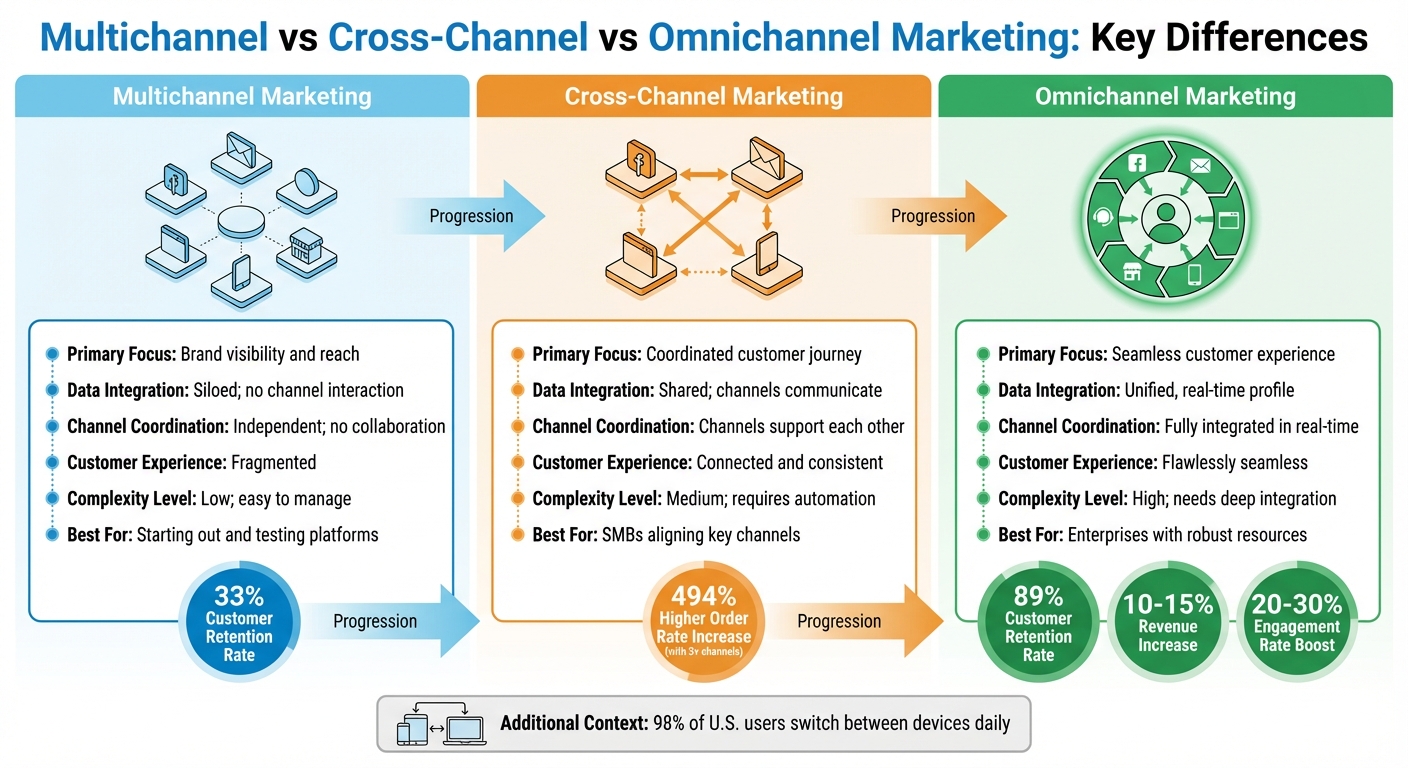
Multichannel vs Cross-Channel vs Omnichannel Marketing Comparison
While these terms are often mixed up, they describe distinct approaches to engaging with customers. Knowing how they differ can help you decide which strategy aligns with your goals and resources. This clarity is crucial for creating a unified presence across platforms.
Multichannel marketing is the simplest approach, where campaigns run independently on platforms like email, social media, and websites. Each channel operates in isolation, often without communication between them. For example, customers might receive the same promotional email and Facebook ad without any coordination behind the scenes. This setup can lead to competition between channels for the customer’s attention.
Cross-channel marketing takes things a step further by connecting platforms to create a more coordinated experience. Data flows between channels, allowing for actions like sending a cart abandonment email while suppressing irrelevant ads and following up with a personalized text. As Amelia Woolard from Bloomreach explains, cross-channel marketing balances complexity and efficiency, enabling brands to align their messaging without requiring advanced data systems.
Omnichannel marketing is the most sophisticated method, where every customer interaction - whether online or offline - feeds into a single, real-time profile. This allows for a seamless transition between touchpoints. Imagine a customer browsing products on their phone, chatting with support online, and then completing their purchase in-store - all without missing a beat. Companies with strong omnichannel strategies retain 89% of their customers, compared to just 33% for those with weaker approaches.
The key differences lie in how data is integrated and how the customer experience is shaped. Multichannel marketing focuses on brand visibility, cross-channel marketing emphasizes the customer journey, and omnichannel marketing prioritizes a seamless, unified experience. Given that 98% of U.S. users switch between devices daily, your choice of strategy directly affects whether customers feel valued or frustrated.
Comparison Table: Multichannel vs Cross-Channel vs Omnichannel
| Feature | Multichannel | Cross-Channel | Omnichannel |
|---|---|---|---|
| Primary Focus | Brand visibility and reach | Coordinated customer journey | Seamless customer experience |
| Data Integration | Siloed; no channel interaction | Shared; channels communicate | Unified, real-time profile |
| Channel Coordination | Independent; no collaboration | Channels support each other | Fully integrated in real-time |
| Customer Experience | Fragmented | Connected and consistent | Flawlessly seamless |
| Complexity Level | Low; easy to manage | Medium; requires automation | High; needs deep integration |
| Best For | Starting out and testing platforms | SMBs aligning key channels | Enterprises with robust resources |
Core Components of Cross-Channel Marketing Automation
To build a successful cross-channel strategy, it's not enough to just link a few tools together. You need a strong foundation that organizes scattered customer data, groups it meaningfully, and maps out how people engage with your brand. Without these elements, automation can feel fragmented and inconsistent.
Unifying Customer Data Across Platforms
Your customers interact with your brand across multiple channels, but their data often lives in silos. For example, email addresses might be in your marketing platform, purchase history in your CRM, website activity in analytics tools, and social interactions scattered across platforms. To create a seamless experience, you need robust integration that eliminates the need for manual data searches.
The key is to consolidate data from sources like CRMs (e.g., Salesforce, HubSpot), product analytics, websites, mobile apps, and even offline interactions. This process builds a Single Customer View (SCV) - a unified profile that combines fragmented identifiers like email addresses, phone numbers, and cookie IDs into one accessible record. A Customer Data Platform (CDP) serves as the backbone, resolving data silos and enabling real-time data flow across your tools.
Identity resolution plays a critical role here. It matches and merges data from different sources, ensuring that the customer browsing on their phone is recognized as the same person who opened an email earlier. Real-time synchronization is equally important, preventing awkward situations like sending a cart abandonment email after the purchase has already been made. This matters because 87% of consumers feel frustrated when they have to repeat their information across different channels.
Start with a data audit - list every system holding customer data and identify the behavioral or demographic details essential for your messaging. Use a consistent naming system, or taxonomy, across platforms to keep data usable when transferred. Companies that master this integration can gain 15% to 20% better marketing budget efficiency through improved cross-channel attribution.
Once your data is unified into a single view, the next step is to segment it effectively.
Building Customer Segments
With unified data in place, segmentation becomes the tool for crafting personalized experiences. Behavioral and intent-based segmentation goes beyond basic demographics like age or location. Instead, it focuses on real-time actions such as browsing habits, email interactions, cart abandonment, and purchase intent.
AI-driven tools can dynamically update segments based on customer behavior. This means your segments stay relevant - customers who just made a purchase won’t see ads promoting the same product, for instance. For cross-channel strategies to work, your segments must also be "actionable everywhere." A segment created in your CRM should trigger email campaigns, social media ads, and website personalization simultaneously.
The benefits are clear. Businesses with strong cross-channel engagement report a 9.5% year-over-year revenue increase, compared to only 3.4% for those with weaker engagement. With 73% of shoppers using multiple channels during their purchase journey, coordinated segmentation prevents repetitive and frustrating customer experiences.
Set up behavioral triggers so that an action in one channel - like clicking on an email link - automatically prompts a response in another, such as a social media retargeting ad. Regularly clean your data to ensure customer profiles remain accurate and consistent across platforms, avoiding duplicate messages.
Mapping the Cross-Channel Customer Journey
Once you've defined your customer segments, mapping their journey helps you identify key touchpoints and optimize interactions. Understanding where customers engage with your brand allows you to pinpoint friction points and areas for improvement. This ensures a smoother, more personalized experience.
Start by mapping the customer journey and identifying critical moments - like onboarding, renewal, or churn risk. For example, a customer might discover your brand through a social ad, explore your website, receive an email, and eventually convert via a retargeted PPC campaign. Each touchpoint should naturally lead to the next, creating a connected experience instead of isolated interactions.
Use global frequency capping through a unified platform to manage message volume across all channels. This prevents "channel fatigue", where customers feel overwhelmed by excessive communication. Since customers often switch between devices, your journey map should account for these transitions, ensuring continuity across platforms. A well-mapped journey helps deliver a seamless experience no matter where or how customers interact with your brand.
sbb-itb-cef5bf6
Strategies for Cross-Channel Marketing Automation
Once you've consolidated your data and outlined customer journeys, it's time to put those insights into action. Combining social media automation with email, CRM, and PPC creates a system that responds to customers in real time, delivering a seamless experience across channels.
Automated Campaign Workflows
Automated workflows take the guesswork out of timing by triggering messages based on customer behavior instead of rigid schedules. At the core of this approach is a unified data source, like a Customer Data Platform (CDP) or CRM, ensuring all channels share the same up-to-date customer information. This avoids awkward missteps, like promoting a product someone has already purchased.
These workflows rely on behavior-driven triggers. For example, if a customer downloads a whitepaper but ignores the follow-up email, the system could send an SMS reminder after 48 hours. If the email is opened but no purchase follows, a retargeting ad might appear on their social media feed. This kind of conditional logic keeps customers engaged across multiple touchpoints.
Here’s a compelling stat: birthday-triggered campaigns drive 342% more revenue than standard promotional efforts. Meanwhile, brands with strong omnichannel strategies retain 89% of their customers, compared to just 33% for those with weaker engagement.
To get started, focus on automating one high-impact journey, like a welcome series or abandoned cart reminders, before scaling up to cover the entire customer lifecycle. Frequency capping is another must - setting limits on how many messages a customer receives across all channels helps prevent fatigue and opt-outs.
AI takes these workflows a step further by adapting content to match each customer’s real-time context, making every interaction feel timely and relevant.
AI-Powered Personalization
Personalization is no longer just about addressing someone by name in an email. AI digs deeper, analyzing behavior, purchase history, and session data to deliver content tailored to each individual. Instead of generic recommendations like "best-sellers", AI pinpoints the exact products or content that align with someone’s preferences and intent.
Predictive segmentation is another game-changer. AI updates customer groups dynamically based on factors like purchase intent, churn risk, or engagement likelihood. It even predicts which channel a customer is most likely to engage with - be it email, SMS, WhatsApp, or push notifications - based on past interactions.
"Personalization is not just about using the customer's name in an email; it's about delivering content that aligns with their preferences and needs." – LimeLeads
The numbers back it up. Behavioral automation can boost conversion rates by up to 9x. Brands that excel at personalization see 40% higher revenue, and 45% of customers are more likely to become repeat buyers when they experience personalized, cross-channel interactions.
AI also helps manage communication frequency. It can cap the total number of messages a customer receives across all channels while adapting content to fit each format - like condensing a detailed email into a short SMS or a snappy social ad - without losing the brand’s voice.
Real-Time Campaign Optimization
Real-time optimization ensures your campaigns stay agile. Instead of waiting for monthly reports, you can make immediate adjustments based on live data. This might mean reallocating budgets from underperforming channels to those driving better engagement and conversions.
By centralizing data from email, social media, CRM, and web analytics, you can turn real-time signals into actionable insights. For instance, if a customer abandons their cart and ignores the email reminder, an automated workflow can trigger an SMS follow-up within 24 hours. Similarly, if website activity shows interest in a specific product category, AI can instantly update on-site banners and email content to reflect that interest.
Revlon’s Glimmer product line launch highlights the impact of this approach. Partnering with Horizon and Amazon Marketing Cloud, Revlon discovered mid-campaign that viewers exposed to both Prime Video and search ads had 24x higher purchase rates. By pivoting their strategy in real time, they exceeded sales forecasts by 120% and achieved 170% sales growth.
"Cross-channel marketing attribution helps you pinpoint exactly what's working, so you can automatically do more of it. Spend your resources where they can have the most impact." – Simon Data
To fine-tune your efforts, implement multi-touch attribution to credit all channels contributing to a conversion, not just the last click. Continuous A/B testing on elements like subject lines, timing, and channel combinations will reveal what works best. For example, ASOS leveraged Simon Data to enhance cross-channel coordination, resulting in an additional $77.5 million in revenue.
Companies that embrace effective cross-channel attribution see a 15-20% improvement in marketing budget efficiency. With 73% of shoppers using multiple channels during their buying journey, real-time optimization ensures you’re delivering the right message at the right time.
Integrating Social Media, Email, CRM, and PPC
Bringing together social media, email, CRM, and PPC creates a feedback loop where activity in one channel triggers responses in others. This interconnected approach builds on automated workflows and AI-powered personalization, ensuring each channel amplifies the others.
Social Media Automation with Email Triggers
When social media and email systems are connected, interactions on platforms like LinkedIn can prompt immediate follow-ups. For example, if someone connects with you on LinkedIn, they could receive a welcome email within 15 minutes, taking advantage of their current interest.
Directly linking social media lead generation forms to email platforms eliminates manual data entry and ensures quick engagement. Additionally, syncing email subscriber segments with social media "Matched Audiences" ensures consistent messaging across platforms.
You can also repurpose top-performing email content as teasers for your social media channels, encouraging followers to join your email list. Meanwhile, data from social media engagement can help tailor email content based on recent interactions. Campaigns that use three or more channels see a 494% higher order rate compared to single-channel efforts.
This seamless data connection also lays the groundwork for personalized PPC retargeting using CRM data.
CRM Data Sync for Personalized PPC Retargeting
Your CRM is a treasure trove of customer insights, from purchase histories to browsing behaviors. When this data flows automatically to PPC platforms via APIs or webhooks, it enables highly targeted retargeting campaigns. For instance, if someone downloads a pricing guide but doesn’t request a demo, you could trigger a retargeting ad on LinkedIn or Google within 24 hours.
Audience suppression is just as important. Once someone converts, they should be removed from retargeting lists to avoid overspending and redundant messaging. Integrated CRM and marketing systems can boost conversion rates by 35% and shorten sales cycles by 20%.
You can also sync CRM segments with social media audiences for sharper targeting. For example, filter by job role, industry, or seniority, and sync this data with LinkedIn Matched Audiences to ensure ads reach the right people with relevant messages. As third-party cookies phase out, first-party CRM data becomes essential for precise targeting.
Once your targeting is optimized, unified reporting helps you see the bigger picture.
Unified Reporting Across All Channels
With automated triggers and CRM integration in place, unified reporting pulls everything together. Relying on separate dashboards can create blind spots, but a consolidated view combines data from social media, email, CRM, and PPC into one report. For example, while a social ad might not show high direct conversions, it could play a critical role in starting customer journeys that lead to email sign-ups and eventual sales.
Multi-touch attribution is key here. Instead of crediting only the last click before a purchase, this approach values every interaction along the customer’s journey. It highlights the importance of awareness-stage ads and nurture emails, which may not directly convert but are crucial in moving prospects forward. Companies that embrace omnichannel marketing report revenue increases of 10–15% and engagement rate boosts of 20–30%.
Real-time dashboards allow for quick adjustments. By identifying which channel combinations deliver the best ROI, you can reallocate budgets on the fly rather than waiting for monthly reports. This comprehensive view not only clarifies ROI but also supports ongoing improvements to integrated campaigns. Brands with strong omnichannel strategies retain 89% of their customers, compared to just 33% retention for those with weaker engagement.
| Integration Component | Challenges | Advantages |
|---|---|---|
| Social Media & Email | Data silos; matching social profiles to email lists | Higher engagement; 494% higher order rates with 3+ channels |
| CRM Data Sync | Technical hurdles (APIs, webhooks); data cleaning | 3.5x higher purchase likelihood through cross-channel recognition |
| PPC Retargeting | High costs if not targeted; cookie loss | Precision targeting for high-intent users like cart abandoners |
| Unified Reporting | Attribution complexity; platform metric differences | Clearer ROI insights; reveals which channels drive revenue |
Conclusion
Cross-channel marketing automation transforms how businesses engage with customers across multiple platforms. When social media, email, CRM, and PPC systems work together, the customer journey feels connected rather than fragmented. Research shows that marketers using three or more channels see a 494% higher order rate, and customers are 3.5 times more likely to make a purchase.
Moving from manual coordination to automated workflows doesn’t just save time - it cuts marketing overhead by over 12% while enabling personalization at scale. With real-time behavioral triggers, messages reach customers at the perfect moment on the right platform. This eliminates the frustration that 87% of consumers experience when they have to repeat themselves across different channels.
To make this shift, start by unifying your customer data into a single database. Identify the key touchpoints in your customer journey and implement automated workflows like abandoned cart recovery or welcome sequences. Multi-touch attribution can help you understand how your channels work together, rather than focusing solely on the last click before conversion.
The best brands don’t just show up on multiple platforms - they create cohesive experiences where every interaction builds on the last. With 92% of marketing leaders agreeing that consistent cross-channel experiences are critical for success, the race is on to implement automation. By aligning your systems, you can ensure every touchpoint contributes to a superior customer experience.
As customers seamlessly move between email, social media, and search, cross-channel automation provides the personalized, consistent experiences that turn one-time buyers into loyal advocates.
FAQs
Do I need a CDP for cross-channel automation?
No, you don’t need a Customer Data Platform (CDP) for cross-channel marketing automation. While a CDP can unify customer data to improve targeting and personalization, automation is still possible with tools that connect various channels like email, social media, and websites. That said, adding a CDP to the mix can give you a centralized view of your customer data, enabling more accurate and tailored campaigns.
How can I stop customers from receiving duplicate messages across channels?
To prevent sending duplicate messages across multiple channels, use automation tools to sync your messaging and data in real time. By consolidating customer data, you can break down silos and maintain a unified view of all interactions. This approach ensures your communication is personalized and avoids redundancy, leading to a smoother customer experience and higher engagement.
What should I automate first for the fastest ROI?
To see results quickly, focus on automating your email marketing campaigns first. Automated emails offer benefits like personalized communication, timely follow-ups, and increased engagement, all of which can help boost conversions and drive revenue.
Start by creating workflows that are triggered by specific customer actions - like cart abandonment or a product inquiry. Once you’ve got your email automation working efficiently, you can expand by adding other channels, such as social media or SMS, to amplify your efforts.