How Social Media Funnels Drive Lead Generation
March 4, 2026Social media funnels transform casual browsers into paying customers by guiding them through three stages: Awareness, Consideration, and Conversion. This structured approach ensures potential buyers interact with your brand multiple times, building trust and encouraging action.
Key insights:
- 68% of marketers report social media directly boosts lead volume.
- Businesses using full-funnel strategies see a 90% revenue ROI increase.
- Platforms like LinkedIn (B2B) and Instagram (B2C) dominate lead generation.
Social media’s role in product discovery is undeniable, with 77% of consumers finding brands on these platforms. By creating engaging content tailored to each stage, leveraging AI tools, and tracking performance metrics like ROI and conversion rates, businesses can turn social activity into measurable growth.
This article explores strategies, tools, and examples to maximize your funnel’s impact.
Social Media Lead Generation Statistics
How Social Media Drives Lead Generation
Social media has become a key player in how consumers discover brands and products. A striking 77% of retail brand and product discovery now happens on social platforms, signaling a major shift in consumer behavior.
For marketers, the numbers are equally telling. 64% of marketers say lead generation is the top benefit of using social media, while 68% consider it a key source for leads. Social platforms not only build brand awareness but also help fill the sales pipeline. Today, social media stands as the second most-used marketing channel at 40%, tied with email marketing. Websites and blogs still lead the pack at 90.7%.
When it comes to conversion, social media also holds its ground. It boasts a 30% average lead-to-MQL (Marketing Qualified Lead) conversion rate, trailing SEO (41%) and email marketing (38%). Paid social advertising contributes 9% of all MQLs, underlining its importance in a well-rounded marketing strategy. With these numbers in mind, it’s worth diving into how different platforms perform.
Performance Data by Platform
The effectiveness of social media platforms varies depending on the audience. For B2B marketers, LinkedIn is the clear frontrunner, generating 80% of social media leads. Notably, 89% of B2B marketers use LinkedIn, and 62% find it effective for lead generation.
On the B2C side, Facebook remains a dominant force. 43% of marketers say it’s the platform that delivers the most leads. Instagram is another heavy hitter, with 89% of users saying that watching an explainer video on the platform influenced their buying decisions. Together, Facebook and Instagram (both Meta platforms) account for 96% of retail brand discovery on social media.
For younger audiences, platforms like TikTok, Instagram, and YouTube take the lead. These three platforms drive over 60% of product discovery, far outpacing Google’s 34.5% share. Among Gen Z, TikTok stands out as the top discovery channel, with 49% naming it their go-to platform, and an impressive 85% of consumers saying social media videos influence their purchasing decisions.
sbb-itb-cef5bf6
How to Build a Social Media Content Funnel That Converts (Step-by-Step)
The 3 Stages of Social Media Funnels
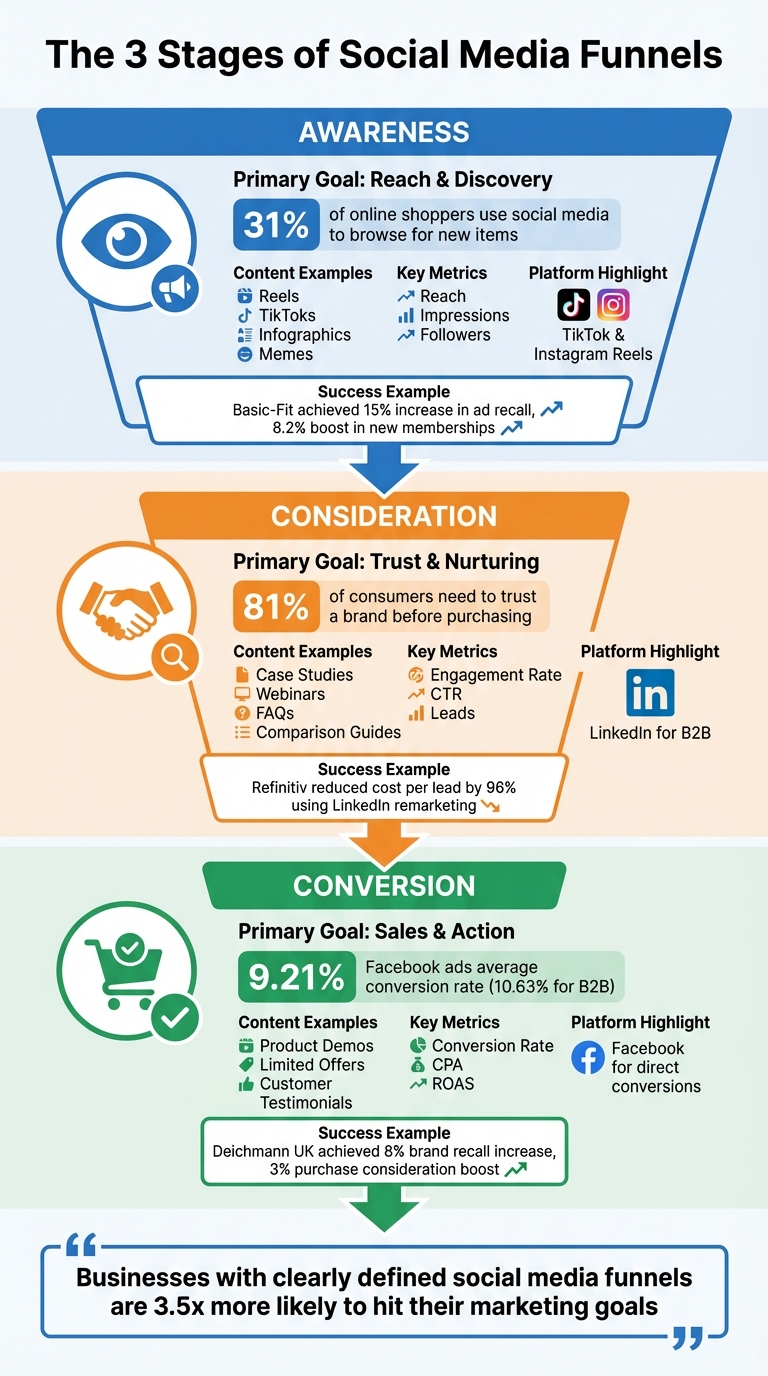
Social Media Funnel 3-Stage Framework with Performance Metrics
A social media funnel is a structured path that guides potential customers from discovering your brand to making a purchase. It consists of three key stages, each with specific goals and tailored content strategies to keep users engaged and moving forward.
Awareness Stage: Building Brand Visibility
The first stage focuses on capturing the attention of a cold audience - people who may not know your brand yet. Interestingly, 31% of online shoppers use social media to browse for new items to buy. Platforms like TikTok and Instagram Reels excel here, thanks to their discovery-friendly algorithms.
At this stage, content should prioritize eye-catching visuals over direct sales pitches. Think educational infographics, trend-inspired posts, or engaging short-form videos. For example, the fitness brand Basic-Fit used TikTok TopView ads to introduce itself to new audiences. This approach resulted in a 15% increase in ad recall and boosted new gym memberships by 8.2%. These early interactions set the foundation for deeper engagement in the next phase.
Consideration Stage: Nurturing Interest and Building Trust
Once awareness is established, the focus shifts to earning trust and demonstrating value. This is crucial, as 81% of consumers say they need to trust a brand before making a purchase. Retargeting campaigns play a pivotal role here, delivering content like case studies, webinars, or comparison guides to users who’ve already interacted with your brand.
A great example is Refinitiv, which used LinkedIn Sponsored Content to build awareness and later leveraged remarketing ads to stay top-of-mind. By collecting prospect data directly through LinkedIn Lead Gen Forms, they reduced their cost per lead by 96% compared to traditional methods. Interactive content like polls, quizzes, and FAQs can further engage users and encourage them to take the next step. With trust firmly established, the stage is set for conversion.
Conversion Stage: Turning Interest Into Action
The final stage is all about sealing the deal. Here, the goal is to reduce any barriers to purchase and encourage immediate action. Tactics like limited-time offers, product demos, and customer testimonials are particularly effective. On average, Facebook ads boast a 9.21% conversion rate, with B2B campaigns performing even better at 10.63%.
Take Deichmann UK’s back-to-school shoe campaign as an example. After creating awareness and engagement through earlier stages, they retargeted users with sales-focused ads featuring a buy-one-get-one-half-price offer. This full-funnel strategy led to an 8% increase in brand recall and a 3% boost in purchase consideration among those exposed to all three stages. Additionally, social commerce tools that enable in-app purchases make this stage even smoother.
| Funnel Stage | Primary Goal | Content Examples | Key Metrics |
|---|---|---|---|
| Awareness | Reach & Discovery | Reels, TikToks, Infographics, Memes | Reach, Impressions, Followers |
| Consideration | Trust & Nurturing | Case Studies, Webinars, FAQs | Engagement Rate, CTR, Leads |
| Conversion | Sales & Action | Product Demos, Limited Offers | Conversion Rate, CPA, ROAS |
Optimization Strategies for Social Media Funnels
Fine-tuning each stage of your social media funnel is a game-changer when it comes to improving lead quality and boosting conversion rates. Research highlights that businesses with clearly defined social media funnels are 3.5 times more likely to hit their marketing goals. Plus, taking the time to optimize these funnels can reduce customer acquisition costs by 35%. The secret? Focus on strategies that minimize friction, build trust, and keep your audience engaged from start to finish.
Using Contests and Giveaways
Contests and giveaways are excellent tools for driving engagement, especially during the awareness and consideration phases. They can increase audience interaction by 34% and improve brand visibility by 25%. Even better, 34% of new followers often come from social media contests alone.
To make the most of these campaigns, choose prizes that resonate with your brand - such as exclusive product bundles or early access offers - rather than generic items. The type of contest you run also matters. For example:
- "Tag-a-friend" campaigns: Expand your reach through participants' social networks.
- "Caption this" posts: Encourage comments and creativity.
- User-generated content challenges: Turn participants into content creators, giving you authentic marketing material.
"Social media contests grow your brand by encouraging organic engagement and sparking genuine interest in your products or services." - Emplifi
Before launching, set SMART goals to measure success, like gaining 500 new followers or increasing website traffic by 20%. Branded hashtags make it easier to track entries, and offering bonus entries for shares transforms participants into brand advocates. To keep things simple, allow multiple entry methods, from commenting to submitting photos. Incorporating AI tools can also help personalize the experience and streamline lead management.
Personalization and AI-Powered Tools
AI-powered personalization is no longer optional - it’s a must-have. Businesses using AI for lead scoring report 21-27% faster pipeline velocity and 14-18% higher close rates. AI-driven lead generation can also boost sales-ready leads by 50% and increase conversion rates by 45%, all while cutting customer acquisition costs by a staggering 60%.
Timing is critical. If you wait more than 24 hours to follow up with a lead, your chances of qualifying them drop by 98%. AI chatbots can bridge this gap by acting as 24/7 virtual assistants. They pre-qualify leads, direct them to the right resources, and ensure no opportunity slips through the cracks.
AI tools are also cost-efficient. While traditional sales teams might cost $5,000–$7,000 per month, AI-driven solutions are available for around $500 monthly. For example, you can set up automated responses triggered by keywords - like sending a lead magnet link when someone comments "GUIDE". Machine learning models can even prioritize leads showing high buying intent, based on their behavior and engagement. This real-time data enrichment allows for immediate scoring and routing, leading to 6.7x more positive replies and 32% shorter sales cycles. While AI handles the heavy lifting, live interactions can still add a personal touch to your brand.
Live Sessions and Referral Programs
Live sessions are perfect for building trust and addressing objections in real time. Hosting live Q&A sessions or webinars during the consideration stage lets you engage directly with prospects and position your brand as a credible authority. Platforms like LinkedIn and Instagram make these sessions easy to organize, and the interactive format fosters deeper connections than pre-recorded content ever could.
Referral programs, on the other hand, turn your satisfied customers into advocates. This strategy is incredibly effective: 92% of consumers trust recommendations from people they know over traditional ads, and 71% are more likely to buy based on social media referrals. To make these programs successful, offer incentives that matter - like discounts, exclusive access, or early product releases - to encourage customers to share their experiences.
Integrating these strategies with your CRM ensures quick follow-ups, ideally within 5 to 15 minutes, to maintain high intent. Combining the immediacy of live sessions with the credibility of referral programs creates an environment where prospects feel confident and motivated to take the next step.
Tracking Social Media Funnel Performance
Once you've set up your funnel optimization strategies, the next step is keeping a close eye on performance. This ensures every stage contributes to your ROI.
To measure your social media funnel effectively, you need to go deeper than basic metrics. Actions like saves, shares, link clicks, and comments with questions are stronger predictors of revenue than passive likes or impressions. Interestingly, about 63% of link clicks are often attributed to the wrong channel, highlighting the importance of a reliable tracking system.
One effective method is using closed-loop analytics. This tracks a customer’s journey from their first interaction on social media to their final purchase, connecting your CRM with marketing and sales data. This approach helps you pinpoint which social media efforts produce high-quality leads and paying customers.
Accurate ROI tracking also means factoring in all costs - not just ad spend. Many businesses overlook expenses like content creation, software, and team salaries, which can account for 60–80% of total investment. The formula for ROI is simple:
ROI = (Revenue Generated – Total Investment) / Total Investment × 100.
Another challenge is dark social, which includes private sharing through channels like direct messages or emails. This can account for 65% to 84% of social sharing but often gets misclassified as direct traffic. To address this, use UTM parameters, platform-specific promo codes, or referral fields at checkout.
Performance Metrics to Monitor
Each stage of the funnel requires its own set of metrics:
- Awareness: Track reach, impressions, video view time, and follower growth.
- Consideration: Focus on engagement rate, saves, shares, link clicks, and downloads of lead magnets.
- Conversion: Measure cost per lead (CPL), conversion rate, click-through rate (CTR), and return on ad spend (ROAS).
- Retention: Look at customer lifetime value (CLV), repeat purchase rate, and brand mentions.
You can refine your analysis with an Engagement Quality Score. For instance, you might assign 10 points to saves, 8 to shares, 7 to link clicks, and just 1 to likes.
"Saves, shares, and link clicks predict revenue far better than passive likes and impressions."
- Harish Reddy, Social Media Strategist, FunnL
Choosing the right attribution model is crucial. For short sales cycles (under 7 days), a last-click model works well. For lead generation that involves nurturing, a position-based (U-shape) model - which credits 40% to the first and last interactions and 20% to the middle steps - is more effective. For longer decision cycles, time-decay models that give more weight to recent interactions are ideal.
CRM Integration for Better Tracking
Integrating your social media insights with a CRM can take your tracking to the next level. Multi-touch attribution, for example, captures all social touchpoints in a conversion, not just the last click. This is especially important since most customer journeys include three to seven touchpoints before they convert.
CRM integration also enables offline conversion tracking, linking online actions to phone calls or in-store visits. This helps you calculate the long-term value of customers acquired through social media, rather than just focusing on immediate purchases. However, a significant challenge remains: 41.5% of marketers say they struggle to show the direct impact of social media on their business.
To improve CRM tracking, sync your CRM IDs with analytics user IDs (like those in GA4) for a unified view of customer activity. Use standardized UTM parameters across social links and implement server-side tagging with Conversions APIs for better accuracy.
Lead segmentation is another powerful tool. For instance, your CRM can tag leads based on their actions, such as clicking on pricing links versus downloading a guide. This allows for tailored follow-ups that match each prospect’s decision-making stage. Additionally, assigning financial values to micro-conversions (like newsletter signups) can help you estimate the ROI of top-of-funnel activities.
SEO Werkz's Approach to Social Media Funnels
SEO Werkz takes a tailored, integrated, and results-driven approach to social media funnels, focusing on strategies that generate leads and measurable outcomes.
Building Custom Funnels for Each Business
Instead of relying on cookie-cutter solutions, SEO Werkz creates campaigns tailored to each client's specific industry and goals. The process starts by pinpointing key social media objectives - whether it’s increasing engagement, generating leads, or driving website traffic - and selecting the platforms that align best with these goals. Using proprietary tools, they analyze website performance and fine-tune funnels to focus on the most effective channels. A great example of their success is Courts Unlimited, which saw a 400% boost in traffic and began receiving 5 to 10 estimate requests daily after regular data reviews improved their online presence in February 2021.
"We don't believe in a one-size-fits-all approach to digital marketing, so you can be sure that you're getting tailored insights that help your business grow." - SEO Werkz
These customized strategies are further enhanced by integrating social media efforts with broader digital marketing tactics.
Combining Social Media with Other Marketing Channels
SEO Werkz ensures that social media doesn’t operate in isolation. Instead, they combine it with SEO, PPC, content creation, and retargeting to establish a cohesive brand presence. By aligning blog and website keywords with social media content, they improve search rankings and attract targeted audiences. Maintaining a consistent brand voice across all platforms is crucial, especially since unified marketing strategies can deliver up to 45% higher ROI, and 60% of consumers interact with multiple touchpoints before making a purchase.
"Social media is not 'separate' from other forms of SEO and digital marketing -- rather, it's all part of the same umbrella." - SEO Werkz
Once campaigns are tailored and integrated, SEO Werkz ensures clients can clearly measure their success.
Providing Transparent Reporting and Results
Transparency is at the heart of SEO Werkz's client relationships. They provide detailed monthly reports that break down deliverables and ROI, ensuring clients see the value of their investment. With no long-term contracts, clients benefit from flexibility and measurable results. SEO Werkz boasts achievements like ranking over 1,000 keywords on the first page of search results, managing more than 100 websites, and building over 50 sites. Their mission is simple: deliver a positive ROI within months.
"Be Transparent, Get Results, and Earn Loyalty." - SEO Werkz
Conclusion
Social media funnels have transformed from basic tools for brand awareness into effective engines for lead generation that deliver measurable growth. By guiding potential customers from awareness to consideration and ultimately to conversion, these funnels play a critical role in generating consistent leads. This shift highlights the importance of a structured, data-focused approach for marketers.
With 66% of marketers already generating leads from platforms such as Facebook, Instagram, and LinkedIn, it's clear that success depends on recognizing the non-linear journey prospects take. People often move back and forth between awareness, consideration, and decision-making stages before converting.
To achieve the best results, businesses must focus on data-driven strategies rather than chasing vanity metrics. Tracking meaningful KPIs - like cost per lead (CPL), return on ad spend (ROAS), and lead-to-customer conversion rates - helps allocate budgets to the most effective campaigns. Tools like UTM parameters and platform pixels allow businesses to identify which posts and campaigns are driving actual conversions.
As Fara Rosenzweig from ZEALS.ai puts it: "If you're not measuring your results, you're just guessing."
Adapting strategies to suit each platform is equally important. For example, B2B campaigns often perform well on LinkedIn, where lead costs are 28% lower than Google AdWords. In contrast, B2C brands excel on visually-driven platforms like Instagram and TikTok. No matter the platform, the ultimate objective should be transitioning prospects from social media into owned channels, such as email lists or CRMs, to mitigate risks from algorithm changes.
When combined with precise tracking and optimization, these strategies can deliver impressive outcomes. Companies like Kainos and Planview have shown how integrating social engagement data with CRM systems can lead to extraordinary results - Kainos achieved a 581% ROI boost, while Planview saw a 22% increase in lead generation. These examples prove that with tailored funnels and robust performance tracking, social media can become a reliable and scalable source of high-quality leads.
FAQs
What’s the fastest way to build a social media funnel?
The quickest path to setting up a social media funnel involves a clear, step-by-step strategy that guides potential customers from discovery to becoming loyal advocates. Here’s how to make it happen:
- Define the stages of your funnel: Break it down into awareness, consideration, conversion, and loyalty. Each stage needs its own approach to keep users moving forward.
- Craft content for each platform: Every social media platform has its quirks. Design content that fits the vibe and audience of each one to maximize engagement.
- Monitor and refine: Use analytics tools to keep an eye on performance. Adjust your tactics to improve return on investment (ROI) and ensure your funnel stays effective.
By combining these steps, you can create a funnel that not only attracts attention but also drives meaningful results.
Which metrics best show social media lead quality?
Metrics such as the Lead Quality Score play an important role in assessing the quality of leads from social media. This score evaluates how closely a lead matches your ideal customer profile and their level of interaction with your brand. Paying attention to these metrics allows you to gauge the potential value of leads generated through your social media efforts.
How do I track ROI with UTMs and a CRM?
To measure ROI effectively, start by creating UTM parameters for your social media links. These parameters help track the traffic source, medium, and campaign details. Once you’ve tagged your links, integrate them with your CRM to connect leads directly to their source. This enables precise attribution of conversions and revenue.
With this data in hand, you can calculate ROI by comparing the revenue generated from your social media efforts against your marketing expenses. This approach gives you a clear picture of how your social media strategies are performing.