
How Cross-Channel Messaging Impacts ROI
February 27, 2026Cross-channel messaging helps businesses deliver a connected customer experience across platforms like email, SMS, social media, and apps. Unlike multi-channel marketing, where platforms operate independently, cross-channel strategies integrate data to create personalized, seamless journeys. This approach drives measurable results:
- 287% higher purchase rates for campaigns using 3+ channels.
- 4.2X boost in customer lifetime value.
- 73% more purchases and 58% improved retention.
Consistency across platforms builds trust and recognition, while personalized messaging increases conversions. For example, brands integrating multiple channels have seen up to 88.3X more purchases per user. Case studies show ROI improvements, such as UKO achieving a 2,658% ROI and Slazenger generating a 49X ROI through tailored customer journeys.
Cross-channel messaging isn’t optional - it’s a proven way to turn casual browsers into loyal customers. To start, unify customer data, map the journey, and coordinate messaging across platforms for better engagement and ROI.
How Consistent Cross-Channel Messaging Increases ROI
Why Consistency Matters
Keeping your brand voice, visuals, and messaging consistent across email, social media, ads, and your website ensures that your audience instantly recognizes you. This consistency eliminates confusion and builds trust. In fact, 62% of B2B decision-makers associate consistent messaging with brand reliability.
The numbers don’t lie: multichannel campaigns deliver a 300% higher ROI compared to single-channel efforts. Additionally, 40% of businesses credit unified cross-channel messaging for their improved ROI. On the flip side, inconsistency can hurt your brand - 69% of consumers report feeling frustrated by disconnected brand experiences. For example, luxury skincare brand Tata Harper saw a 43% growth in total attributed revenue in Q1 2024 after integrating its email and SMS marketing into a single platform. Alexandra Barlowe, the DTC Email and SMS Marketing Director at Tata Harper, explained:
It was just a clunkier experience.
This streamlined approach not only simplifies the customer experience but also sets the stage for better conversion rates, as we’ll discuss next.
How Multi-Channel Engagement Drives Conversions
Consistency is just the beginning - coordinated multichannel strategies take it a step further by speeding up customer decision-making. When your messaging aligns across platforms like email, social media, and your website, it creates "consumption synergies", where the combined impact is greater than the sum of individual efforts.
Here’s the kicker: each additional channel you add results in 4.3X more purchases per user. Brands that integrate push notifications, in-app messages, email, and SMS into their strategy can see up to 88.3X more purchases per user. For instance, apparel brand Linksoul achieved an 82% year-over-year increase in flow revenue by weaving SMS into nearly all of their automated email flows. They used unified customer data to send targeted weekly campaigns. Similarly, beauty brand Laura Geller saw its quarterly SMS revenue grow 3.9X after doubling SMS campaign frequency while keeping engagement strong across both email and SMS.
sbb-itb-cef5bf6
Mastering Cross-Channel Marketing For A Seamless Customer Journey
Case Studies: Cross-Channel Messaging Results
These examples highlight how combining multiple communication channels can elevate customer engagement and deliver impressive ROI.
Case Study 1: UKO's 2,658% ROI with Integrated Strategies

Australian shared living provider UKO teamed up with Rocket Agency in 2019 to increase rental sign-ups across its growing portfolio. Rocket Agency crafted a unified digital strategy that utilized Google Ads, Meta ads, SEO, email marketing, and CRM automation. The key? Each channel worked together seamlessly, avoiding overlap and maximizing impact.
Here’s how it worked:
- Meta ads built brand awareness by targeting audiences based on their online behavior and interests.
- Google Ads captured attention from people actively searching for co-living solutions and helped defend against competitor ads.
- Automated email workflows connected potential renters with property managers, speeding up the conversion process.
The results? UKO saw a staggering 2,658% ROI on its combined agency and media spend. Conversions jumped 80% year-over-year, and the cost per lead dropped by more than 50% from the initial target. Their contact-to-lease conversion rate hit 10%, enabling UKO to scale from just a few locations to 22 properties across Sydney and Melbourne.
This case demonstrates how a well-coordinated, multi-channel approach can unlock major growth.
Case Study 2: Slazenger's 49X ROI Through Personalization
In 2023–2024, sports brand Slazenger revamped its digital marketing using Insider's "Architect" and "Sirius AI" tools. By creating personalized customer journeys for nearly 30 unique segments, Slazenger focused on two key areas: recovering abandoned carts and sending price drop alerts tailored to customer preferences.
Here’s what they did:
- Abandoned cart recovery: Email and web push notifications served as gentle nudges, while SMS was reserved for high-value incentives like coupon codes.
- Targeted price drops: AI-driven segmentation identified shoppers likely to respond to discounts, ensuring offers reached the right people without cutting too deeply into profits.
The payoff was huge. Over just eight weeks, Slazenger achieved a 49X ROI and a 700% increase in customer acquisition. A single cart abandonment campaign recovered 40% of lost revenue, and price drop notifications boosted conversion rates by 54% among price-sensitive shoppers.
An eCommerce Director at Slazenger shared:
"Architect helped us build a truly omnichannel marketing experience for our customers, enabling us to engage them on the right channels and at the right time."
Case Study 3: Styli's 50% ROI Boost Through Channel Diversification
Styli's story shows how moving from a single-channel approach to a multi-channel strategy can significantly improve results. By integrating Braze’s messaging tools, Styli expanded its communication efforts to include in-app notifications, email, and SMS. This ensured they stayed connected with customers throughout their entire journey.
The outcome? Styli achieved a 50% improvement in ROI, along with increased engagement and revenue. By combining in-product messages with external communications, they created a cohesive experience that kept customers engaged every step of the way.
These success stories underscore the power of blending multiple channels to create a unified, customer-focused strategy.
Research Data: Metrics and Comparisons
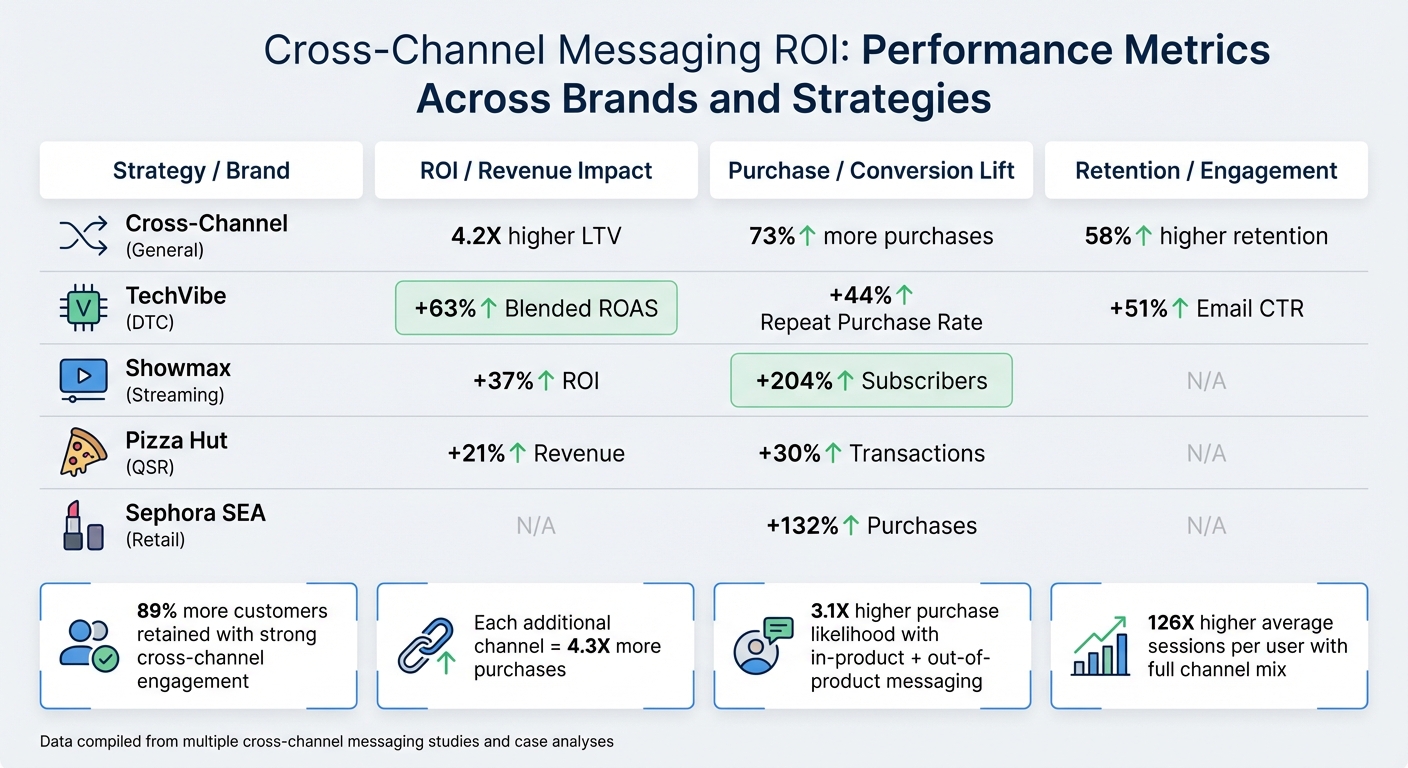
Cross-Channel Messaging ROI Comparison by Brand and Strategy
Research highlights the power of cross-channel messaging in driving growth. Brands with strong cross-channel engagement retain 89% more customers than those with weaker strategies.
Adding more channels amplifies results significantly. For instance, each additional channel increases purchases by 4.3X and raises the likelihood of buying by 2.8X. Combining in-product messages (like in-app notifications) with out-of-product channels (email, push notifications, SMS) boosts purchase likelihood by 3.1X compared to single-channel methods. High-performing brands stand out - they are 12% more likely to use three or more channels and 73% more likely to apply advanced message personalization.
The impact of combining channels is striking. Adding out-of-product channels to in-product messaging increases purchases by 6.5X, while incorporating in-product messaging into out-of-product channels results in a 25% purchase lift. A mix of in-app messages, mobile push, email, and web push can lead to 126X higher average sessions per user compared to no messaging at all.
These numbers underline the measurable ROI improvements that consistent cross-channel messaging delivers. The following table offers a comparison of metrics across various strategies.
Comparing ROI Across Cross-Channel Strategies
| Strategy / Brand | ROI / Revenue Impact | Purchase / Conversion Lift | Retention / Engagement |
|---|---|---|---|
| Cross-Channel (General) | 4.2X higher LTV | 73% more purchases | 58% higher retention |
| TechVibe (DTC) | +63% Blended ROAS | +44% Repeat Purchase Rate | +51% Email CTR |
| Showmax (Streaming) | +37% ROI | +204% Subscribers | N/A |
| Pizza Hut (QSR) | +21% Revenue | +30% Transactions | N/A |
| Sephora SEA (Retail) | N/A | +132% Purchases | N/A |
Certain industries display distinct trends. Fintech apps, for example, achieve conversion rates as high as 31% through cross-channel strategies. E-commerce, while seeing a smaller 6% conversion lift, experiences a 26% increase in customer stickiness. Subscription-based models benefit significantly, with stickiness improving between 30% and 70% when using two to four channels. Gaming platforms see a 32% improvement in stickiness with three or more channels, while fintech achieves a 28% boost.
Conclusion: What Business Owners Should Know
Cross-channel messaging isn't just a buzzword - it's a game-changer. Integrated channels can retain 89% more customers and drive 73% more purchases per user, creating a seamless journey from initial interest to brand loyalty. The numbers speak for themselves: TechVibe saw a 63% increase in ROAS while slashing customer acquisition costs by 28%. Pizza Hut, leveraging machine learning for testing, achieved a 30% boost in transactions and 21% revenue growth. As marketing strategist Alexander aptly said:
Winning isn't about mastering one platform - it's about choreographing your presence across platforms to move customers seamlessly from interest to intent to loyalty.
Consistency is critical. When your messaging aligns across email, social media, websites, and ads, customers experience a cohesive story rather than the frustration of repeating themselves - a frustration cited by 87% of consumers. Yet, only half of marketers report achieving this level of messaging consistency, leaving plenty of room to differentiate your brand.
Adding more channels to your strategy can amplify results. Each additional channel increases purchases by 4.3X and raises buying likelihood by 2.8X. Combining in-product and out-of-product messaging boosts purchase likelihood by 3.1X, and top-performing brands are 12% more likely to leverage three or more channels. Armed with these insights, you’re ready to take the next steps toward effective cross-channel messaging.
How to Implement Cross-Channel Messaging
1. Start with data integration. A centralized system, like a CRM or Customer Data Platform, is essential to unify customer profiles and provide a single source of truth. For example, abandoned cart actions should trigger coordinated responses across email, SMS, and retargeting ads.
2. Map your customer journey. Pinpoint where customers drop off and identify opportunities for cross-channel engagement. Use the 70-20-10 budget rule: devote 70% to proven channels, 20% to emerging opportunities, and 10% to experimental efforts.
3. Coordinate your channels. Ensure each channel supports the others. For instance, if a customer clicks an email but doesn’t convert, a follow-up ad on social media can reinforce the message. This approach helped Pizza Hut achieve its impressive gains in transactions and revenue.
4. Maintain consistency and personalization. Keep your voice, tone, and visuals uniform across all platforms. Then, tailor messages based on where customers are in their journey. A partner like SEO Werkz (https://www.seowerkz.com) can help integrate strategies like SEO, PPC, email, and social media into a cohesive system that maximizes ROI.
5. Adopt multi-touch attribution. Use tools like post-purchase surveys and multi-touch attribution to better understand how your channels work together. AI-powered tools are also emerging to personalize content in real time, delivering the right message at the right moment based on customer behavior.
The goal isn’t to be on every platform - it’s to ensure that wherever you are, your efforts are synchronized and purposeful. This coordination is what turns casual interest into lasting loyalty.
FAQs
What’s the difference between cross-channel and multi-channel marketing?
The key distinction lies in how the channels interact. Multi-channel marketing involves independent channels - such as social media, email, or physical stores - that function separately without much overlap. In contrast, cross-channel marketing connects these channels, allowing them to share data and deliver cohesive, tailored messages. This integration ensures a smooth customer journey, enhancing both engagement and return on investment (ROI). While multi-channel marketing gives customers various options, cross-channel marketing ensures those options work together seamlessly and meaningfully.
How do I connect customer data across email, SMS, ads, and my website?
To bring together customer data from email, SMS, ads, and your website, focus on creating a unified view of all interactions. This means integrating your platforms so they can share information and trigger personalized messages based on customer behaviors. By connecting data across channels, you can track the entire customer journey, making your messaging more consistent and your targeting more precise. Begin with a data audit to ensure your systems work together smoothly, enabling a seamless experience across every touchpoint.
How can I measure cross-channel ROI without double-counting conversions?
To get an accurate picture of cross-channel ROI without inflating results, try using cross-channel attribution models such as linear, time decay, or data-driven attribution. These models distribute credit for conversions across various touchpoints, ensuring each channel's impact is measured fairly. By unifying data from all channels, they offer a clearer understanding of the customer journey, helping you calculate ROI that truly reflects performance.