
Why Storytelling Matters for Education Brands
February 26, 2026Education brands are facing a trust crisis. Confidence in higher education has dropped from 57% in 2015 to just 36% in 2023. Traditional marketing methods like program listings no longer resonate with families questioning the value of a degree. Storytelling offers a solution by creating emotional connections and making information memorable.
Here’s why storytelling works:
- Boosts retention: Facts in stories are remembered 22x better; video storytelling increases retention to 95%.
- Builds trust: Emotional narratives answer key questions like, "Is this school worth it?"
- Solves marketing challenges: Overcomes low engagement, intense competition, and emotional disconnect.
- Drives results: Improves conversions, reduces costs, and strengthens loyalty.
Storytelling humanizes brands, highlights personal journeys, and differentiates institutions in a crowded market. By sharing relatable student and alumni stories, education brands can rebuild trust, inspire action, and stand out.
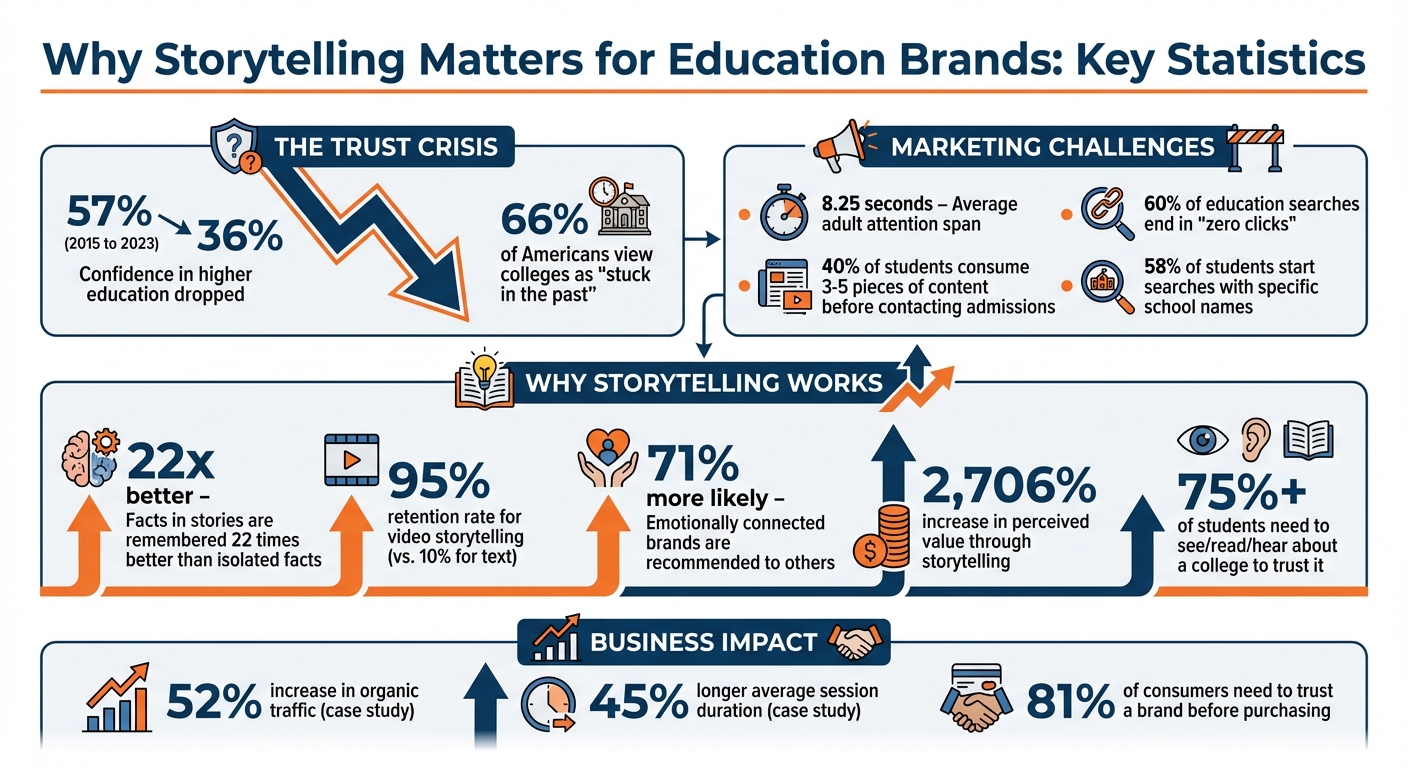
Education Marketing Challenges and Storytelling Impact Statistics
Does Your Brand Really Matter? A lesson from Higher Education [VIDEO]
sbb-itb-cef5bf6
Marketing Challenges for Education Brands
Education brands are navigating rough waters in today’s marketing world. The days when glossy brochures and polished campus photos could grab attention are long gone. Now, these institutions face three major hurdles that make it harder to stand out and connect with their audiences.
Low Audience Engagement
Today’s prospective students are harder to captivate than ever. With the average adult attention span clocking in at just 8.25 seconds, education marketers have only a fleeting moment to make an impression. Unfortunately, many lose their audience before they even begin.
The problem is compounded by digital ad fatigue. Students are overwhelmed by overly polished, corporate-style marketing that often feels disconnected from their real concerns. Adding to the challenge, nearly 60% of education-related searches end in "zero clicks" because students find what they need from AI-generated summaries or snippets. And when students do engage, 40% of them consume three to five pieces of content before even reaching out to admissions. This makes it clear that schools relying heavily on text-heavy or impersonal content are missing the mark.
High Competition in a Crowded Market
Standing out is no easy task when everyone is saying the same thing. At college fairs or on websites, phrases like "Empower the future" or "Change the world" are so overused that they’ve lost their meaning. It’s like trying to shout in a room where everyone’s already yelling the same thing.
What makes this even tougher is that 58% of students start their search with specific school names, not general program keywords. If a school doesn’t already have strong brand recognition, it risks being left out of the conversation entirely.
"We don't suffer from a storytelling problem. We suffer from a personality problem. Not a lack of it. An inconsistency expressing it."
- Joe Master, Vice President of Marketing and Brand Strategy, Carnegie
Another issue is inconsistent branding. One department might use a formal tone for alumni communications, while the social media team takes a casual approach, and ads lean on jargon. This lack of cohesion can make a school seem disjointed and unreliable. To rise above the competition, schools need more than just a catchy slogan - they need messaging that feels authentic and emotionally compelling.
Emotional Disconnect
The final hurdle is the lack of emotional connection in traditional education marketing. Many schools lean on dry statistics, rankings, and technical details - things people forget almost immediately. Research by psychologist Jerome Bruner shows that people are 22 times more likely to remember information when it’s part of a story rather than isolated facts.
Emotions play a huge role in decision-making. Brands that create emotional connections are 71% more likely to be recommended to others. Yet, much of education marketing still focuses on institutional prestige rather than the personal journeys of prospective students.
With 66% of Americans viewing colleges as "stuck in the past," simply listing features doesn’t cut it anymore. Schools need to show how they transform lives and create impactful experiences. Without this emotional depth, their messages risk fading into the background. To rebuild trust and inspire action, storytelling must take center stage, turning facts into narratives that truly resonate.
How Storytelling Solves These Problems
Storytelling changes the game for education marketing by turning impersonal facts into meaningful, relatable experiences. Instead of overwhelming prospective students with rankings or statistics, it connects with them emotionally, making the information memorable. Take Kenyon College as an example: when they announced a new library, they didn’t focus on square footage or design accolades. Instead, they showcased students sharing stories about the friendships and experiences that space would foster. The result? A message that resonated because it spotlighted the human side of campus life, not just the infrastructure.
Humanizing the Brand
One of the biggest shifts storytelling brings is replacing cold, formal language with genuine human connection. For instance, when Indiana Wesleyan University launched its engineering program, they didn’t feature high-ranking administrators. Instead, they highlighted Dr. David Che, a faculty member, in their marketing materials. This choice made their professors feel approachable, presenting them as mentors rather than distant figures. It built a sense of empathy and relatability that prospective students could connect with.
"Effective communication occurs at the intersection of empathy and authenticity."
This strategy works because it answers the questions students truly care about: "Will I belong here? Will my professors know me? Can I see myself thriving in this place?" By consistently sharing this personality across various platforms - like social media and alumni magazines - schools foster trust, turning initial curiosity into genuine interest. Once this personal connection is established, storytelling can go even further by crafting unforgettable narratives.
Creating Memorable Messages
After humanizing the brand, the next step is creating messages that inspire action. Visual storytelling, for example, leaves a stronger impression than plain text. But it’s not just about using visuals - it’s about structuring the story effectively. Many successful education campaigns use the "Hero’s Journey" framework, where the student takes center stage as the hero, and the institution acts as the mentor guiding them.
"Every student is the hero of their story."
- Joseph Lapin, Vice President of Marketing and Brand Strategy, Archer Education
When Houghton College wanted to address concerns about affordability and career outcomes, they didn’t just release employment statistics. Instead, they shared alumni success stories that featured real graduates thriving in their careers. These stories answered the question, "Is this school worth it?" in a way that spreadsheets and charts never could.
Highlighting What Makes You Different
Buzzwords like "world-class" or "transformative" have lost their punch because they’re overused. To stand out, schools need specific, vivid stories that show - not just tell - what sets them apart. For example, instead of claiming to be “innovative,” a school might share a story about a student who revamped the campus recycling program or a professor whose research influenced local policies. These concrete examples create a voice that feels distinct and authentic, making it hard for competitors to imitate.
Consistency is key here. When your emails, social media, and other materials all reflect the same personality and tone, you build a recognizable reputation. As Carnegie Higher Ed puts it, brands that achieve this clarity can "brand more - so they can market less". In other words, a strong, consistent voice does much of the work for you, cutting through the noise without the need for constant explanation.
Benefits of Storytelling for Education Brands
When human connection meets a memorable narrative, the results can be powerful for education brands. Storytelling doesn’t just solve marketing challenges - it creates meaningful connections that drive real outcomes.
Improving Conversions and Reducing Costs
A compelling story does more than grab attention - it motivates action while keeping marketing budgets in check. Research shows that when prospective students are drawn into a narrative, they experience "reduced counterarguing", meaning they’re less likely to push back against your message. This shift can streamline decision-making for families and shorten the enrollment process.
Storytelling also boosts perceived value - by an astonishing 2,706%. Add video into the mix, and your message becomes even more memorable. This matters when families are weighing significant education investments.
Take the example of Joseph Lapin, Vice President of Marketing and Brand Strategy at Archer Education. In 2021, his team launched a storytelling campaign for a Master’s in Education program. After interviewing a student inspired by caring for a foster child with autism, they centered their campaign around the theme: "Raise your hand if you want to change education forever." By focusing on students as the heroes of their own journeys, they moved beyond fact-based marketing, helping to justify tuition and increase enrollment.
"Using technology effectively to reach prospective students can reduce marketing costs by allowing you to get the message out at scale."
- Joseph Lapin, Vice President of Marketing and Brand Strategy, Archer Education
Reinforcing the same story across multiple platforms builds trust and lowers the cost per lead.
Increasing Loyalty and Retention
Storytelling doesn’t end with enrollment - it keeps students engaged throughout their education journey and beyond. Emotional connections built through stories encourage persistence and long-term loyalty.
In fact, emotionally connected customers are 71% more likely to recommend a brand to others. Stories also enhance memory retention, which can strengthen the sense of community among students, alumni, and their families.
This is especially critical in an era of declining trust in higher education. Public trust has dropped by 88% in just three years, with Americans’ confidence in colleges falling from 57% in 2015 to 36% in 2023. Authentic storytelling can rebuild that trust by fostering a sense of belonging.
Consider ClassDojo, which reached over 50 million students worldwide between 2011 and 2021. By shifting its focus from product features to storytelling, the company expanded its reach and deepened engagement. This approach also boosted internal buy-in, with 86% of employees believing in the company’s commitment to learning and development.
Building Trust and Credibility
In a competitive market, where over 75% of students say they need to see, read, or hear about a college to trust it, storytelling bridges the gap between being unknown and being credible. A genuine narrative makes your institution relatable and trustworthy, answering the critical question: "Can I believe what you’re telling me?"
Consistency is key. When admissions, alumni relations, and social media teams all speak with one cohesive voice, it strengthens brand recognition and builds trust.
"Repetition is recall. And even more? That consistency of expression results in clarity of perception."
- Joe Master, Vice President of Marketing and Brand Strategy, Carnegie
Visual storytelling amplifies this effect. Audiences retain 95% of a message delivered through video, compared to just 10% when reading text. Pairing alumni stories with hard data - like career outcomes - creates a balanced narrative that appeals both emotionally and logically.
Over time, trust built through storytelling can spark a cycle of word-of-mouth referrals, reducing reliance on paid advertising and enhancing long-term reputation. These benefits highlight why storytelling is a cornerstone of successful education branding.
Storytelling Strategies for Education Brands
Using Student and Alumni Stories
Student and alumni stories create a connection that helps prospective students picture themselves at your institution. A great way to do this is by focusing on transformation - showcasing the challenges students faced before enrollment, the support they received during their studies, and the success they achieved after graduation.
One effective idea is to implement a student ambassador program. For instance, Lee University’s Vice President for Enrollment and Marketing, Dr. Jeff Salyer, brought together a team of 10 student social media storytellers from various majors to share authentic content through their own voices.
Research shows that stories improve memory retention, making them a powerful tool. While your institution’s brand represents a promise, alumni serve as proof of that promise. Highlighting "before and after" success stories - like career achievements and personal growth - can help prospective students visualize how your institution could shape their future.
"Your graduates are your greatest assets, and the most relatable way for a prospective student to see the connection between their life today and a graduate in a career they love."
- Brad Miller, CMO, Studio Enterprise
Interviews with students, staff, and community members can uncover genuine moments of passion, perseverance, and growth - key ingredients for compelling narratives.
Next, let’s discuss how to ensure these stories remain consistent across all digital platforms.
Integrating Stories Across Digital Channels
Consistency is key when sharing your story. Studies show that brand trust jumps when people encounter the same message across at least three platforms. Whether it’s your admissions team, alumni office, or social media managers, everyone should communicate a unified narrative.
Adopt a media-first mindset by creating short, mobile-friendly content that works across different platforms. Video should play a central role - viewers retain 95% of a message when they watch it in a video compared to only 10% when reading text. Share your core stories across your website, email campaigns, and social media to keep your audience engaged.
Take inspiration from New York University’s "MeetNYU", launched in 2015. This social media initiative engages prospective students and simplifies the admissions process. Over time, it’s grown into a multi-platform storytelling ecosystem that supports students from recruitment through graduation.
Data can also guide your storytelling. Tools like Google Analytics and social media monitoring platforms can reveal your audience’s interests and pain points, helping you craft stories that directly address their concerns. With nearly 60% of education-related searches ending in "no clicks" due to students relying on AI-generated summaries, optimizing your stories for search engines is more important than ever.
For a truly cohesive message, consider collaborating with professional storytellers.
Working with Experts for Better Results
Education brands often struggle with fragmented messaging - admissions, alumni relations, and social media teams may sound like they’re speaking for different institutions. Professional storytellers can help unify these voices, creating an authentic and trustworthy brand identity.
Internal teams might miss powerful stories because they see academic journeys as routine. Professional storytellers, however, know how to uncover those impactful moments of transformation. They turn data like rankings and ROI into emotional narratives that connect with prospective students’ goals and values.
For example, SEO Werkz specializes in helping education brands craft effective content marketing strategies. They address communication gaps across digital channels with expertise in search engine optimization, web design, social media marketing, and storytelling. This ensures your student and alumni stories reach the right audience at the right time, building trust and driving enrollment.
"We don't suffer from a storytelling problem. We suffer from a personality problem. Not a lack of it. An inconsistency expressing it."
- Joe Master, Brand Strategist
Working with experts also brings specialized skills in areas like visual storytelling, psychological archetypes, and omnichannel messaging - capabilities that internal teams may not have. With over 4,300 colleges and universities in the U.S., professional storytelling can set your institution apart from the rest.
Measuring the Impact of Storytelling on ROI
To evaluate how storytelling contributes to your ROI, look at both hard outcomes like enrollment numbers and soft outcomes such as brand trust. Since students often make decisions over an extended period, it’s crucial to track their journey - from their first interaction with a story to eventual enrollment and beyond.
The Council for Advancement and Support of Education (CASE) suggests breaking down your measurement into six categories: brand development, recruitment and retention, strategic communications, alumni engagement, philanthropy, and external engagement. This approach helps you see how storytelling influences various aspects of your institution's goals, turning engagement into measurable success across the board.
Engagement Metrics
Start by gauging how well your stories resonate with your audience. Metrics like time spent on a page, scroll depth, and social media activity (shares, comments, click-throughs) provide valuable insights into audience engagement. Tools like Hotjar and Crazy Egg can help identify where readers lose interest.
For example, Manning Pool Service partnered with EWR Digital to redesign their website with a storytelling focus. The results? A 52% increase in organic traffic, a 58% rise in page views, and a 45% longer average session duration year-over-year. This example highlights how narrative-driven content not only grabs attention but also keeps visitors engaged, encouraging them to explore more.
Conversion Tracking
Engagement is just the beginning - next, track how storytelling drives tangible results. Use attribution techniques like UTM parameters and dedicated landing pages to directly link storytelling campaigns to enrollment applications. Your CRM system (whether it’s HubSpot, Salesforce, or Zoho) should map out the entire student journey, starting with their first exposure to a story and ending with their enrollment decision.
Take the case of MyVitalC’s owner, Chris Burres, who shared his brand’s story through 13 podcasts, including the Dr. Gundry podcast. Instead of running traditional ads, this storytelling approach turned a $3,600 investment into $234,000 in revenue, with monthly sales jumping from $4,000 to $12,500. While this example comes from retail, it underscores how authentic storytelling can turn engagement into measurable conversions.
Retention and Satisfaction Indicators
Storytelling doesn’t just attract new students - it also strengthens loyalty and satisfaction. Tools like Brandwatch or Mention can analyze the emotional tone of social media mentions and reviews. Additionally, tracking your Net Promoter Score (NPS) among current students and alumni can reveal whether your narratives are fostering long-term advocacy.
Research shows that emotional connections can triple repeat engagement and referrals. For educational institutions, this means better retention rates, increased alumni donations, and more word-of-mouth recommendations. To measure the effectiveness of your storytelling campaigns, survey students before and after these efforts to track changes in brand trust and recognition. Keep in mind that 81% of consumers need to trust a brand before making a purchase. By continuously monitoring these metrics, you can ensure your storytelling strategy builds lasting value and strengthens relationships with your audience.
Conclusion
Education brands are grappling with a significant trust gap - public confidence in higher education has dropped to just 36%, a sharp decline from 57% in 2015. Storytelling offers a way to bridge this divide by turning impersonal institutional data into relatable, emotional narratives that resonate with audiences.
Making the shift to storytelling requires more than just good intentions. It calls for expertise, consistent messaging across every platform, and reliable methods to measure impact. As Joe Master puts it, "brand more, so you can market less". This approach hinges on creating a unified voice that ties together every interaction and communication channel.
When institutions are ready to see measurable results, working with experts can solidify their efforts. Collaborating with professionals like SEO Werkz (https://seowerkz.com) provides the strategic framework and creative tools needed to implement cohesive storytelling. These experts guide institutions through the complexities of modern digital marketing, help them optimize for AI-driven search engines, and produce engaging video content - a format where 95% of the message sticks with viewers. With their support, key metrics such as engagement, conversions, and long-term student loyalty can be effectively tracked and improved.
FAQs
What makes a school story feel authentic (not like an ad)?
A school story resonates best when it captures real-life experiences shared by students, families, and staff. Steering clear of overly polished or promotional language, these stories focus on meaningful moments that build an emotional connection. This approach helps showcase the school’s genuine character and core values.
How do we turn student outcomes data into a compelling story?
To turn student outcomes data into a story that resonates, pair the numbers with a personal narrative. Zero in on one student’s journey to bring the data to life - share their struggles, the support they received, and their eventual triumphs. For instance, rather than just presenting dropout rates as cold figures, recount how a specific program helped a student navigate challenges and succeed. This kind of storytelling makes the data relatable and leaves a lasting impression on your audience.
Which storytelling metrics best predict enrollment ROI?
Key metrics for storytelling that can impact enrollment ROI include brand clarity, the effectiveness of narratives in building a memorable identity, and how well prospective students connect with the brand’s story. These elements play a role in improving retention rates, enhancing the institution’s appeal, and distinguishing it in a crowded market - all of which contribute to stronger enrollment results.