5 Pros and Cons of Manual and Automated Bidding
April 11, 2026When deciding between manual and automated bidding for your ad campaigns, the choice often comes down to control versus efficiency. Here's the breakdown:
- Manual Bidding: Gives you full control over individual bids but requires constant monitoring and expertise. Best for small campaigns, limited budgets, or niche markets.
- Automated Bidding: Uses machine learning to optimize bids in real-time, saving time and handling large-scale campaigns. Works best when you have sufficient conversion data (15–50 conversions in 30 days).
Quick Overview:
- Manual Bidding:
- Pros: Full control, real-time adjustments, ideal for small budgets and niche campaigns.
- Cons: Time-consuming, prone to human error, hard to scale.
- Automated Bidding:
- Pros: Saves time, optimizes with data, handles large campaigns, reacts quickly to market changes.
- Cons: Less control, depends on quality data, higher initial costs during learning phase.
Quick Comparison
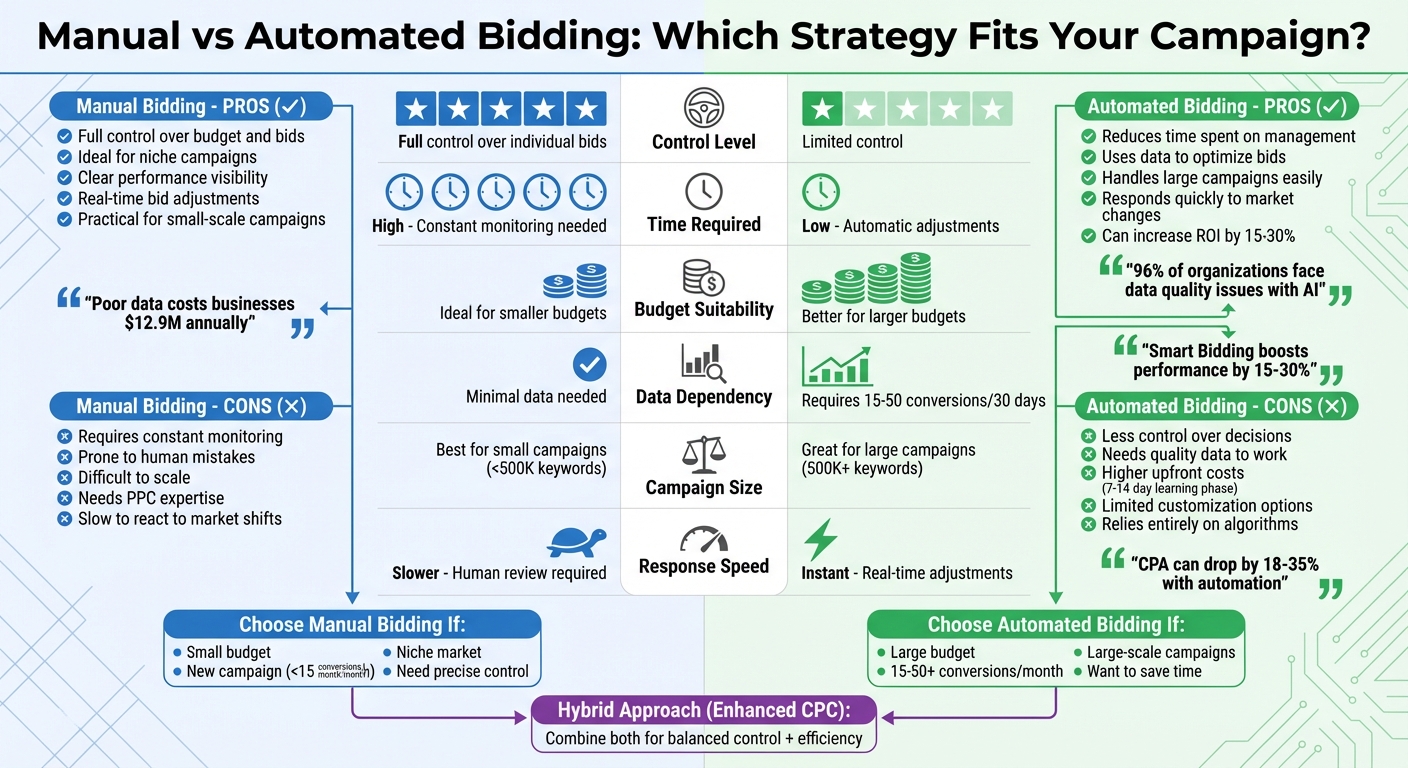
| Factor | Manual Bidding | Automated Bidding |
|---|---|---|
| Control Level | Full control | Limited control |
| Time Required | High | Low |
| Budget Suitability | Ideal for smaller budgets | Better for larger budgets |
| Data Dependency | Minimal | High |
| Campaign Size | Best for small campaigns | Great for large campaigns |
Choose manual bidding for precision and smaller campaigns. Opt for automated bidding to save time and scale larger campaigns. A hybrid approach, like Enhanced CPC, can combine the strengths of both.
Manual vs Automated Bidding: Complete Comparison Guide
5 Advantages of Manual Bidding
1. Full Control Over Budget and Bids
With manual bidding, you’re in the driver’s seat when it comes to spending. You can set the exact maximum bid for each keyword, ad group, or location, ensuring you never exceed your desired cost per click. This hands-on approach removes the guesswork often associated with algorithms. As Nick Budincich from Basis explains, "Control of bids gives the advertiser direct power over influencing performance." Plus, this level of transparency helps you monitor spending on specific search terms and make quick adjustments when something isn’t performing as expected.
2. Ideal for Niche Campaigns
Automated bidding typically requires a minimum of 15 conversions in 30 days to function effectively, which can make it less suitable for niche campaigns. Manual bidding allows you to lean on your strategic insights and personal expertise, especially when focusing on specialized markets or highly targeted keywords. For smaller campaigns with fewer variables, manual bidding often proves to be the more effective option. It also simplifies performance tracking, giving you a clearer picture of your results.
3. Clear Performance Visibility
One of the standout benefits of manual bidding is its straightforward cause-and-effect relationship. When you tweak your bids, you can immediately see how it impacts clicks and conversions. This clarity makes it easier to identify what’s working and what isn’t. If a particular strategy isn’t delivering results, you can spot the issue quickly and take corrective action.
4. Real-Time Bid Adjustments
Manual bidding shines when it comes to responding to sudden market changes. Whether it’s a competitor launching a promotion or a spike in seasonal demand, you can adjust your bids instantly. This flexibility is especially useful for high-value keywords and campaigns tied to specific timeframes. For example, you can increase bids during peak hours to capture more traffic and scale back during quieter periods to save your budget.
5. Practical for Small-Scale Campaigns
For smaller campaigns, manual bidding offers a hands-on, budget-conscious approach. The ability to make real-time adjustments and focus spending on proven performers is invaluable when working with limited funds. As Susmy T S, PPC Analyst at TechWyse, points out, "We don't recommend going ahead with automated bidding when you have less budget. Automated bidding tends to raise the max CPC bids of keywords based on the competition. And finally, you might end up spending all your budget for a few clicks..." This makes manual bidding a safer choice for campaigns where every dollar counts.
sbb-itb-cef5bf6
5 Disadvantages of Manual Bidding
1. Requires Constant Monitoring
Manual bidding demands continuous attention and regular adjustments. You need to frequently analyze performance data, decide when and how much to adjust bids, and manually implement these changes - sometimes daily or weekly. This process eats into time that could be spent on higher-level tasks like shaping media strategies, writing persuasive ad copy, or improving landing pages.
"Time investment is needed. Continuous analysis, review, and mental energy must be applied on the same set of tasks. Manual bidding takes time and effort!" – Nick Budincich, Basis
The repetitive nature of these tasks can lead to mental fatigue, increasing the risk of burnout or errors. Without consistent oversight, bids might end up too low to attract valuable traffic or too high, leading to wasted ad spend. To manage this, some marketers set up automated alerts to flag when bids hit specific thresholds. Still, the heavy involvement required makes errors more likely.
2. Prone to Human Mistakes
Mistakes in manual bidding can have a significant impact on campaign performance. For instance, marketers may over-optimize by adjusting too many variables - like age, gender, location, and device - all at once. They might also make decisions based on just one day’s data instead of examining trends over a longer period. This can lead to poor choices, like focusing solely on ROAS while ignoring other key metrics such as POAS or impression share.
Another common issue is making overly cautious adjustments, such as tweaking bids by just 5% when a more aggressive change of 15% to 30% might be needed.
"We should not jump into conclusions after testing the bidding strategy for just 1 or 2 weeks." – Susmy T S, PPC Analyst, TechWyse
3. Difficult to Scale
As campaigns grow, manual bidding quickly becomes unsustainable. Large programs - those managing over 500,000 keywords and handling monthly budgets of $500,000 or more - can overwhelm even the most experienced marketers. Managing so many variables manually is not only exhausting but also risks compromising the quality of your campaigns.
"There is a problem of scale that arises. Time and effort from humans has limits, particularly with regard to processing power." – Nick Budincich, Basis
Unlike automated systems that process millions of data points in real-time, human managers simply can’t keep up with the sheer volume of decisions needed for every auction.
4. Needs PPC Knowledge
To succeed with manual bidding, you need a solid understanding of PPC. This includes knowing when to adjust bids, by how much, and which metrics to prioritize. Gaining this expertise takes time and experience, especially when it comes to analyzing performance data, understanding customer journey timelines (which can vary from 7 to 90 days), and knowing when to act versus when to wait. Without this knowledge, adjustments can backfire, hurting overall campaign performance.
Manual bidding is often better suited for smaller campaigns with fewer moving parts. However, delays in responding to market changes can still limit its effectiveness.
5. Slow to React to Market Shifts
Manual bidding struggles to keep pace with sudden changes in the market. Automated systems can instantly analyze real-time data and make adjustments across thousands of variables, while manual processes require time to detect shifts, evaluate their impact, and implement changes. This slower response time can lead to missed opportunities, especially during unexpected demand spikes or competitor promotions.
"Manual bidding requires you to constantly monitor your campaigns, which can be difficult if you run many of them at once. You'll need to keep track of each individual account and adjust bids accordingly, which means checking multiple spreadsheets or dashboards throughout the day." – Josh Maraney, CEO, Topclick
5 Advantages of Automated Bidding
1. Reduces Time Spent on Management
Automated bidding takes the hassle out of constant manual monitoring by adjusting bids automatically based on real-time data. Instead of dedicating hours to analyzing performance reports and tweaking bids for individual keywords or ad groups, machine learning takes care of these tasks instantly. This allows you to focus on other priorities like crafting better ad copy, refining your overall strategy, or improving conversion rates.
The system can handle multiple campaigns and a large volume of keywords at once - work that would otherwise demand serious manual effort. If managing campaigns daily feels overwhelming, automated bidding can significantly lighten your load while keeping your campaigns on track.
2. Uses Data to Optimize Bids
Automated bidding taps into a wealth of historical and real-time data to make smarter decisions. These machine learning algorithms analyze data points beyond what advertisers can see, predicting the chances of a click turning into a conversion for every individual auction.
"With automated bidding strategies, Google is able to take data points into account that we don't even know exist." – Sharky, Sharkz Marketing
For example, strategies like Target ROAS use past performance data to forecast future conversion values, setting the ideal bid for specific users at specific moments. While Google recommends a minimum of 15 conversions in the past 30 days for Target CPA bidding, industry experts suggest aiming for 30 to 50 conversions to give the algorithm enough data to work effectively. Enhanced CPC has also improved, now adjusting bids without the previous 30% cap, making it even more precise.
3. Handles Large Campaigns Easily
Managing large-scale campaigns is where automated bidding shines. It uses AI to adjust bids across thousands of keywords simultaneously - something that would be incredibly difficult to do manually. This makes it especially useful for advertisers running multiple campaigns or dealing with extensive keyword lists.
"Larger firms and skilled marketers, on the other hand, may gain from automated bidding in terms of efficiency and ROI." – 7SearchPPC
The best part? It handles this complexity without requiring extra effort from you, ensuring consistent performance across all campaigns, no matter their size.
4. Responds Quickly to Market Changes
Automated bidding reacts in real time to auction data and market trends, keeping your campaigns competitive. Unlike manual bidding, which relies on human observation and slower adjustments, automated systems can instantly adapt to shifts in competition, demand surges, or trending patterns.
"Automated bidding adapts according to market changes, assuring competitiveness." – 7SearchPPC
This quick reaction time ensures your campaigns stay effective, even during unexpected market changes, capturing opportunities that manual methods might miss.
5. Can Increase ROI
By constantly fine-tuning bids based on performance data, automated bidding can help improve your return on investment over time. It uses real-time auction insights and historical data to hit goals like Target ROAS or Target CPA, ensuring every dollar spent works harder for you.
"AI and machine learning maximize bids using previous data and real-time auction insights." – 7SearchPPC
For example, when Enhanced CPC is working properly, you should see improvements in both Click-Through Rate (CTR) and Conversion Rate (CVR). However, the system's success depends on having solid historical data - without enough conversions, it can't make accurate predictions.
5 Disadvantages of Automated Bidding
1. Less Control Over Decisions
With automated bidding, you lose the ability to adjust individual bid amounts manually. Unlike manual bidding, where you can tweak the Maximum Cost-Per-Click (Max CPC) for each keyword, automated systems keep these individual bid decisions hidden from view. The platform essentially takes full control of the bidding process.
"Control of bids gives the advertiser direct power over influencing performance. A human looks at performance, judges if the bids need to change, decides what that change should be, and then actually makes that change." – Nick Budincich, Basis
This lack of transparency can be frustrating. For instance, the system might increase your Cost-Per-Lead without you being able to intervene at the auction level. Automated bidding systems are designed to spend your budget to meet their preset goals, which might not always align with your business priorities. If your attribution model is flawed, the algorithm's decisions will reflect those inaccuracies, leaving you with limited options to correct them.
2. Needs Quality Data to Work
Automated bidding is only as effective as the data it relies on. If your data is incomplete or inaccurate, the system's performance will take a hit. Errors in the data aren't just small setbacks - they can cascade into larger problems across your campaigns.
For example, poor-quality data has caused significant financial losses for companies using machine learning models. Statistics reveal that 96% of organizations face data quality issues when training AI systems, and these issues cost businesses an average of $12.9 million annually.
"If 80 percent of our work is data preparation, then ensuring data quality is the most critical task for a machine learning team." – Andrew Ng, Founder, DeepLearning.AI
Without timely and accurate data, automated bidding systems make flawed assumptions, leading to wasted ad spend. Additionally, these systems often drive up costs during their initial learning period, compounding the problem.
3. Can Cost More Upfront
Automated bidding requires a "learning phase" that typically lasts 7 to 14 days. During this time, performance is unstable, and costs often spike as the algorithm experiments with different bid amounts to gather data. This trial-and-error process can lead to much higher initial costs compared to manual bidding.
For instance, in a test using a Target CPA strategy, the Cost-Per-Acquisition soared to around $1,100 during the learning phase before eventually stabilizing at approximately $600. Campaigns without historical data are especially vulnerable to inefficiencies during this period, potentially leading to significant overspending without immediate results.
4. Limited Customization Options
Automated bidding systems lack the flexibility to make precise adjustments. While you can set high-level goals and budget limits, you lose the ability to fine-tune bids for specific keywords or ad groups based on your unique insights. This can be a major drawback for campaigns that require detailed adjustments to align with specific business strategies.
5. Relies Entirely on Algorithms
These systems depend entirely on algorithms, which can overlook important external factors. While they analyze historical data and real-time signals, they can't account for unexpected events or seasonal trends that fall outside their programmed parameters.
"Psychologically, control makes the process 'known'. It is familiar. It removes a large black box and replaces it with understandable logic." – Nick Budincich, Basis
Algorithms can also experience "drift" over time, meaning their effectiveness may decline as market conditions evolve. Unlike a human strategist, an algorithm can't adapt to sudden changes or apply business intuition, which can leave your campaign vulnerable when the market shifts rapidly.
Manual vs. Automated Bidding Comparison
Comparison Table
Here's a quick breakdown to help you figure out whether manual or automated bidding is the better fit for your campaign:
| Factor | Manual Bidding | Automated Bidding |
|---|---|---|
| Control Level | Full control over individual keyword bids and max CPC | Limited control; the algorithm adjusts bids based on goals |
| Time Required | High – demands constant monitoring and manual tweaks | Low – the system adjusts bids automatically |
| Precision | High – spending is tightly managed through human judgment | Lower – relies on algorithmic decisions using real-time data |
| Responsiveness | Slower – depends on how often performance data is reviewed | Instant – quickly reacts to market changes |
| Budget Suitability | Ideal for smaller, fixed budgets | Perfect for larger, more adaptable budgets |
| Data Dependency | Minimal – works well without much historical data | High – needs significant data for optimization |
| Ideal Campaign Size | Best for smaller campaigns with targeted keywords | Great for large campaigns with numerous keywords |
| Cost Efficiency | High when managing specific keyword costs | High for optimizing ROI across large datasets |
This table highlights the balance between control and efficiency, making it easier to choose based on your campaign size, budget, and data readiness.
Manual bidding appeals to those who want full control but are ready to invest time and effort. On the other hand, automated bidding is all about speed and reduced hands-on management. As Nick Budincich from Basis Technologies explains:
"Machines are taking our jobs is real; but in the best of ways. You (the human) get the job of thinking, planning, and deciding, then the robot gathers the data, performs the calculations, and executes hundreds of thousands of actions for you."
One key consideration is that automated bidding thrives on a solid conversion history. Without this data, its effectiveness can be limited. Manual bidding, however, doesn’t rely on historical data, making it a practical option for new campaigns.
Another advantage of manual bidding is its ability to tightly control spend on individual keywords. Automated strategies, while efficient, may use up your entire budget. This makes manual bidding a better choice for campaigns with tight budget constraints, while automated bidding works well when you have a larger, more flexible budget.
🧐 Pros & Cons of Manual Vs Automated Bidding [Part I]
When to Use Manual Bidding
Manual bidding is particularly effective when working with limited budgets, as it helps avoid overspending on costly clicks. Susmy T S, a PPC Analyst at TechWyse, highlights this point:
"We don't recommend going ahead with automated bidding when you have less budget. Automated bidding tends to raise the max CPC bids of keywords based on the competition."
This approach is also beneficial for new campaigns with minimal data. If your campaign hasn’t generated 15–50 conversions within 30 days, automated systems won’t have enough information to optimize effectively. Additionally, Google Ads' learning phase may slow down the process, further delaying results.
Manual bidding is a smart choice in niche markets where your audience is clearly defined. By assigning specific bids to low-volume but high-intent keywords, you can allocate your budget more precisely. This level of control is especially useful for strategies that demand tailored adjustments.
For high-stakes keywords, such as branded terms, manual bidding offers the ability to set exact bid caps and make real-time adjustments. This ensures you can secure top positions while keeping spending in check. Unlike automated bidding, which takes a broader approach, manual bidding gives you the precision needed to fine-tune your strategy.
When to Use Automated Bidding
Manual bidding can work well for smaller, niche campaigns, but when it comes to managing large-scale, data-heavy campaigns, automated bidding is the way to go.
Automated bidding shines in campaigns with thousands of keywords - far beyond what human monitoring can handle. For example, e-commerce businesses running multiple product campaigns benefit greatly from algorithms that automatically manage and analyze vast amounts of data. This makes automation a key tool for large e-commerce operations where managing data manually isn’t feasible.
Campaigns rich in data see the biggest advantages from automated bidding. Google’s machine learning algorithms can analyze millions of signals - like device type, location, time of day, browser, and operating system - within milliseconds. However, for automation to deliver its best results, your campaigns need to have already collected a solid amount of conversion data.
If you have specific performance goals, automated bidding can help you achieve them efficiently. Whether you're targeting a specific CPA, conversion value, or ROAS, automation can help optimize bids to meet those objectives. In fact, Smart Bidding has been shown to boost performance by 15–30% compared to manual strategies, with cost per acquisition often dropping by 18–35% due to more accurate bid adjustments.
Automated bidding is also incredibly effective during critical moments like seasonal sales or product launches. Unlike manual methods, automation can instantly adapt to market changes and competitive shifts, adjusting bids in real time. This auction-time bidding sets a unique bid for every search query, tailored to its specific context and conversion potential.
Using Both Manual and Automated Bidding Together
Blending manual and automated bidding allows you to combine the precision of manual control with the adaptability of automation, creating a balanced approach to improve campaign performance. This hybrid strategy can help you take advantage of both methods without compromising on efficiency or oversight.
One popular hybrid method is Enhanced CPC (E-CPC). This approach lets you manually set maximum CPC bids for each keyword while using automation to adjust bids dynamically to boost conversions. As Susmy T S, PPC Analyst, explains:
"The difference which sets apart the E-CPC and automated bidding is that you can view the max CPC bid of each keyword and change the bids of each keyword".
E-CPC provides the benefit of real-time optimization while allowing you to maintain visibility and control over individual keyword bids.
Another useful strategy is keyword tiering. With this approach, you can apply manual bidding to high-value keywords that require precise control. For lower-priority or high-volume keywords, automated bidding can help streamline management and improve efficiency. This way, you avoid the overwhelming task of manually managing thousands of keywords while still focusing on your most critical terms.
When starting out, manual bidding can be a great way to gather initial data. Aim to collect conversion data - typically 15 to 50 conversions over 30 days - before transitioning to automated strategies like Target CPA or Target ROAS for more advanced optimization. This phased approach ensures that your automated strategies have enough data to perform effectively.
Conclusion
Choosing the right bidding strategy depends on factors like budget, campaign size, data availability, and your specific goals. Manual bidding is ideal for smaller budgets, niche campaigns, or situations where historical data is limited. It gives you complete control and transparency over bids but requires ongoing management and expertise. This approach is particularly useful in the early stages of a campaign or when precision is a top priority.
On the other hand, automated bidding shines in larger campaigns with enough conversion data - typically 15–50 conversions within 30 days. It simplifies management, responds quickly to market changes, and optimizes for goals like Target CPA or Target ROAS. However, it does mean giving up some control over individual bids.
A hybrid approach, such as Enhanced CPC, offers a balance by combining manual control with automated adjustments to boost conversions. For example, you could manually manage high-value keywords while using automation for lower-priority or high-volume terms.
The trick is aligning your bidding strategy with your campaign's current needs. If you're just starting out or lack sufficient data, manual bidding is a good starting point. As your campaign grows and you gather performance data, transitioning to automated bidding can help scale your efforts. Always test changes before fully committing, and remember that automated strategies typically need a two-week learning period to optimize effectively.
FAQs
How do I know if I have enough conversion data for automated bidding?
To make the most of automated bidding, your campaign should generate at least 30 conversions per month. This provides enough data for machine learning to work efficiently, helping it fine-tune and align with your specific goals.
What should I do during the automated bidding learning phase?
During the automated bidding learning phase, it's best to avoid making frequent changes to your campaign. Doing so can restart or prolong the learning process. After updating your bid strategy, give the algorithm about 1–2 weeks to collect data and stabilize. Focus on making only essential adjustments, such as fine-tuning your targeting or budget. Keep a close eye on performance during this time to help the algorithm optimize as intended.
Can I use manual and automated bidding together in one account?
Yes, you can mix manual and automated bidding within the same account by assigning different strategies to specific campaigns or ad groups. This approach lets you retain manual control where precision is key while taking advantage of automated tools to boost efficiency in other areas. By aligning bidding methods with your unique goals and metrics, you can tailor your strategy for the best possible performance.