Free vs. Paid Email Marketing: Key Differences
July 18, 2026If I have a small list and send a few emails a month, a free plan can work. If email helps me get sales, leads, or repeat buyers, a paid plan usually makes more sense.
Here’s the short version:
- Free plans cost $0/month
- They often cap me at around 500 to 1,000 subscribers
- They limit monthly sends, automation, reporting, and support
- They often keep the provider’s logo in my emails
- Paid plans give me more sends, more control, and better tracking
- Segmented campaigns can drive 760% more revenue
- Automated email sequences can drive 320% more revenue
- One 2024 study found email ROI of $45 for every $1 spent with automation, versus $24 for every $1 from manual sends
If I’m deciding between free and paid, I’d look at:
- List size
- How often I send
- Whether I need automation
- How much revenue email brings in
- Whether basic reports are enough
- How much time my team spends doing things by hand
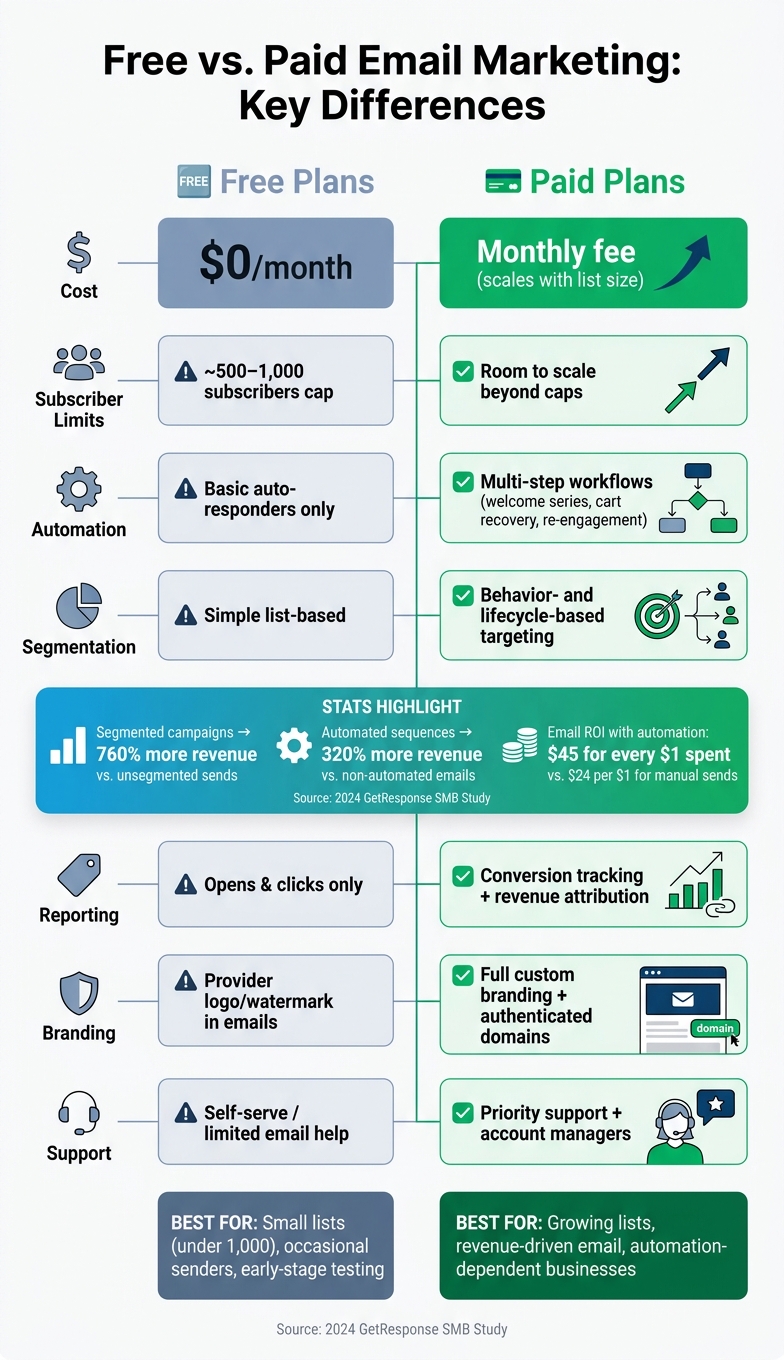
Free vs. Paid Email Marketing: Features, Limits & ROI at a Glance
Best Email Marketing Platform | Free vs Paid: What's Right for YOU in 2026?
sbb-itb-cef5bf6
Quick Comparison
| Aspect | Free Plans | Paid Plans |
|---|---|---|
| Cost | $0/month | Monthly fee that grows with list size |
| Subscriber limits | Low caps | More room to grow |
| Send limits | Tight monthly limits | Higher sending capacity |
| Automation | Basic only | Multi-step flows |
| Segmentation | Simple lists | Behavior-based targeting |
| Reporting | Opens and clicks | Conversions and revenue data |
| Branding | Provider logo often stays | Brand control |
| Support | Self-serve or limited email help | Priority support options |
My takeaway: free plans are fine for testing. Paid plans fit better once email becomes part of growth and revenue.
Free Email Marketing Plans: What They Include and Where They Fall Short
Free plans are a solid way to test email before spending money. They work well for early experiments. But they tend to run out of room once you start growing.
Features Commonly Found in Free Plans
Most free plans give you a drag-and-drop editor, starter templates, and basic open and click reporting. You can put together a campaign without much setup, which is the whole point when you're just getting started.
Mobile-friendly templates still matter, since most people read email on phones.
The trade-off is simple: these tools stay pretty basic as your list gets bigger.
Limits on Sends, Branding, and Support
This is where free plans start to pinch. They often limit both subscribers and monthly sends, and many leave the provider's branding in the footer.
Reporting is usually limited to opens and clicks, without much detail that ties email activity to business results. So even if a campaign gets attention, it can be tough to tell what that attention actually led to.
Support is often self-serve, or you get limited help by email.
Once those limits start getting in the way, paid plans are usually the next move.
Paid Email Marketing Plans: More Features and Higher Capacity
When free-plan caps start getting in the way, paid plans give you room to grow. They add the tools that help turn email from a simple broadcast channel into a steady source of revenue.
Automation, Segmentation, and Reporting in Paid Plans
The biggest day-to-day upgrade is deeper automation. Free plans may cover basic auto-responders, but paid plans can run multi-step workflows based on how subscribers act. That includes welcome series, cart recovery, and re-engagement flows that trigger on their own. And that matters, because automation drives a large share of email revenue.
Of course, automation is only half the story. You also need reporting that shows what those flows are doing.
Paid plans also make segmentation much more useful. Instead of blasting the same email to everyone, you can group people by behavior and lifecycle stage. That means a new subscriber, a repeat buyer, and someone who abandoned a cart don’t all get the same message. Segmented campaigns drive a 760% increase in revenue compared with unsegmented broadcast sends.
Reporting gets sharper too. Paid plans often include conversion tracking and revenue attribution, so you can see actual sales tied to your emails, not just opens and clicks. If email is supposed to drive repeat purchases - not just push out updates - those numbers matter.
Higher Limits, Cleaner Branding, and Better Support
There’s a practical side to paid plans too. You get higher sending limits, and your emails usually go out without the provider’s branding. That gives your messages a cleaner look and keeps the focus on your business.
Paid plans also support full email authentication. SPF, DKIM, and DMARC can help with inbox placement, which is a big deal once volume starts climbing. Some higher-tier plans also come with dedicated support and account managers who review campaign data and help fine-tune performance.
The next step is figuring out whether those gains are worth the price.
Free vs. Paid Email Marketing: Direct Comparison
Here’s the side-by-side view.
| Aspect | Free Plans | Paid Plans |
|---|---|---|
| Automation | Basic auto-responders | Multi-step workflows |
| Segmentation | Basic lists | Behavior- and lifecycle-based segments |
| Analytics | Opens and clicks | Conversion and revenue reporting |
| Send Limits | Low monthly caps; limited subscriber capacity | High-volume capacity with room to scale |
| Branding | Platform logo or watermark on emails | Custom branding; fully authenticated domains |
| Support | Self-service and knowledge base | Priority support |
Those differences don’t just sit on a feature checklist. They shape engagement, deliverability, and revenue.
When Free Plans Work and When Paid Plans Make Financial Sense
Free plans make sense when your list is small, you send now and then, or you’re still testing what works.
Paid plans start to make more sense when email is tied to leads, sales, or retention. At that point, better automation, deeper reporting, and more control can have a direct effect on results. And the revenue gap can be hard to brush off: automated email sequences generate 320% more revenue than non-automated emails.
Put simply, if email plays a meaningful role in growth, a paid plan often covers its own cost. The right call comes down to your list size, send volume, and where you want the program to go next.
How to Choose the Right Email Marketing Plan for Your Business
Pick your plan based on four things: list size, send volume, automation needs, and the effect email has on revenue. The feature gaps covered earlier make this choice a lot easier. They also show when a free plan starts to get in the way.
If your business is still near the usual free-plan caps - about 500 to 1,000 subscribers and only a few campaigns each month - a free tier can still do the job. But that changes fast once email starts bringing in sales, leads, or repeat customers. At that point, plan limits don't just feel annoying. They can cost you money.
A 2024 GetResponse study of SMBs found average email marketing ROI of $45 for every $1 spent when automation is used, compared with $24 per $1 for manual, broadcast-only campaigns. That's a big gap, and it's a strong reason to move up once email becomes a growth channel.
Factors to Check Before Upgrading Your Plan
Before you upgrade, look at these checkpoints:
- Subscriber count: Are you close to, or often hitting, your free plan's contact cap?
- Send volume: Do you need more than a handful of campaigns each month, or several automated flows running at once?
- Automation needs: Do you need multi-step sequences like welcome series, abandoned cart emails, and re-engagement flows, or is one simple auto-reply enough?
- Reporting depth: Do you need revenue attribution and conversion tracking, or are open and click rates still enough?
- Branding: Is a "Powered by" footer making your business look less polished?
- Team capacity: Can your team keep handling campaigns by hand without wasting time, or would automation save hours each month?
FAQs
When should I switch to a paid plan?
Consider moving to a paid email marketing plan when you're ready to grow your reach and push past the limits of free tools.
A paid plan usually makes sense when you need advanced automation, detailed audience segmentation, or multi-channel campaign management. It can also support deeper personalization, which may help improve conversions and ROI.
What features matter most when upgrading?
Prioritize features that bring your data into one place and handle hard tasks for you. Look for advanced segmentation based on real-time behavior, predictive analytics for churn risk and send-time optimization, and cross-channel options like SMS or web push.
Also check for strong CRM integration. That makes it easier to build a single customer view and run more personalized, measurable campaigns.
Can a free plan hurt email results?
Yes. A free plan can limit email marketing results because it blocks access to features that help you grow.
Free tiers are a fine starting point. But they often leave out strong automation, detailed segmentation, and cross-channel integration. That makes it harder to keep data clean, protect sender reputation, and get the most from engagement and ROI.