
E-E-A-T for Healthcare Blogs: SEO Best Practices
April 27, 2026Want your healthcare blog to rank higher on Google? Focus on E-E-A-T: Experience, Expertise, Authoritativeness, and Trustworthiness. Google uses this framework to evaluate content quality, especially for healthcare topics, which fall under the "Your Money or Your Life" (YMYL) category. Here's what you need to know:
- Experience: Highlight firsthand clinical knowledge (e.g., patient interactions, real-world scenarios).
- Expertise: Showcase credentials like MD, PhD, or RN, and link to verified profiles (e.g., PubMed, LinkedIn).
- Authoritativeness: Earn backlinks from trusted sources like CDC, NIH, or academic institutions.
- Trustworthiness: Ensure accuracy, use HTTPS, cite peer-reviewed sources, and display clear author bios.
Google prioritizes healthcare content that meets these standards, especially with the rise of AI-powered search results. By aligning your blog with E-E-A-T principles, you can boost visibility, build credibility, and meet the strict guidelines for medical SEO.
Key Stats:
- Over 1 billion health-related searches happen daily on Google.
- 67.3% of U.S. healthcare searches result in zero clicks, with users relying on featured snippets.
- Only 12% of medical practices optimize for snippets, even though they drive 35% of organic visibility.
This guide dives into actionable steps to meet E-E-A-T standards and improve your blog’s performance.
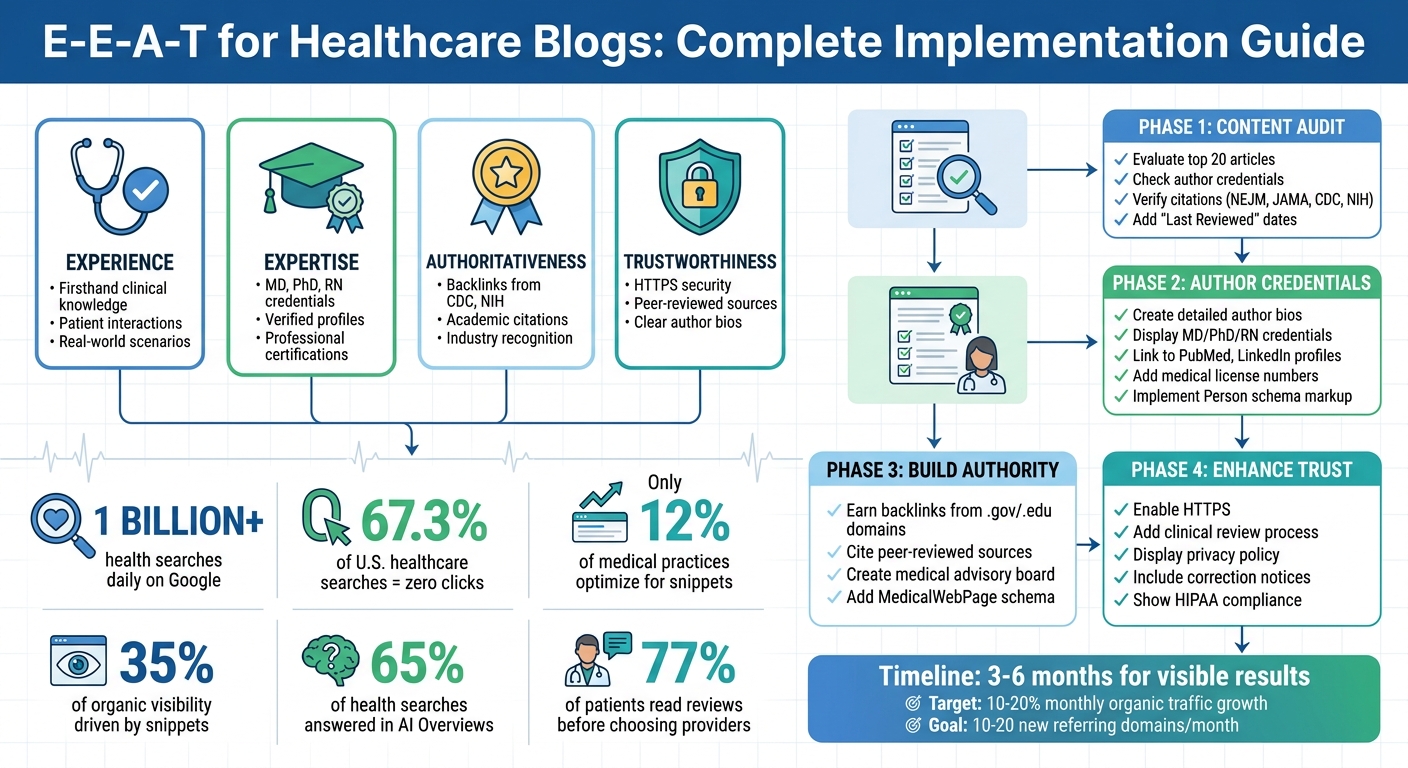
E-E-A-T Framework for Healthcare SEO: 4 Pillars and Implementation Steps
EEATing Up Credibility Navigating Healthcare SEO with Lily Ray
sbb-itb-cef5bf6
Building Experience in Healthcare Blog Content
The "Experience" aspect of E-E-A-T (Experience, Expertise, Authoritativeness, and Trustworthiness) is what sets authentic human expertise apart from AI-generated content. Stella Hart, a Content Strategist at WG Content, puts it best:
"Expertise signifies specialized knowledge through formal qualifications, while experience refers to firsthand, real-world, practical and personal accounts from actual use".
Incorporating real-world experiences into your healthcare content not only strengthens credibility but also builds trust - an essential component of E-E-A-T.
Creating Content Based on Healthcare Scenarios
Firsthand clinician accounts are powerful tools for engaging both readers and search algorithms. For example, instead of vaguely stating, "Diabetes management requires regular monitoring", you could write: "In my 10 years of treating diabetic patients, I've found that the biggest challenge isn't understanding glucose levels - it's helping patients build sustainable daily routines around testing." This approach highlights direct clinical experience, which Google's evaluators value highly.
Practical applications can also elevate your content. Consider adding features like an "Ask the Doctor" section to provide direct insights from physicians. Video content is another excellent way to demonstrate expertise - clinicians can explain procedures or showcase medical equipment in action. Such visual content is often prioritized in Google's AI-driven search overviews and rich results, signaling hands-on knowledge.
Patient stories are another way to incorporate real-world experience, but they must comply with HIPAA regulations and maintain strict anonymization. For instance, a physical therapist might recount: "One patient came to me unable to climb stairs after knee surgery. After six weeks of targeted exercises, she completed a 5K race." These relatable narratives highlight practical outcomes while safeguarding patient privacy.
Avoid generic stock photos whenever possible. Instead, use authentic images and videos of your medical team in action. Maria Kanwal, a Healthcare SEO Strategist at MedRankSEO, emphasizes:
"A successful healthcare SEO strategy must show actual clinical experience rather than only academic understanding".
By weaving these elements into your content, you can naturally transition into supporting your claims with solid data and case studies.
Using Data and Case Studies to Support Claims
Every healthcare claim you make should be backed by reliable sources like peer-reviewed journals (e.g., New England Journal of Medicine, Journal of the American Medical Association, or Cochrane Reviews) or reputable agencies such as the CDC, NIH, and WHO. Case studies are especially effective, as they provide concrete evidence of treatment success through anonymized patient outcomes. For example, instead of saying, "This treatment is effective", you could share: "In our clinic, a significant percentage of patients using this protocol showed measurable improvement within 30 days, based on standardized pain scale assessments".
To further enhance credibility, include at least three recent primary source citations for your claims. Adding MedicalWebPage schema and a "Content Reviewed by [Name, Credentials]" badge can also boost trustworthiness. Additionally, healthcare content that uses MedicalCondition or FAQ schema is twice as likely to appear in AI-driven search overviews.
Regular updates to your data are critical. Medical guidelines and best practices evolve, and outdated information can harm your credibility and E-E-A-T standing. Consider using custom visuals like diagrams and infographics to present complex research in a more reader-friendly way. These tools are far more effective at building trust than generic stock imagery and make your content easier to understand.
Establishing Expertise through Author Credentials
Google's algorithms are designed to reward genuine medical expertise, emphasizing the importance of E-E-A-T standards for healthcare content. To ensure credibility, clear author credentials play a vital role in reinforcing trust and authority.
Highlighting Author Qualifications
Healthcare articles should always showcase detailed author credentials to build trust with both readers and Google's quality raters. Using vague bylines like "Staff Writer" or "Editorial Team" can negatively impact E-E-A-T signals, as outlined in Google's 176-page evaluation guidelines. Instead, credentials such as MD (Medical Doctor), DO (Doctor of Osteopathic Medicine), NP (Nurse Practitioner), PA (Physician Assistant), RN (Registered Nurse), PhD, or DVM (Doctor of Veterinary Medicine) should be displayed prominently next to the author’s name.
To further enhance credibility, create dedicated author profile pages (e.g., /about/dr-sarah-johnson/) that include:
- Professional headshots
- Full credentials
- Years of experience
- Institutional affiliations (e.g., Harvard Medical School or Mayo Clinic)
- Board certifications
For example, instead of listing "John Smith, MD", provide a more detailed description like, "John Smith, MD, Board-certified Cardiologist with 15 years of clinical experience at Johns Hopkins Hospital". Link these profiles to external sources such as Healthgrades, hospital directories, PubMed, Google Scholar, or ResearchGate for third-party verification.
Additionally, implement "Person" schema markup on author pages. This structured data should include attributes like medical specialty, affiliations, and expertise, which help search engines verify credentials through "identity graphs". Where possible, include medical license numbers to enhance transparency and trust. Structured data not only improves clarity for users but also boosts SEO performance.
| Credential Type | Examples to Highlight | Verification Sources |
|---|---|---|
| Medical Degrees | MD, DO, NP, PA, RN, PhD, DVM | University registries, State Medical Boards |
| Professional Roles | Chief of Surgery, Clinical Director, Specialist | Hospital directories, LinkedIn |
| Research/Academic | Published Author, Peer Reviewer | PubMed, Google Scholar, ResearchGate |
| Certifications | Board-certified, Specialized Fellowships | Medical Board databases, Healthgrades |
Using Peer Reviews and Expert Opinions
Beyond individual credentials, incorporating peer reviews and expert opinions strengthens the credibility of healthcare content. For articles not directly authored by a physician, include a "Medically reviewed by [Name, Degree]" tag at the top. This tag should feature the reviewer’s credentials, a professional headshot, and a link to their full bio, along with the date of the latest review to ensure the information is up to date.
Establishing a medical advisory board is another effective strategy. Create a dedicated page listing all clinical advisors and their qualifications to enhance site-wide authority. This extra layer of review ensures that content aligns with Google's E-E-A-T criteria for healthcare.
Atilla Kuruk, an SEO & AI Search Specialist, highlights the importance of genuine expertise:
"In a world where AI can generate generic expert content in seconds, first-hand experience is the one signal that cannot be faked. Show your real data, share your actual results, document your process. That is what separates content that ranks from content that gets buried".
To further solidify trust, authors should directly cite primary research from reputable sources like the New England Journal of Medicine, JAMA, CDC, or NIH. Relying on primary sources not only strengthens E-E-A-T signals but also increases the likelihood of being featured in AI Overviews and snippets, as Google prioritizes content backed by verified medical experts and authoritative citations.
Demonstrating Authoritativeness with Backlinks and Citations
When it comes to healthcare blogs, building authority isn't just about showcasing expertise or supporting claims with data. It's also about earning external validation. Google assesses your site's authority based on endorsements from trusted organizations like medical institutions, academic bodies, and peer-reviewed publications.
Earning High-Quality Backlinks
Once you've established credibility, gaining high-quality backlinks strengthens your blog's authority even further. But not all backlinks are created equal. As SEO Strategist Sarah Mitchell explains:
"Last month, I audited a client in the fintech space. They had 5,000 links but zero traffic. Why? 90% of their links were from 'general' blogs. We disavowed the junk, focused on just 5 high-E-E-A-T links from verified financial journals, and saw their traffic double in 6 weeks".
This same principle applies to healthcare. Focus on links from well-regarded sources like government health organizations (e.g., CDC, NIH), academic institutions (.edu domains), hospitals, and respected medical journals such as NEJM or JAMA.
Here are some effective strategies to earn these authoritative links:
- Leverage digital PR and expert commentary: Offer expert insights to health journalists or contribute guest articles to trusted platforms like WebMD, Healthline, or Medscape.
- Participate in professional communities: Join reputable medical associations or local health initiatives to gain directory links and community-based backlinks.
- Create linkable assets: Develop resources like original research, BMI calculators, or medication interaction tools. These tools naturally attract citations from other healthcare professionals.
For example, a dermatology practice implemented a strategy combining local authority building and E-E-A-T principles. By creating 15 in-depth skin condition guides and engaging with state dermatology committees, the practice earned 35+ links from respected medical sources, increased its Domain Rating from 32 to 47, and achieved a 140% boost in organic traffic.
When choosing link partners, examine their topical relevance, traffic patterns, and editorial standards. High-quality sites often feature real author bios and enforce strict editorial guidelines. Additionally, using MedicalWebPage and MedicalOrganization schema markup can help search engines recognize your site's authority and its connection to credible medical entities.
Citing Credible Sources in Blog Content
In addition to external validation, internal credibility plays a crucial role. Every clinical claim you make should be backed by primary sources - original research, official documents, or peer-reviewed studies. Avoid relying on secondary summaries or news articles. Instead, cite reputable journals and organizations such as the New England Journal of Medicine (NEJM), JAMA, Cochrane Reviews, CDC, NIH, and WHO.
Michael Smith, a Digital Marketing Expert at EOS Healthcare Marketing, highlights this approach:
"Trustworthiness is the foundation of SEO success for healthcare sites, and it's earned by regularly publishing reliable content... linking to reputable sources, and building a strong reputation over time".
To enhance transparency, include fact-check boxes or source lists directly within your articles. Place citations near the claims they support, and ensure all links lead to original research rather than intermediary summaries. This sets professional healthcare blogs apart from lower-quality, AI-generated content that often lacks proper review and evidence-based depth.
Regular audits are essential. Review your top-performing health articles, replacing outdated or weak sources with current peer-reviewed research. Establish a clinical review process to update evergreen content annually, as outdated information can damage both trust and search rankings.
Healthcare content falls under Google's YMYL (Your Money or Your Life) category, which faces intense scrutiny from quality raters. With over 1 billion health-related searches happening daily - accounting for more than 7% of all Google searches - accurate sourcing isn't just good SEO; it's a moral obligation.
Enhancing Trust in Healthcare Blogs
Once you've established experience, expertise, and authority, the next step is reinforcing trust - a cornerstone of Google's E-E-A-T framework for healthcare blogs. According to Google's Search Quality Rater Guidelines:
"Trustworthiness is the most important member of the E-E-A-T family because untrustworthy pages always have low E-E-A-T no matter how Experienced, Expert, or Authoritative they may seem".
For healthcare content, which falls under Google's Your Money or Your Life (YMYL) category, trust plays a crucial role in search rankings and, more importantly, in safeguarding patient well-being.
Ensuring Content Accuracy and Fact-Checking
Accuracy is non-negotiable in medical content. Every article should undergo a clinical review process by a qualified medical professional, such as an MD, PhD, or RN, before it goes live. To support this, cite primary sources like peer-reviewed journals (e.g., NEJM, JAMA, or Cochrane Reviews) and reputable health organizations such as the CDC, NIH, or WHO. Display the name of the reviewer and include a "Last Reviewed" date to demonstrate transparency.
To keep content current, implement an annual review cycle to update information based on the latest medical guidelines and research. If errors are identified, correct them promptly and include a clear correction notice. Using evidence-based language like "Research suggests..." enhances credibility, while verified statistics and quotations improve both trust and visibility in search results.
Once content accuracy is addressed, the next focus should be on transparency through author disclosures.
Improving Transparency with Author Bios and Disclosures
Detailed author information builds trust by showcasing expertise. Include credentials, professional headshots, and links to external profiles like LinkedIn, Doximity, or PubMed on author pages. If AI tools were used during the writing or research process, include a clear disclosure to align with increasing scrutiny from regulators like the FTC and FDA. Additionally, label sponsored content or affiliate links clearly to maintain editorial integrity.
Transparency matters because trust influences behavior - 77% of patients read online reviews before choosing a healthcare provider. By being upfront about affiliations and contributions, you can convert cautious readers into confident patients.
Next, let’s address website security, which is another essential aspect of trustworthiness.
Prioritizing Website Security and HTTPS
A secure website is critical for healthcare blogs. Using HTTPS ensures that sensitive data, such as health-related information, is encrypted and protected from unauthorized access. Search engines often flag sites without HTTPS as unreliable, which can hurt both rankings and credibility.
To further establish trust, display security seals (e.g., URAC or HIPAA compliance) and include clear privacy policies explaining how user data is handled. Providing a physical address and verified contact information also adds a layer of transparency.
Looking ahead, search engines are expected to prioritize secure, E-E-A-T-compliant sites in AI-driven search results by 2026. Additionally, healthcare websites that use structured data, such as FAQ, How-To, MedicalCondition, and Speakable schema, are twice as likely to appear in AI-powered features.
Ultimately, website security isn't just about rankings - it's a fundamental requirement for any YMYL content. It directly supports the trust pillar of E-E-A-T, ensuring users feel safe and confident when engaging with your site.
Implementing E-E-A-T: Best Practices for Healthcare Blogs
You’ve got a grasp on the four pillars of E-E-A-T, so now it’s time to put them into action. Since healthcare content tops Google’s YMYL (Your Money or Your Life) hierarchy, even the best technical SEO won’t save a site that fails to meet E-E-A-T standards. But here’s the upside: with a structured plan, you can systematically enhance your blog’s E-E-A-T signals.
Conducting a Content Audit for E-E-A-T Compliance
Start with a detailed content audit. Use a spreadsheet to evaluate each post based on the four E-E-A-T criteria: Creator, Content, Technical, and Authority. Label each post as Strong, Adequate, Needs Work, or Missing.
| Audit Phase | Focus Area | Key Checklist Items |
|---|---|---|
| Phase 1: Creator | Expertise & Experience | Identify authors, check for MD/PhD credentials, include detailed bios, and use original clinical photos. |
| Phase 2: Content | Accuracy & Trust | Ensure peer-reviewed citations, add "Last Updated" dates, include medical disclaimers, and avoid clickbait. |
| Phase 3: Technical | Security & Transparency | Confirm HTTPS, display a HIPAA policy, list a physical address, and outline an editorial policy. |
| Phase 4: Authority | Reputation | Look for backlinks from .gov/.edu sites, mentions in medical journals, and recognition like industry awards. |
Pay special attention to anonymous content - assign credentialed authors to these posts. Start your audit with the top 20 most popular articles since they carry the most weight in shaping your site’s E-E-A-T profile. Make sure each article includes citations from reputable sources like NEJM, JAMA, CDC, or NIH. For clinical pages, display the name of the reviewing clinician and the date of the last review.
Once the audit is complete, focus on improving on-page elements to further boost E-E-A-T signals.
Optimizing On-Page Elements for E-E-A-T
Building on your audit, refine your on-page content to highlight expertise and credibility. For clinical pages, ensure the author’s name and credentials appear next to the byline (e.g., "By Dr. Sarah Chen, MD, Board-Certified Cardiologist"). Create detailed author profile pages that include medical license numbers and affiliations, and link these profiles to external sources like PubMed, LinkedIn, or Google Scholar.
Use medical schema markup to help search engines understand the qualifications behind your content. For instance:
MedicalWebPageschema: Indicates evidence levels and intended audiences.Personschema: Links author qualifications to their content.FAQPageschema: Captures opportunities for featured snippets.
Include clear "Published" and "Last Reviewed" dates to show the currency of your guidelines. Reinforce trust by weaving internal credibility signals - like peer-reviewed citations - throughout your content.
Adding quotes and statistics to your posts can also improve visibility significantly. With over 7% of global Google searches related to health - amounting to more than 1 billion searches daily - these on-page improvements can make a measurable difference.
Developing an E-E-A-T-Focused Content Strategy
Once your audit and optimizations are complete, fold these enhancements into a long-term E-E-A-T strategy. Begin with easy fixes like adding author bios and implementing HTTPS. Next, establish a medical review board to vet every post. Incorporate firsthand accounts, patient testimonials, and case studies to showcase real-world impacts.
Maria Kanwal, a Healthcare SEO Strategist at MedRankSEO, puts it this way:
"E-E-A-T is essentially about being truly exceptional at what you do and showcasing that excellence online in a clear and verifiable manner".
Go beyond academic expertise by including firsthand clinical experiences, HIPAA-compliant patient stories, and case studies that demonstrate tangible outcomes. Add interactive features like "Ask the Doctor" sections where specialists answer patient questions, or develop videos of medical professionals explaining conditions and procedures. Regularly review evergreen content - like treatment guidelines or medication dosages - at least annually to keep it accurate.
Invest in original research, such as clinical studies or surveys, to attract editorial backlinks from trusted health authorities. Aim to secure mentions or guest contributions in respected outlets like WebMD, Healthline, or Medscape to further enhance your domain’s authority. In today’s competitive search landscape, excellent E-E-A-T isn’t optional - it’s essential for any site covering healthcare topics.
Measuring the Impact of E-E-A-T on Healthcare Blog Performance
Once you've implemented E-E-A-T enhancements, the next step is to measure their impact using performance data. This helps ensure that the principles we've covered are translating into improved SEO outcomes. Keep in mind that these changes often take 3 to 6 months to show noticeable results, so consistent tracking during this period is crucial.
Tracking Key SEO Metrics
Google Search Console is an excellent starting point for monitoring the performance of YMYL (Your Money or Your Life) queries. These health-related searches are subject to the strictest E-E-A-T evaluations, making them a reliable indicator of progress. Be sure to also track brand search volume - an increase in searches for your practice name or specific physicians often reflects growing trust and authority.
Set achievable goals, such as aiming for 10% to 20% month-over-month growth in organic traffic after implementing E-E-A-T optimizations. Focus on acquiring backlinks from authoritative medical domains like .edu, .gov, or major health organizations. Instead of simply counting links, aim for 10 to 20 new referring domains per month. Additionally, monitor your visibility in Google's AI Overviews, as over 65% of U.S. health-related searches are now answered directly in AI-generated summaries before users even click on links.
| Metric Category | Key Performance Indicator (KPI) | Tracking Tool |
|---|---|---|
| SEO Rankings | YMYL Keyword Positions | Google Search Console |
| Authority | Referring Domains (.gov, .edu, .org) | Ahrefs / SEMrush |
| Trust | Brand Search Volume | Google Search Console |
| Engagement | Average Time on Page | Google Analytics 4 |
| AI Visibility | AI Overview (SGE) Citations | Manual Search / SEO Tools |
Beyond rankings and backlinks, user engagement metrics are another critical way to assess the trustworthiness of your content.
Analyzing User Engagement and Trust Signals
User engagement metrics provide insight into how readers perceive the reliability of your content. In Google Analytics 4, pay close attention to time on page and bounce rates for your medical articles. Lower bounce rates often indicate that users find your information trustworthy and worth their time. Another useful metric is traffic to individual author profile pages, which can reflect how much authority readers attribute to your contributors.
Engagement with content like case studies and patient outcome data is also a strong indicator of credibility. When users spend more time on these pages, it suggests they trust the firsthand experience and insights you're sharing.
Use this data to fine-tune your strategies and build even greater trust.
Adjusting Strategies Based on Performance Data
Analytics can help you identify areas for improvement. For example, if a high-traffic article has a high bounce rate, consider updating it with more credible citations, adding reviews from credentialed experts, or enhancing author bios. If you're not seeing much visibility in AI Overviews, use schema markup such as MedicalWebPage and Person to make your expert credentials more accessible to search engines.
Conduct a 30-day audit of your top 20 medical articles to ensure each one features a named, credentialed author and a recent "last reviewed" date. If brand searches remain stagnant, consider investing in digital PR campaigns or contributing guest articles to respected medical platforms. Remember, 68% of consumers will stop engaging with a business if they encounter incorrect or inconsistent information online, so double-check that your NAP (Name, Address, Phone) data is consistent across all platforms.
Conclusion
Building E-E-A-T (Experience, Expertise, Authoritativeness, and Trust) into healthcare blogs is a long-term effort that demands consistent, high-quality content. Google has made it clear: medical content without these qualities risks being downranked, even if it has strong technical SEO or numerous backlinks. With over 1 billion health-related searches happening on Google every day, the importance of getting this right cannot be overstated.
Kyle Roof, Co-Founder of PageOptimizer Pro, emphasizes the stakes:
"In an industry where accuracy and trust can save lives, prioritizing E-E-A-T is non-negotiable."
The rise of AI-driven search results has made E-E-A-T even more essential. Today, 65% of U.S. health-related searches are answered directly in AI Overviews before users even click on a link. To stand out in this landscape, healthcare content must incorporate strategies like schema markup, regular updates, and clinically reviewed articles authored by credentialed experts.
Given the complexity of these requirements, many medical practices turn to professional support. SEO Werkz offers tailored digital marketing solutions, including healthcare-specific SEO, content development, and reputation management. Their expertise ranges from implementing MedicalWebPage schema to securing authoritative backlinks from respected medical domains. By aligning your blog with Google's YMYL (Your Money or Your Life) standards, you not only protect your search rankings but also strengthen your credibility within the healthcare industry.
FAQs
How do I prove E-E-A-T on my healthcare blog?
To highlight E-E-A-T (Experience, Expertise, Authority, Trustworthiness) on your healthcare blog, make sure every clinical page includes a clearly named author with relevant credentials. Strengthen trust by using visible signals like SSL certificates, HIPAA compliance policies, and references to peer-reviewed studies. Focus on publishing well-researched, evidence-backed content, and use schema markup to improve your blog’s credibility. These actions not only build authority but also enhance trust in your content.
What medical schema should I add for better rankings?
To give your rankings a boost, consider using medical schema markup. This helps search engines better understand your content and can make your site eligible for rich results. Key schema types to focus on include:
- MedicalCondition
- MedicalProcedure
- MedicalTest
- MedicalDevice
- Physician
Using these schema types can strengthen your authority, make clinical pages more visible, and enhance your site's credibility. Additionally, reinforce trust by including signals like SSL certificates, HIPAA compliance, and peer-reviewed citations. These steps align your site with Google's E-E-A-T (Experience, Expertise, Authoritativeness, and Trustworthiness) guidelines.
How long until E-E-A-T improvements boost SEO?
Building up E-E-A-T (Experience, Expertise, Authoritativeness, and Trustworthiness) can lead to visible SEO improvements in just a few months. However, establishing real trust and authority takes time - think several months to a year or even longer. Consistency, patience, and regular fine-tuning are essential for achieving results that truly stick.