10 A/B Testing Tools for E-commerce Stores
March 6, 2026A/B testing is a must for e-commerce stores aiming to boost conversions and revenue. It helps you make data-driven decisions by testing changes like product images, checkout buttons, or pricing strategies before rolling them out. With tools tailored for e-commerce, you can integrate seamlessly with platforms like Shopify, track revenue, and test without needing developers. Here are 10 tools to consider:
- Personizely: Easy-to-use visual editor with audience targeting. Pricing starts at $19/month.
- Kameleoon: AI-powered personalization and advanced testing. Starts at ~$495/month.
- AB Tasty: Personalization and multivariate testing for larger brands. Estimated $60,000/year.
- Optimizely: Designed for high-traffic sites with advanced features. Starts at ~$36,000/year.
- VWO: User-friendly with tools for multivariate and server-side testing. Custom pricing.
- Adobe Target: Enterprise-level testing with machine learning personalization. Custom pricing.
- Dynamic Yield: Combines testing and personalization for large-scale optimizations. Starting ~$25,000/year.
- Zoho PageSense: Affordable with heatmaps and session recordings. Starts at $19/month.
- Compose: Pay-as-you-go model, ideal for Shopify users. $0.0012 per Monthly Tested User.
- Unbounce: Landing page builder with A/B testing and AI tools. Plans start at $112/month.
Quick Comparison
| Tool | Key Features | Starting Price | Ideal For |
|---|---|---|---|
| Personizely | Visual editor, audience targeting | $19/month | Small to mid-sized stores |
| Kameleoon | AI personalization, fast testing | ~$495/month | High-traffic businesses |
| AB Tasty | Multivariate, emotion-based tests | ~$60,000/year | Larger enterprises |
| Optimizely | Advanced experimentation | ~$36,000/year | Enterprise-level e-commerce |
| VWO | Multivariate, server-side testing | Custom pricing | All business sizes |
| Adobe Target | Machine learning personalization | Custom pricing | Enterprise-level solutions |
| Dynamic Yield | Personalization, recommendations | ~$25,000/year | Large-scale optimizations |
| Zoho PageSense | Heatmaps, session recordings | $19/month | Budget-conscious stores |
| Compose | Pay-as-you-go | $0.0012/MTU | Shopify-focused brands |
| Unbounce | Landing pages, AI testing | $112/month | Conversion-focused stores |
Choose based on your budget, technical needs, and traffic volume. Tools like Zoho PageSense and Personizely are great for smaller businesses, while Kameleoon and Optimizely cater to enterprises. For Shopify users, Compose offers affordable and easy integration.
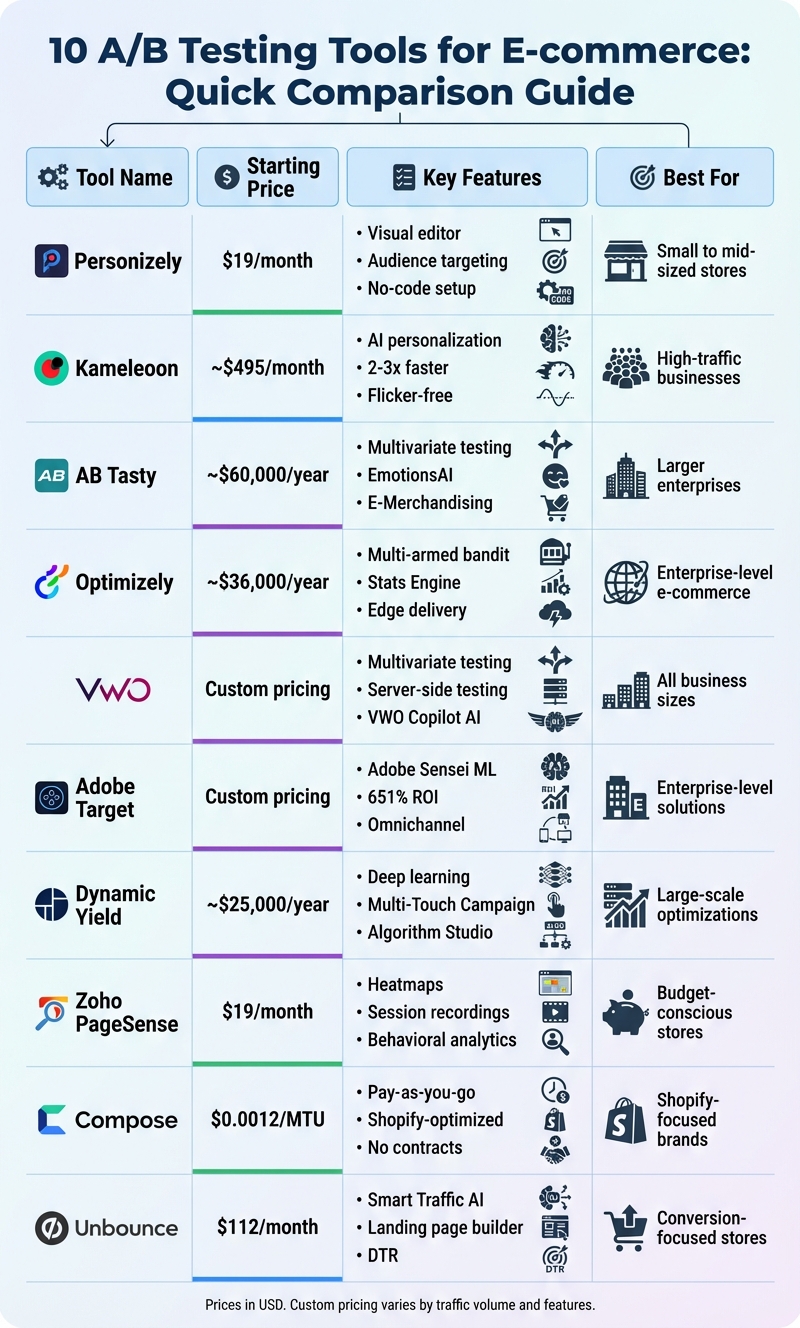
A/B Testing Tools Comparison: Features and Pricing Guide for E-commerce
We Evaluated the Top A/B Testing Software Tools To Help You Decide
1. Personizely
Personizely is designed specifically for e-commerce businesses, making it easy to test design changes without needing a developer. With its click-based visual editor, you can experiment with elements like product images, headlines, pricing, and shipping options while keeping track of how these changes affect revenue. Let’s dive into its standout features.
E-commerce Platform Integrations
Personizely works seamlessly with popular platforms like Shopify, Wix, WordPress, Magento, and BigCommerce. For Shopify users, there’s even a native app available in the Shopify App Store, simplifying the installation process. This integration ensures that testing and optimization processes are smooth and efficient.
Personalization and Targeting Capabilities
One of Personizely’s standout features is its ability to run A/B tests tailored to specific audience segments. Instead of showing the same variation to all visitors, you can target shoppers based on factors like location, device type, cart contents, or purchase history. This ensures your tests are more precise and reach the right people at the perfect moment.
Pricing in USD
Personizely offers three pricing tiers:
- Essential: $19/month for up to 5,000 visitors, including URL and theme testing along with basic popups.
- Premium: $59/month for up to 10,000 visitors, with advanced testing and targeting features.
- Premium Plus: $149/month for up to 50,000 visitors, featuring all available tools and a dedicated manager.
Each plan includes a 14-day free trial, and you can save 20% by opting for annual billing.
Advanced Testing Features
Beyond basic A/B testing, Personizely provides advanced tools like multivariate testing, server-side testing, and multi-page journey testing. It also eliminates flicker issues by instantly loading variations and allows for custom goal tracking, such as monitoring "Add to Cart" or "Purchase" actions.
Eren Kece from Dashl Beauty shared that Personizely helped save thousands in development costs while generating over $12,000 in additional revenue.
2. Kameleoon
Kameleoon brings together web, full-stack, and feature experimentation into a single platform. Designed with e-commerce teams in mind, it balances robust testing capabilities with speed, claiming to be 2–3 times faster than other solutions, all while remaining flicker-free.
E-commerce Platform Integrations
Kameleoon integrates seamlessly with Shopify and Shopify Plus, available directly via the Shopify App Store. Setting it up is straightforward - just a few clicks - and the app immediately begins tracking key actions like product views, transactions, cart activity, and collection views. Beyond Shopify, Kameleoon connects with over 50 tools, including GA4, Klaviyo, Triple Whale, Snowflake, BigQuery, and Salesforce. These integrations open the door to advanced personalization and data-driven insights.
"One of the biggest problems Shopify store owners have with testing is that they're not very technical and are therefore limited in what they can do. With the Shopify-Kameleoon App, there's no need for technical knowledge so you can start testing right away."
- Frederic de Todaro, Chief Product Officer, Kameleoon
Personalization and Targeting Capabilities
Kameleoon uses AI-powered personalization to predict visitor intent in just 15 seconds. With over 45 segmentation criteria - including behavioral, contextual, technical, and demographic factors - you can create highly specific audience experiences. It also offers 17+ product recommendation algorithms, tailoring suggestions based on user browsing habits.
For example, in January 2019, French retailer Cdiscount leveraged Kameleoon’s machine learning to identify "undecided" visitors with moderate purchase interest. By targeting this segment with discount coupons - rather than offering them site-wide - they doubled the ROI of their promotional campaigns while maintaining profit margins.
Advanced Testing Features
Kameleoon supports multivariate testing, enabling you to test several variations of page elements at once to discover the best combinations. Additionally, its server-side experimentation allows you to optimize backend elements like pricing models or checkout processes without affecting site performance. The platform also offers a "Hybrid™" feature that combines the power of server-side testing with the simplicity of client-side tools, making it easier for non-technical teams to manage server-side experiments.
In January 2022, The Wine Collective used Kameleoon on their Shopify Plus store and saw a 5.3% boost in conversions along with an 18% drop in bounce rate.
Pricing in USD
Kameleoon’s pricing starts at ~$495/month, depending on your average monthly unique visitors. There are three unlimited license tiers available: Web Experimentation, Feature Experimentation, and AI-Powered Personalization. The platform holds strong user ratings, with a 4.6/5 on G2 and 4.9/5 on the Shopify App Store. While users appreciate its flicker-free performance and user-friendly segment builder, some mention that the documentation could be more thorough for complex setups, and pricing might be a hurdle for smaller businesses.
3. AB Tasty
AB Tasty provides tools for experimentation and personalization, supporting over 1,100 e-commerce brands. With a 4.6-star rating on both G2 and Capterra, it enables online retailers to test, refine, and customize customer experiences - all without requiring extensive developer involvement.
E-commerce Platform Integrations
AB Tasty works seamlessly with major e-commerce platforms like Shopify, PrestaShop, Salesforce Commerce Cloud, Magento, BigCommerce, and WooCommerce. Its Integration Hub facilitates no-code data exchanges with third-party tools, such as Google Analytics 4 and Contentsquare. Shopify users benefit from a native connector for smooth data flow, while PrestaShop and Magento users can rely on dedicated modules or APIs. For headless or custom setups, AB Tasty offers flexible integration options, including API-based real-time synchronization or scheduled data feeds in formats like CSV, JSON, or XML [30, 31].
Personalization and Targeting Capabilities
AB Tasty's E-Merchandising module combines search, recommendations, and real-time merchandising into one tool. Features like EmotionsAI allow for emotion-based audience segmentation, while AdaptiveCX tailors experiences for anonymous visitors. For instance, in 2025, Clarins, a luxury skincare brand, used AB Tasty to test adding sun and moon icons to product tiles on their listing page. This small tweak led to higher conversions. Similarly, Diptyque experimented with variations of its checkout login interface, reducing exit rates and increasing conversions.
Advanced Testing Features
The platform supports various testing methods, including multivariate, server-side, split URL, and multi-page testing [34, 35]. Server-side experimentation helps test backend elements like algorithms and pricing models without causing the disruptive "flicker effect." AB Tasty employs a Bayesian statistics engine to identify winning variations with confidence. ASICS, for example, integrated AB Tasty with Contentsquare to refine its "hycremental" experimentation process. By using behavioral segmentation, ASICS was able to fine-tune tests and drive revenue growth.
"You start with small individual optimizations, and test them separately so you understand what exactly the impact of those changes is. And after you've validated those results... you come up with a final, big optimization."
- Andrey Prokhorov, Digital Experience Optimization Manager, ASICS
These advanced testing tools work in harmony with AB Tasty's integration and personalization features.
Pricing in USD
AB Tasty offers custom pricing based on factors like traffic volume, the number of tests, and support requirements. Industry estimates suggest starting costs around $60,000 annually, with smaller enterprise setups beginning at roughly $1,000 per month. For high-traffic sites with complex needs, contracts can exceed $150,000 per year [36, 40]. While the initial investment may seem high, users often highlight the platform's capabilities as worth the cost. Many appreciate its intuitive visual editor and strong customer support, though some mention a learning curve and potential impacts on page load speeds due to JavaScript weight.
4. Optimizely
Optimizely is a platform designed specifically for experimentation, catering to high-traffic e-commerce sites. It’s been credited with helping digital leaders achieve a 37% boost in website engagement and a 35% increase in test impact. With a 4.2-star rating on G2, Optimizely is a choice for businesses seeking advanced testing tools and willing to invest significantly on an annual basis.
E-commerce Platform Integrations
Optimizely integrates seamlessly with major e-commerce platforms, offering bi-directional integration with Shopify and Shopify Plus. This allows real-time synchronization of sales data, product catalogs, and shopper information with the Optimizely Data Platform (ODP). It also supports WooCommerce, syncing product and sales data, and Magento, catering to enterprise-scale needs. During beta testing, the Shopify Blog Sync feature showed a 111% increase in clickthrough rates for dynamic blog content.
These integrations, combined with Optimizely’s advanced testing capabilities, allow businesses to fine-tune every aspect of their e-commerce operations.
Advanced Testing Features
Optimizely provides a range of sophisticated testing tools:
- Multivariate testing (MVT): Test multiple combinations of changes simultaneously to pinpoint the best-performing elements.
- Multi-armed bandit testing: Uses AI to dynamically shift traffic toward top-performing variations in real time.
- Server-side testing: Enables backend experimentation for more complex use cases.
- Stats Engine: Developed alongside Stanford experts, this tool ensures fast and accurate experiment results.
- Edge delivery: Tests are deployed via a global CDN to eliminate page flicker and minimize latency.
These features empower businesses to experiment with confidence, improving user experience and performance.
Personalization and Targeting Capabilities
Optimizely excels in personalization, offering 1:1 customization based on user behavior, context, and intent. The platform complements its A/B testing capabilities with AI-generated variations, thanks to "Optimizely Opal", an AI assistant that suggests experiment ideas and summarizes results. It also supports feature experimentation, allowing developers to test new features with controlled rollouts before a full-scale launch.
"We are able to identify what development work is worth pursuing and what isn't based on the experiment results deployed by their platform."
- Audrey Ortiz, CRO Marketing Manager at ServiceTitan
With these capabilities, Optimizely combines robust testing tools with advanced personalization to meet the demands of enterprise users.
Pricing in USD
Optimizely operates on a custom pricing model, with no publicly available fixed rates. Enterprise plans typically start between $36,000 and $50,000 annually, with some estimates suggesting a minimum of $25,000 per year. For businesses handling 10 million monthly impressions, the Web Business plan costs approximately $63,700 annually, while the Web Enterprise plan can reach $113,100 per year. High-traffic enterprise contracts may go beyond $200,000 to $400,000 annually.
Optimizely requires upfront annual commitments, with no option for monthly payments. While users appreciate its powerful reporting tools, the platform’s high cost and steep learning curve are often mentioned as challenges.
5. VWO
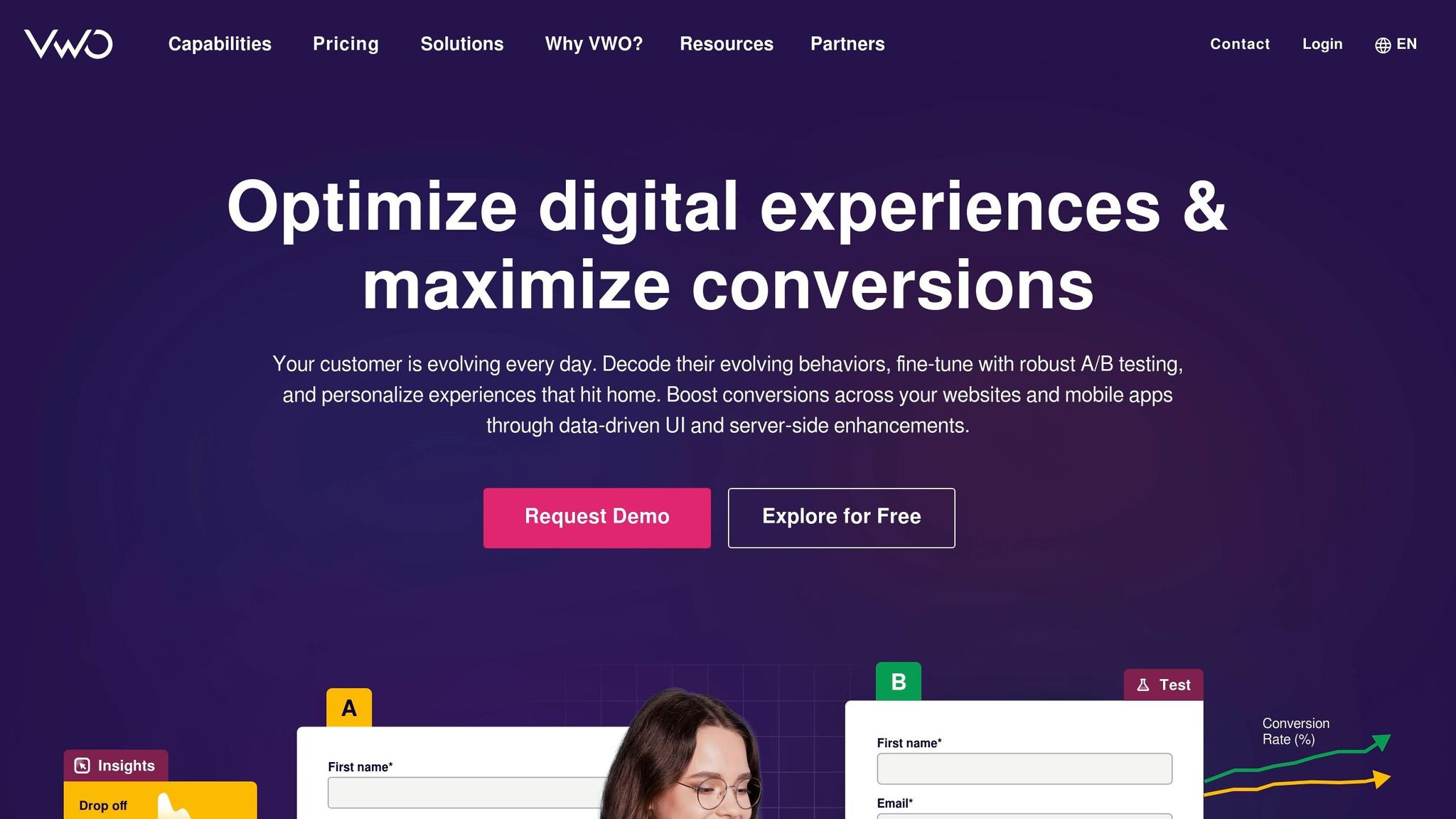
VWO stands out as a user-friendly yet powerful testing platform tailored for e-commerce. It has optimized 170 billion experiences across 675,000+ websites and serves 40,000+ customers in over 190 countries. With a 99% customer satisfaction rating and a swift first response time of 45 minutes, VWO has become a trusted choice for businesses worldwide.
E-commerce Platform Integrations
VWO simplifies the integration process with a no-code Shopify app available in the Shopify App Store. This allows for quick installation of the VWO SmartCode, which automatically tracks key e-commerce events like product views, add-to-cart actions, checkout initiations, and purchases. These events can then be used to build metrics or funnels within VWO.
The platform also integrates seamlessly with tools such as Google Analytics 4, providing additional insights. For platforms that don't have native integrations, VWO offers an asynchronous JavaScript "SmartCode", ensuring it doesn't slow down your website.
Advanced Testing Features
VWO enables businesses to run multivariate testing (MVT), where multiple elements are tested simultaneously to find the best-performing combination. For instance, Provident Hotels & Resorts tested 12 combinations of form titles and CTA text with 27,500 visitors over a month, achieving a 9.1% increase in click-through rate.
The platform also supports server-side testing through SDKs in over eight programming languages, allowing for more complex backend experiments. Human Interest utilized this feature via a VWO-Contentful integration, which eliminated engineering bottlenecks and resulted in a 75.84% increase in lead form conversions.
Other standout features include:
- Feature flags with kill switches to revert changes instantly if metrics drop.
- Multi-Armed Bandit testing, which uses AI to direct traffic toward winning variations in real-time.
- A Bayesian statistical engine that delivers real-time probability reports, enabling quicker decision-making without waiting for traditional significance levels.
Personalization and Targeting Capabilities
VWO Personalize uses machine learning to analyze shopper behavior, location, and purchase patterns. Its VWO Copilot, powered by GPT-4, suggests testing ideas, automates variation creation, and identifies hidden audience segments.
An example of its impact: Flos USA, a lighting manufacturer, used VWO’s optimization tools to add CTAs to category listing tiles, resulting in 47% more orders and an 86% increase in revenue. Another test that updated color swatches on product pages boosted conversions by 19.35%.
"VWO is not just an A/B testing tool, but a comprehensive website utility tool."
- Ilse Normington, UX and Web Analyst at Eastpak
These features ensure that VWO doesn’t just test variations but actively improves user experiences, driving measurable results.
Pricing in USD
VWO’s pricing is based on Monthly Tracked Users (MTU) and the specific tools you choose. It offers three tiers:
- Growth: Designed for small businesses.
- Pro: Aimed at mid-sized companies.
- Enterprise: Built for large organizations.
The platform matches its flexibility with a 30-day free trial, giving businesses full access to its features without requiring a credit card. Specific pricing details are available upon request, ensuring tailored solutions for businesses of all sizes.
"VWO had clear and concise documentation... it had transparent pricing, and we could know how much we would need to pay once we confirmed that VWO suits our needs."
- Jared Brown, CEO, Hubstaff
sbb-itb-cef5bf6
6. Adobe Target
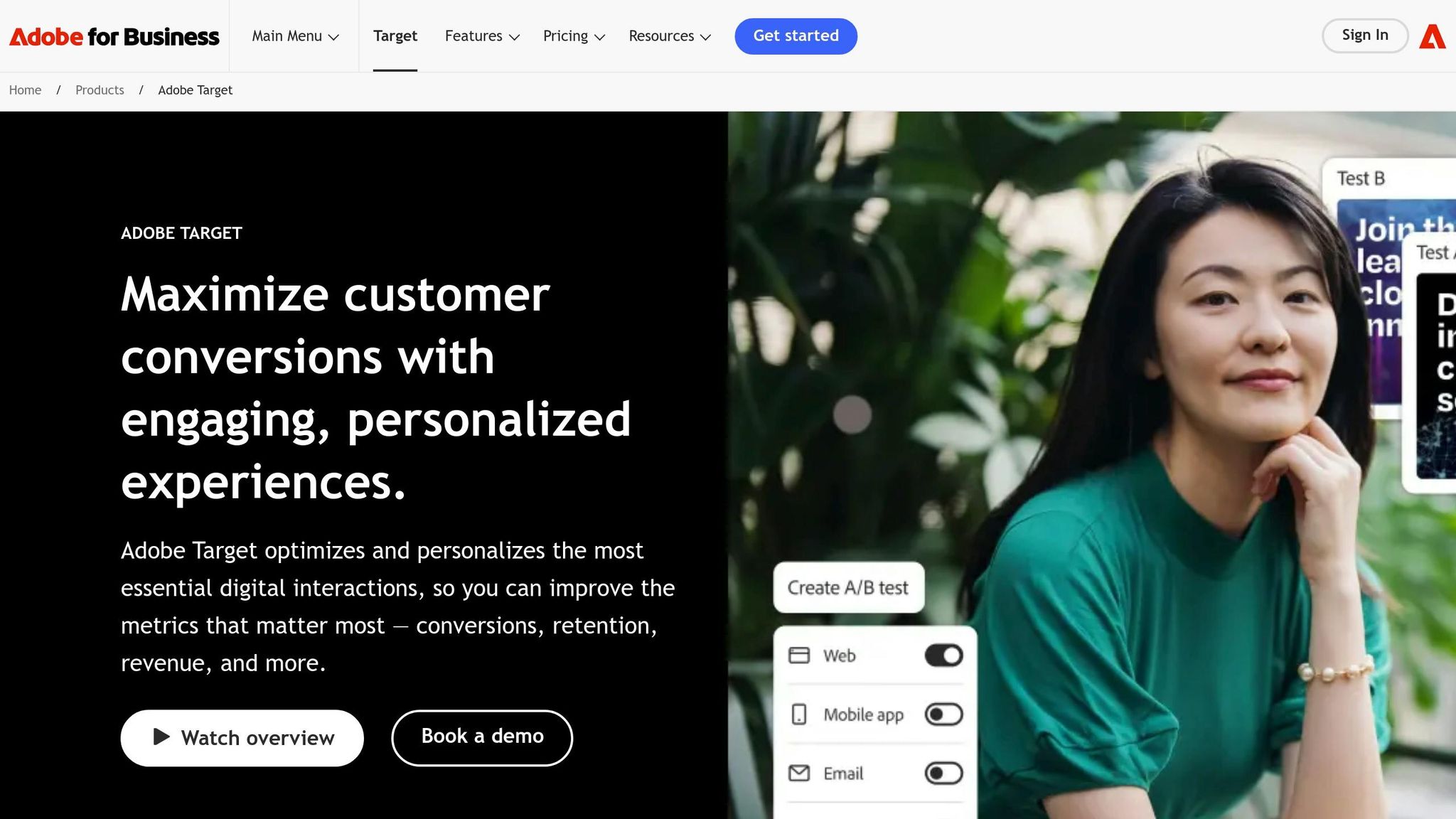
Adobe Target provides robust testing and personalization tools tailored for e-commerce businesses. According to an IDC study, the platform delivered an impressive 651% ROI over three years, with some implementations achieving up to a 38% increase in conversion rates. For businesses already using Adobe’s ecosystem, it offers seamless integration and advanced AI-powered features that extend well beyond standard A/B testing.
E-commerce Platform Integrations
Adobe Target works seamlessly with the Adobe Experience Cloud, particularly through Adobe Analytics (A4T), allowing you to use Analytics metrics and segments as your reporting source. The platform supports omnichannel delivery, enabling businesses to engage customers across web, mobile, email, and IoT.
For custom platforms, including Shopify, Adobe Target offers flexible deployment options like mobile SDKs, server-side APIs, and Node.js. These options allow businesses to run tests on the client side, server side, or both. Additionally, it integrates with Adobe Experience Manager (AEM) to incorporate Experience Fragments directly into tests and with Adobe Advertising to optimize landing pages for traffic from Google Ads and Microsoft Advertising.
Advanced Testing Features
Adobe Target supports multivariate testing (MVT), which explores all possible combinations of elements equally using full factorial testing. The platform includes tools like a traffic estimator to determine sample size needs and an element contribution report that pinpoints which elements drive the most impact.
The Auto-Allocate feature uses multi-armed bandit testing to dynamically adjust traffic toward the best-performing experiences. Traffic updates can occur as frequently as every two hours, making it ideal for time-sensitive events like Black Friday. For server-side testing, Adobe Target eliminates page flicker and speeds up load times through a unified delivery system that supports both server-side APIs and Node.js.
With Auto-Target, the platform leverages advanced machine learning to serve tailored experiences based on visitor profiles and past behavior. One implementation resulted in 182,000 additional clicks while reducing annual bounces by 150,000.
These advanced testing tools, combined with Adobe Target's seamless integrations, make it a powerful solution for optimizing customer experiences.
Personalization and Targeting Capabilities
Adobe Target relies on Adobe Sensei machine learning to simplify and enhance personalization efforts. The Automated Personalization (AP) feature builds detailed visitor profiles and matches content to similar users. By aggregating data from multiple sources, the platform creates unified, cross-channel customer profiles.
The Recommendations feature suggests products based on user behavior, using algorithms like "People who bought this also bought that." These recommendations have been shown to drive a 70% higher conversion rate and a 55% increase in return sessions. Research indicates that 80% of consumers are more inclined to engage with companies offering personalized experiences, and 48% of marketers who adopted website personalization reported a double-digit revenue boost.
"Adobe is critical to my team. The customer is receiving an experience that is being personalized, but they don't realize it's being personalized. They just recognize that it's relevant for them." - Will Harmer, Senior Manager, Insights and Optimization, EE
One example of Adobe Target in action includes a 125% boost in engagement and the creation of 76 new audience segments. Additionally, the platform's AI Assistant helps streamline workflows by answering product questions, suggesting best practices, and assisting with campaign copy and imagery creation.
Pricing
Adobe Target is designed for enterprise-level needs and offers customizable pricing based on factors like the number of digital properties, whether you opt for Target Standard or Target Premium, and the scope of omnichannel delivery across web, mobile, email, and IoT. Advanced features such as Automated Personalization, Recommendations, and Auto-Target are available only with Target Premium. Pricing is determined through a custom contract.
7. Dynamic Yield
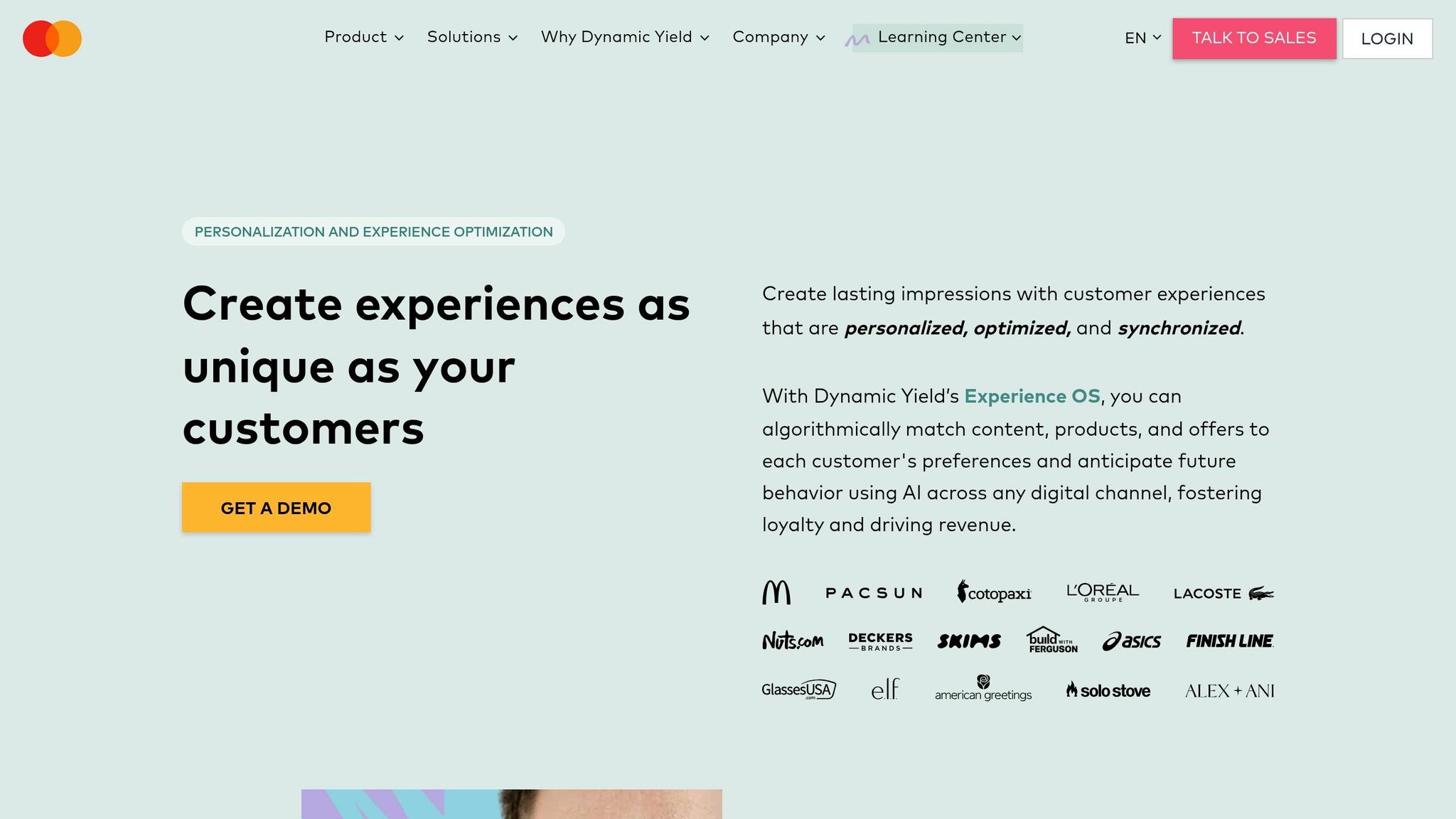
Dynamic Yield stands out among tools that combine testing with personalization, offering enterprise-level features tailored for impactful optimizations. Recognized by Gartner and Forrester for its capabilities, it earned the title of "Enterprise AB Testing Tool of the Year" in 2024.
E-commerce Platform Integrations
Dynamic Yield seamlessly integrates with leading e-commerce platforms like Shopify, Magento, BigCommerce, Wix, and WordPress. It also connects with marketing tools such as DMPs, Google Tag Manager, GA4, and Adobe Analytics. Shopify users benefit from a dedicated app that allows them to manage experiments directly from the admin interface. Additionally, server-side templates and native support for SPAs (single-page applications) reduce the need for extensive developer involvement. These integrations provide a solid foundation for the platform's testing and personalization capabilities.
Advanced Testing Features
Dynamic Yield offers advanced testing options, including multivariate testing (MVT) and server-side testing, which enable backend optimizations without the issue of page flicker. Its multi-armed bandit algorithms automatically allocate traffic to the best-performing variations, while the Multi-Touch Campaign feature focuses on optimizing complete customer journeys.
"We used the Multi-Touch Campaign capabilities to drive changes and test the entire website journey for one of our key customer segments... we've seen great returns, with an increase of over 27% in the conversion rate for these customers." - Christian Ebhardt, Shop Manager, Chal-Tec
Personalization and Targeting Capabilities
Dynamic Yield leverages deep learning models to deliver real-time product recommendations and adaptive content across web, email, and mobile platforms. Its Affinity Allocation feature updates user profiles in real time based on their interactions, ensuring recommendations evolve alongside user interests.
Real-world results highlight its effectiveness:
- Sweaty Betty saw a 62% increase in average order value (AOV) through personalized quizzes.
- Glasses USA achieved an 88% boost in average revenue per user with personalized recommendations.
- e.l.f. Cosmetics experienced an 18% rise in user engagement.
The platform's Algorithm Studio allows teams to create custom recommendation algorithms, while the Sorting Optimizer enables testing of category page sorting logic based on user preferences and business priorities. Dynamic Yield also ensures consistent experiences across multiple channels, including web, mobile apps, email, SMS, and push notifications.
Pricing
Dynamic Yield uses an enterprise pricing model that varies based on traffic volume and required features, with starting costs around $25,000 annually.
8. Zoho PageSense
Zoho PageSense is a comprehensive tool designed for e-commerce businesses, combining A/B testing with behavioral analytics like heatmaps and session recordings. With the ability to track over 3 million visitors daily, it provides a robust platform for improving conversion rates and understanding customer behavior.
E-commerce Platform Integrations
Zoho PageSense makes integration simple. If you're using Zoho Commerce or Zoho Sites, the process is seamless with a single click. Shopify and Magento users can connect through custom code or Google Tag Manager. Additionally, integrations with Zapier and Zoho Flow expand its functionality, while the Chrome extension allows you to launch tests directly on live websites.
"It's a simple step integration tool into any website, just adding custom element code on target pages." - Rwabwogo B., General Manager Operations
These integration options ensure that businesses can easily set up and start testing without unnecessary technical hurdles.
Advanced Testing Features
Zoho PageSense offers server-side testing (also called full-stack testing), which runs experiments before the page fully loads - perfect for maintaining site performance during tests. For businesses running time-sensitive promotions like flash sales, the Multi-Arm Bandit testing feature is a game-changer. Using Thompson Sampling, it dynamically shifts traffic toward the best-performing variations in real time.
Other testing capabilities include:
- Split URL testing for comparing entirely different web pages.
- Cross-domain tracking, which is helpful for businesses with multiple domains.
- Support for both Bayesian and Frequentist models to analyze test results.
These tools not only enhance testing precision but also allow businesses to make data-driven decisions faster.
Personalization and Targeting Capabilities
Zoho PageSense takes personalization to the next level. It allows businesses to tailor their websites based on factors like demographics, browsing history, and interests. Audience segmentation options include parameters such as location, device type, traffic source, and even custom variables.
For more targeted experiments, its advanced URL targeting provides seven match types, letting you include or exclude specific pages as needed. On checkout pages, Form Analytics pinpoints fields that may lead to cart abandonment, while Custom Dimensions let businesses add attributes like pricing tiers or loyalty status to fine-tune personalization.
Pricing
Zoho PageSense uses a tiered pricing structure based on Monthly Tracked Users (MTU). Here's a breakdown:
- Enterprise Plan: $30/month for 10,000 MTU (billed annually). Includes essential features like A/B testing, split URL testing, full-stack testing, and personalization.
- Professional Plan: Starts at $12/month but excludes testing features.
- Forever Free Plan: Supports up to 5,000 MTU with basic tools like goals and heatmaps.
A 15-day free trial is available, requiring no credit card, making it easy for businesses to explore the platform before committing. Note that prices exclude applicable taxes.
Zoho PageSense offers a strong mix of tools and flexibility, making it a solid choice for e-commerce stores looking to optimize their websites effectively.
9. Compose
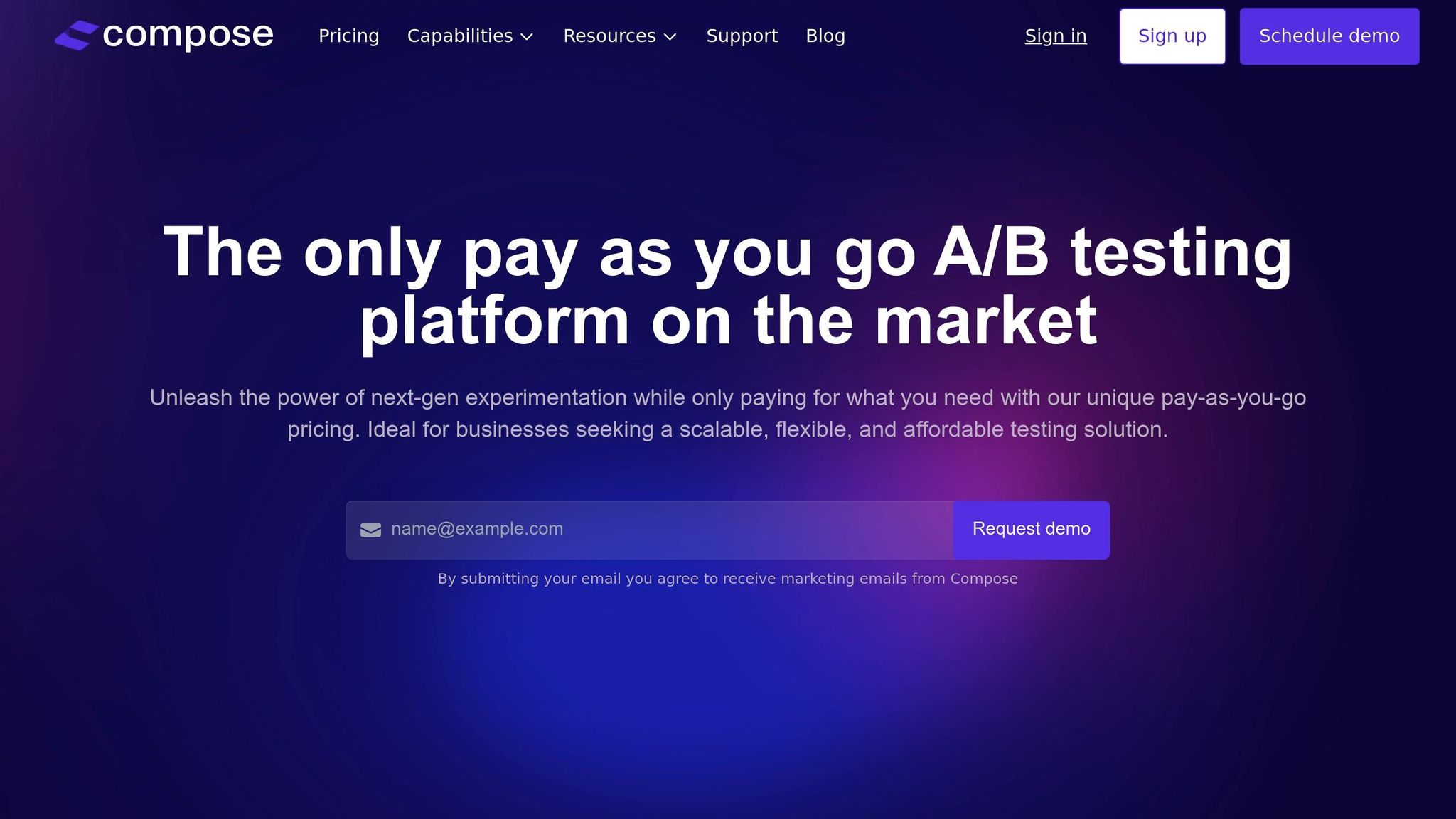
Compose operates on a pay-as-you-go model, charging just $0.0012 per Monthly Tested User (MTU). This means you only pay for active testers - no hidden fees, no minimums, and no contracts locking you in.
E-commerce Platform Integrations
Compose is built with Shopify in mind, offering a seamless, no-code integration through the Shopify App Store. With a simple one-click "App Block" installation, the platform automatically adds the tracking script, allowing you to set up experiments directly in the Shopify Theme Editor using familiar templates. While it’s optimized for Shopify, Compose works with any website by installing a straightforward tracking code. For non-Shopify users or those needing manual setups, Compose provides thorough documentation, tutorial videos, and even a free one-hour technical onboarding session. Additionally, it integrates with Google Analytics 4 and BigQuery for advanced reporting capabilities.
Advanced Testing Features
Compose supports a range of testing options, including A/B/n (multivariate) testing, split URL testing, and split theme testing. A built-in JavaScript code editor allows for custom variants, while the QA testing mode ensures smooth execution with AWS Lambda@Edge-powered anti-flicker protection.
Other standout features include:
- Audience segmentation by device, traffic source, and user type.
- Custom trigger conditions for precise experiment control.
- Shopify Trigger Presets to quickly launch tests across specific categories like product pages.
To streamline planning, Compose offers tools like collaborative hypothesis lists, experiment roadmaps, and PIE prioritization. However, it’s worth noting that server-side testing isn’t supported at this time.
"I have used a few different A/B testing tools and Compose is by far the best value. It gives you what you need without being overly complicated."
- Alex Nelson, eCommerce Manager, Cozy Earth
These robust features, combined with a user-friendly approach, make Compose a compelling choice for Shopify users and other e-commerce platforms.
Pricing
Compose’s pricing stands out for its affordability. At $0.0012 per MTU, 100,000 testers would cost just $120 per month - making it over 4× cheaper than Convert and 5× cheaper than VWO.
For those needing extra support, an Advanced Support add-on is available for $200 per month, which includes chat support and monthly meetings with a dedicated success manager. Technical consulting is also offered at $400 for a half-day or $800 for a full day. The Shopify app itself is free to install, with all charges billed in USD.
10. Unbounce
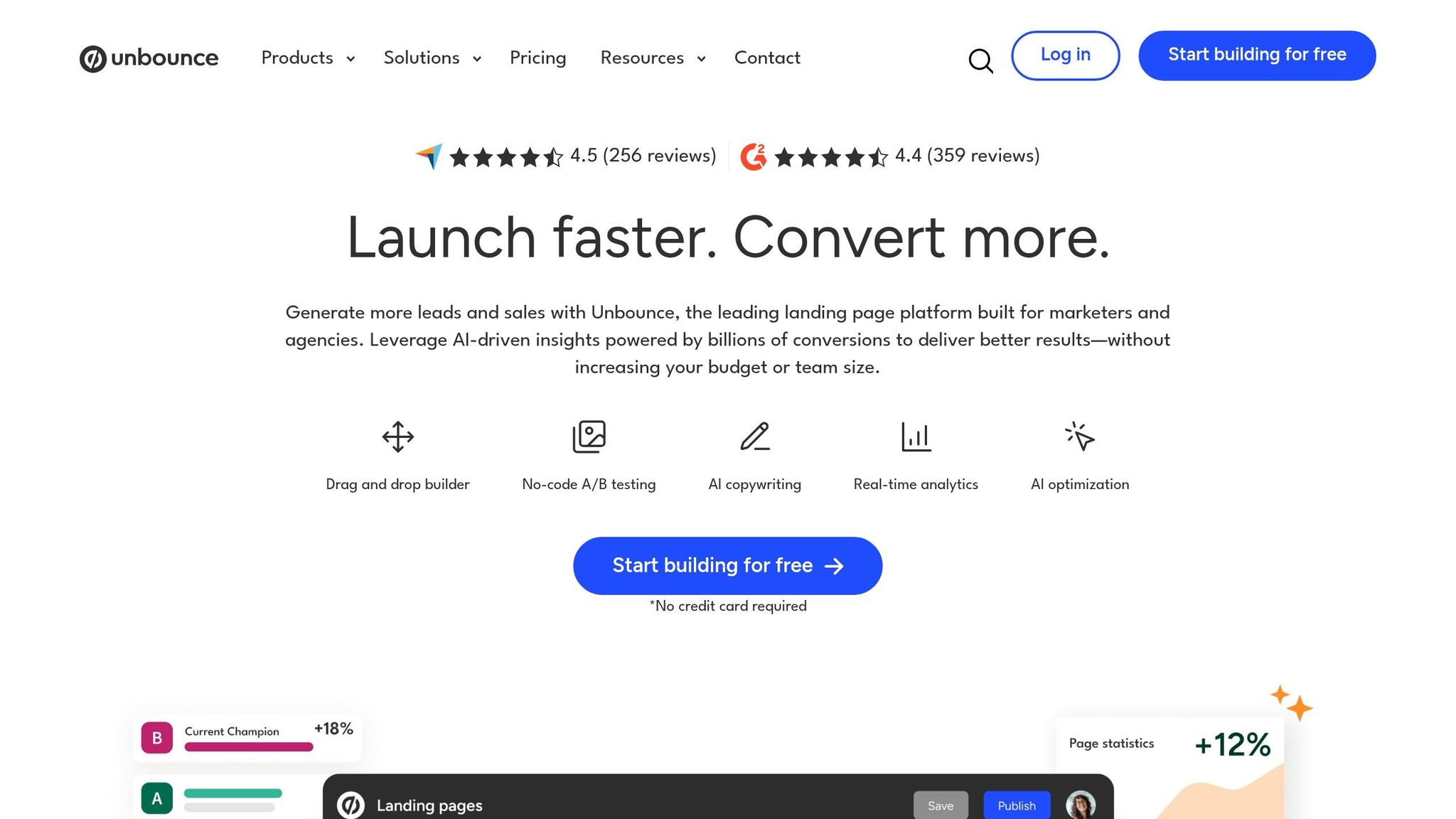
Unbounce is a leading landing page builder that also offers robust A/B testing tools tailored for e-commerce stores. It integrates seamlessly with Shopify, supports payment platforms like Stripe and PayPal, and connects with HubSpot, Salesforce, Mailchimp, and Zapier. These features make it easier to create high-converting landing pages, which can generate double the revenue compared to standard category pages. Let’s dive into the advanced testing features Unbounce provides.
Advanced Testing Features
Unbounce supports both A/B and multivariate testing (MVT), allowing you to test multiple variations at the same time. One of its standout tools is Smart Traffic, an AI-powered feature that automatically directs users to the page variant most likely to convert. This tool factors in details like device type, location, and browser, and it starts optimizing after just 50 visits. To make decision-making easier, Unbounce includes built-in reporting with confidence levels, so you know exactly when to declare a winner.
Another key feature is Dynamic Text Replacement (DTR), which customizes landing page text to match a visitor’s search keywords. This personalization not only enhances the user experience but can also boost your Quality Score and conversion rates.
Pricing
Unbounce offers tiered pricing in USD, making it accessible for businesses of various sizes.
- The Experiment plan costs $112/month (billed annually) and includes unlimited A/B testing for up to 30,000 visitors.
- The Optimize plan is $187/month (billed annually) and supports up to 50,000 visitors, adding Smart Traffic for AI-driven optimizations.
- For businesses with over 100,000 monthly visitors, custom Concierge plans are available, featuring dedicated support.
All plans include a 14-day free trial, so you can test the platform risk-free.
"The A/B testing functionality is superb, with clear metrics on traffic weighting." - Verified User, G2 Review
Going (formerly Scott's Cheap Flights) is a great example of Unbounce in action. By tweaking their call-to-action (CTA) from "Sign up for free" to "Trial for free", they saw a 104% increase in trial starts. Similarly, the sustainable diaper brand DYPER used Unbounce to test landing pages that highlighted different value propositions. Over six months, this strategy led to over 6,000 conversions, primarily from long-term subscriptions.
Conclusion
Picking the right A/B testing tool comes down to three main factors: your budget, your team's technical know-how, and how well the tool fits into your current e-commerce setup. With the optimization and testing market expected to grow from $9.41 billion in 2025 to $34.83 billion by 2034, there are now 271 tools to choose from.
To get started, clearly outline your testing goals. Are you focusing on simple changes like button colors or headlines? Or do you need a tool for more advanced tasks, like full-funnel optimization with server-side testing? If your team doesn’t include developers, prioritize tools with no-code visual editors, such as Personizely or Zoho PageSense. For tests involving pricing or shipping thresholds, look for tools that track key metrics like Revenue Per Visitor (RPV) and Average Order Value (AOV). Also, ensure the tool includes anti-flicker technology to maintain a smooth experience for your users.
Your budget and expected return on investment (ROI) are just as important. For smaller stores, affordable options like Plerdy ($16/month) and Zoho PageSense ($19/month) are great starting points. Mid-tier tools like Personizely ($49/month) offer more advanced features. On the other hand, enterprise-level platforms such as Kameleoon (around $25,000/year) and AB Tasty (approximately $20,000/year) are designed for high-traffic businesses that need AI-driven personalization and robust security features.
When analyzing test results, focus on statistical accuracy. Choose tools that display confidence scores - usually in the 90–95% range - before deciding on a winner. Plan to run tests for at least one to two weeks to cover a full business cycle. The ideal tool will integrate effortlessly with your platform, provide actionable insights, and empower you to make data-backed decisions that improve conversions and revenue. By following these steps, e-commerce businesses can select a tool that drives growth and measurable results.
FAQs
How do I pick the right A/B testing tool for my store size and traffic?
When picking an A/B testing tool, consider your store's traffic and specific goals. Smaller stores should look for tools that are easy to use, with features like visual editors and straightforward functionality. These tools simplify the process and are perfect for beginners.
On the other hand, larger stores with more traffic might benefit from platforms that offer advanced options like detailed targeting, in-depth analytics, and seamless integration with tools such as Shopify or Google Analytics.
The key is to align the tool’s capabilities with your needs. Make sure it fits your budget, handles your technical requirements, and has room to grow as your store scales.
What should I test first to improve e-commerce conversions?
To improve your e-commerce conversions, focus your A/B testing efforts on areas that directly influence user engagement and decision-making. Here are a few key places to start:
- Homepage: Try testing static images against videos to see which reduces bounce rates more effectively.
- Product Pages: Experiment with different product images, descriptions, or call-to-action buttons to find what resonates best with your audience.
- Shopping Cart: Simplify the checkout process or add trust indicators like security badges to minimize cart abandonment.
For the best results, test one element at a time. This approach helps you pinpoint exactly what's driving the changes in user behavior.
How long should I run an A/B test before choosing a winner?
A/B tests generally need to run for 2 to 6 weeks, though the exact duration depends on factors like your website's traffic, business patterns, and the goals of the test. Running a test for too short a time can lead to unreliable results, while letting it run too long risks the influence of outside factors that could skew the data. The key is finding the right balance to achieve statistically sound and meaningful insights. To figure out the best timeframe for your test, tools like duration calculators can be incredibly helpful.