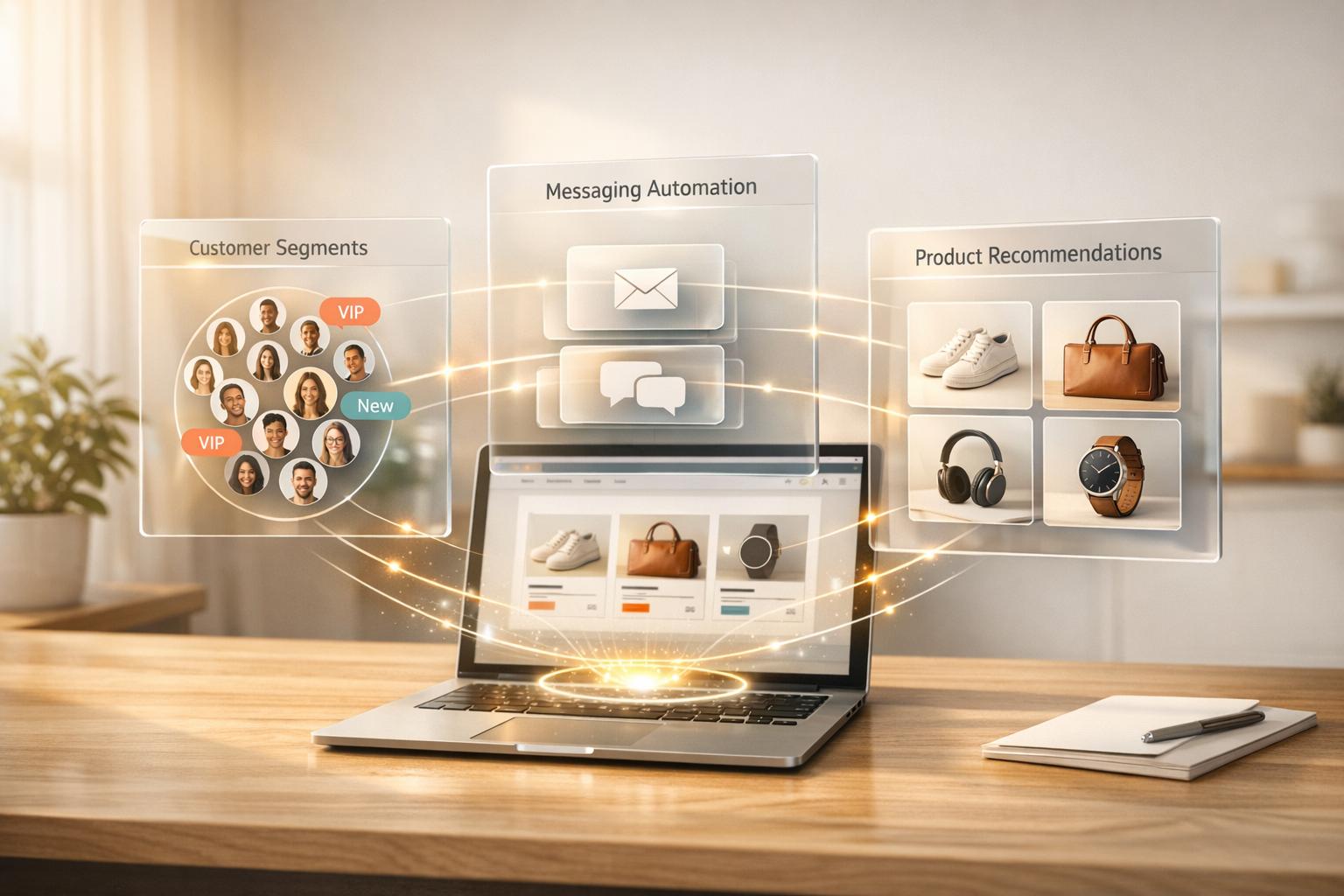
Using CRM Data to Personalize E-commerce Marketing
April 22, 2026E-commerce businesses face a simple truth: customers expect personalized shopping experiences. Generic marketing no longer works. Here's why personalization matters and how CRM data can drive results:
- 71% of consumers expect personalization, while 76% feel frustrated when it’s missing.
- Businesses using personalized strategies see a 20% average sales boost and 40% higher revenue.
- A unified CRM system helps you leverage first-party data like purchase history and browsing behavior, especially as third-party cookies disappear.
Key Takeaways:
- Segment Customers: Use RFM modeling (Recency, Frequency, Monetary value) to group customers into actionable categories like VIPs or at-risk shoppers.
- Automate Campaigns: Trigger real-time, behavior-based emails or SMS campaigns, such as abandoned cart reminders or personalized product recommendations.
- Leverage AI: AI tools can analyze customer behavior, update segments instantly, and predict future needs, saving time and increasing returns.
- Measure Results: Track metrics like conversion rates, average order value (AOV), and customer lifetime value (CLV) to assess the impact of personalization.
CRM-driven personalization isn’t just about boosting sales; it builds loyalty and improves customer retention. Start small with segmentation and automated workflows, then scale with AI for even better results.
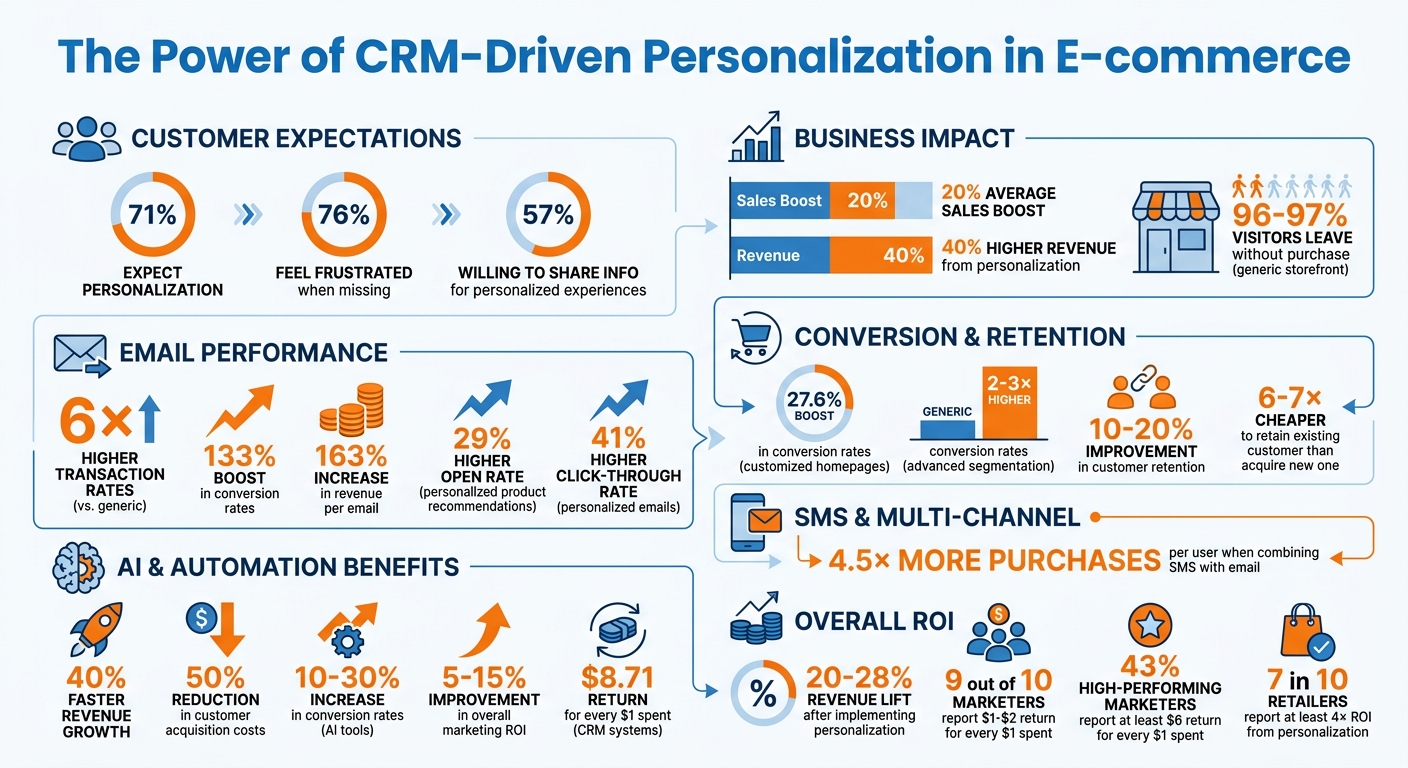
CRM Personalization Statistics: Impact on E-commerce Revenue and Customer Engagement
Common Personalization Problems in E-commerce
Why Generic Marketing Doesn't Work Anymore
Relying on the same homepage, product suggestions, and promotions for every visitor is a thing of the past. Generic storefronts overwhelm shoppers with irrelevant options, leading to decision fatigue and frustration. The result? An alarming 96% to 97% of visitors leave without making a purchase when faced with this outdated approach.
Today’s shoppers expect experiences tailored to their preferences. When brands fail to deliver, it leads to dissatisfaction. Broad, untargeted campaigns often attract visitors who have no intention of buying, wasting ad dollars on unqualified traffic. Meanwhile, competitors leveraging AI-driven tools are creating real-time personalized experiences, leaving generic marketers struggling to keep up.
The difference is clear. Generic email campaigns barely make an impact, while dynamic, personalized email content achieves transaction rates six times higher. Similarly, customized homepages can boost conversion rates by 27.6% compared to generic ones.
"If you are showing the same homepage, the same recommendations, and the same promotions to every visitor, you are not just leaving revenue on the table. You are ceding ground to competitors who are not." - Manoj Mane, RBMSoft
These challenges highlight the necessity of using data to truly understand and engage with customers.
Why You Need Data to Understand Customers
Here’s the reality: personalization relies entirely on data. Without insights into what customers want, what they’ve browsed, or how they’ve interacted with your brand, you’re left guessing. And guesswork doesn’t cut it.
The issue worsens when data is scattered across different platforms. Siloed information - spread between email systems, point-of-sale tools, social media, and web analytics - prevents a full understanding of the customer journey. This fragmentation leads to clumsy mistakes, like sending duplicate emails or missing opportunities for timely cross-sells. Without a unified CRM system, you can’t automate behavioral triggers like abandoned cart reminders or personalized product suggestions, which often results in lost revenue.
The move away from third-party cookies makes this even more urgent. As browsers phase out cookie tracking, first-party CRM data has become your most dependable resource for understanding customer behaviors. The upside? 57% of shoppers are willing to share personal information if they see a clear benefit. Your CRM can capture this opt-in data - purchase history, browsing habits, and preferences - giving you the tools to create the personalized experiences that shoppers now expect.
sbb-itb-cef5bf6
How to Segment Customers with CRM Data
Creating Segments Based on Customer Behavior
Your CRM holds a treasure trove of data - purchase history, browsing habits, email interactions, and cart activity - that can help you create meaningful customer segments. The trick is combining these insights to reflect customer intent and value.
A great starting point is RFM modeling, which scores customers based on Recency (how recently they purchased), Frequency (how often they buy), and Monetary value (how much they spend). This method helps identify key groups like "Champions" (high scores across all three), "Loyalists" (frequent buyers), and "At-Risk" customers (those who haven’t purchased in 45–90 days). Companies that leverage advanced segmentation often see 2–3x higher conversion rates and improve customer retention by 10%–20%.
You can take this further by layering in behavioral signals like product interest, sensitivity to discounts, and device usage. For instance, someone who browses running shoes on their mobile device multiple times in a week should be segmented differently from a shopper who only buys during sales. In fact, 39% of marketers say behavioral segmentation is the most effective for their e-commerce business.
Consider real-world examples: Brondell used AI-powered personalization to analyze onsite search behavior, leading to a 173% boost in search revenue and a 63% increase in revenue per visitor. Similarly, Just Sunnies, an Australian eyewear retailer, integrated Klaviyo and Searchspring with their CRM to create mobile-first segments. This strategy resulted in a 21% increase in conversions and a 15% year-over-year sales growth.
To start, focus on 5–7 core segments such as new subscribers, first-time buyers, repeat customers, VIPs, at-risk shoppers, cart abandoners, and dormant contacts. Each segment should tie directly to a marketing action. For example, VIPs could receive early access to new products or loyalty perks, while at-risk customers might get win-back emails with gentle incentives. Keeping these segments updated in real-time ensures your marketing stays relevant and effective.
Updating Segments in Real-Time
Defining your segments is just the beginning - keeping them updated is essential to maintain relevance. Static lists can quickly become outdated. In fact, data older than 45 days reduces segmentation accuracy to just 61%. This is where dynamic segmentation comes in, adjusting segments automatically based on real-time customer actions.
Your CRM should recalculate RFM scores and lifecycle stages whenever a customer interacts with your brand - whether they visit your website, click an email, or make a purchase. For instance, if a customer buys something, they should immediately exit the "At-Risk" segment to avoid receiving irrelevant win-back emails. This kind of instant suppression prevents awkward situations, like a customer getting a "We miss you" email hours after completing a purchase.
"A customer belongs to a segment as long as they meet the criteria and exits the moment they don't. The segment isn't a list you manage. It's a condition that manages itself." - Samira Farzana, FluentCRM
Real-time segmentation can deliver impressive results. Sandler, a global B2B sales training company, used HubSpot Breeze to tailor content based on live behavioral signals. This approach helped them quadruple sales-qualified leads and cut their sales cycle from 90 days to 45 days. Similarly, Rent a Mac personalized their homepage for three key groups - freelancers, enterprise clients, and students. The result? A 34% decrease in bounce rates, a 63% increase in enterprise demo requests, and a 52% rise in student sign-ups.
To make this work, set up automated workflows that reassess segments as soon as customers take high-intent actions like browsing, adding items to their cart, or starting the checkout process. For example, recovery efforts for cart abandonment should be triggered within an hour. Delays caused by slow data syncing between your store and CRM can lead to missed opportunities and lost revenue.
CRM-Powered Personalization Tactics
Personalizing Email Campaigns with CRM Data
Your CRM is a goldmine for creating engaging, tailored email campaigns. By combining identity details (like a customer's first name), purchase history (what they’ve bought and how often), and behavioral data (emails opened or pages visited), you can build a complete customer profile. With this, you can deliver content that aligns with each customer’s journey - whether it’s a welcome series for new subscribers or a win-back email for those at risk of disengaging.
The impact of personalization is undeniable. Emails tailored with CRM data boast 6× higher transaction rates compared to generic ones. Open rates leap from 15–20% for mass emails to 30–50% for these targeted campaigns, resulting in a 133% boost in conversion rates and a 163% increase in revenue per email.
Grubhub proved the power of this approach with their "Taste of 2020" campaign. Using the Braze API, they personalized each email with 32 custom attributes, such as favorite restaurants and total orders. The result? A 100% jump in social media mentions and an 18% increase in word-of-mouth referrals.
You can elevate email performance even further by incorporating AI-driven send-time optimization, ensuring emails arrive when recipients are most likely to engage. And don’t forget to set fallback values - like “Valued Customer” in place of a missing first name - to avoid awkward mistakes.
"The main benefit of first-party data is that your target audience shares this information with you. You don't have any concerns about permission to use this data." - Aleksandra Korczynska, CMO, GetResponse
These strategies lay a strong foundation for equally effective SMS campaigns that can capture attention at just the right moment.
Using Behavioral Triggers for SMS Campaigns
SMS works best when messages are timely and relevant. By integrating your CRM with platforms like Shopify, WooCommerce, or Magento, you can automate texts triggered by customer actions - like starting checkout, placing an order, or when an item comes back in stock. Brands that pair SMS with email as a second channel see 4.5× more purchases per user.
To make SMS messages resonate, lean on CRM data. Use browsing habits, wishlist activity, and past purchases to craft messages that feel personal. For instance, if a customer abandons their cart, send a reminder within an hour featuring the exact items they left behind. Or, if someone hasn’t shopped in 60 days, send a “We miss you” text with an exclusive discount.
Showmax, a video subscription service, showcased the potential of this approach by using over 600 metadata tags to personalize cross-channel messages (email, push, and in-app). By tailoring content to viewing history and customer lifecycle, they achieved a 204% increase in subscribers and a 37% ROI boost. Modern CRM tools can even analyze the best times to send messages, ensuring they land when customers are most likely to respond.
Together, these CRM-driven tactics create a smooth, multi-channel experience that strengthens customer relationships and drives conversions.
Recommending Products Based on Customer Data
While email and SMS enhance customer engagement, personalized product recommendations turn interest into sales. CRM-powered recommendations are a game-changer. Amazon, for example, credits 35% of its revenue to its recommendation system - a testament to their effectiveness.
The best strategies combine several methods:
- Collaborative filtering: Suggesting products based on what similar users liked.
- Content-based filtering: Matching products with a customer’s past preferences.
- Affinity-based recommendations: Highlighting items tied to specific brands or styles.
Placement is just as important as the recommendations themselves. Use “Most Popular” sections for new visitors, “Similar Products” on product pages, and “Frequently Bought Together” in the cart to encourage cross-sells. For returning customers, tap into their CRM profiles to show “Recently Viewed” items or suggestions based on their last purchase. Personalized emails featuring product recommendations see a 29% higher open rate and a 41% higher click-through rate compared to generic emails.
Advanced systems go a step further with predictive analytics, anticipating customer needs before they arise. For example, by analyzing purchase intervals in your CRM, you can predict when a customer might need to reorder makeup or pet food and send a reminder with a one-click option. And if your system struggles to find personalized results, default to a “Most Popular” fallback to ensure recommendation widgets are never empty.
"Amazon attributes 35% of its revenue to product recommendations. This single statistic reveals the massive revenue opportunity that effective recommendations represent for ecommerce brands." - Brian V Anderson, Founder & CEO, Nacelle
These personalization tactics, powered by CRM data, create a seamless shopping journey that not only boosts sales but also deepens customer loyalty.
Using AI and Machine Learning to Scale Personalization
How AI Automates Personalization
Traditional CRM systems excel at tailoring messages, but AI takes personalization to a whole new level by automating updates and insights in real time. Instead of relying on rigid rules, AI uses adaptive learning models that adjust to customer behavior on the fly. This means no more manually categorizing customers - AI instantly processes actions to update profiles, distinguishing between casual browsers and serious buyers in real time.
This shift from batch processing to real-time orchestration ensures personalization reflects what customers care about right now, rather than what they cared about last week. AI also bridges fragmented data across devices - like mobile, laptops, and apps - into unified profiles, creating seamless interactions.
Take Marks & Spencer, for example. In late 2024, they launched an AI stylist capable of generating outfit recommendations from 40 million combinations based on customer size and style preferences. This AI system also handled 80% of product descriptions, leading to a 7.8% year-over-year increase in online fashion and home sales. Similarly, Amazon used real-time AI algorithms to drive revenue growth from $575 billion to $638 billion in 2024 - an 11% jump - by tailoring search results and recommendations for individual shoppers.
"In 2025, the battle for e-commerce loyalty isn't fought on discounts - it's won on relevance." - Sciforce
To make AI work effectively, ensure your CRM data is well-structured. Include dedicated fields for product details like dimensions, materials, and compatibility so AI can easily query them. For instance, Rasendoktor, an online lawn care retailer, combined structured ERP and CRM data with their Qualimero AI system. This integration delivered product recommendations tailored to soil type and regional climate, achieving a 16× ROI and 100% automation for customer consultations.
With this kind of automation, AI not only scales personalization but also frees your team to focus on more strategic tasks.
Saving Time While Increasing Returns
AI-powered CRM personalization doesn’t just deliver better results - it also slashes the time spent on manual marketing tasks. Many business owners report saving 10 to 15 hours per week by automating tasks like drafting product descriptions, segmenting email lists, and triggering win-back campaigns. For example, Jill's Homestead, a leather goods brand, saved $250 per product launch by using Shopify Magic's AI-powered media editor instead of traditional photo shoots.
The financial benefits are just as compelling. AI-driven personalization can grow revenue 40% faster while cutting customer acquisition costs by up to 50%. Retailers using these tools have seen conversion rates jump by 10% to 30%, and overall marketing ROI can improve by 5% to 15%. Considering that CRM systems already deliver an average return of $8.71 for every $1 spent, adding AI makes the investment even more worthwhile.
Start small to see meaningful results. Focus your AI efforts on one or two specific KPIs, such as boosting click-to-cart rates or increasing average order value, rather than chasing vague goals like "improving user experience". Make sure your models are retrained daily or weekly to stay aligned with seasonal trends and customer behavior. For mid-sized retailers, pre-built connectors (priced between $5,000 and $25,000 with 2–6 week implementation timelines) offer a quicker alternative to custom builds, which can cost $25,000 to $150,000 and take 3–6 months to implement.
"89% of business leaders call [AI-powered personalization] critical to their success." - Sciforce
Measuring Personalization Results and ROI
Which Metrics to Monitor
To understand the impact of personalization, start by focusing on financial metrics that directly affect your bottom line. Metrics like revenue growth, conversion rate improvements, and average order value (AOV) reveal whether personalized product recommendations and dynamic content are driving sales. For example, 57% of businesses cite increased sales revenue as the top benefit of implementing CRM software. These numbers don’t just reflect immediate gains - they also show how personalization strengthens long-term customer relationships.
Beyond short-term gains, look at customer lifetime value (CLV) and customer retention rate to see if your efforts are fostering loyalty rather than just grabbing attention. Retaining a customer is far more cost-effective - 6 to 7 times cheaper than acquiring a new one. Adding a second messaging channel, like SMS alongside email, can amplify results, leading to 4.5 times more purchases per user.
Engagement metrics are equally important. Monitor click-through rates, email open rates, and website interactions to measure how well your audience is responding. Tools like Net Promoter Score (NPS) can provide insights into customer satisfaction and whether CRM data is helping improve service resolution times.
| Business Goal | Primary KPI | Personalization Tactic Example |
|---|---|---|
| Increase Conversion Rate | Conversion Rate (%) | Personalized CTAs for new vs. returning visitors |
| Boost Average Order Value | Average Order Value (AOV) | "Complete the look" or "Frequently bought together" suggestions |
| Enhance Customer Loyalty | Customer Lifetime Value (CLV) | Exclusive offers for loyalty program tiers or anniversaries |
| Reduce Cart Abandonment | Cart Abandonment Rate (%) | Targeted pop-ups or emails triggered by exit intent |
The next step is translating these metrics into measurable ROI through testing and ongoing engagement analysis.
Tracking Engagement to Measure Success
Once you’ve identified the right metrics, calculating ROI is essential. Use this formula: divide the net incremental revenue by the cost of your personalization tools and multiply by 100. For accuracy, apply with-and-without testing - split customers into control (default) and experiment (personalized) groups to see the direct impact of personalization. If a controlled test isn’t feasible, compare performance from 14–30 days before implementation to the period after.
A key metric to watch is revenue per visitor (RPV), which combines AOV, conversion rates, and unique visitors. Successful personalization should increase this figure by boosting both basket size and conversion frequency. The payoff can be substantial: businesses often experience a 20% to 28% revenue lift after implementing personalization, and 9 out of 10 marketers report returns of $1–$2 for every $1 spent. High-performing marketers see even better results, with 43% reporting at least $6 in return for every $1 spent.
Abandoned cart recovery is another area worth tracking. Send recovery emails within an hour, followed by one or two additional messages over the next 48 hours. Measure how many of these efforts convert compared to your baseline. For repeat purchases, segment customers by lifecycle - frequent buyers versus dormant ones - and tailor incentives to increase average spend per visit. Keep in mind that 79% of customers are more likely to recommend a brand when it offers a strong, personalized loyalty program.
"Personalization is here to stay... if you're not investing in personalization, you will eventually be left behind." - LimeSpot Team
It’s important to note that meaningful changes in repeat purchase rates often take 3–6 months, while advanced AI-driven personalization may take 6–12 months to show full ROI. To account for seasonality, track macro metrics like total conversion rate and AOV on a quarterly basis. For more immediate insights, look at micro metrics such as "sales from clicks" to evaluate specific offers. If immediate revenue gains are lacking, check engagement metrics like time-on-site and bounce rates - these can signal effective personalization even if external factors like pricing or shipping are limiting conversions.
Master Your eCommerce Personalization Strategy
Conclusion
CRM-driven personalization has become a game-changer for staying competitive in e-commerce. As highlighted earlier, most consumers now expect tailored experiences, and businesses that deliver see impressive revenue increases. By transitioning from broad, generic marketing to real-time, behavior-based interactions, you're not just improving sales - you’re also building trust that transforms one-time buyers into loyal, repeat customers.
The foundation of this transformation lies in your data. Combine insights from website activity, purchase history, and email interactions to create a unified customer profile. Use this profile to automate impactful triggers and multi-channel campaigns that drive consistent results. It’s worth noting that retaining an existing customer costs six to seven times less than acquiring a new one, making personalization one of the smartest ways to grow sustainably.
To get started, focus on the basics: segmentation, personalized product recommendations, and automated workflows. Once you’ve mastered these, you can explore advanced AI-driven strategies. Always test your efforts and let the data guide your decisions. Ameer Draidy from Circular Design offers an insightful reminder:
"Be prepared to be wrong. Our team was convinced that highlighting our refugee employment program on the homepage for everyone would boost conversions. We tested it. It didn't... Let the data, not your assumptions, decide what works."
The most successful businesses aren’t waiting for flawless systems - they’re taking incremental steps, analyzing results regularly, and refining their strategies based on real customer behavior. With 7 in 10 retailers reporting at least 4x ROI from personalization, the real question isn’t whether to start but how soon you can put your CRM data to work.
Every click, every purchase, every interaction is your customer’s way of telling you what they want. Now, it’s your turn to let your CRM data respond.
FAQs
What CRM data should I use first for personalization?
Leverage purchase history and browsing behavior data to personalize recommendations. These insights provide a clear view of what customers prefer and how they interact with your offerings. By understanding their habits, you can craft experiences that feel more relevant and keep them engaged.
How do I set up real-time segments without messy data?
To set up real-time segments effectively, rely on dynamic, automated segmentation that adjusts instantly based on user activity. Prioritize clean, verified first-party data - such as clicks or cart interactions - and utilize AI-powered tools to analyze this data as it happens. This approach ensures your segments stay accurate and up-to-date, reflecting real-time user behavior while avoiding unnecessary errors or data clutter.
How can I prove personalization ROI in dollars?
To showcase the financial return of personalization, focus on tracking the revenue boost directly linked to these efforts. Research indicates that personalization can drive a revenue lift of 5% to 15%, with some businesses experiencing even greater results. On top of that, 70% of retailers report returns exceeding 400% from their personalization investments. These figures underscore the strong financial benefits of implementing personalization strategies effectively.