Ultimate Guide to Social Media Sentiment Analysis
April 18, 2026Social media sentiment analysis helps businesses understand how customers feel about their brand by analyzing online mentions, reviews, and comments. It uses AI and natural language processing (NLP) to classify sentiments as positive, negative, or neutral. This allows companies to turn customer emotions into actionable data.
Key Takeaways:
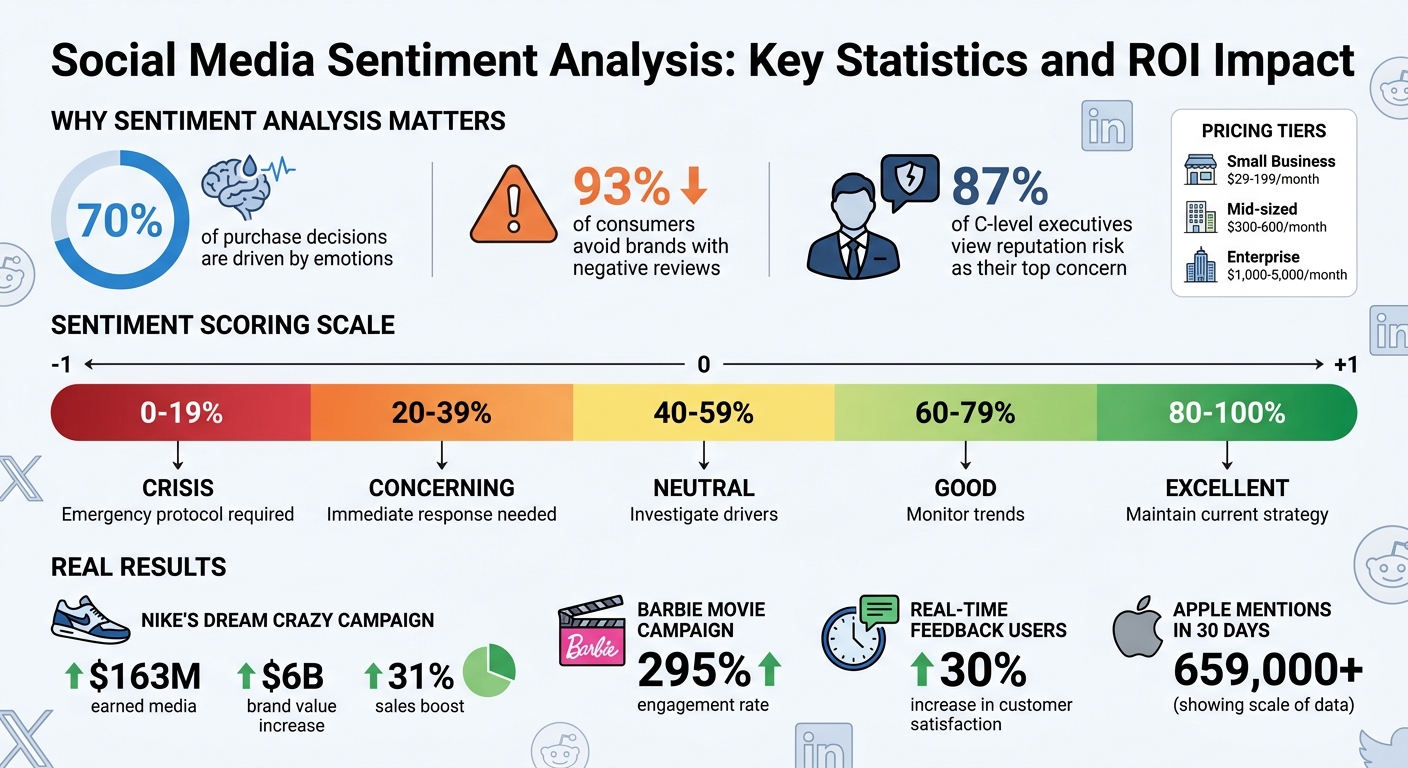
- Why It Matters: Emotions drive 70% of purchase decisions, and 93% of consumers avoid brands with negative reviews.
- How It Works: Tools analyze data from platforms like X (formerly Twitter), LinkedIn, and Reddit, using rule-based systems, machine learning, or hybrid methods.
- Applications: Common uses include brand monitoring, customer satisfaction tracking, crisis management, and competitive analysis.
- Challenges: Sarcasm, context-specific language, and mixed sentiments can complicate analysis, but human oversight and advanced AI models improve accuracy.
- Tools and Costs: Options range from $29/month for small businesses to $5,000/month for enterprise solutions.
Sentiment analysis helps brands stay ahead by identifying trends, addressing customer concerns, and improving their strategies based on emotional insights.
Social Media Sentiment Analysis: Key Statistics and ROI Impact
Sentiment Analysis Basics
What is Sentiment Analysis?
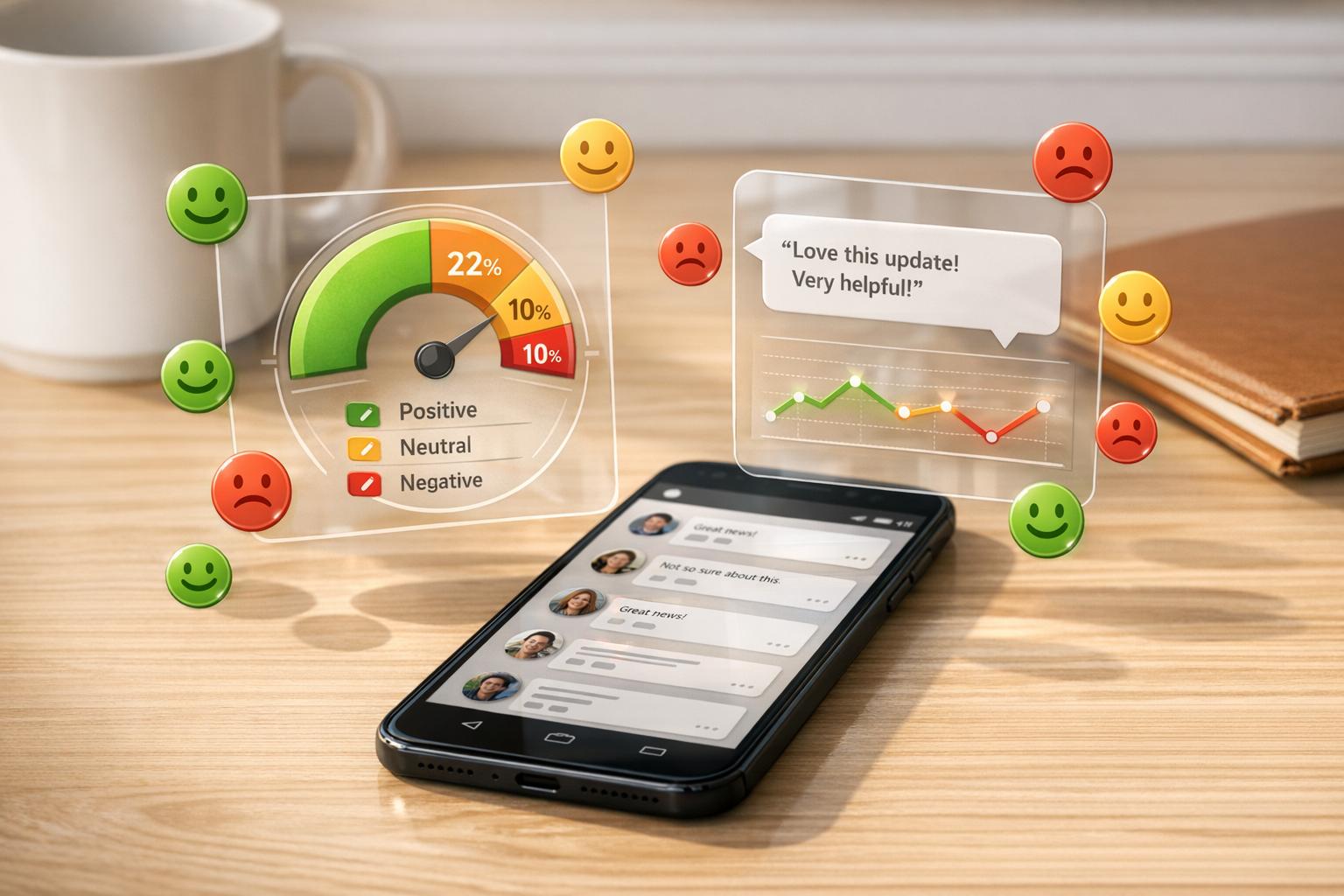
Sentiment analysis, also known as opinion mining, uses AI, natural language processing (NLP), and machine learning to determine the emotional tone behind social media mentions, reviews, and comments. It categorizes these as positive, negative, or neutral. Unlike traditional analytics that focus on metrics like clicks or shares, sentiment analysis digs deeper, uncovering the emotions - whether excitement or frustration - driving those actions.
Sentiment is often measured using a scale from –1 (very negative) to +1 (very positive) or expressed as a percentage (0–100). Net sentiment is calculated with this formula: (Positive Mentions – Negative Mentions) / (Positive Mentions + Negative Mentions). A score above 80% typically indicates strong brand health, while anything below 50% signals potential customer experience issues that need immediate attention.
Why Businesses Need Sentiment Analysis
Customer emotions influence 70% of purchase decisions. Sentiment analysis helps businesses understand these emotions, identify what's resonating with customers, and refine their strategies accordingly.
It also acts as a safeguard for reputation management. By spotting spikes in negative sentiment in real time, companies can address problems before they escalate into PR disasters. This is crucial, as 87% of C-level executives view reputation risk as their top concern.
"Sentiment analysis can strengthen your decision-making process. As you build out marketing strategies, factor in what customers say. Rather than just what they do." – Sydney Go, Content Author, Semrush
These insights provide a solid foundation for smarter marketing strategies.
Social Media Marketing Applications
One of the most common uses for sentiment analysis is brand monitoring. Automated tools can identify urgent conversations, saving teams from manually sifting through thousands of mentions. For example, Apple was mentioned over 659,000 times in just 30 days, showcasing the sheer volume of data that automated sentiment analysis can process.
Another key application is customer satisfaction tracking. Aspect-based analysis breaks down feedback into specific features, revealing strengths (like product design) and weaknesses (such as a complicated checkout process). This helps product teams act on precise, data-driven recommendations.
Crisis management also benefits significantly. Automated alerts can flag sudden spikes in negative sentiment or unusually high mention volumes, enabling teams to respond quickly. Additionally, sentiment analysis supports competitive intelligence by monitoring how customers feel about competitors. This can reveal market opportunities and help fine-tune your positioning.
sbb-itb-cef5bf6
How Sentiment Analysis Works
Data Collection and Preprocessing
The first step in sentiment analysis involves gathering raw, unfiltered data from platforms like X, LinkedIn, Reddit, forums, blogs, and review sites. This is typically done using APIs (application programming interfaces) or web scraping tools to access the data.
Once the data is collected, it must be cleaned to remove irrelevant or distracting elements like spam, duplicate entries, and unrelated content. Preprocessing includes tasks like stripping away HTML tags and URLs, converting all text to lowercase for consistency, and removing punctuation. Emojis and hashtags, which can heavily influence sentiment, are also standardized during this phase. These steps transform chaotic, unstructured data into a format that AI systems can analyze effectively. With the data prepared, the next stage focuses on determining sentiment through analysis.
Sentiment Classification Methods
Once the text is preprocessed, it is categorized as positive, negative, or neutral using one of three primary methods:
- Rule-based systems: These rely on predefined dictionaries to identify sentiment. While they are fast and easy to understand, they often fall short when handling sarcasm or subtle context.
- Machine learning models: Algorithms like Naive Bayes and Support Vector Machines (SVM) learn from human-labeled examples, making them better at identifying nuanced sentiment. However, they require large datasets for effective training.
- Hybrid approaches: These combine rule-based methods with machine learning, using rules for straightforward cases and machine learning for more ambiguous ones. This combination can achieve accuracy rates of 80–90%.
Modern tools also leverage Large Language Models (LLMs) like GPT or BERT. These models excel at understanding sarcasm, irony, and complex intent, thanks to their ability to perform zero-shot learning - analyzing sentiment in unfamiliar domains without needing extensive retraining. These classification techniques form the backbone of how sentiment data is interpreted and applied in various contexts.
Common Challenges and Solutions
Despite advancements, sentiment analysis still faces hurdles. Sarcasm, irony, and ambiguous contexts remain difficult for even the most advanced AI systems to interpret. For example, a tweet like "I love waiting on hold for 45 minutes" might be mistakenly classified as positive when it’s clearly negative. Context-specific language poses additional challenges. Words like "bug" or "crash" may seem neutral in everyday speech but carry negative meanings in tech-related discussions.
To address these issues, many tools incorporate human-in-the-loop systems, where human reviewers periodically verify and refine AI-generated results. Another approach is aspect-based analysis, which separates mixed sentiments within a single piece of text - for instance, highlighting praise for a product's design while noting criticism of its shipping process. These strategies underscore the importance of thorough preprocessing and flexible classification methods to improve accuracy and reliability.
Tools and Implementation Strategies
Selecting Sentiment Analysis Tools
When it comes to sentiment analysis, choosing the right tool is key to turning data into actionable insights. Start by identifying your business objectives. If your focus is crisis prevention, opt for platforms that provide real-time alerts, such as notifications for a 30% drop in sentiment within 24 hours or a threefold increase in negative mentions. For product feedback, tools offering aspect-based sentiment analysis (ABSA) are ideal. ABSA breaks down sentiment by specific features - like "camera quality" or "battery life" - rather than providing just an overall score.
Accuracy should take precedence over speed. Test tools to see how well they handle industry-specific nuances like sarcasm. Basic rule-based systems often miss these subtleties, whereas advanced machine learning models or hybrid systems are better at delivering reliable results. Also, ensure your chosen tool integrates seamlessly with your CRM (e.g., Salesforce, HubSpot) or help desk software (e.g., Zendesk) for smoother workflows.
Pricing varies significantly depending on your business size. Small businesses can start with tools priced between $29 and $199 per month (examples include Awario, Brand24, and Sprout Social). Mid-sized agencies typically pay $300 to $600 monthly for tools like Mentionlytics and Agorapulse. Enterprise-level solutions with more advanced features and extensive data access, such as Brandwatch, Meltwater, or Sprinklr, can cost anywhere from $1,000 to $5,000 per month.
Once you've selected the right tool, the next step is implementing a robust analysis system.
Implementing Two-Stage Analysis
A two-stage analysis approach can help you manage sentiment data effectively. Start with a lightweight rule-based system to filter mentions by urgency. For instance, high-priority negative mentions can be routed directly to customer care teams, helping prevent data overload.
In the second stage, use advanced machine learning or large language models to dive deeper into the filtered data. This step allows for aspect-based segmentation, breaking down sentiment by product line, geographic location, or customer type. This granular analysis can reveal hidden pain points. To ensure accuracy, review 10–20% of AI-classified mentions manually. This is particularly important for catching misinterpretations of sarcasm or jargon. Additionally, adjust alert thresholds as needed to fine-tune the system.
Once the data is processed, the next challenge is using these insights effectively within your marketing efforts.
Using Sentiment Data in Marketing Campaigns
Sentiment insights can be a powerful tool for shaping marketing strategies. Start by defining clear response protocols. Share positive testimonials and express gratitude to advocates. For negative mentions, respond quickly and move heated discussions offline to resolve issues privately. Neutral mentions, often overlooked, can be a goldmine of opportunity. A simple acknowledgment of unanswered questions or passive reposts can turn these into positive interactions.
A great example comes from the Atlanta Hawks. In early 2026, they used a social listening tool to monitor sentiment during a jersey launch. They found 99% positive sentiment, which led to a 127.1% increase in video views and a 170.1% growth in their Facebook audience.
"Look at sentiment, reviews, mentions, and the tone of what's being said. I pay attention to patterns in feedback and how people respond over time. These signals help you understand what's working - and what needs to change!" - Phil Pallen, Brand Strategist
Rather than focusing solely on absolute sentiment scores, track trends over time. Set automated alerts for sudden changes in sentiment and segment data by product line or location to address emerging issues promptly.
Reading and Using Sentiment Data
How Sentiment Scores Work
Sentiment analysis tools often translate emotions into numerical scores. These scores typically range from –1 (very negative) to +1 (very positive) or 0–100%, providing a measurable way to assess customer sentiment. For example, a score above 80% is usually a sign of strong brand health, while anything under 50% signals serious customer experience issues that demand immediate attention.
But sentiment analysis goes beyond just labeling something as positive or negative. Modern tools can identify specific emotions like joy, anger, or frustration, and even analyze intent - figuring out whether someone is looking to purchase, needs help, or is venting a complaint. Take the phrase, "Everything is fine 🔥." At first glance, it seems positive, but the fire emoji often signals sarcasm, flipping the sentiment entirely.
Context is key. Emojis, hashtags, and industry-specific jargon can completely change the meaning of a message. For instance, the word "bug" has a negative connotation in tech but is neutral in other contexts. Advanced tools using Natural Language Processing (NLP) can pick up on these subtleties, whereas simpler rule-based systems often miss them.
One helpful way to evaluate overall brand health is through Net Sentiment. This metric is calculated as (Positive Mentions - Negative Mentions) / (Positive Mentions + Negative Mentions). Neutral mentions, while often overlooked, can still provide opportunities to engage and improve.
| Sentiment Score Range | Status | Next Steps |
|---|---|---|
| 80–100% | Excellent | Maintain current strategy |
| 60–79% | Good | Monitor trends, optimize messaging |
| 40–59% | Neutral | Investigate negative drivers |
| 20–39% | Concerning | Immediate response strategy needed |
| 0–19% | Crisis | Emergency response protocol required |
Understanding how these scores are calculated lays the groundwork for deeper analysis, including tracking sentiment by time, topic, and recurring themes.
Analyzing Sentiment by Topic and Time
Once you grasp sentiment scoring, the next step is to analyze these scores across different topics and timeframes. Context matters. For instance, a 65% sentiment score might seem decent until you realize your competitor is at 82%. Benchmarking against your past performance and industry standards helps you understand where you truly stand.
Tracking sentiment trends over time is where the real value emerges. Sudden spikes or dips can serve as early warnings for PR crises or viral moments. Setting up automated alerts for dramatic changes allows you to respond quickly before small issues spiral into major problems.
Topic-based analysis - also known as aspect-based sentiment analysis - dives into how customers feel about specific aspects of your brand. For example, a customer might rave about your product's design but criticize its pricing. Breaking down sentiment by feature or service helps pinpoint areas needing improvement. For instance, analyzing mentions of "customer service" versus "product quality" might reveal that complaints are more about response times than the product itself.
It’s also worth noting that sentiment can vary by platform. A "good" sentiment score on X (formerly Twitter) might appear lower than on Instagram due to differences in tone and user behavior. Tracking sentiment separately for each platform ensures you avoid misleading conclusions.
Combining Sentiment with Theme Analysis
Adding theme analysis to sentiment data provides a fuller picture of customer feedback. While sentiment analysis tells you how people feel, theme analysis uncovers why they feel that way. Together, they offer actionable insights.
This matters because 70% of customer purchase decisions are influenced by emotions rather than logic. If you notice a drop in positive sentiment, theme analysis can identify the cause - maybe it’s a price hike, shipping delays, or backlash from an ad campaign. Without this deeper understanding, you’re just reacting to numbers without addressing the root cause.
"The truth? Most teams still treat sentiment like a vanity metric - a quick glance to see if people are mostly positive, but real sentiment work is about emotional strategy. It's not just reacting to noise - it's about reading the room at scale."
– Zuza Kumorek, Social Media Specialist, Brand24
Take Nike’s "Dream Crazy" campaign featuring Colin Kaepernick as an example. By monitoring real-time social media sentiment and analyzing the themes behind reactions, Nike discovered that while the ad was divisive, it resonated strongly with their younger demographic. The results? $163 million in earned media, an increase of $6 billion in brand value, and a 31% boost in sales.
The lesson here is clear: tracking sentiment alone isn’t enough. To truly understand customer behavior and make informed decisions, you need to dig into recurring themes and patterns. That’s where the real insights - and opportunities - lie.
How to Use Sentiment Analysis to Drive Business and Social Strategy
Conclusion
Social media sentiment analysis goes beyond counting mentions - it deciphers the emotions and motivations behind them. Considering that 70% of customer purchase decisions are influenced by emotions rather than logic, tapping into these emotional drivers is essential for any business aiming to grow.
Brands that succeed don’t just listen - they act. Take the Barbie movie's marketing team, for example. In July 2023, they spotted a viral fan conversation connecting Ryan Gosling's wardrobe to BTS member Jimin. Acting on this, they released a personalized video from Gosling, which led to a 295% engagement rate, making it the campaign's standout post. Another example: in May 2024, Samsung turned negative sentiment about Apple’s "Crush" iPad Pro ad into an opportunity. By launching its "Uncrush" campaign, Samsung positioned itself as a champion of creativity, cleverly addressing customer frustrations.
These examples highlight the power of acting quickly and strategically on sentiment insights.
To make the most of sentiment data, integrate it with your CRM and business intelligence tools. This allows you to link customer emotions directly to metrics like lifetime value. Set up automated alerts to tackle negative sentiment spikes and turn neutral mentions into engagement opportunities. Companies that leverage real-time feedback report a 30% increase in customer satisfaction.
Start by establishing a baseline sentiment score, monitor it weekly, and compare it to industry benchmarks. In today’s fast-paced digital world, success doesn’t come from having the largest audience - it comes from truly understanding your customers’ emotions and responding in meaningful ways.
FAQs
How accurate is sentiment analysis on social media?
Social media sentiment analysis accuracy hinges on the tools and techniques employed. While advanced models like BERT can perform well in controlled environments, the informal and unpredictable nature of social media language often reduces their effectiveness in practice. Research indicates that models such as VADER and BERT achieve accuracy rates of approximately 60% and 55%, respectively. Ultimately, the success of these models depends on factors like the quality of the data, the specific context, and the model being used.
What else should I track besides a single sentiment score?
To get a clearer picture of customer sentiment, don't just rely on a single sentiment score. Dive deeper by tracking emotional tones - whether feedback leans positive, negative, or neutral - and pinpoint specific emotions like happiness or frustration. Pay attention to the key themes that emerge in customer feedback to uncover what influences sentiment the most.
It’s also important to analyze mention volume and frequency to identify trends or sudden spikes in activity. Take it a step further by examining the platforms or demographics driving these mentions. Together, these metrics offer a more complete understanding of how customers feel and why.
How do I connect sentiment data to real business results?
To connect sentiment data with business results, use the insights to shape decisions that directly influence essential metrics. By monitoring positive, negative, and neutral sentiments, you can uncover trends, enhance customer experiences, and increase both satisfaction and loyalty. Combine sentiment data with metrics such as sales figures or customer retention rates to demonstrate how shifts in sentiment correlate with outcomes like revenue growth. This approach also helps validate the value of investing in sentiment analysis tools.