Future of Geofencing: Innovations in 2026
April 2, 2026Geofencing in 2026 has evolved into a powerful tool for businesses, combining cutting-edge technologies like 5G, AI, and advanced GPS to deliver precise, real-time customer engagement. Here's what you need to know:
- 5G Integration: Faster, more accurate location tracking enables instant, personalized offers as customers enter a geofenced area.
- AI-Powered Targeting: Predictive algorithms analyze behavior to deliver tailored messages, increasing engagement by 67%.
- Market Growth: The geofencing market is set to grow by $10.19 billion by 2030, with a 32.5% annual growth rate.
- Privacy-First Approach: Compliance with stricter regulations like GDPR and CCPA ensures trust while leveraging first-party data.
- New Applications: Augmented reality and multi-technology geofencing (GPS, Wi-Fi, BLE beacons) expand possibilities, from aisle-level navigation to dynamic promotions.
Businesses using geofencing report 2–3× higher ROI compared to traditional ads. With privacy regulations tightening and third-party cookies disappearing, geofencing provides a compliant, high-impact way to connect with the right customers at the right time.
Geofencing Market Growth and Business Adoption
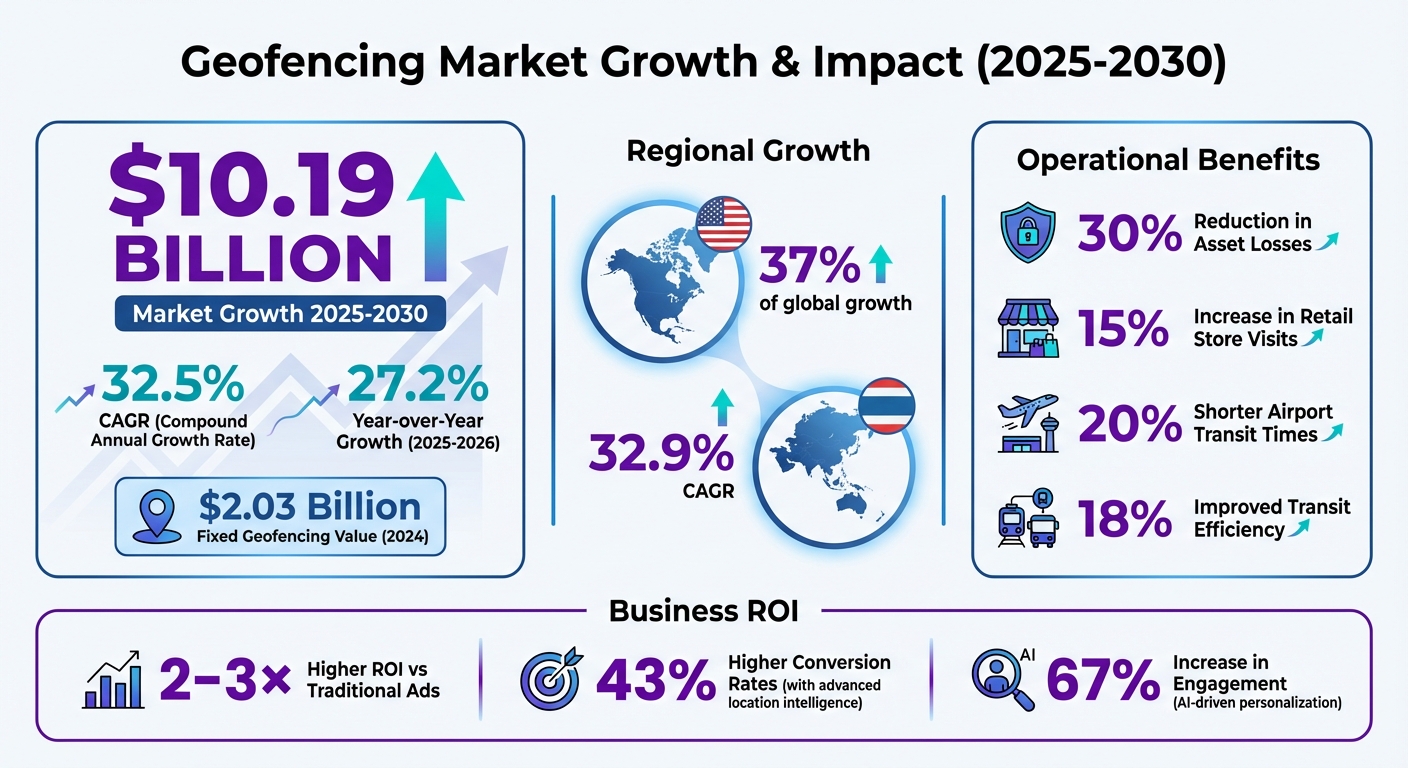
Geofencing Market Growth and ROI Statistics 2026-2030
Market Size and Growth Projections
The geofencing market is projected to grow by $10.19 billion between 2025 and 2030, with an impressive 32.5% compound annual growth rate (CAGR) and 27.2% year-over-year growth from 2025 to 2026. North America leads the charge, contributing 37% of global growth, while the Asia-Pacific region is expanding at a rapid 32.9% CAGR. Fixed geofencing, expected to reach a value of $2.03 billion in 2024, continues to attract significant investment. These figures highlight the growing momentum and provide a solid foundation for discussing the innovations that are fueling this expansion.
What's Driving Market Expansion
Several factors are propelling the growth of geofencing technology. Here’s a closer look at the key drivers:
- Operational Benefits: Geofencing alerts have proven to reduce asset losses by 30%, increase retail store visits by 15%, shorten airport transit times by 20%, enhance patient monitoring in healthcare, and improve transit efficiency by 18%. These measurable benefits make geofencing an attractive solution across industries.
- Accessibility for Businesses: The availability of geofencing APIs and SDKs has made it easier for smaller businesses to integrate location-based features into their mobile applications. This accessibility is broadening the adoption of geofencing beyond large enterprises.
- Notable Deployments and Innovations:
- In September 2024, CloudSphere Inc. introduced advanced geofencing APIs designed to enhance application functionality.
- Carrefour Romania implemented over 560 Beacon devices across 28 supermarkets to study customer shopping habits and deliver personalized promotions in real time.
- In March 2024, cybersecurity firm Trustifi LLC expanded into Australia, incorporating geofencing features to restrict sensitive data transmissions to specific geographic regions. This move ensures compliance for sectors like healthcare, finance, and legal services.
These advancements not only showcase the diverse applications of geofencing but also pave the way for further technological progress. The integration of cutting-edge technologies like 5G and AI will continue to refine and expand geofencing capabilities, a topic that will be explored in the next sections.
sbb-itb-cef5bf6
How 5G and Advanced GPS Are Changing Geofencing
5G Networks and Faster Location Data
5G is reshaping geofencing, turning it into a tool for instant customer engagement. Thanks to its ultra-low latency, 5G enables "instant ad experiences" that activate the moment someone steps into a designated area. This speed allows brands to send personalized offers or messages exactly when a potential customer approaches a store or service location - something that older networks couldn't handle as effectively.
The accuracy of location data has also taken a leap forward. In areas with strong 5G, cellular, and Wi-Fi coverage, geofencing systems can now combine multiple signals to deliver more reliable and precise location tracking. This multi-signal approach minimizes missed triggers and ensures campaigns perform consistently, particularly in densely populated urban areas where network infrastructure is robust.
Add to this the advancements in GPS technology, and the precision of location-based targeting reaches new heights.
Improved GPS Accuracy for Precise Targeting
GPS has come a long way, moving from broad city-level targeting to pinpointing locations as small as 100 meters or even a single building. This level of accuracy redefines what’s possible in location-based marketing. By 2026, mobile GPS technology is expected to operate within a 100-meter radius, making it possible to differentiate between someone walking past a competitor’s store and someone standing right outside your own.
With 5G networks, the integration of Real-Time Kinematics (RTK) has pushed precision even further. Monica Zethzon, Head of Core Networks at Ericsson, explains:
"With the launch of 5G Advanced Location Services we are evolving the value of 5G Standalone networks. This innovation gives CSPs the precision and scalability to create differentiated services based on location capabilities".
The result? Outdoor precision now reaches sub-10 centimeter levels, while indoor accuracy stays within sub-1 meter, overcoming the limitations of traditional GPS signals. This opens doors for advanced applications like foot traffic attribution, where marketers can track if someone visited a store after seeing an ad on their phone.
Another game-changer is the reduced battery usage on mobile devices. By shifting positioning calculations to the 5G network core, users get accurate location tracking without draining their batteries. This improvement makes geofencing far more practical for everyday use, increasing the chances that people will keep their location services active.
AI and Machine Learning in Geofencing
Predicting Behavior and Personalizing Messages
Thanks to advancements in 5G and GPS, artificial intelligence has taken geofencing to a whole new level. What was once a basic tool for targeting users within a set radius is now a predictive powerhouse capable of anticipating customer needs before they even realize them. Instead of sending the same message to everyone within a two-mile radius, AI dives into browsing habits, purchase history, and device usage to craft tailored experiences delivered at just the right moment.
This shift isn’t just theoretical - it’s measurable. AI-driven personalization boosts engagement by 67% compared to static, radius-based messaging. Even more impressive, location-based intent prediction achieves 73% greater accuracy in influencing immediate purchase decisions than keyword analysis. Why? Because AI doesn’t just focus on where someone is but digs deeper into why they’re there. For instance, someone near a coffee shop during their morning commute likely has different intentions than a person in the same spot on a relaxed Saturday afternoon.
Through micro-segmentation, AI groups users into behavioral categories - like convenience-driven shoppers, comparison seekers, or experience enthusiasts - based on their movement patterns. This kind of segmentation has enabled businesses to reduce their cost-per-lead by over 30%. AI also powers sequential messaging, guiding users through the marketing funnel. For example, it might start with awareness campaigns, move to consideration content, and finally deliver conversion-focused offers as a user’s behavior or location changes.
The HubSpot 2026 State of Marketing Report highlights this evolution:
"The competitive gap has shifted from 'who is using AI' to 'how well they're operationalizing it'".
With over 80% of marketers now using AI tools, the technology isn’t a novelty - it’s a necessity. By 2026, Gartner predicts predictive location marketing will reach 89% accuracy in forecasting customer movements and intentions. This level of insight enables systems to adjust geofence parameters automatically, keeping them aligned with real-time behaviors and needs.
Dynamic Geofences with Automated Adjustments
Machine learning has introduced dynamic geofences that adapt in real time, adjusting their size or location based on current patterns and external factors. These systems analyze multiple data points - such as location, time, weather, personal history, and even competitor activity - within just 500 milliseconds to determine the best message and delivery method.
The results speak for themselves. Companies leveraging advanced location intelligence report 43% higher conversion rates compared to those sticking with traditional approaches. For example, a geofence might expand during busy shopping hours or shrink when foot traffic slows, ensuring that budgets are used efficiently. If a local event like a concert creates an unexpected surge in activity, the system can instantly adjust boundaries and triggers to seize the moment.
AI also handles frequency caps with precision, which is crucial given the typically smaller size of geofenced audiences. By setting limits - like 3-5 impressions per device per week - it prevents overexposure while maintaining visibility. These systems also factor in contextual variables, such as local weather, inventory levels, and proximity to competitors, ensuring every message is delivered when it’s most relevant. This is location-based targeting at its smartest, using dynamic signals to predict and act on customer intent in real time.
Privacy Regulations and Compliance
Meeting GDPR, CCPA, and Other Privacy Requirements
By early 2026, privacy regulations in the U.S. expanded significantly, with 19 states enacting consumer privacy laws. States like Indiana, Kentucky, and Rhode Island joined the ranks of California's CCPA/CPRA and others on January 1, 2026. The message from regulators is crystal clear. As Mary Race, Of Counsel for Data, Cyber + Privacy, emphasizes:
"Their message to companies for 2026: you can't opt out of honoring opt-outs."
One major change involves how precise geolocation data is treated. In states like Oregon and Connecticut, tracking within 1,750 feet is now considered sensitive personal information. This means businesses must obtain explicit opt-in consent instead of relying on opt-out mechanisms. Companies are also required to honor Global Privacy Control (GPC) signals, which allow users to broadcast a universal "do not sell or share" preference directly from their browsers. When a GPC signal is detected, businesses should confirm compliance with messages like a footer stating, "Your Opt-Out Request Has Been Honored".
These evolving regulations demand strong data practices. Let’s explore how businesses can balance privacy requirements with effective marketing campaigns.
Protecting Privacy While Running Effective Campaigns
Privacy compliance isn’t just about avoiding penalties - it’s about earning consumer trust. Around 75% of consumers say they won’t buy from companies they don’t trust with their personal data, and 63% feel most businesses lack transparency about how their data is used. Despite these challenges, 99% of organizations now report a measurable ROI from their privacy investments.
One effective strategy is server-side tracking, which safeguards data while maintaining campaign performance. By transitioning from client-side tags to server-side event tracking (like GTM server-side containers), businesses can strip out personally identifiable information before sending data to third-party platforms. This method can recover 15–30% of conversion signals and helps bypass browser restrictions and ad blockers that have disrupted traditional tracking.
To remain compliant, businesses should take the following steps:
- Conduct Data Protection Impact Assessments (DPIAs): These are essential for high-risk initiatives like geofencing or behavioral profiling.
- Archive Consent Logs: Export and store consent logs monthly, keeping records for at least three years to demonstrate compliance.
- Review Vendor Agreements: Ensure all third-party tools operate under Data Processing Agreements (DPAs) that prevent vendors from using customer data for their own purposes.
- Audit for Shadow Pixels: Regularly check for abandoned tracking scripts from previous vendors, as regulators view these as unauthorized data transfers.
New Applications and Trends in 2026
With advancements in 5G, GPS, and AI, the year 2026 brings fresh applications that refine how geofencing strategies are used.
Combining Augmented Reality with Geofencing
Augmented Reality (AR) is reshaping geofencing by overlaying location-specific, real-time information directly onto a user’s environment. The AR market is expected to grow significantly, from $58.29 billion in 2024 to $828.47 billion by 2033, with mobile AR users projected to reach 1.19 billion by 2028.
At the heart of this transformation are anchored AR experiences, where AR content is tied to specific physical locations and remains accessible to multiple users over time. For instance, walking into a geofenced area could now trigger AR displays like 3D navigation, product details, or special promotions. Campaigns incorporating AR have already demonstrated success, with a 2.4x increase in Ad Awareness and a 1.8x boost in Brand Awareness.
A practical example of this comes from MobiDev, which developed an AR app for setting up internet routers. Using a smartphone camera, the app identifies the router model, guides users through cable connections, and provides real-time 3D troubleshooting instructions. While this example is technical, the same concept can be applied to retail. Imagine pointing your phone at a store display and instantly seeing product reviews, price comparisons, or assembly instructions.
This is made possible by Visual Positioning Systems (VPS), which use AI models and camera imagery to pinpoint locations with greater accuracy than standard GPS. This technology even enables aisle-level navigation in retail stores, where GPS typically struggles. Andrew Makarov, Solutions Architect at MobiDev, highlights the shift in focus:
"Product value is shifting from 'AR effects' to spatial workflows (anchored panels, persistent context, shared sessions) based on platform conventions".
AR’s ability to provide visual overlays enhances in-store experiences, while integrating multiple location technologies ensures adaptability across various environments - whether urban, indoor, or outdoor.
Multi-Technology Geofencing Solutions
Standalone GPS has its limitations, especially in areas like urban centers with tall buildings or inside stores. In 2026, geofencing strategies are taking a multi-technology approach, combining GPS, Wi-Fi, BLE beacons, and UWB for seamless indoor and outdoor coverage.
- GPS: Best for broad outdoor targeting but struggles in "urban canyons" and enclosed spaces.
- Wi-Fi-assisted GPS: Speeds up location detection using known network databases, enabling faster triggers when users enter a zone.
- BLE beacons: Deliver precise targeting inside buildings, such as guiding customers to specific aisles or departments without relying on cellular data.
- IP-based geofencing: Allows businesses to serve ads without requiring users to download apps or opt in to location services, lowering barriers to participation.
A campaign combining these technologies can yield impressive results. For example, Coca-Cola partnered with Tiger Pistol to run Facebook ads targeting geofenced high-traffic areas like airports and college campuses. The ads directed users to nearby vending machines, leading to a 25% sales increase compared to non-targeted machines. This campaign used IP-based targeting for smooth ad delivery and GPS for precise location guidance.
This multi-layered approach can also be applied to restaurants. A restaurant might use GPS to attract customers within a 3-mile radius during lunchtime, then switch to BLE beacons to send dessert offers to diners already seated inside. Dr. Aaron Morris, Global Director of AI and Innovation at Woolpert, underscores the importance of this integrated strategy:
"The next decade of geospatial innovation will not be defined by any single technology, but by how effectively the profession can connect sensors to decisions".
Conclusion
Geofencing has grown far beyond simple location tracking. By 2026, it integrates 5G networks, AI-driven insights, and advanced targeting methods to deliver highly precise marketing. Businesses can now trigger ads automatically when customers enter specific areas and even track store visits after campaigns.
Over 70% of marketers are already incorporating location-based services into their strategies. Companies that leverage strong first-party data strategies report 2.9 times better customer retention and 1.5 times higher marketing ROI. Compared to generic campaigns, geofencing often doubles or even triples ROI.
The move toward privacy-focused frameworks ensures geofencing remains effective and compliant. With the decline of third-party cookies and stricter data regulations, today’s geofencing depends on transparent, consent-based first-party data. As David Martin, COO at Adwave, puts it:
"The local businesses winning today aren't reaching the most people - they're reaching the right people in the right places".
This shift highlights geofencing's versatility across industries. Whether it’s a restaurant attracting nearby lunch-goers or a retailer using augmented reality, geofencing delivers measurable success. Combining location-specific messaging with demographic or behavioral data amplifies its impact.
The market for geofencing is on track to hit $8.82 billion by 2030, reflecting the value of these advancements. For businesses aiming to stay ahead, now is the perfect time to incorporate geofencing into your marketing strategy.
At SEO Werkz, we explore innovative digital marketing methods to help businesses take advantage of these tools. Visit our blog at SEO Werkz to learn how geofencing and other strategies can elevate your marketing efforts.
FAQs
How accurate can geofencing get in 2026, especially indoors?
By 2026, indoor geofencing could achieve accuracy as precise as 2 centimeters, thanks to advancements in technologies like indoor positioning systems (IPS). These systems rely on tools such as Wi-Fi, Bluetooth, magnetic fields, and acoustic signals to refine location tracking. Outdoors, geofencing integrates GPS with other signals to deliver accuracy within ±5 meters. Improvements in GPS tracking and device permissions are steadily boosting reliability, making geofencing more precise for both indoor and outdoor use cases.
What first-party data do I need to run geofencing without third-party cookies?
To make geofencing work without relying on third-party cookies, you’ll need to build a solid foundation of first-party data. This means gathering and managing data directly from your audience - things like customer interactions, purchase history, or app usage. Beyond powering geofencing efforts, this data can also become an additional source of revenue.
How do I keep geofencing compliant with GDPR, CCPA, and state privacy laws?
To stay compliant with regulations like GDPR, CCPA, and various state privacy laws, focus on transparent and ethical data practices. Here’s how you can align your geofencing efforts with these requirements:
- Be transparent about data collection: Clearly inform users about what geolocation data is being collected, how it will be used, and who it might be shared with.
- Obtain explicit consent: When required, ensure users give clear, affirmative consent before their geolocation data is collected or processed.
- Provide control options: Offer users straightforward ways to manage their data preferences, such as opting out of data sharing or restricting certain uses.
Regularly audit your data practices to ensure you’re not collecting or sharing geolocation data without proper authorization. Keep in mind that regulations are constantly evolving. For instance, GDPR emphasizes transparency and lawful data processing, while CCPA focuses on respecting user rights, such as limiting data sharing and providing opt-out mechanisms. Staying informed and proactive is key to maintaining compliance.