
AI in Real-Time Personalization: How It Works
April 3, 2026Real-time personalization tailors content and recommendations instantly based on user actions, preferences, and context. Powered by AI, it analyzes behavior in milliseconds to deliver relevant experiences, boosting engagement and sales. For example, companies like Panera Bread and The Vitamin Shoppe have leveraged AI tools to increase conversions and retention rates. Businesses using personalization effectively report up to 40% higher revenue and reduced customer acquisition costs by 50%.
Key Takeaways:
- What It Does: Adjusts user experiences in real time using AI.
- Why It Matters: 88% of consumers are more likely to buy when experiences feel personal.
- How It Works: AI processes user interactions (clicks, searches) in under 0.1 seconds to update content dynamically.
- Results: Companies see higher sales, better retention, and improved engagement metrics.
AI-driven personalization is no longer optional - it’s a core strategy for businesses looking to stay competitive and meet customer expectations.
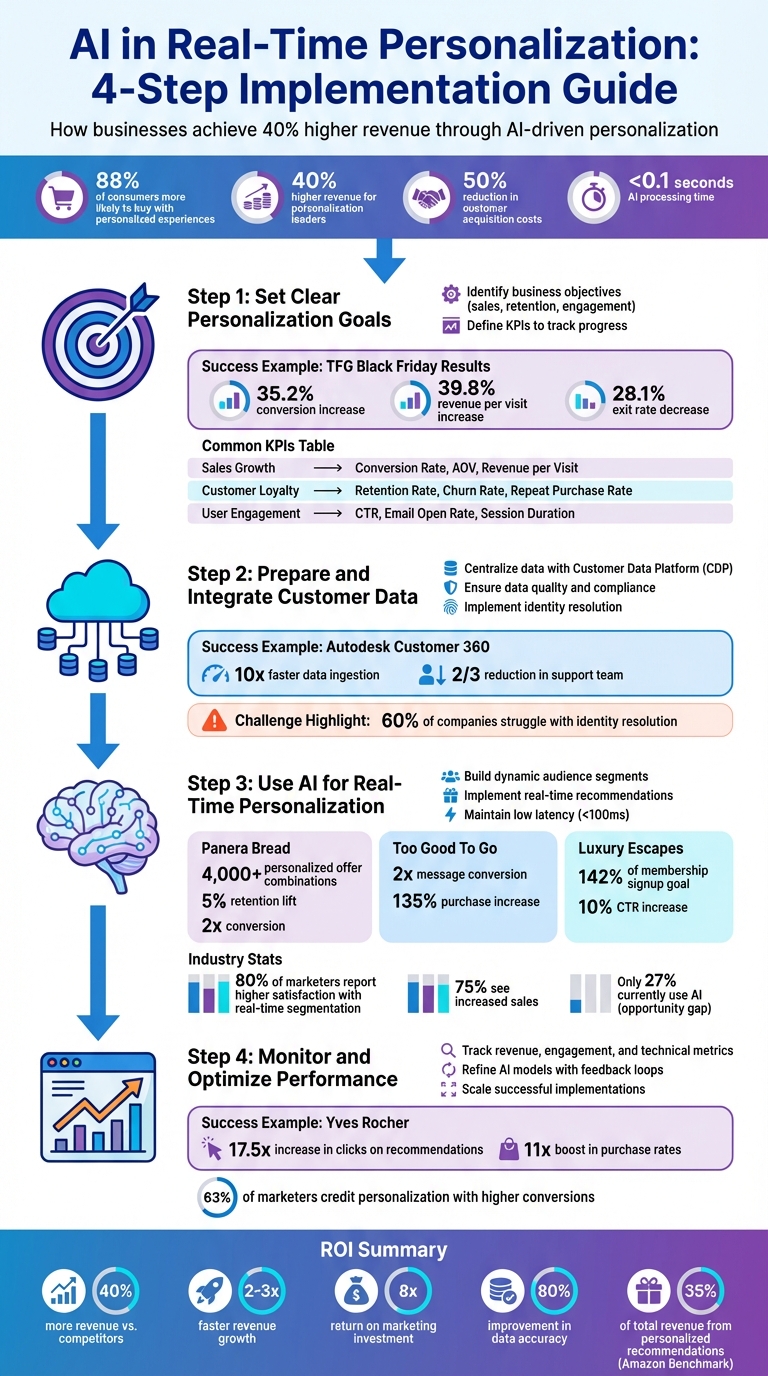
4-Step AI Personalization Implementation Process with Key Metrics
Step 1: Set Clear Personalization Goals
Identify Key Business Objectives
Before diving into AI-driven personalization, it’s essential to have a clear vision of what you want to achieve. Your personalization efforts should directly align with specific business goals. Are you aiming to boost sales, reduce churn, or increase engagement across your website or email campaigns? These objectives will shape the data you collect and the AI tools you choose to implement [6,7,9].
Take the example of TFG, a specialty retail group, which set a clear goal during Black Friday: increasing online conversions during their busiest shopping period. By introducing an AI-powered chatbot on their website, they achieved impressive results - conversions jumped by 35.2%, revenue per visit increased by 39.8%, and exit rates dropped by 28.1%. This case highlights how defining your goals upfront can lead to measurable success.
The financial benefits of goal-oriented personalization are hard to ignore. Businesses that excel in personalization efforts generate 40% more revenue compared to those that lag behind. Additionally, advanced personalization can slash customer acquisition costs by up to 50% [1,7,9]. These outcomes demonstrate how a focused approach can lay the groundwork for impactful, measurable results.
Define KPIs for Success
Once you’ve identified your objectives, the next step is to establish clear KPIs (Key Performance Indicators) to measure progress. KPIs translate broad goals into specific, trackable metrics. For instance, if your focus is on increasing sales, you might track conversion rates, average order value (AOV), and revenue per visit. If customer loyalty is your target, monitor metrics like retention rate, churn rate, and repeat purchase rate. For engagement, keep an eye on click-through rates (CTR), email open rates, and session durations [1,9].
Luxury Escapes, an Australian travel brand, offers a great example of how KPIs can drive success. In 2025, they used Braze Cloud Data Ingestion and advanced logic to personalize membership benefits. By focusing on metrics like membership signups and email engagement, they exceeded their goals - achieving 142% of their membership signup target within the first month and increasing their email click-through rates by 10%.
Here’s a quick reference table of common business objectives and their corresponding KPIs:
| Business Objective | Primary KPIs to Track |
|---|---|
| Sales Growth | Conversion Rate, Average Order Value (AOV), Revenue per Visit |
| Customer Loyalty | Retention Rate, Churn Rate, Repeat Purchase Rate |
| User Engagement | Click-Through Rate (CTR), Email Open Rate, Session Duration |
| Marketing Efficiency | Customer Acquisition Cost (CAC), Return on Ad Spend (ROAS) |
| Customer Satisfaction | Net Promoter Score (NPS), Customer Satisfaction Score (CSAT) |
sbb-itb-cef5bf6
Step 2: Prepare and Integrate Customer Data
Centralize Customer Data
Bringing customer data together from various sources - like CRM systems, website analytics, mobile apps, and transaction databases - is essential. When data is siloed, it’s impossible to get a full picture of your customers. A Customer Data Platform (CDP) can solve this by merging all customer interactions into a Single Customer View.
Take Autodesk, for example. In November 2025, the company revamped its Customer 360 platform, consolidating all data into a single governed system. This move eliminated silos, sped up data ingestion by 10x, and even reduced the platform support team by two-thirds. Once data is centralized, the next step is tackling identity resolution to unify customer profiles.
Identity resolution connects various data points to a single individual. Imagine a customer browsing your site on a laptop, adding items to their cart via a phone, and completing the purchase in-store. Without AI-powered algorithms to link identifiers like email addresses, device IDs, or cookies, the same person might show up as separate profiles. This is a common issue - 60% of companies struggle with identity resolution, leading to fragmented and inaccurate profiles.
To handle the sheer volume and speed of data, a layered data architecture is key. Real-time processing systems handle immediate data needs, while data warehouses like Snowflake or Google BigQuery store historical data for deeper analysis. For instance, in 2024–2025, SimpliSafe used Braze Data Transformation to bring together siloed user data from multiple platforms. By automating the transfer of survey responses and call data into unified Braze user profiles via webhooks, they saved about four weeks of development time and launched personalized campaigns faster.
Ensure Data Quality and Compliance
Accurate data is the backbone of effective AI-driven recommendations. A staggering 61% of companies worry that bad data negatively impacts their AI personalization efforts. As Derek Slager, Co-founder of Amperity, puts it:
"If you don't get the input right, that magical-seeming output will be wrong".
This is the classic "garbage in, garbage out" scenario - poor data leads to irrelevant and frustrating customer experiences.
Start by implementing solid data governance policies. Standardize formats for customer information like names, addresses, and product categories across all sources before data is ingested. Automated tools can monitor and correct errors early, ensuring the data remains reliable. Jacqueline Woods, CMO of Teradata, highlights the importance of clean data:
"AI is nothing if it doesn't have clean data to essentially build intelligence off of, particularly when you talk about generative AI".
Equally important is privacy compliance. Under GDPR, fines for non-compliance can reach up to 4% of a company's global annual revenue. To stay compliant, collect only the data you truly need for personalization and make privacy settings easy for users to understand and manage. With just 27% of consumers feeling they understand how their personal data is used, transparency becomes a competitive edge as well as an ethical obligation.
Whenever possible, focus on first-party data. This type of data is not only cleaner and more reliable but also ensures compliance, providing a strong foundation for successful AI personalization strategies.
How to Architect Data for AI Agents & Real-Time Personalization | Tealium CEO Keynote
Step 3: Use AI for Real-Time Personalization
With reliable, high-quality data in place, AI can now take personalization to the next level by delivering precise, real-time experiences.
Build Dynamic Audience Segments
Traditional segmentation methods can be slow - 60% of marketers relying on these older techniques need over a month just to update customer segments. AI changes the game by creating segments that adapt instantly based on user behavior.
AI works by grouping users dynamically or assigning them to predefined segments using real-time signals like location, device type, and clickstream data.
Here’s how it plays out in practice:
- BMW and HSBC used SuperAGI's platform to unify data across all customer touchpoints. By mid-2025, they saw a 25% improvement in targeting accuracy and a 30% jump in campaign ROI.
- Amazon leveraged AI for real-time segmentation to deliver tailored product recommendations based on immediate user actions, resulting in a 20% boost in total sales.
The impact is clear: 80% of marketers using real-time segmentation report higher customer satisfaction, and 75% see increased sales. Yet, only 27% of businesses currently use AI to meet the personalized experiences that 72% of customers now expect.
Implement Real-Time Recommendations
AI can also deliver instant recommendations based on live user behavior. Instead of relying on outdated data, it uses real-time signals - like clicks, page views, or location - to ensure recommendations are relevant to the user’s current session.
For example:
- Panera Bread revamped its menu in April 2024 and integrated an AI-powered decision engine with Braze. This setup generated over 4,000 unique combinations of personalized offers across email, app, and web channels. It saved 50 hours of manual work, lifted retention among at-risk guests by 5%, and doubled purchase conversions.
- Too Good To Go sent API-triggered notifications to alert users when nearby retailers had "Surprise Bags" available. This real-time strategy doubled message conversion rates and increased CRM-attributed purchases by 135%.
- Luxury Escapes synced its data warehouse with its engagement platform to update membership statuses in real time. This allowed them to display member-only pricing and hidden deals dynamically, helping them surpass their membership signup goal by 42% in the first month and achieve a 10% increase in email click-through rates.
The secret? Instant event triggers. For example, showing a celebratory message after a completed task or offering a discount when a user approaches a feature limit. By using modular "Content Blocks" and conditional logic, these recommendations adjust automatically based on user actions, keeping the experience fresh and engaging.
Maintain Low Latency for User Experience
Speed matters. A recommendation loses its impact if it’s delayed. Processing and delivering personalized content must happen within milliseconds to meet user expectations.
Achieving this requires a unified data system where CRM tools, marketing platforms, and analytics systems share information in real time. This setup ensures a seamless user experience.
SimpliSafe tackled this by using Braze Data Transformation and webhooks to automate the integration of survey responses and call data into unified user profiles. This approach eliminated manual data consolidation and saved their development team four weeks of work.
Kevin Wang, Chief Product Officer at Braze, highlights the importance of real-time personalization:
"What makes these cases of mistaken personalization so jarring is that they undercut the customer relationship, revealing to people that your brand doesn't know them as well as they'd thought. It's like waking up one day and finding out your best friend doesn't know your last name."
The focus should be on what users are doing right now rather than solely relying on past data. When systems operate in real time, interactions feel natural and timely, leaving users with a sense of being understood rather than frustrated by outdated or irrelevant experiences.
Step 4: Monitor and Optimize Performance
Launching AI-driven personalization is just the beginning. To maintain long-term success, you need to continuously monitor performance and make adjustments. Without this ongoing effort, you risk missing opportunities or falling behind competitors.
Track Key Metrics
Keep an eye on metrics that directly connect personalization efforts to business outcomes. These include:
- Revenue metrics: Conversion rate lift, average order value (AOV), revenue per visitor (RPV), and customer lifetime value (CLV).
- Engagement metrics: Click-through rate (CTR) and pages per session.
- Technical performance: Response times (aim for under 100 ms), prediction accuracy, and error spikes.
- Customer sentiment: Net Promoter Score (NPS) and Customer Satisfaction (CSAT) scores.
A great example of success comes from Yves Rocher. In August 2025, the brand used Bloomreach Engagement to implement real-time personalized product recommendations. By creating anonymous user profiles to customize sessions instantly, they saw a 17.5-fold increase in clicks on recommended items within one minute and an 11-fold boost in purchase rates. To ensure your efforts are effective, compare personalized experiences against a non-personalized control group to confirm the statistical significance of any improvements.
Refine AI Models and Strategies
Use performance data to continuously improve your AI models. Implement a feedback loop where user behaviors - like clicks, purchases, and bounces - are logged and used to retrain models. Retrain these models regularly, such as on a weekly basis, so they stay aligned with current user behavior instead of relying on outdated patterns. Micro-segmentation can also help you identify subtle trends and target audiences more effectively, allowing you to allocate resources to those delivering the best results.
The impact of ongoing refinement is clear. While 63% of marketers credit personalization with higher conversion rates - and nearly 25% report increases of over 20% - only 31% believe their efforts are significantly boosting revenue. By fine-tuning your models, you can close this gap and maximize results.
Scale Successful Implementations
Once you know what works, expand those strategies across different campaigns, channels, or audience segments. Centralize your data using a Customer Data Platform (CDP) to integrate information from websites, email platforms, and customer service systems. Automated journey orchestration can then sequence touchpoints like email, SMS, push notifications, and paid media based on predicted user intent and engagement. Reusing core models and data pipelines also makes it easier to scale into new markets or channels efficiently.
Brands that excel at personalization often see impressive results. They generate 40% more revenue compared to those that don’t, and retailers using advanced personalization typically experience revenue growth two to three times faster, with a 6% to 10% lift. Personalized recommendations alone can account for up to 35% of total revenue, often referred to as the "Amazon Benchmark". To maximize success, balance automation with human oversight - especially for complex customer service issues - and go beyond basic triggers like cart abandonment. For example, implement "browse abandonment" notifications via SMS or push alerts to re-engage high-intent users.
Conclusion: The Benefits of AI-Driven Personalization
AI-driven personalization has shifted from being a nice-to-have to an absolute necessity. Businesses that master it see measurable success: they generate 40% more revenue and grow two to three times faster than their competitors. The stats back this up - 88% of consumers are more likely to buy when brands personalize their interactions in real time, and 78% of customers stick with brands that genuinely understand them.
When done right, personalization doesn't just drive sales - it saves money. Companies can cut customer acquisition costs by up to 50% and achieve an 8x return on their marketing investments. These financial wins also streamline operations, creating opportunities for scalable growth. A great example is Panera Bread's AI-powered personalization campaign, which led to noticeable improvements in both customer retention and conversion rates.
Beyond the numbers, AI-driven personalization enhances efficiency. By automating tasks like data collection and audience segmentation, teams can focus on strategy while enjoying better data accuracy - up by 80% - and a potential 40% boost in labor productivity by 2035. This means you can expand your personalization efforts without needing to scale your workforce or resources at the same rate.
The roadmap is straightforward: start with clear objectives, build a solid data strategy, and keep refining your approach. Whether it’s tailoring email recommendations, suggesting products, or crafting entire customer experiences, using real-time data ensures every interaction feels intentional. With 71% of consumers now expecting personalized content, adopting AI-driven personalization today isn’t just about staying relevant - it’s about leading the way.
FAQs
What data do I need to start real-time personalization?
To kick off real-time personalization, start by gathering data that showcases how users interact with your platform. This includes details like clicks, time spent on specific pages, scrolling behavior, session information, and engagement metrics such as click-through rates. AI processes this data in real time to adjust content on the fly. By monitoring browsing habits and engagement levels, the system ensures users receive content tailored to their interests, boosting both satisfaction and interaction.
How do I keep personalization fast without slowing my site?
To keep personalization fast without compromising your site’s speed, rely on AI-driven solutions built for ultra-low latency and real-time decision-making. Make sure your infrastructure can scale seamlessly, manage interdependencies efficiently, and maintain up-to-date data. On top of that, use AI tools to identify and fine-tune resource-heavy elements or coding bottlenecks as they happen. This way, you can deliver personalized experiences instantly while preserving both site performance and user satisfaction.
How can I personalize while staying compliant with privacy laws?
To stay compliant with privacy laws while implementing real-time personalization, it's crucial to focus on transparency and user consent. Make sure users are clearly informed about what data is being collected, why it's being collected, and how it will be used. Always obtain explicit permission through opt-in methods.
Incorporate privacy-conscious practices such as anonymization, pseudonymization, and minimizing the amount of data you collect. Additionally, secure data handling is non-negotiable - protect user information at every stage. Offering users the ability to access or delete their data not only complies with regulations like GDPR and CCPA but also fosters trust.