Why Mobile Page Speed Matters for E-commerce Sales
March 27, 2026Mobile page speed directly impacts your sales. Here's why:
- 53% of users leave if a mobile site takes over 3 seconds to load. At 5 seconds, bounce rates hit 90%.
- Amazon reported a 1% revenue loss for every 100ms of added delay - costing them billions.
- Faster loading improves conversions: a 0.1-second speed boost can increase conversion rates by 8.4% and "Add to Basket" rates by 9.1%.
- Mobile traffic now makes up 73% of all e-commerce visits, but slow load times lead to higher abandonment rates and lower conversions compared to desktop.
Prioritizing speed isn't optional anymore. Faster pages mean more sales, higher customer retention, and better brand perception.
Why Mobile Page Speed Will MAKE or BREAK Your WEBSITE in 2025
sbb-itb-cef5bf6
Mobile Page Speed and Bounce Rates
Every extra second your site takes to load on mobile devices increases the likelihood that visitors will leave. Mobile users are especially impatient, and slow-loading pages can lead to steep financial losses.
Google's Data on Load Time and Bounce Rates
Google's research paints a stark picture. If your page load time jumps from just 1 second to 3 seconds, the chance of a visitor bouncing increases by 32%. That’s a significant number of potential customers leaving before they even engage with your site.
It gets worse. At 5 seconds, bounce rates can skyrocket to 90%. Stretch that load time to 10 seconds, and bounce rates soar by 123% compared to a 1-second load time. On average, mobile users experience higher bounce rates (56.8%) compared to desktop users (50%), often because mobile sites tend to load more slowly.
These numbers highlight just how much slow speeds can hurt your ability to convert visitors into customers.
Akamai's Research on Conversion Drops

Slow load times don’t just drive visitors away - they also slash conversion rates. According to Akamai, every 1-second delay can lead to a 7% drop in conversions. To put that into perspective, if your e-commerce site brings in $100,000 a month, a single second of delay could cost you around $7,000 monthly - or $84,000 annually.
What Happens After 5 Seconds
The 3-second mark is a critical tipping point. Around 70% of consumers say that slow loading times directly affect their willingness to make a purchase.
Once load times exceed 5 seconds, the situation becomes dire. Pages that take longer than this can make your brand seem "unprofessional", damaging trust and loyalty. Mobile users, who account for 73% of e-commerce traffic, are three times more impatient than desktop users. This makes speed optimization a non-negotiable priority for businesses looking to succeed in today’s mobile-first world.
Mobile Page Speed Effects on Conversions and Revenue
Slow mobile load times don't just increase bounce rates - they also take a toll on conversions and revenue.
Mobile Delays and Conversion Losses
Even a small delay can have a big impact. A 1-second delay in mobile load time reduces conversion rates by 20%. For product pages, each additional second of delay cuts conversions by another 7%. Checkout pages are even more sensitive. When load times increase from 0–2 seconds to 5 seconds, completion rates drop dramatically - from 35% to just 12%. That’s a staggering 66% reduction in successful transactions.
On the flip side, faster mobile speeds not only keep visitors engaged but also drive revenue growth.
Revenue Increases from Faster Pages
Speeding up your mobile site can directly translate into higher conversions. For instance, reducing mobile load time by just 1 second can boost conversion rates by 27%. Even shaving off 0.1 seconds can increase "Add to Basket" rates by 9.1% in retail and an impressive 40.1% in luxury markets .
The numbers don’t lie. In 2025, a furniture retailer cut its mobile load time from 5.4 seconds to 2.1 seconds. The result? A 92% jump in conversion rates (from 1.2% to 2.3%) and an 81% increase in monthly revenue, adding $1.7 million more per month. Another example comes from a fashion brand that optimized images and split its code, reducing mobile load time from 5.1 seconds to 2.3 seconds during a 14-day A/B test with 42,000 sessions. The changes boosted conversions by 57% (from 1.4% to 2.2%) and increased revenue per visitor by 62%.
"The brands winning mobile commerce in 2025 treat speed as a revenue lever, not a technical metric." – RoastWeb
Mobile-Specific Performance Challenges
When it comes to e-commerce, mobile devices bring their own set of hurdles that make success more challenging compared to desktop experiences. Although mobile traffic dominates - accounting for 73% to 78% of all e-commerce visits - the smaller screens, weaker hardware, and inconsistent cellular connections mean that every second (or even millisecond) matters. These limitations create challenges in areas like traffic, abandonment rates, script performance, and even how much shoppers spend.
High Mobile Traffic and Abandonment Rates
Mobile might lead in traffic, but when it comes to conversions, it falls behind. Mobile conversion rates typically range from 1.4% to 2.0%, compared to desktop rates of 3.2% to 4.1%. Even more telling is the cart abandonment rate: mobile shoppers abandon their carts 78% to 82% of the time, while desktop shoppers do so at a slightly lower rate of 68% to 72%. Mobile users are also three times more likely to lose patience with slow-loading sites. This impatience becomes a bigger issue when servers fail to handle sudden traffic spikes, leading to even higher abandonment rates.
JavaScript Execution on Mobile Devices
Heavy JavaScript usage poses another problem for mobile e-commerce. Mobile processors struggle with the intensive demands of running JavaScript, which can delay page rendering. E-commerce websites often rely on 15–30 third-party scripts - tools like analytics, chat widgets, and review plugins - that can block the browser from completing the page or responding to user actions. For example, when a shopper taps "Add to Cart", a slow response caused by these scripts can create frustration and lost sales. This issue is often measured by metrics like Interaction to Next Paint (INP), which tracks delays in user interactions.
A real-world example highlights the impact of optimizing script performance. In early 2026, Artisan Bloom, an online ceramic store, faced a 9.2-second load time due to render-blocking JavaScript. By deferring non-essential scripts and removing underperforming Shopify apps, their developer, Mo from Better Call Mo, cut the load time to just 2.1 seconds in 30 days. The results? A 212% increase in conversion rate (from 0.8% to 2.5%) and a 45% drop in bounce rate.
Page Speed and Average Order Value
Improving mobile page speed doesn’t just affect conversions - it also influences how much shoppers spend. For instance, reducing load times by just 0.1 seconds can increase average order value by 9.2%. However, mobile shoppers still tend to spend less than their desktop counterparts, with mobile average order values trailing by 18% to 28%. Smaller screens make it harder for users to discover products, often requiring more scrolling, and slow-loading pages can delay critical elements like the "Add to Cart" button. These factors combine to further reduce mobile conversions and spending.
Customer Retention and Engagement
Mobile speed plays a crucial role not just in driving immediate sales but also in shaping customer loyalty and long-term revenue. It directly impacts how customers perceive your brand. If your mobile pages take longer than 5 seconds to load, shoppers might start to see your business as unprofessional, which can hurt your brand's image. This perception shift can erode the trust necessary for completing purchases and encouraging repeat visits.
How Slow Pages Hurt Customer Loyalty
When pages load slowly, it reduces customer lifetime value. Visitors who abandon your site due to delays are less likely to respond to remarketing efforts, which lowers their overall value to your business. Even a small delay can push potential customers toward competitors, especially in a world where patience for slow-loading pages is in short supply.
On the flip side, faster pages help build trust, encouraging repeat visits and fostering long-term loyalty. As mentioned earlier, speed improvements can significantly boost first-time conversions. For returning users, these improvements strengthen confidence in your brand. Features like service workers, which cache content for near-instant loading on future visits, further enhance retention rates. These examples highlight how speed directly ties into customer engagement and loyalty.
"The difference [in speed] is the difference between 'I'm leaving' and 'I'm buying'".
Real-Life Examples of Speed Enhancements
Practical examples show how speed improvements can transform engagement. In 2026, a global e-commerce platform optimized their site by implementing CDN tuning, adopting modern image formats like WebP and AVIF, and splitting JavaScript bundles. These updates cut their Time to First Byte from 600 ms to 280 ms and reduced their Largest Contentful Paint from 4.5 seconds to 2.2 seconds. The result? Conversion rates increased by 6–10%, and mobile bounce rates dropped from 42% to 33%.
Comparison of Study Metrics
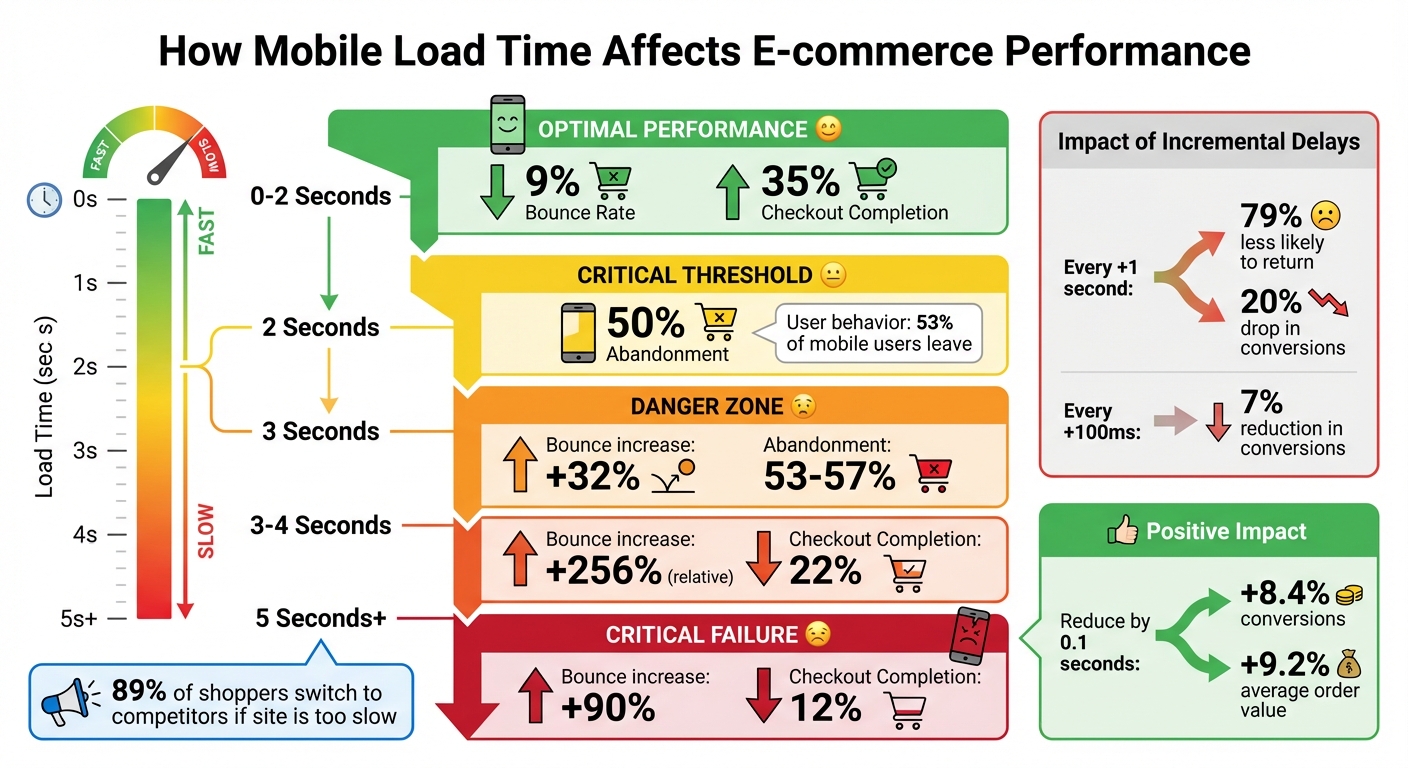
Mobile Page Load Time Impact on E-commerce Bounce Rates and Conversions
Research highlights how delays in mobile load times can dramatically affect user behavior. Here's a breakdown of how load time impacts bounce rates, conversions, and revenue:
| Load Time Delay | Bounce Rate / Abandonment Impact | Conversion / Revenue Impact | Source |
|---|---|---|---|
| 0–2 Seconds | 9% Bounce Rate | 35% Checkout Completion | RoastWeb / Google |
| 2 Seconds | 50% Abandonment | 53% of mobile users leave | WebsitePulse / Salesforce |
| 3 Seconds | 32% Increase in Bounce Probability | 53–57% Abandonment | Google / Drip |
| 3–4 Seconds | 256% Relative Bounce Increase | 22% Checkout Completion | RoastWeb |
| 5 Seconds | 90% Increase in Bounce Probability | 12% Checkout Completion | Google / RoastWeb |
| Every +1s Delay | 79% Less Likely to Return | 20% Drop in Conversions | Portent / WebsitePulse |
| Every +100ms Delay | N/A | 7% Reduction in Conversions | WebsitePulse |
The data paints a clear picture: speed matters. For instance, nearly half of users abandon a page that takes just 2 seconds to load. As load times stretch to 3–4 seconds, abandonment rates climb to 57%, and checkout completion plummets from 35% (at 0–2 seconds) to just 22%.
Even smaller delays have a measurable impact. A 100ms delay can slash conversion rates by 7%, while trimming just 0.1 seconds off load time can boost conversions by 8.4% and increase average order value by 9.2%. These stats highlight the undeniable importance of mobile speed in shaping e-commerce outcomes.
Conclusion
Mobile page speed isn't just a technical concern anymore - it’s a direct driver of e-commerce revenue. As mobile users grow increasingly impatient, speed has become a key factor in retaining customers and boosting sales.
Consider this: abandonment rates skyrocket once load times exceed three seconds. On the flip side, a mere 100ms improvement can increase conversions by 8.4% and boost average order values by 9.2%. And the stakes are high - 89% of shoppers admit they’ll switch to a competitor if a site’s too slow.
"The brands winning mobile commerce in 2025 treat speed as a revenue lever, not a technical metric." – RoastWeb
Beyond immediate revenue, mobile page speed has long-term implications for your brand’s competitiveness. With Google’s mobile-first indexing, mobile performance now directly affects search rankings and organic visibility. Sites that meet Core Web Vitals standards often see higher traffic, while slower sites face lower rankings and higher bounce rates. In short, optimizing mobile speed isn’t just about maintenance - it’s a strategic move to strengthen your brand’s online presence.
The time to act is now. SEO Werkz specializes in technical audits and performance upgrades - like image compression, lazy loading, JavaScript optimization, and CDN implementation - turning mobile speed into a competitive edge.
FAQs
What mobile speed metrics should I track first?
Tracking your website's load time and keeping it under 3 seconds is key. Why? Because slow load times can frustrate users, leading them to abandon your site before exploring further. This directly ties into your bounce rate, which measures how many visitors leave after viewing just one page. A high bounce rate often signals poor user experience, which can hurt your mobile conversions and make it harder to retain customers.
By focusing on these metrics, you’ll not only enhance the user experience but also create a smoother path for visitors to engage with your e-commerce site and complete their purchases.
Which fixes speed up mobile pages the most on e-commerce sites?
Fast-loading mobile pages can make or break an e-commerce site. To keep users engaged and drive conversions, here are some effective strategies:
- Optimize Images: Compress and resize images without sacrificing quality. Tools like TinyPNG or ImageOptim can help reduce file sizes, ensuring quicker load times.
- Use CDNs (Content Delivery Networks): CDNs distribute content through servers located closer to users, reducing latency and speeding up page loading times.
- Adopt Mobile-First Design: Build your site with mobile users in mind from the start. Simplify layouts, use responsive design, and prioritize essential content to create a smooth mobile experience.
- Regularly Monitor Performance: Keep track of your site’s speed using tools like Google PageSpeed Insights or GTmetrix. Regular checks can help you spot and fix issues before they impact user experience.
By implementing these techniques, you can enhance load times, improve customer satisfaction, and ultimately increase sales.
How can I prove a speed upgrade increased revenue?
Tracking key metrics such as conversion rates, average order value, and revenue is essential when evaluating the impact of improving page speed. Tools like Google Analytics can help uncover connections between faster load times and enhanced performance. Research indicates that even minor changes - like cutting load time by just 0.1 seconds - can lead to an 8–10% increase in conversions and revenue. This underscores how critical speed is to driving success in e-commerce.