
Ultimate Guide to Healthcare Content Marketing Trends
February 24, 2026Healthcare content marketing focuses on creating helpful, accurate resources like blogs, videos, and infographics to educate and engage patients. This approach builds trust, combats misinformation, and supports patients in making informed decisions throughout their healthcare journey. Key trends shaping the field include:
- AI Integration: 98% of marketers use AI for tasks like keyword research, content drafting, and audience segmentation. Answer Engine Optimization (AEO) is critical for visibility in AI-driven tools like ChatGPT and Google AI Overviews.
- Patient Behavior: 7% of daily Google searches are health-related, and 84% of patients check online reviews before choosing providers. Local SEO and accurate provider information are vital for attracting patients.
- Short-Form Video: Platforms like TikTok and Instagram Reels are popular for quick, educational content, especially among younger audiences.
- Privacy-First Marketing: Compliance with HIPAA and state-level privacy laws is essential. First-party data collection and privacy-focused tools are replacing traditional tracking methods.
- Reputation Management: 90% of patients read reviews before selecting a provider, and providers with over 50 reviews see up to 10× more bookings.
Marketing success now hinges on trust, transparency, and measurable outcomes like patient appointments and retention. This guide dives into how healthcare organizations can stay ahead in a fast-changing digital landscape.
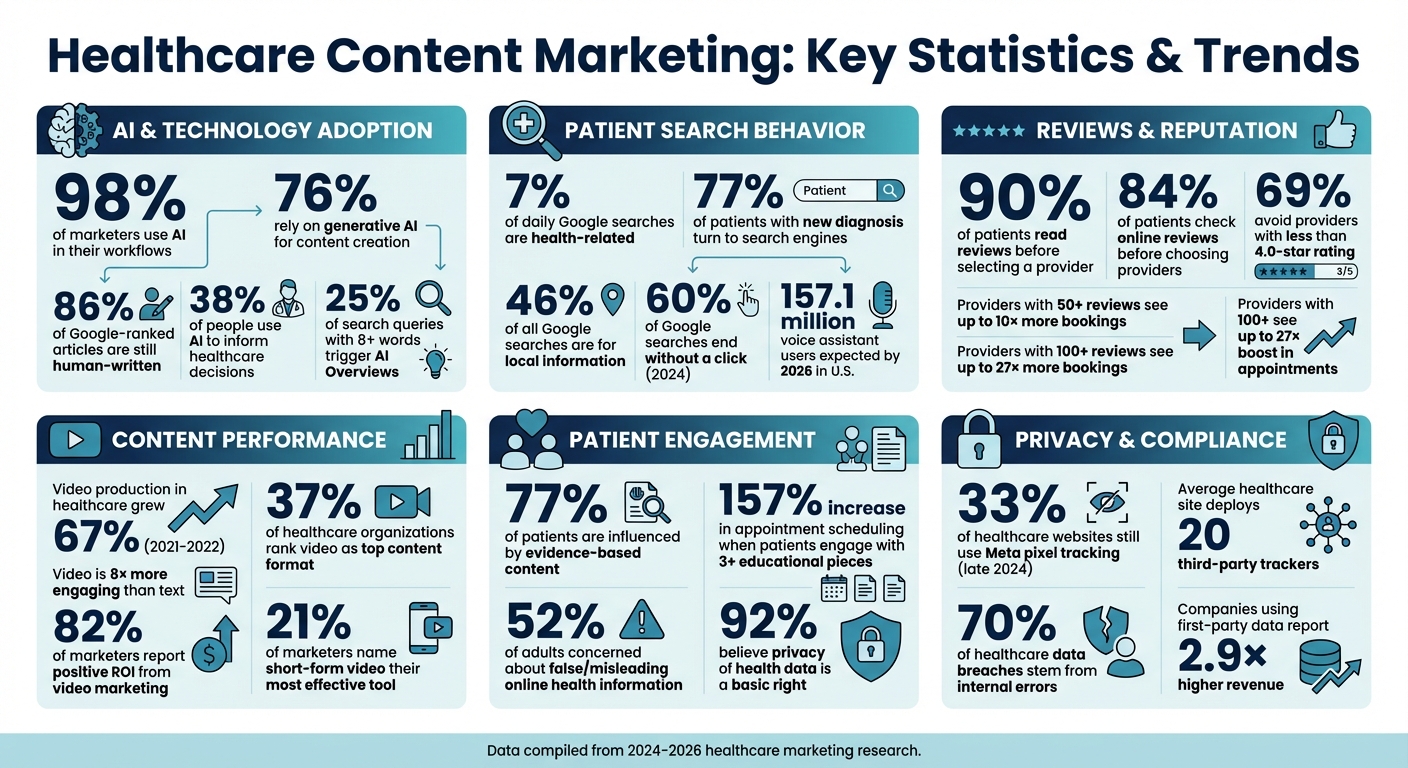
Healthcare Content Marketing Statistics and Trends 2024-2026
The future of healthcare marketing: AI, SEO shifts, and what’s next
sbb-itb-cef5bf6
AI and Personalization in Healthcare Content Marketing
As patient research evolves, integrating AI into healthcare content marketing is becoming essential. Artificial intelligence has shifted from being a novelty to a core tool within healthcare marketing teams. By late 2023, a staggering 98% of marketers reported using AI in their workflows, with 76% relying on generative AI for basic content creation tasks. Interestingly, while AI tools like ChatGPT and Perplexity are gaining traction, 86% of Google-ranked articles are still human-written, and only 18% of citations in AI-generated outputs are based on AI-created content. Beyond content creation, AI is revolutionizing personalization in healthcare marketing.
Using AI to Create Healthcare Content
AI is being used across healthcare marketing to draft meta descriptions, social media posts, email subject lines, and content outlines. It also supports keyword research, competitive analysis, and crafting detailed audience personas.
One powerful approach is persona prompting. By feeding AI a detailed visitor persona and asking how well the content meets their needs, marketers can uncover gaps they might have missed. Andy Crestodina, Co-Founder and CMO of Orbit Media, emphasizes this:
"Give the AI a detailed persona, then copy and paste your content and ask, 'To what extent does this page meet or not meet this visitor's information needs?' When properly trained, AI can give you exactly what's not on the page - the important things you missed".
AI also enhances audience segmentation, delivering personalized messages in real time. With 38% of people already using AI to inform healthcare decisions, marketers must ensure their content is optimized not just for traditional search engines but also for AI-driven tools.
This shift has led to the rise of Answer Engine Optimization (AEO). Instead of chasing keywords, healthcare marketers now focus on conversational, long-tail questions - mirroring the way patients naturally ask for information. AI-driven summaries appear in 25% of search queries with eight or more words, with 72% of these answers sourced from reputable medical institutions. To stay visible in AI-generated search results, content must directly and clearly address these specific questions.
| AI Task Category | Specific Use Cases in Healthcare Marketing |
|---|---|
| Content Creation | Drafting social posts, meta descriptions, headlines, and emails |
| Strategy & Research | Conducting keyword research, competitive analysis, and building personas |
| Personalization | Real-time website personalization and tailored messaging |
| Operations | Summarizing interviews, transcribing videos, automating reports |
| Optimization | Checking readability, grammar, and identifying content gaps |
While AI takes on these tasks, retaining human oversight is critical.
Keeping the Human Touch in Automated Content
Human involvement remains the cornerstone of healthcare marketing. Diane Hammons, Director of Digital Engagement at WG Content, highlights the collaborative role of AI:
"AI can be an effective teammate. It doesn't replace real people, but it's a collaborative tool and a new addition to the lineup that supports everyone's efforts".
In healthcare, trust is everything. Ann Handley, Chief Content Officer at MarketingProfs, underscores this point:
"Clear writing is not the same as genuine insight. Generative AI is more of an efficiency accelerator than a 'writing' tool. I rarely use AI for anything reader-facing because trust is paramount in marketing. (Especially in healthcare.)".
AI tools can sometimes produce plausible but inaccurate information - commonly referred to as "hallucinations." To avoid this, all medical content must be reviewed by licensed professionals or subject matter experts before publication. This "human-in-the-loop" approach ensures accuracy, authenticity, and emotional resonance.
Transparency is also vital. Clearly labeling AI-generated content helps maintain trust and ensures compliance with HIPAA regulations. The "Assured AI" framework - built on Policy, Process, and Platform - further safeguards patient privacy and organizational credibility by making AI outputs observable, reversible, and auditable.
While AI simplifies tasks like keyword research, metadata creation, and transcription, producing content that patients trust still requires a careful balance of technology and human expertise.
Creating Transparent Healthcare Content
Transparency in healthcare content marketing serves as a digital bedside manner, fostering trust through honesty and clarity. With 52% of adults expressing concern about false or misleading online health information, transparent content becomes a beacon, cutting through misinformation and empowering patients rather than overwhelming them.
Evidence-based, transparent content significantly influences patient decisions. In fact, 77% of patients are swayed by such content, and appointment scheduling jumps by 157% when patients engage with three or more educational pieces.
To create transparent healthcare content, it's essential to:
- Have medical professionals review clinical claims.
- Use clear, plain language that avoids jargon.
- Back up claims with citations from peer-reviewed data.
Avoid making absolute promises like "guaranteed results" or "cures." Instead, present a balanced view by outlining both risks and benefits, helping patients make informed choices.
"There's no place for jargon in healthcare content - especially when you're writing for a patient or caregiver audience. Accessing reliable health information should be the easiest part of the patient journey." – Ann Key, Content Strategist at Aha Media Group
Adding real-life clinician experiences can further enhance credibility and trust.
Sharing Real Stories from Healthcare Professionals
Content created or led by clinicians not only builds trust under Google's E-E-A-T framework but also humanizes your brand, helping to ease patient anxiety before appointments.
Take Cleveland Clinic's example from March 2020. They published an article and video titled "Here's the Damage Coronavirus Can Do to Your Lungs", featuring an experienced lung pathologist. This expert-led, transparent content struck a chord during uncertain times, garnering over 26,000 Facebook shares. The combination of medical authority and accessible explanations made it highly effective.
Similarly, between 2022 and 2023, Mark Oborn Ltd., a digital dental marketing agency, implemented a blog strategy for a dental clinic. By focusing on educational content that directly addressed patient concerns, they tripled the clinic's digital conversions and achieved 19,000 organic blog visits per month within six months.
Effective storytelling starts by addressing common patient concerns - like recovery times, billing confusion, or diagnosis anxiety - and using real experiences to provide clarity. If sharing patient testimonials or images, always obtain explicit written consent to remain HIPAA-compliant. Anonymized patient stories can also work well, offering social proof while protecting privacy.
"In the health category, there's no such thing as a generalist... Have someone who is a content expert craft the engaging, effective, high-impact story. But work with a medical expert who can fact-check and reality-check what you're writing." – Amy O'Connor, Editor-in-Chief at Healthination
This trust-building approach extends seamlessly into visual formats, where short-form videos can amplify transparency and engagement.
Using Short-Form Video in Healthcare Marketing
Short-form video has emerged as a top-performing content format, with 21% of marketers naming it their most effective tool. Between 2021 and 2022, video production in healthcare grew by 67%, and 37% of healthcare organizations now rank video as their leading content format. Video is also eight times more engaging than text.
Platforms like TikTok, Instagram Reels, and YouTube Shorts are ideal for creating quick, educational videos. These 15- to 60-second clips can demystify procedures, debunk myths, or provide behind-the-scenes glimpses, meeting patients - especially younger audiences - where they already spend time. For instance, "What to Expect" videos showcasing procedures like colonoscopies or first consultations help reduce anxiety by setting clear expectations.
Short-form videos also reinforce transparency. When healthcare professionals explain procedures in plain language on camera, it builds trust faster than written content alone. The same evidence-based standards apply: ensure clinical claims are reviewed by licensed professionals, use accessible language, and prioritize education over promotion.
"The time your audience spends with your content is really a transaction. You have to give them back something of value. If the content becomes too promotional, too self-serving, you will lose your audience very quickly." – Tomas Kellner, Former Editor at GE Reports
To maximize reach, repurpose longer physician interviews into multiple short clips for social media. Include credentials and "last updated" dates in video descriptions to signal reliability to both viewers and search engines. With 82% of marketers reporting positive ROI from video marketing in healthcare, short-form video has become an essential tool, not just an experiment.
Adapting to New Search Behaviors
Patients are changing how they search for healthcare information. Thanks to AI and voice technology, search queries have become more conversational. Instead of typing "dermatologist Chicago", people now ask, "Who is the best dermatologist near me?" These natural, full-sentence queries demand clear, immediate answers.
By 2024, nearly 60% of Google searches ended without a click. AI tools like ChatGPT, Google AI Overviews, and voice assistants now provide direct answers on search results pages. If your content isn’t designed to work with these "answer engines", your visibility to potential patients drops significantly. Organizations that combine traditional SEO with Generative Engine Optimization (GEO) report a 20-40% boost in AI-driven visibility compared to those sticking to outdated strategies.
Voice search is also on the rise. By 2026, the number of voice assistant users in the U.S. is expected to hit 157.1 million. Currently, 25% of search queries with eight or more words trigger AI Overviews. This shift is happening now, and healthcare providers must adapt by focusing on natural language queries, voice commands, and AI-driven tools that prioritize quick, synthesized answers over traditional search results.
Preparing Content for Voice Search
To succeed in voice search, healthcare content must be structured for conversational queries. For example, when someone asks Alexa, "What should I do if my child's fever won’t go down?" they expect a clear, concise answer - not a dense, jargon-filled article. This makes conversational and contextual SEO more important than ever, focusing on long-tail queries that mirror how people naturally speak.
Here’s how to optimize for voice search:
- Use patient-friendly phrases like "how to bring down a child's fever at home" instead of technical terms like "pediatric fever management protocols".
- Add FAQ sections to service pages and blog posts, with short, scannable answers (2-3 sentences) that AI assistants can easily read aloud.
- Implement structured data with schema markup - such as
MedicalEntity,Physician, andFAQPage- to help AI tools understand your content’s context.
| Feature | Traditional SEO | Voice & AI Search (GEO) |
|---|---|---|
| Keyword Type | Short-tail, fragmented (e.g., "dermatologist Chicago") | Long-tail, conversational (e.g., "Who is the best dermatologist near me?") |
| Content Structure | Keyword-dense, long-form articles | Scannable, succinct answers, bullet points, FAQs |
| User Intent | Research and browsing | Immediate answers and local action |
| Primary Goal | Ranking in top blue links | Appearing in AI Overviews and voice responses |
Since most voice searches occur on mobile devices, your website must load quickly and display flawlessly on smartphones. Use a mix of patient-friendly language and medical terminology to capture searches at every stage, from symptom research to choosing a provider.
"Accessing reliable health information should be the easiest part of the patient journey." – Ann Key, Content Strategist, Aha Media Group
This transformation in search behavior also underscores the importance of optimizing local information to engage patients effectively.
Local SEO and Provider Information Accuracy
Local search can make or break a healthcare organization’s ability to attract patients. Nearly 46% of all Google searches are for local information, and 77% of people with a new diagnosis turn to search engines for answers. A query like "urgent care near me open now" requires accurate, up-to-date information - and increasingly, AI assistants are delivering it.
The foundation of local SEO is NAP consistency: your Name, Address, and Phone number must match exactly across platforms like Google Business Profile, Apple Maps, Bing, Yelp, and healthcare directories such as Healthgrades, Vitals, and ZocDoc. Why? Because 91% of people say accurate healthcare information is critical to their decision-making, and 64% will switch providers if they encounter incorrect or missing details.
Here’s why accuracy matters:
- Healthcare locations syncing information to at least 75% of publishers in an extended directory network see up to 186% more website clicks from Google Business Profiles.
- By 2025, an estimated 70% of healthcare searches will start with an AI assistant instead of a traditional browser. AI models cross-check multiple sources to verify provider information, making omnichannel consistency essential.
Structured data, as mentioned earlier, also plays a crucial role in local SEO. Schema markup helps AI validate your authority and prioritize your organization in recommendations.
"It's no longer enough to rank. Brands also need to be referenced, summarized, and recommended accurately by the tools patients are using to narrow options before they ever click a website." – Tim Worstell, President, Relevance
To stay competitive, healthcare organizations should:
- Conduct a digital audit every six months using tools like Moz, SEMrush, or Whitespark to identify inconsistencies in NAP data and missing schema markup.
- Claim and verify every provider profile on healthcare-specific platforms. AI models rely on these profiles to establish authority before making recommendations.
- Publish detailed medical credentials and staff bios on your website to strengthen "entity authority".
Patient reviews also play a huge role. Google’s algorithm favors providers with a 4.0+ star rating in local search results. AI tools similarly weigh review quality when making recommendations. Actively monitor and respond to reviews across platforms, and post frequent updates like local health tips or FAQs to show your practice is engaged and knowledgeable. AI engines prioritize organizations demonstrating current, consistent expertise.
"You can't dictate how AI-driven search engines surface information, but you can control the quality and consistency of your data. The more structured and comprehensive your information, the better your chances of being prioritized by AI." – Wilhelmina Ryith, Strategic Advisor, Yext
Privacy-First Marketing in Healthcare
Protecting patient data is the cornerstone of trust in healthcare marketing. Yet, as of late 2024, 33% of healthcare websites still use Meta pixel tracking, despite increasing regulatory scrutiny. On average, healthcare sites deploy 20 third-party trackers that collect and share user data, creating a significant gap between patient expectations and industry practices. This disconnect is stark, given that 92% of people believe the privacy of their health data is a basic right. Industry insiders have dubbed this period the "HIPAApocalypse", as regulatory updates and lawsuits redefine what constitutes Protected Health Information (PHI).
In January 2025, HealthPartners settled a lawsuit over tracking pixels for $6 million, while Blue Shield of California reported a data breach involving Google Analytics that impacted 4.7 million members. These events highlight how traditional marketing practices can lead to serious financial and reputational consequences.
HIPAA Compliance and Patient Trust
HIPAA compliance comes into play when online tools connect an individual’s IP address or device ID to visits on health-related webpages. Even public-facing pages, like symptom checkers or provider directories, can expose PHI if tracking scripts are present. The U.S. Department of Health and Human Services has made this clear:
"Regulated entities are not permitted to use tracking technologies in a manner that would result in impermissible disclosures of PHI to tracking technology vendors or any other violations of the HIPAA Rules".
To comply, every third-party vendor handling patient data - whether analytics platforms, email services, or CRM systems - must sign a Business Associate Agreement (BAA), sharing responsibility for PHI protection. However, major platforms like Google Ads and Meta typically don’t sign BAAs, forcing healthcare organizations to rethink their strategies. Violations can cost anywhere from $100 to $50,000 per incident, and over 70% of healthcare data breaches stem from internal errors in handling sensitive information.
Springfield Clinic tackled this challenge by overhauling its 2,500-page website, which suffered from poor navigation and SEO. They switched to privacy-first analytics, focusing on aggregate traffic patterns rather than individual patient data. The results were striking: a 60% reduction in unnecessary pages, a 30% increase in daily search volume, and a 2022 eHealthcare Leadership Award.
Understanding what qualifies as PHI is key. HIPAA identifies 18 specific identifiers, including names, Social Security numbers, IP addresses, and even implied health information, like visiting an oncology webpage. Any of these linked to health data becomes PHI, requiring strict protection.
"All of our trackers, in one day, were rendered inoperable. We moved swiftly in response to what we were seeing in the changing regulatory environment... Without an understanding of how our media campaigns were performing, we were flying blind." – DJ Willard, Senior Director of Strategic Marketing, Priority Health
Transparency is essential to building trust. Updating privacy policies to clearly explain what data is collected (e.g., clicks and page views, not medical history), offering easy opt-out mechanisms, and using plain language in consent forms can make patients feel more secure and encourage engagement.
With HIPAA as the baseline, marketers must also navigate additional state-level privacy laws that impose stricter requirements.
Marketing Under Stricter Data Privacy Rules
The regulatory landscape is evolving beyond HIPAA. States like Washington (My Health My Data Act) and California (CCPA/CPRA) have implemented privacy laws that often go further than federal regulations, creating a complex compliance environment. For healthcare marketers, adapting to these rules while maintaining campaign effectiveness is critical.
The shift to first-party data is no longer optional. With third-party cookies being phased out, organizations are turning to loyalty programs, personalized newsletters, and member dashboards to collect data directly from patients with explicit consent. Companies leveraging first-party data effectively report 2.9 times higher revenue and 1.5 times greater cost savings compared to those relying on traditional tracking methods.
Here’s how healthcare marketers can thrive under stricter data privacy rules:
- Server-side tracking: Instead of sending data directly from browsers to vendors, route it through secure servers where PHI can be stripped, hashed, or anonymized. Northern Arizona Healthcare adopted this approach during a CMS migration, replacing Google Analytics with Siteimprove. This allowed them to track patient behavior across 1,800 pages using anonymized data, achieving full HIPAA compliance and a 100% accessibility score.
- De-identification techniques: Use methods like hashing and salting to turn identifiers into irreversible tokens. Aggregate reporting, which analyzes groups of 11 or more records, further protects individual data. One behavioral healthcare provider saw a 70% drop in Cost Per Lead after implementing a HIPAA-compliant data foundation.
- Contextual advertising: Instead of behavioral retargeting, place ads based on the content of the page. For example, promoting heart health services on cardiology articles ensures relevance without tracking individual users.
- Regular script audits: Inventory all tracking tools, including pixels and session replay scripts. Use tag management systems to block outdated scripts on sensitive pages, and create "exclusion zones" for areas like patient portals.
| Traditional Marketing | Privacy-First Healthcare Marketing |
|---|---|
| Third-party cookies and pixels | First-party and zero-party data |
| Individual behavioral tracking | Contextual and content-driven targeting |
| Full user-level identification | Anonymized aggregate reporting |
| Standard Terms of Service | Mandatory Business Associate Agreements (BAAs) |
Collecting zero-party data - information patients voluntarily share, such as health goals or communication preferences - can strengthen relationships while respecting privacy. Southern Orthodontic Partners embraced this approach in 2025–2026 with ActiveCampaign's HIPAA-compliant forms and CRM. By securely funneling PHI into their CRM, they achieved an 87% response rate within 24 hours for patient inquiries.
"Privacy isn't optional - it's mission-critical for healthcare marketing success in 2026." – Ethan Miller, HC Marketers
As regulations tighten, prioritizing privacy offers a competitive edge. Patients value transparency and reward it with loyalty, while compliance shields organizations from costly breaches and penalties.
"If you can control PHI, you can control compliance." – Becker's Hospital Review
Managing Reputation and Trust Signals
Managing your online reputation is a cornerstone of building patient trust. Today, patients approach healthcare with the same mindset as any other consumer decision, heavily relying on online reviews to choose providers. In fact, around 90% of patients read reviews before selecting a healthcare provider, and 69% avoid providers with less than a 4.0-star rating. This makes managing reviews not just important for trust but also for increasing appointment bookings and improving online visibility.
The numbers speak volumes: Providers with over 50 reviews can see up to 10× more bookings, while those with more than 100 reviews may experience a 27× boost in patient appointments. Responding to reviews - especially promptly - can significantly enhance patient confidence and even improve your search rankings.
"We've reached a tipping point where patients increasingly rely on crowdsourced consumer feedback rather than brand promises or provider referrals when seeking care." – Reputation 2024 Healthcare Trends Guide
How to Manage Reviews Effectively
Effective reputation management involves three key actions: monitoring reviews, responding quickly, and encouraging new feedback. This applies to both first-party reviews (like HCAHPS surveys displayed on your site) and third-party reviews on platforms such as Google, WebMD, and Yelp. During the pandemic, healthcare reviews surged by 131.7%, showing how critical they’ve become.
Transparency plays a big role. Displaying first-party star ratings and comments on provider landing pages not only builds trust but also helps with SEO. Google can use this data to create "rich snippets" that stand out in search results. However, always ensure responses avoid Protected Health Information (PHI). Using pre-approved templates reviewed by legal teams ensures HIPAA compliance. If resources are tight, focus on addressing 1-star and 2-star reviews first to show patients their concerns matter.
Generating Reviews the Right Way
Getting reviews isn’t just about asking - it’s about asking the right way. SMS messages for review requests have a 45% response rate, compared to just 8% for email. Timing is also critical: sending requests within 24 hours of a patient’s visit yields the best results. For in-person visits, QR codes linking to review pages make it simple for patients to leave feedback.
Automation can streamline the process. Integrating your Electronic Medical Records (EMR) system with a review platform via API ensures consistency, especially for organizations with multiple locations.
| Review Request Method | Click-Through Rate | Response Rate |
|---|---|---|
| ~3.4% | ~8% | |
| SMS (Text) | ~36% | ~45% |
Handling Negative Reviews
Negative reviews aren’t just complaints - they’re opportunities to improve. About 40% of patients have canceled appointments or avoided providers due to negative feedback. More than half of consumers expect a quick response, so addressing issues within a few days is crucial. Use tools like sentiment analysis to identify recurring themes (e.g., billing issues or wait times) and take steps to resolve them.
"A negative review is a gift: someone gave you the information you need in order to make adjustments and deliver a better experience in the future." – Jessica Cates, Yext
AI is also changing the game. Search engines now analyze review sentiment, frequency, and even reviewer credibility as part of their ranking algorithms. This makes reputation management not just a necessity but a strategic advantage.
Using Patient Reviews and Ratings
As mentioned earlier, SMS requests generate far better response rates than email, especially when sent promptly after visits. For face-to-face interactions, QR codes simplify the process, while automating review requests through EMR integration ensures consistency. These efforts not only boost review volume but also help maintain a steady flow of fresh feedback.
Creating Community-Focused Campaigns
Reputation isn’t just about online reviews - it’s also about how your organization engages with the local community. For example, Cincinnati Children's Hospital Medical Center partnered with the Avondale community to improve child health, creating a deeper connection with local residents.
Collaborating with local organizations, schools, and community centers strengthens credibility and shows that your mission extends beyond clinical care. A great example is TriHealth’s "Ask Fearlessly" campaign, which featured survivor stories and encouraged open conversations about cancer through social media ads.
"Trust isn't just earned in the exam room, it starts with how your brand shows up in the community." – Brandience
Social media plays a big role in humanizing your brand. Responding to comments, thanking users, and addressing concerns publicly show that you’re listening. PurposeMed’s TikTok series, featuring a humorous "talking PrEP pill" to highlight LGBTQ2S+ stories, is a bold example of connecting with a specific audience.
Educational events - like health fairs, awareness campaigns, or seasonal festivals - offer low-pressure ways to engage with your community. You can extend their reach by repurposing content from these events into blogs, social media posts, or newsletters. Keep the language simple and avoid medical jargon to ensure accessibility for everyone, including those with low health literacy.
Another way to connect is by gathering questions directly from the community. Using "Ask an Expert" email addresses or social media forms allows you to address real concerns. Pair these insights with feedback from clinical teams to create content that resonates with your audience and builds trust early in their healthcare journey.
Conclusion
Healthcare content marketing is no longer about chasing vanity metrics like clicks and impressions. The focus has shifted to delivering real business outcomes. If marketing budgets can’t be tied to measurable results - like appointments, patient retention, or revenue - they lose their value. The key lies in breaking down silos by integrating data across marketing, operations, and finance. This unified approach drives growth that can be tracked and measured.
To stay ahead, healthcare organizations must constantly refine their strategies. Content marketing outpaces traditional methods by efficiently generating leads and revenue. This is achieved through building strong topical clusters and optimizing content for AI-powered platforms like ChatGPT and Google Gemini. With the healthcare digital content market growing at over 22% annually, the importance of digital strategies is only increasing. Establishing topical authority and adapting to AI-driven algorithms remain essential priorities.
When it comes to content, authenticity is the winning formula. While 76% of marketers are tapping into generative AI for basic content creation, patients are drawn to genuine, human-centered stories. Highlight real patient experiences, provider profiles, and behind-the-scenes glimpses of your team. Short-form videos on platforms like TikTok and Instagram Reels are perfect for connecting with younger audiences where they already spend their time. A mobile-first, relatable approach often outperforms expensive, polished productions.
"Marketing doesn't get a hall pass in healthcare anymore. If you can't tie spend to revenue, why should the business fund it?" – Monu Kalsi, SVP Marketing, Duly Health & Care
This human-centered approach must also translate into measurable results.
To achieve this, focus on strategies that deliver clear outcomes. Local SEO with location-specific keywords is critical for capturing "near me" searches. Interactive tools like symptom checkers can engage patients immediately, while optimizing for voice search with natural, conversational language ensures accessibility. Reputation management is equally important - providers with over 50 reviews secure up to 10× more bookings than those with fewer than 10. The healthcare leaders of 2026 will be those who balance AI-driven efficiency with genuine human connection, all while keeping patient trust at the heart of every decision.
FAQs
How do I optimize healthcare content for AI search?
To make healthcare content more effective for AI search, aim for clarity, structure, and relevance. Provide direct answers to common user questions, organize information with logical headings, and implement schema markup to help AI understand your content better. Including multimedia elements, such as images or videos, can enhance accessibility and engagement. Additionally, keep your content up-to-date to ensure accuracy and maintain credibility. Highlighting expertise and trustworthiness throughout your content can also boost its likelihood of being cited in AI-generated responses.
What tracking is HIPAA-safe on healthcare websites?
Tracking user activity on healthcare websites requires extra care to comply with HIPAA's strict privacy and security standards. Analytics tools must not only protect user data but also meet specific requirements, such as offering Business Associate Agreements (BAAs) and ensuring that protected health information (PHI) isn't transmitted to third parties without proper safeguards.
Popular tools like Google Analytics usually don't meet these standards unless configured very carefully - and even then, risks remain. A safer approach is to choose analytics platforms specifically designed for HIPAA-regulated environments. These tools prioritize both data privacy and security, helping ensure compliance with HIPAA regulations.
How can we get more patient reviews fast?
To gather patient reviews quickly, focus on timing and convenience. Ask happy patients for feedback right after their appointment - when their positive experience is fresh. Make it easy by providing review links or QR codes they can access on the spot. Follow up with a friendly email or text shortly after their visit, reminding them to share their thoughts. Keeping the process simple and accessible encourages more patients to leave reviews promptly, helping you collect feedback faster.