


How YouTube SEO Impacts Audience Retention
March 7, 2026YouTube SEO directly affects how long viewers stay on your videos. The platform prioritizes content that keeps people engaged, using metrics like audience retention to decide whether to promote your video. If viewers leave early, YouTube is less likely to recommend it. Here’s what matters most:
- Retention is key: Videos with over 50% audience retention perform better in search and recommendations.
- Keywords vs. Engagement: Matching viewer intent matters more than stuffing titles with keywords.
- Metadata quality: Clear titles, accurate thumbnails, and captions help align content with viewer expectations.
- First impressions count: Hooking viewers within the first 30 seconds prevents early drop-offs.
- Analytics are your guide: Retention graphs show where you lose viewers and help refine your content.
Focus on creating videos that deliver on their promise, use data to identify weak spots, and optimize metadata for relevance. Retention isn’t just a metric - it’s what drives your video’s success on YouTube.
YouTube SEO: Unlock Viral Success with These Audience Retention Hacks!
sbb-itb-cef5bf6
YouTube SEO Mistakes That Reduce Audience Retention
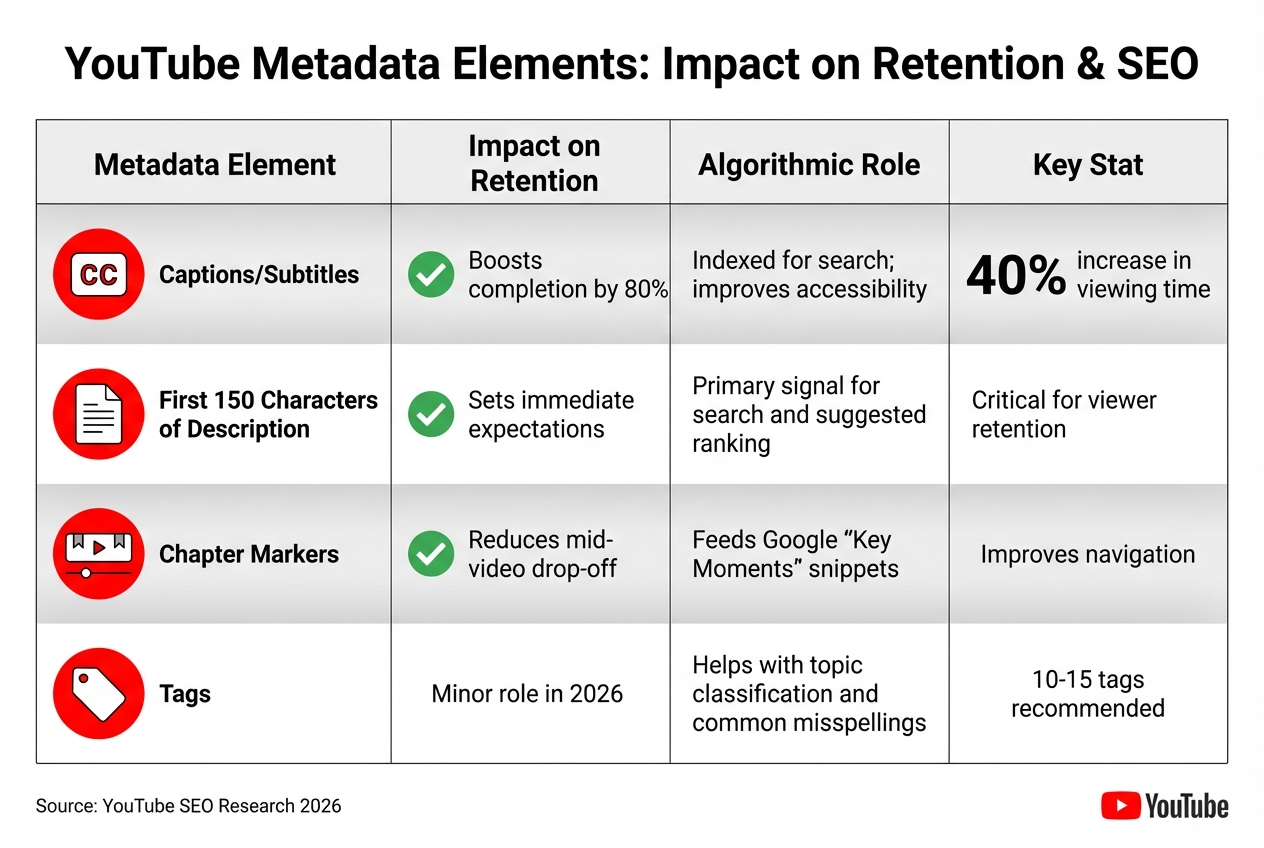
YouTube Metadata Elements Impact on Audience Retention and SEO
Mismatched metadata that prioritizes clicks over viewer satisfaction can quickly tank your video's performance. Let’s dive into some common errors that hurt audience retention.
Keywords That Don't Match Viewer Intent
Chasing high-volume keywords without considering what your audience actually wants can backfire. If viewers expect one thing but get something completely different, they’ll leave - fast. This disconnect between expectation and reality sends a clear signal to YouTube’s algorithm to stop recommending your video.
Here’s why: YouTube operates more like a prediction engine than a simple search engine. It prioritizes viewer behavior over text-based metadata. A study of 1.6 million videos revealed that only 6% of top-ranking videos used exact keyword matches in their titles, but 75% used related terms that aligned with viewer intent.
"Keywords tell the algorithm what your video is about; engagement signals tell it whether your video is worth showing." – DigitalApplied
High click-through rates paired with poor retention are a red flag for the algorithm. While targeting unrelated but trending keywords might give you a temporary bump in views, it ultimately hurts your channel’s credibility and algorithmic standing. Using misleading visuals only makes things worse.
Misleading Titles and Thumbnails
Custom thumbnails can increase your click-through rate by 8–15x compared to auto-generated ones. But here’s the catch: if your title and thumbnail overpromise and your content doesn’t deliver, you’re setting yourself up for failure. Viewers who feel misled will leave within seconds, causing a steep drop in your retention graph.
YouTube’s algorithm prioritizes viewer satisfaction, not just clicks. Clickbait tactics might get you some initial views, but the algorithm quickly notices when people bounce, limiting your video’s reach.
"A video that gets clicked but not watched actually hurts your channel's algorithmic standing." – DigitalApplied
This goes beyond just one video. If viewers feel tricked, they’re more likely to click “not interested,” sending negative feedback that impacts your entire channel. Rebuilding trust after this kind of damage is no small feat. Now, let’s look at how incomplete metadata can further undermine your retention.
Weak Metadata and Missing Captions
Incomplete metadata and missing captions confuse the algorithm, making it harder to connect your video with the right audience. When your metadata is vague or incomplete, your video gets shown to viewers who might not stick around.
Captions, on the other hand, can significantly improve retention. They not only make your video more accessible but also include searchable text that boosts indexing. Videos with subtitles see a 40% increase in viewing time, and viewers are 80% more likely to watch to the end when captions are available. Without captions, you miss the opportunity to rank for key phrases mentioned in your content.
The first 150 characters of your video description are critical. This is where you set expectations for viewers and provide a primary signal for YouTube’s search and suggestion algorithms. If this space is filled with generic or irrelevant text, viewers may lose interest and click away.
| Metadata Element | Impact on Retention | Algorithmic Role |
|---|---|---|
| Captions/Subtitles | Boosts completion by 80% | Indexed for search; improves accessibility |
| First 150 Chars of Description | Sets immediate expectations | Primary signal for search and suggested ranking |
| Chapter Markers | Reduces mid-video drop-off | Feeds Google "Key Moments" snippets |
| Tags | Minor role in 2026 | Helps with topic classification and common misspellings |
YouTube SEO Practices That Improve Retention
Let’s dive into strategies that can help keep viewers glued to your videos. These approaches not only align your content with what people are searching for but also ensure you deliver on their expectations.
Keyword Research Based on Viewer Intent
Focus on keywords that match what your audience is actively looking for. When your video addresses a specific problem or question, viewers are more likely to stick around. Traffic driven by search often results in higher retention rates compared to random clicks from social media.
Optimizing for viewer intent can have a big impact: watch time can increase by 22%, and impressions can grow by 52%. Long-tail keywords - phrases with three or more words - are especially effective, generating three times higher click-through rates than shorter, more generic terms. Notably, 91% of high-ranking videos use these longer phrases to target specific intents.
To find the right keywords, try typing your topic into YouTube’s search bar while in Incognito mode. The autocomplete suggestions can provide clues about what viewers are searching for, whether it’s tutorials ("how to"), comparisons, or buying advice. For educational videos, focusing on "how-to" queries is a smart move - they often lead to longer watch times.
Also, include related terms naturally in your script. For example, if your video is about "YouTube SEO", mention terms like "retention", "CTR", or "algorithm." YouTube’s AI picks up on these connections, helping your video reach the right audience.
Once you’ve nailed your keywords, make sure your title, thumbnail, and opening moments deliver on the promise.
Clear Titles, Thumbnails, and Opening Hooks
Your title and thumbnail are your first chance to grab attention, but your opening moments are where you seal the deal. Within the first 15–30 seconds, you need to validate the viewer’s expectations. This is the most critical period, as it’s where retention tends to drop off sharply.
In those opening seconds, answer these three questions: Who is this video for? What will they gain? Why should they trust you?. Avoid wasting time on long intros or generic greetings - get straight to the point. Over 33% of viewers exit within the first 30 seconds if they’re not engaged.
Keep your titles concise - under 60 characters - to avoid truncation on mobile. Place your main keyword within the first 40 characters for maximum impact. For thumbnails, stick to bold, high-contrast colors and limit text to 3–5 easy-to-read words. Thumbnails with expressive or emotional faces often perform 3–5 times better in click-through rates than neutral ones.
If you can retain 70–80% of viewers past the 30-second mark, your video is more likely to gain traction and go viral. To keep viewers engaged, switch things up - use different camera angles, add B-roll, or include text overlays every 5–7 seconds. These small changes, known as pattern interrupts, can boost total watch time by 28%.
Once your video grabs attention, your metadata should reinforce its relevance to both viewers and the algorithm.
Complete Descriptions and Accurate Tags
Your video description and tags play a key role in helping YouTube’s algorithm understand your content. This is especially crucial for newer channels that lack an established viewer base.
Write a description that’s around 200 words, with your main keywords appearing in the first 2–3 sentences. This section is visible in search results and can influence both rankings and whether viewers click on your video. Adding timestamps to create chapters is another great tactic - it helps viewers navigate your content and allows Google and YouTube to index specific sections.
For tags, stick to 10–15 well-researched, specific terms. Start with your primary keyword and include variations, such as common misspellings or slang terms. While tags are less influential than titles or descriptions, they still assist with topic classification.
When your metadata accurately reflects your video’s content, the algorithm is more likely to recommend it to viewers who will watch it all the way through. And that’s exactly what you’re aiming for.
Using Analytics to Fix SEO and Retention Problems
YouTube Analytics offers a clear window into your SEO strategy's strengths and weaknesses. It tracks every second of viewer behavior, showing where your content keeps audiences engaged and where it falls short. This data is essential for identifying gaps between your metadata and the actual content, helping you realign viewer expectations with what your video delivers.
Reading Audience Retention Graphs
Your audience retention graph is a key indicator of whether your SEO is attracting the right viewers. If over 55% of your audience exits within the first 60 seconds, there's likely a mismatch between what your title and thumbnail promised and what the video provided. For context, successful videos generally retain 70% or more of their audience during the introduction.
Different graph patterns can highlight specific issues:
- A steady decline from the start suggests your intro didn’t deliver on the expectations set by your SEO.
- Sharp dips over 4% in specific moments point to pacing problems or off-topic detours.
- Spikes in the graph indicate parts of the video that viewers rewatched, signaling content that resonated strongly and could guide future keyword strategies.
To evaluate your SEO's effectiveness with new viewers, compare retention rates between new and returning audiences. If new viewers - those arriving via search - drop off faster than returning subscribers, your intro might not be effectively converting search traffic. Adjust your opening to deliver on the promise of your keywords.
"The cool thing about YouTube is they give us super detailed graphs for every video that show the exact second we lose a viewer." - MrBeast
Check your traffic sources to identify potential keyword issues. If viewers arriving via "YouTube Search" leave faster than those from "Suggested Videos", your keyword targeting might be too broad or attracting the wrong audience.
Updating Metadata Based on Performance Data
Analytics can reveal whether your video’s packaging matches its content. For example:
- A high click-through rate (CTR) but low retention means your title and thumbnail set expectations your video didn’t meet.
- A low CTR with high retention indicates your content is engaging, but your title and thumbnail aren’t compelling enough to attract clicks.
After publishing, run a 48-hour check. If your CTR is below 4%, test a new thumbnail or adjust your title to spark curiosity. Use YouTube Studio’s thumbnail testing tool to compare designs and choose the most effective option.
To optimize your metadata, include your primary keyword within the first 40 characters of the title and rewrite the first 150 characters of the description to clearly highlight the video’s value. If your "YouTube Search" traffic accounts for less than 20% of views, your keyword targeting needs improvement.
Leverage retention spikes to refine your metadata. If a specific segment is frequently rewatched, add a chapter timestamp with a keyword-rich title to highlight it. These chapters can even appear as "Key Moments" in Google search results, boosting your SEO visibility.
Focusing on High-Retention Topics
Use your performance data to refine your content strategy. Sort your videos by Average Percentage Viewed to identify top-performing content and look for patterns in topics, presentation styles, or keyword strategies.
Create a "spike library" by cataloging moments in your best-performing videos that viewers rewatched. These moments reveal what resonates most with your audience and can guide future content planning.
Only 16.8% of YouTube videos achieve a 50% average retention rate. If your videos consistently surpass this benchmark, focus on those topics. Videos retaining more than 65% of viewers past the first minute often see a 58% higher average view duration.
Analyze your "Suggested Videos" data to ensure your content aligns with your niche. If 70-80% of the videos driving traffic to your channel are on-topic, your SEO and content strategy are working in harmony with YouTube’s algorithm. Even a 10-point increase in your channel’s average retention can lead to a 25% or greater boost in impressions from YouTube’s recommendations.
Finally, track your "Views Per Unique Viewer" metric to identify topics that encourage binge-watching. A high ratio signals that viewers are engaging with multiple videos in a single session, strengthening your content loop and signaling to the algorithm that your channel is hitting the mark.
Conclusion
YouTube SEO is all about keeping viewers engaged, not just matching keywords. The platform’s algorithm focuses more on how people interact with your content than just the metadata. That means your titles and thumbnails need to match your video’s content accurately to avoid drop-offs and keep viewers watching. When your strategy aligns with what viewers want, you build watch time, which drives YouTube’s recommendations - responsible for 70% of the platform’s watch time.
Retention data is your secret weapon. Videos that hold at least 50% of viewers until the end are four times more likely to rank on the first page of search results. By analyzing retention graphs, identifying successful topics, and refining your metadata, you can create a sustainable growth strategy. As Ali Abdaal puts it:
"YouTube doesn't reward views - it rewards watch time. A video with fewer views but higher watch time will rank higher than a viral clip with a low retention rate."
This insight makes it clear: focusing on retention isn't optional - it’s essential for long-term success.
For businesses aiming to use YouTube as a key organic traffic channel, the technical side of optimization can feel overwhelming. That’s where SEO Werkz comes in. They provide end-to-end YouTube optimization services, combining keyword research, analytics, and custom thumbnail design to help you boost click-through rates and retention. By analyzing retention graphs, they identify where viewers drop off and use strategies like playlists and end screens to extend session watch time - a metric YouTube's algorithm loves.
If you're facing challenges like low retention, misleading metadata, or a lack of strategy, expert help can make a big difference. SEO Werkz offers tailored solutions for your audience and niche, turning YouTube into a reliable source of leads. Schedule a free consultation to see how smarter SEO practices can improve your video performance and grow your channel for the long haul.
FAQs
What retention numbers should I aim for on YouTube?
For most videos, try to keep a retention rate between 40% and 60%. If your video runs longer, aim for at least 45% or higher. The better your audience retention, the more likely YouTube is to recommend your content, which can significantly improve your video's overall performance.
How can I tell if my title and thumbnail are affecting retention?
To figure out if your title and thumbnail are affecting retention, take a close look at click-through rate (CTR) and audience retention in YouTube Analytics. A low CTR could mean your title or thumbnail isn’t grabbing attention, while early drop-offs might signal that they’re misleading or not aligned with the content. Test updates to your titles or thumbnails and compare the metrics before and after to see if the changes boost engagement and retention.
Which metadata updates usually improve watch time the fastest?
To quickly boost watch time, focus on updating metadata like titles, descriptions, and thumbnails. These elements play a big role in grabbing attention and encouraging clicks.
Another key tactic is diving into audience retention data. By analyzing where viewers drop off, you can tweak your content structure and opening hooks to keep people engaged right from the beginning. Small adjustments here can make a big difference in how long viewers stick around.


