
How Location Bid Adjustments Boost ROI
March 26, 2026Location bid adjustments allow advertisers to optimize ad spend by modifying bids for specific geographic areas. This strategy helps focus budgets on high-performing regions and reduce spending in underperforming ones, leading to better returns without increasing overall costs. Key takeaways:
- Adjustments range from -90% to +900%, offering precise control over ad spend.
- Studies show reallocating budgets to top-performing locations can increase revenue by 4%.
- Automated bidding can reduce ad spend by 24% and boost click-through rates by 28%.
- Real-world examples demonstrate significant ROI improvements, like a 333% revenue increase in targeted campaigns.
Research Findings: Location Bid Adjustments and ROI
Efficiency Gains Through Geo-Targeted Bidding
Research shows that leveraging location-based bid adjustments can significantly improve campaign efficiency. For example, campaigns using programmatic technology achieve efficiency gains of 20–30% compared to manual bidding methods. Automated bidding strategies also deliver measurable benefits, including a 24% reduction in ad spend and a 28% boost in click-through rates.
In addition to cost savings, regularly reviewing and fine-tuning bids based on geographic performance can lead to a 15–20% increase in conversion rates. This approach moves away from generic bidding strategies, focusing instead on actual data-driven insights. When businesses adopt AI-powered bidding systems, the results can be even more impressive, with some seeing a 25% increase in conversions while cutting ad spend by 15%. These advancements highlight how tailored bidding strategies can unlock better performance and higher returns.
Higher ROAS with Precise Location Allocation
While cutting costs is a clear benefit, reallocating budgets strategically can further enhance return on ad spend (ROAS). Research has shown that shifting budgets from the 20 lowest-performing states to the top 20 performing states can boost revenue by 4% - all without increasing overall ad spend. This is because performance metrics often vary dramatically between locations, sometimes by a factor of two or more, making geographic optimization a key driver for campaign success.
A real-world example of this approach comes from the Hauser-Ross Eye Institute & Surgicenter in Illinois. In January 2012, Jennifer Smith, a Digital Marketing Specialist, implemented a geo-targeted PPC strategy within a 45-mile radius of Sycamore and Dekalb, Illinois. By focusing on location-specific keywords, the institute achieved a staggering 333% year-over-year revenue increase in vision correction surgery during what was typically a slow season. Additionally, overall medical procedures grew by 33.5%, and organic search traffic increased by 52.8%.
"Our goal was really to cut through that competition to boost our visibility and certainly attract users with a high-intent to purchase", Jennifer Smith said.
This example underscores how precise location targeting allows businesses to channel resources where they yield the highest returns, rather than spreading budgets evenly across all areas.
sbb-itb-cef5bf6
Bid Adjustments | Ultimate Google Ads Guide

Case Studies: Location Bidding Results
These examples showcase how different strategies for location-based bid adjustments can drive better returns by focusing on data-driven local targeting.
Seasonal Adjustments: Nutrition Company Case Study
A nutrition and health product company achieved impressive results by tailoring its bids to seasonal and regional trends. During December 2025 and January 2026, Samuel Edwards, the company’s Chief Marketing Officer, applied bid multipliers to target high-intent micro-markets in the UK and Greater London. The results? ROAS soared from 122% to 790%, cost per acquisition plummeted by 82% (from £48.39 to £8.92), and conversion rates jumped from 1.36% to 8.77%.
Edwards and his team also analyzed device performance by location, uncovering a key insight: computers converted at 21.16%, compared to 10.56% for mobile devices. This allowed them to refine their bids not just by geography but also by device type.
"Geographic bid multipliers can be further refined to capitalize on these micro-markets, all the way down to the zip code, refining bids to the zip-code level." - Samuel Edwards, Chief Marketing Officer
By aligning bids with regional purchase intent during peak seasonal periods, the company maximized its ROI. But while this approach leveraged seasonal trends, other strategies can focus on merging digital and physical targeting for even broader results.
E-commerce Geo-Targeting with Device Integration
Zhou Nutrition took a different route, combining digital location-based targeting with their physical store footprint. The company tested geographic targeting across more than 430 Target store locations, running over 160 ad sets aimed at nearby or recent visitors. With a modest daily budget of $4.62 per location, Zhou Nutrition deactivated underperforming areas and reallocated funds to the best-performing locations.
This hyper-focused strategy led to a 27% increase in in-store sales and achieved an average cost per click of $0.78. By integrating digital ads with offline purchases, Zhou Nutrition successfully bridged the gap between online advertising and physical retail performance.
Manual vs. Automated Location Adjustments
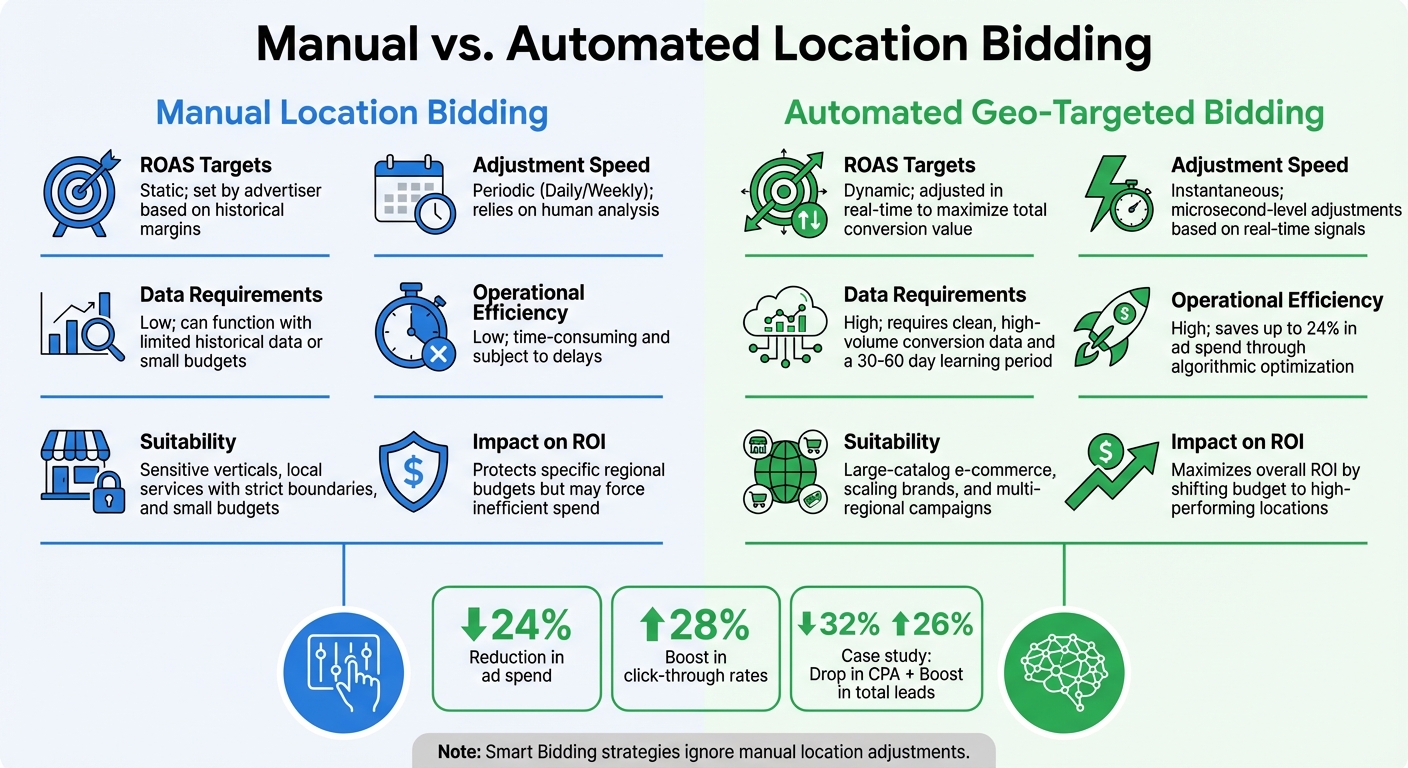
Manual vs Automated Location Bidding: Performance Comparison
Deciding between manual and automated location bidding boils down to a trade-off: control versus efficiency. With manual adjustments, you have precise control over your budget, making it a solid choice for businesses with tight service boundaries or limited funds. However, this approach demands significant time, can be delayed, and lacks the ability to react to real-time changes. On the flip side, automated bidding evaluates countless contextual factors - such as competitor pricing, device trends, and seasonal patterns - during the auction itself, making adjustments in microseconds that no human could match.
The difference in performance is striking. Automated strategies can reduce ad spend by up to 24% while increasing click-through rates by 28%. For example, in a lead generation case study from February 2024, Jason Tabeling restructured regional campaigns previously managed with manual budget allocations. By leveraging Google's algorithms to reallocate spending toward the most efficient regions, the campaign achieved a 32% drop in CPA and a 26% boost in total leads. The cost per conversion varied up to fivefold between top-performing and underperforming states, highlighting how automation can redirect budgets away from inefficient areas.
This performance gap is clear when comparing manually managed campaigns to those optimized by algorithms. That said, automation isn't universally applicable. For campaigns using Smart Bidding strategies, such as Target ROAS or Maximize Conversions, manual location bid adjustments are ignored entirely. As Google Ads Coach Jyll Saskin Gales puts it:
"A static manual bid adjustment just can't compete with that real-time optimization, which is why even if you add location bid adjustments to a campaign that is using Smart Bidding, they will be ignored".
For businesses like local service providers, where strict geographic or legal boundaries are critical, manual "Presence" targeting remains a better option.
Comparison Table: Manual vs. Automated Bidding
| Feature | Manual Location Bidding | Automated Geo-Targeted Bidding |
|---|---|---|
| ROAS Targets | Static; set by the advertiser based on historical margins | Dynamic; adjusted in real-time to maximize total conversion value |
| Adjustment Speed | Periodic (Daily/Weekly); relies on human analysis | Instantaneous; microsecond-level adjustments based on real-time signals |
| Data Requirements | Low; can function with limited historical data or small budgets | High; requires clean, high-volume conversion data and a 30-60 day learning period |
| Operational Efficiency | Low; time-consuming and subject to delays | High; saves up to 24% in ad spend through algorithmic optimization |
| Suitability | Sensitive verticals, local services with strict boundaries, and small budgets | Large-catalog e-commerce, scaling brands, and multi-regional campaigns |
| Impact on ROI | Protects specific regional budgets but may force inefficient spend | Maximizes overall ROI by shifting budget to high-performing locations |
Ultimately, the choice depends on your business needs. If you're running a large-scale e-commerce operation with substantial conversion volume, automation can deliver stronger ROI. But for businesses with smaller budgets or stricter geographic constraints, manual control could be the better fit. Matching your bidding strategy to your goals can make a big difference in overall performance.
How to Implement Location Bid Adjustments
To make the most of location-based strategies, focus on analyzing performance data at a detailed geographic level. Use mathematical formulas - not guesswork - to apply location bid adjustments that maximize your returns.
Using ZIP-Code Targeting for Precision
If you want to zero in on conversion hotspots, ZIP-code targeting is a powerful tool. In Google Ads, the "Narrow by" feature in the Locations report lets you view data like costs and conversions at the ZIP-code level, even if your initial targeting was broader, such as a city or state. This approach avoids the pitfalls of radius targeting, which can unintentionally cover a much larger area as the radius expands.
To refine your strategy, try tiered bidding. For example:
- Increase bids for ZIP codes near your store or those with high conversion rates.
- Decrease bids for distant or underperforming areas.
Mark Irvine, Director of PPC at SearchLab Digital, sums it up well:
"Using location bid adjustments, you can still reach audiences far away while prioritizing your spend and focus on a hyper-specific local market".
Tools like Google Analytics and distance reports can help you identify the "cutoff point" where user behavior shifts. Remember, not all users can be tracked to specific ZIP codes or cities. To cover untracked traffic, maintain broader targets like state or country-level campaigns. Performance heat maps can also help you fine-tune your strategy by visually highlighting high-value areas.
Using Performance Heat Maps
Heat maps are great for spotting trends in costs and conversions that might not stand out in raw data tables. Start by reviewing data at the most specific level where you have enough conversions to work with. If ZIP-code data is too scattered, look at city or metro area (DMA) data instead.
Use a color-coded system where darker shades represent stronger performance metrics, like higher conversion rates or lower costs per acquisition. Make sure your map includes a legend to clarify what the colors mean.
Before making any bid adjustments, ensure your data sample is large enough to draw meaningful conclusions. Cross-check heat map insights with tools like Google Analytics or even session recordings to understand why certain locations perform better than others. Don’t forget to exclude internal IP addresses to avoid skewed results. With this visual data in hand, you’ll be ready to fine-tune your bid adjustments effectively.
Setting Bid Ceilings for Budget Control
Bid ceilings are essential for keeping spending in check in low-performing areas while still allowing your ads to reach those audiences. To calculate bid modifiers, use this formula:
(Account Average CPA – Geographic Segment CPA) / Geographic Segment CPA × 100. This ensures a data-driven approach rather than relying on intuition.
Keep your bid adjustments reasonable - stick to a range of -70% to +100%. Extreme adjustments can lead to unpredictable results, as Eric Iwashita from Basis explains:
"Super high bid modifiers lead to unpredictable results and super low bid modifiers tend to quash traffic".
If an area performs poorly, a -100% bid adjustment will prevent your ads from appearing there at all. Regularly reviewing and updating your geographic bid modifiers can lead to a 15-20% boost in conversion yield, helping you get more from your ad spend.
Finally, always double-check your geographic settings during setup. Platforms can sometimes confuse similarly named locations, like "Washington" (state) and "Washington DC" or "New York" (state) and "New York City". Review your settings at least every six months to account for changes in population and search behavior.
Conclusion
Location bid adjustments help concentrate ad budgets on regions that perform best, turning geographic insights into measurable returns. By using the bid modifier formula - (Account Average CPA – Geographic Segment CPA) / Geographic Segment CPA × 100 - you can base adjustments on actual performance data, often boosting conversions by 15–20%.
Taking it a step further, a data-driven approach sharpens results even more. Factors like regional brand awareness, competition levels, and local terminology can heavily influence campaign outcomes, making precise geotargeting essential. Industry experts stress that optimizing for geography is a key tactic for improving campaign success. These findings underline the importance of leveraging geographic nuances for long-term PPC growth.
For e-commerce businesses looking to scale, tools like ZIP-code targeting, heat maps, and smart bid ceilings aren’t just helpful - they’re essential. Aligning your bidding strategy with geographic performance not only improves return on ad spend (ROAS) but also drives sustainable business growth.
FAQs
Which locations should I raise or lower bids for first?
When managing bids, it's smart to increase bids in locations where conversion rates or performance metrics are strong. On the flip side, reduce bids in areas showing low ROI or limited engagement. Let your decisions be guided by data-driven insights and geographic segmentation to maximize efficiency and results.
How much conversion data do I need before changing location bids?
To fine-tune location bid adjustments, it's crucial to collect enough conversion data to spot clear performance patterns. This usually means running your campaigns for several weeks to gather data that holds statistical weight. Taking the time to analyze this ensures your decisions are backed by solid insights, helping you optimize ROI effectively.
When will Smart Bidding ignore my location bid adjustments?
Smart Bidding doesn’t take location bid adjustments into account when paired with automated bidding strategies like Maximize Conversions. Why? Because Smart Bidding works by optimizing bids in real time, relying on a variety of signals. This approach effectively overrides any manual location adjustments you might have set.