How PWAs Improve Mobile-First SEO
March 15, 2026Progressive Web Apps (PWAs) are transforming mobile-first SEO. With mobile devices driving 60% of global web traffic and Google prioritizing mobile-first indexing, PWAs offer a solution for faster load times, better user experiences, and improved search rankings.
Here’s why PWAs matter for SEO:
- Speed: PWAs load faster using service workers and caching, reducing bounce rates and improving rankings.
- Mobile Optimization: Designed for mobile-first indexing, PWAs ensure responsive, user-friendly experiences across devices.
- Discoverability: Unlike native apps, PWAs are fully indexable by search engines, boosting organic traffic.
- Engagement: Features like offline access and push notifications lower bounce rates, increase session time, and drive conversions.
PWAs align with Google’s Core Web Vitals and mobile-first priorities, making them a smart choice for businesses looking to improve SEO and user engagement.
PWAs & SEO: Why you want one, how to get them & optimize for them
sbb-itb-cef5bf6
How PWAs Improve Page Speed and Load Times
Speed plays a key role in mobile SEO rankings, directly affecting your site's visibility in search results. Progressive Web Apps (PWAs) address this issue with technologies that leave traditional mobile websites feeling slow in comparison.
How Service Workers Enable Faster Load Times
Service workers act as a programmable middleman between the browser and the internet, intercepting all requests your site makes. On a user's first visit, the service worker caches essential assets like HTML, CSS, and JavaScript. For return visits, these files load instantly from the device's local storage, bypassing slow network connections.
"A service worker intercepts all network requests, enabling offline functionality, background sync, and push notifications. Without a properly registered and updated service worker, you have a web app, not a PWA." - Digital Applied
This setup allows static elements of the user interface to load in under 0.5 seconds on repeat visits. Meanwhile, updated content is fetched in the background, giving users the impression of near-instant loading - even on unreliable 3G networks.
Different caching strategies fine-tune performance:
- Cache-First: Ensures static assets are loaded immediately.
- Stale-While-Revalidate: Displays content instantly while updating it in the background.
- Network-First: Fetches fresh data but falls back to cached content if the network fails.
Google's Workbox library simplifies these strategies, so you don’t have to manually code complex caching logic.
How Page Speed Affects SEO Rankings
Google makes it clear: "Website speed is one of the signals used by Google's algorithm to rank pages". With mobile-first indexing as the standard, your site's mobile load time is now a critical factor in search rankings.
The business impact of speed is undeniable. A mere 0.1-second improvement in mobile site speed can boost retail conversions by 8.4% and increase average order value by 9.2%. Conversely, a one-second delay can slash conversions by 20%. These user behaviors - lower bounce rates and longer session durations - signal higher quality to search engines, which reward faster sites with better rankings.
The results speak for themselves. Twitter Lite, a PWA, saw a 65% increase in pages per session and a 20% drop in bounce rate. These changes not only enhanced user experience but also strengthened organic search performance.
Technical Features Behind PWA Speed
PWAs go beyond caching to deliver even faster performance and stronger SEO outcomes. For example, pre-caching assets during service worker installation ensures critical resources are ready before users need them. IndexedDB stores large datasets locally, cutting down on redundant API calls.
On average, PWAs achieve 2-3x faster repeat load times than native apps. They can also reduce mobile page load times by over 40%. Optimized PWAs often achieve a Largest Contentful Paint (LCP) of under 0.5 seconds on return visits - well below Google's 2.5-second benchmark for "good" performance.
The size of the app also matters. For instance, Twitter’s PWA is just 600 KB, compared to its 23.5 MB Android app. This lightweight design means faster downloads, lower data usage, and quicker time-to-interactive - all of which improve Core Web Vitals scores and, in turn, search rankings.
To fully leverage these advantages:
- Register service workers after the main content loads to avoid delaying the first render.
- Set performance budgets, aiming for a Time to Interactive under 3.5 seconds on first visits and under 1.0 second on repeat visits.
- Use code splitting to load only the JavaScript needed for each page, and inline critical CSS to reduce render-blocking resources.
Better Mobile Responsiveness and SEO Benefits
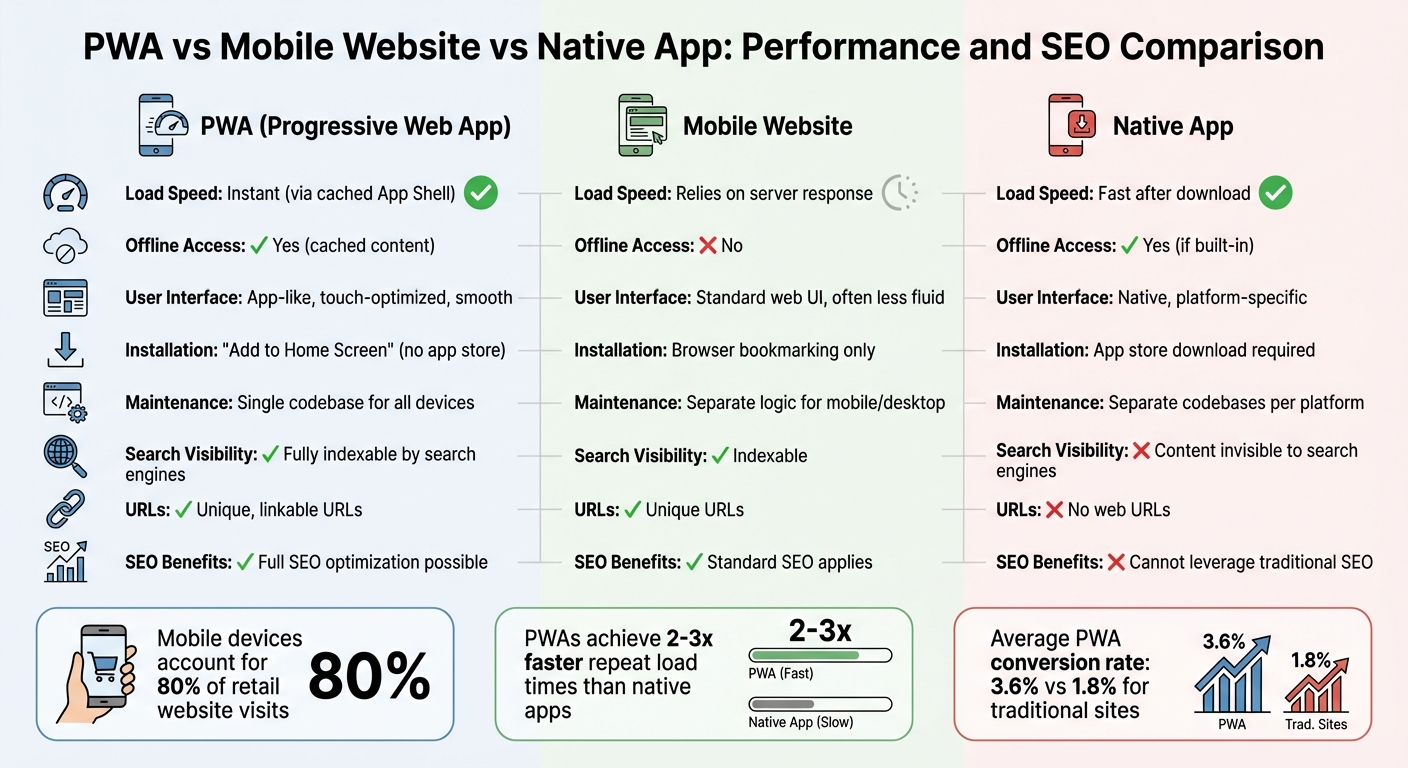
PWA vs Mobile Website vs Native App: Performance and SEO Comparison
Mobile devices now account for nearly 80% of retail website visits. PWAs (Progressive Web Apps) cater to this trend by offering a single, responsive codebase that adjusts seamlessly to any screen size - whether it’s a smartphone, tablet, or desktop. But this isn’t just about making content fit smaller screens; it’s also about aligning with Google’s mobile-first indexing requirements.
Responsive Design and Mobile-First Indexing
PWAs are built using HTML, CSS, and JavaScript, which naturally support responsive design. Additionally, the App Shell Architecture separates your site’s core UI elements - like headers, navigation, and layout - from its dynamic content. This ensures that the core framework loads instantly on any device. The HTML5 History API further enhances SEO by maintaining clean, unique URLs for each page, making it easier for search engines to crawl and index content independently. Tools like Google’s Lighthouse can verify your PWA’s mobile-friendliness, ensuring it meets modern standards.
This responsive approach gives PWAs a clear edge over traditional mobile websites.
PWAs vs. Mobile Websites
One of the biggest distinctions between PWAs and traditional mobile websites lies in their architecture and performance. Traditional sites often use a monolithic structure where the front end and back end are tightly linked, which can slow down rendering. PWAs, on the other hand, typically use a headless architecture. By decoupling the front end and back end, they enable faster rendering through APIs.
| Feature | PWA | Mobile Website |
|---|---|---|
| Load Speed | Instant (via cached App Shell) | Relies on server response |
| Offline Access | Yes (cached content) | No |
| User Interface | App-like, touch-optimized, smooth | Standard web UI, often less fluid |
| Installation | "Add to Home Screen" (no app store) | Browser bookmarking only |
| Maintenance | Single codebase for all devices | Separate logic for mobile/desktop |
The benefits of PWAs are evident in real-world examples. For instance, Lancôme’s 2023 PWA implementation used service workers to pre-cache resources, reducing page load times by 84%. This led to a 17% increase in conversions, a 53% jump in mobile sessions on iOS devices, and push notifications that recovered 8% of abandoned carts.
These architectural and performance advantages translate into a smoother, more reliable user experience across devices.
Consistent Experience Across Devices
PWAs leverage Progressive Enhancement, allowing them to function on older browsers while offering advanced features on modern ones. The Web App Manifest - a JSON file - controls how PWAs appear across platforms, including home screen icons, splash screens, and display modes like "standalone" or "fullscreen".
This consistency delivers measurable engagement benefits. For example, in mid-2025, Shop Dog Marketing transformed a Colorado auto repair shop’s website into a PWA. As a result, mobile load times dropped from 4–6 seconds to just 0.9 seconds. Over 90 days, the site saw a 38% decrease in bounce rate, a 29% increase in appointment bookings, and a 22% rise in interactions with its Google Business Profile. These improvements not only enhance user engagement but also signal search engines that the site provides high-quality content, boosting its rankings.
Pinterest’s experience further highlights the potential of PWAs. After realizing that only 1% of mobile users were converting to their native app, Pinterest revamped its mobile experience as a PWA. The result? A 40% to 60% increase in core engagement metrics, ad revenue, and time spent on the site. On average, conversion rates for PWAs were 36% higher than those of native mobile apps.
PWAs clearly offer a blend of speed, functionality, and SEO advantages that traditional mobile websites struggle to match.
How Search Engines Index and Discover PWAs
PWAs (Progressive Web Apps) stand out because they exist on the open web, unlike native apps that are locked within app stores. This means PWAs have unique, linkable URLs, which makes them easier for search engines to discover and index. This feature ties directly into the benefits of mobile-first SEO, offering a clear advantage in organic search visibility.
PWAs vs. Native Apps in Search Visibility
Native apps operate within closed ecosystems like app stores, making their content nearly invisible to search engines like Google. On the other hand, PWAs are built with standard web technologies, allowing them to leverage unique URLs. This means search engines can crawl and index their content seamlessly. As a result, PWAs can benefit from traditional SEO techniques, such as backlinking, content optimization, and keyword targeting - strategies that native apps can't utilize.
That said, there's a technical consideration to keep in mind. Google indexes PWAs in two stages. First, it fetches and indexes server-side rendered (SSR) content. Later, it processes JavaScript to render the full content. As Tom Bennet from Builtvisible explained during the 2018 Google I/O Conference:
"Googlebot defers rendering JavaScript until sufficient resources are available"
To minimize delays in indexing, it's critical to implement SSR along with clean URL structures, like using "/products/shoes" instead of "/#/products/shoes." These steps ensure that search engines can index your content promptly and completely.
By improving visibility, PWAs naturally drive more organic traffic.
How PWAs Drive Organic Traffic
PWAs' shareable and linkable nature makes them excellent for generating organic traffic. Every page in a PWA is accessible and shareable via search engines and social media, creating multiple user entry points. This is a stark contrast to native apps, which require users to download the app before accessing its content.
The results speak for themselves. In 2022, AliExpress adopted a PWA and saw a 104% increase in conversion rates for new users across all browsers, along with a 74% increase in session duration. Similarly, UK-based retailer George reported a 31% rise in conversions and a 50% reduction in bounce rates after switching to a PWA setup. These successes were largely driven by better search visibility, allowing users to directly find specific products through Google without the hassle of downloading an app.
To maximize your PWA's discoverability, consider submitting XML sitemaps through Google Search Console. This helps search engines locate all deep-linked content. Additionally, make sure your robots.txt file doesn’t block Googlebot from accessing critical JavaScript and CSS resources. These optimizations not only enhance organic traffic but also strengthen your mobile-first search rankings.
User Engagement Metrics and SEO Impact
PWAs (Progressive Web Apps) don't just enhance site speed and responsiveness - they also influence user engagement metrics that indirectly impact SEO. While Google's John Mueller has clarified that "PWAs currently don't have any advantage in Google Search", the story is more layered. As Peyton R from Stack Daily puts it:
"PWAs don't just improve user experience - they subtly but powerfully influence SEO metrics in ways you might not expect."
Metrics such as bounce rates, session durations, and conversion rates are key behavioral signals that help search engines identify valuable content and align with mobile-first indexing priorities.
Lower Bounce Rates and Improved Engagement
Quick loading times are a game-changer for reducing bounce rates. Thanks to service workers, PWAs cache vital components like the "app shell", enabling repeat visits to load almost instantly. This matters because 53% of mobile users leave a site if it takes longer than three seconds to load. By integrating PWA features, businesses have reported bounce rate reductions ranging from 15% to 38%.
PWAs also keep users engaged in challenging conditions, such as low connectivity. By serving cached content instead of error pages, they maintain user interaction in places like parking garages or subway tunnels. These lower bounce rates send a clear message to search engines: your content is relevant and worth ranking.
Longer Time-on-Site and Higher Conversion Rates
PWAs deliver app-like features - smooth scrolling, easy navigation, and push notifications - that not only extend session durations but also drive repeat visits. For example, when Pinterest revamped its mobile site into a PWA, it saw a 60% increase in time-on-site and a 44% jump in ad revenue.
The impact on conversions is equally impressive. On average, PWAs boast a 3.6% conversion rate, compared to 1.8% for traditional e-commerce sites. Lancôme experienced a 17% increase in overall conversions and an 8% recovery in abandoned cart conversions using push notifications. Spotify, after transitioning to a PWA, reported a 46% surge in free-to-paid subscriber conversions.
Tools like push notifications and "Add to Home Screen" prompts also play a big role in bringing users back. For instance, Voot, a streaming service, saw session times increase by 39% and daily visits rise by 15% after launching its PWA.
Behavioral Signals That Support SEO
Although search engines don't directly rank PWAs higher, they do value the behavioral improvements PWAs bring. Metrics like longer dwell times, more pages viewed per session, and increased conversions signal relevance to search engines. On average, PWAs generate 5.1 pages per session, and many businesses report a 140% increase in time-on-site after adoption. These metrics complement Google's Core Web Vitals - key performance indicators like Largest Contentful Paint (LCP) and First Input Delay (FID) - which are essential for ranking mobile-first content.
Dan from Shop Dog Marketing highlights the future importance of these metrics:
"In 2026, if your website does not load fast enough or render cleanly, AI Overviews may ignore you - even if your content is strong. PWAs fix that problem."
Conclusion
Progressive Web Apps (PWAs) represent more than just a technical improvement - they're a game-changer for businesses aiming to thrive in a mobile-first world. By leveraging tools like optimized service workers, app shell design, and intelligent caching, PWAs deliver the speed, reliability, and user engagement metrics that search engines prioritize. For instance, when an auto repair shop in Colorado reduced its mobile load time from 4–6 seconds to just 0.9 seconds using a PWA, it experienced a 38% drop in bounce rate and a 29% boost in appointment bookings within three months.
But it’s not just about speed. PWAs seamlessly align with Core Web Vitals standards, enhance visibility compared to native apps, and keep users engaged with features like offline functionality and push notifications. The measurable improvements in conversions highlight their effectiveness.
Dan from Shop Dog Marketing emphasizes this shift:
"PWAs are no longer 'new tech.' They are becoming the default expectation for usability, speed, and local visibility".
Looking ahead to 2026, as AI-driven search increasingly favors fast and efficient websites, businesses without PWAs risk falling behind.
The advantages of PWAs extend beyond technical performance. They offer a unified codebase that works across platforms, are fully indexable, and significantly improve SEO by enhancing load times, user experience, and behavioral signals. This combination creates a ripple effect, boosting both search rankings and conversions.
More than just a technical tool, PWAs are a cornerstone of a robust digital strategy. Whether you're managing an e-commerce store, a local service business, or a content-driven platform, adopting PWA technology positions you to meet evolving ranking factors and AI-driven search trends. By embracing PWAs, you ensure your business stays competitive in the mobile-first era, delivering both enhanced SEO performance and tangible business outcomes.
FAQs
Do PWAs directly improve Google rankings?
PWAs can play a direct role in improving Google rankings, especially when it comes to mobile-first SEO. Their ability to load quickly and provide a smoother user experience aligns perfectly with the factors search engines prioritize. This often results in better rankings, making PWAs an effective option for businesses looking to boost their online visibility.
Will my PWA content be indexed if it uses a lot of JavaScript?
Yes, content from PWAs can be indexed, even if they rely heavily on JavaScript. To make this happen, focus on optimizing how JavaScript is rendered and ensure your content is accessible to search engines. Using techniques like server-side rendering (SSR) or a combination of server-side and client-side rendering can make it easier for search engines to access and understand your content effectively.
Which Core Web Vitals should I prioritize for a PWA?
For a PWA, pay attention to Largest Contentful Paint (LCP), Interaction to Next Paint (INP), and Cumulative Layout Shift (CLS). These metrics measure how quickly content loads, how responsive interactions are, and how stable the layout feels - essential for creating a smooth user experience and improving search engine rankings. Optimizing these areas helps your PWA meet mobile-first SEO standards effectively.