Ultimate Guide to Multi-Channel Marketing Integration
March 16, 2026Multi-channel marketing integration is about creating a unified customer experience across digital and offline channels like email, social media, SEO, and paid ads. Why does it matter? Because 86% of shoppers use multiple channels before buying, and campaigns across four or more channels can be 300% more effective. However, challenges like data silos, attribution issues, and shrinking budgets make execution tricky.
Here’s the quick takeaway:
- Benefits: Boosts campaign performance, improves retention (up to 90%), and increases revenue by 10–20% with consistent branding.
- Challenges: Data fragmentation (83% of marketers struggle), attribution difficulties, and budget constraints.
- How to Succeed:
- Set SMART goals with clear KPIs.
- Audit your channels and map customer journeys.
- Align channels with specific roles in the funnel.
- Use tools like CRMs, marketing automation, and analytics to integrate platforms.
- Track results with UTM tagging and proper attribution models.
The key is connecting your data, tailoring messages to each channel, and ensuring a smooth customer journey. With the right strategy and tools, multi-channel marketing drives measurable growth.
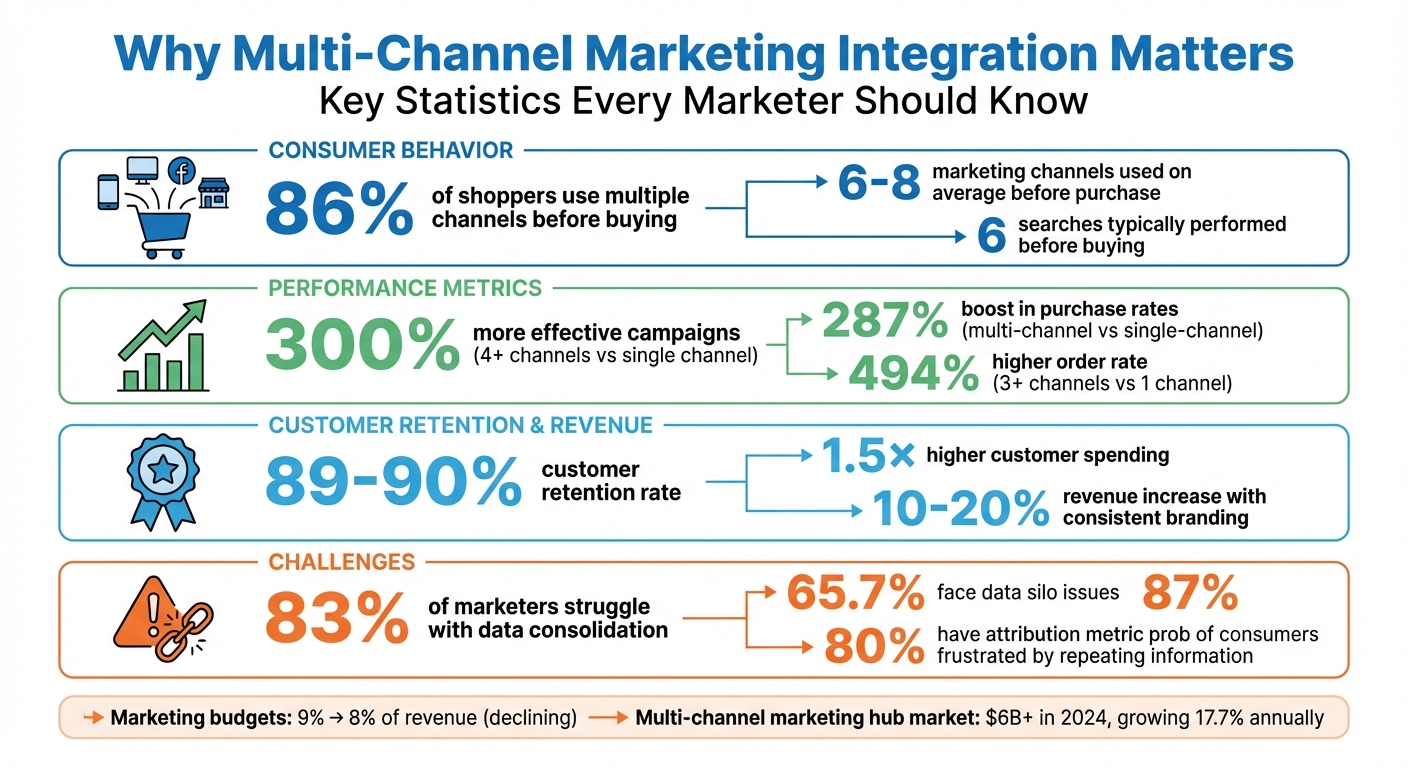
Multi-Channel Marketing Integration: Key Statistics and Benefits
When to Use Multi-Channel vs. Omni-Channel Marketing
sbb-itb-cef5bf6
Benefits and Challenges of Multi-Channel Marketing Integration
Multi-channel marketing integration offers impressive results but also comes with its fair share of hurdles. Let’s break it down.
A well-integrated approach can significantly amplify campaign performance - boosting it by 300%. It also helps retain an impressive 89–90% of customers, encourages 1.5× higher spending, and increases revenue by 10–20% when branding remains consistent. The key here? A unified customer experience. Seamless transitions between channels are crucial, especially since 87% of consumers report frustration when they have to repeat their information. This makes having a "single customer view" essential for crafting personalized and effective messaging.
However, integration isn’t without its challenges. 65.7% of marketers struggle with data silos, while 83% find it difficult to consolidate fragmented data into unified user records. On top of that, 80% face issues with attribution metrics. Traditional last-click attribution models only add to the confusion, often failing to account for the early, awareness-building stages of the customer journey.
Adding to the complexity, marketing budgets have taken a hit - shrinking from nearly 9% to just under 8% of revenue. Yet, successful multi-channel marketing requires investments in technology, skilled teams, and seamless coordination across platforms. Tackling these challenges head-on is vital for executing the strategies discussed later in this guide.
"Consistency doesn't mean identical; it means coherent."
Single-Channel vs. Multi-Channel Marketing Comparison
Here’s a quick look at how single-channel and multi-channel marketing stack up against each other:
| Feature | Single-Channel Marketing | Multi-Channel Marketing |
|---|---|---|
| Reach | Limited to one platform's audience | Broad reach across various demographics |
| Customer Experience | Simple but often lacks depth | Consistent and reinforced across touchpoints |
| Data Insights | Siloed and limited to one interaction type | Comprehensive view of the customer journey |
| ROI Potential | Lower; relies on a single point of failure | Up to 300% higher than single-channel |
| Customer Retention | Lower loyalty rates | 89–90% retention rate |
| Complexity | Low; easy to manage | High; requires integration and coordination |
| Risk Level | High; vulnerable to algorithm changes or platform decline | Lower; diversified revenue streams provide stability |
| Ideal Use Case | Small businesses with very limited budgets | Businesses aiming for scale and high retention |
How to Plan Multi-Channel Marketing Integration
Planning a multi-channel strategy isn’t about trying to dominate every platform simultaneously. It’s about carefully selecting the right channels and weaving them together into a connected system. Before launching campaigns, you need a clear roadmap that aligns your channels, messaging, and data. A structured approach ensures that your efforts are effective and cohesive.
Step 1: Set SMART Goals and KPIs
Goals like "get more leads" or "increase brand awareness" are too vague for a multi-channel strategy. Instead, focus on SMART goals - Specific, Measurable, Achievable, Relevant, and Time-bound. These provide a clear direction and measurable benchmarks. For instance, instead of saying "improve sales", aim for something like:
"Increase Sales Qualified Leads (SQLs) by 20% in Q4 through coordinated email and social retargeting."
Once your goals are defined, pair them with relevant KPIs that reflect the customer journey stage. For top-of-funnel (TOFU) efforts, track metrics like reach and engagement. For middle (MOFU) and bottom-of-funnel (BOFU) stages, focus on click-through rates (CTR), conversion rates, cost per acquisition (CPA), and return on ad spend (ROAS). Retargeting efforts might track email open rates or assisted conversions.
It’s also worth using an attribution model that goes beyond last-click attribution. This approach highlights the value of channels like social media, which may assist conversions even if they don’t get direct credit. These metrics will guide your decisions in the next steps.
Step 2: Audit Your Channels and Map the Customer Journey
Start by auditing your existing channels. This means identifying strengths, weaknesses, and potential data bottlenecks. Create a technology inventory to list all the tools you’re currently using. Check which systems integrate well and pinpoint areas where data flow is restricted. Many marketers find that data integration is a significant challenge.
Next, dive into historical data to evaluate channel performance. Which platforms drive the most conversions? Where are costs lowest? Which channels assist conversions, even if they don’t earn the last-click credit? This analysis helps you set realistic targets within your SMART framework.
Then, map out the customer journey. Identify every touchpoint where customers interact with your brand, from Awareness (TOFU) to Consideration (MOFU), Decision (BOFU), and even Loyalty. On average, consumers engage with 6–8 marketing channels before making a purchase, and they typically search six times before buying. By understanding these interactions, you can focus on the key moments that heavily influence purchase decisions.
Step 3: Choose and Align Your Marketing Channels
With your goals in place and your audit complete, it’s time to choose the channels that will best connect with your audience. Start by focusing on 2–3 core platforms where your audience is most active, then expand based on ROI.
For example, B2B businesses might prioritize LinkedIn and Google Search, while e-commerce brands targeting younger audiences could lean into TikTok, Meta, and email. Assign each channel a specific role in the customer journey. Use platforms like TikTok, YouTube, and display ads to build awareness at the top of the funnel, while email automation and webinars can nurture leads in the middle. Channels like Google Search and abandoned cart recovery are ideal for closing sales at the bottom.
Keep in mind, your messaging should adapt to each platform’s unique style and audience while maintaining a consistent core narrative. For instance, TikTok might call for short, engaging videos, while LinkedIn works better for detailed case studies. A message map can help you define your core message, identify audience pain points, and tailor content for each channel.
Here’s a real-world example: In 2024, a water filtration company restructured its marketing by shifting its budget from underperforming channels like linear TV and Google Discovery to platforms like TikTok and eRetail. By aligning their efforts, they achieved 8.6% revenue growth and a $1.2M profit boost - all while cutting their media budget by $500,000.
"Multi-channel marketing done right is a coordinated system - where every channel has a defined role, data flows freely across platforms, and strategy evolves based on real performance data."
- Wieldr
With your channels aligned under a unified strategy, you’re ready to move forward with the tools that will bring your campaigns to life.
Tools and Technologies for Multi-Channel Integration
Building an effective multi-channel strategy starts with a solid technology stack. Without the right tools, you might find yourself overwhelmed - manually transferring data, struggling with attribution, and buried in spreadsheets. The solution? Tools that work together seamlessly, enabling automated data flows and campaigns that practically run themselves.
At the core of this setup are three key layers:
- CRM or Customer Data Platform (CDP): This serves as your central hub, consolidating customer interactions across all channels into a single, unified view.
- Marketing Automation Platform: These tools manage workflows and deliver tailored messages triggered by customer behavior in real-time.
- Analytics and Intelligence Tools: This layer evaluates performance across channels and helps fine-tune your budget allocation.
When these layers are connected, your CDP feeds detailed customer profiles into the automation platform, which then powers cross-channel campaigns. Meanwhile, the analytics tools track results and provide insights to refine your strategy. This interconnected system not only improves customer experiences but also boosts your marketing ROI.
Why Integration Matters
The numbers make it clear: integrating multiple channels works. Campaigns using at least four digital channels are 300% more effective than single- or dual-channel efforts. Marketers who use three or more channels see a 494% higher order rate compared to those relying on just one. This kind of setup also lays the groundwork for leveraging AI to streamline and improve campaigns.
For instance, in February 2026, SegmentStream introduced an AI solution that directly integrates with measurement tools to automatically execute and optimize budgets. Sophie Renn from SegmentStream sums it up perfectly:
"If your current stack ends at a dashboard and requires a spreadsheet layer before anything changes, you're running analytics, not intelligence."
The market for multi-channel marketing hubs is expanding rapidly, surpassing $6 billion in 2024 and projected to grow by 17.7% annually through 2034.
Getting Started with Integration
Instead of focusing solely on feature-heavy tools, prioritize systems that integrate smoothly. A connected toolset is far more effective than a fragmented one. Start small - implement a simple journey like a welcome series or abandoned cart recovery - before scaling up to more intricate campaigns. Also, establish clear data governance practices before deploying a CDP; otherwise, your "single source of truth" could turn into just another chaotic database.
By choosing tools that work together, you’ll be better equipped to deliver coordinated, data-driven campaigns that align with your overall strategy.
Multi-Channel Integration Tools Comparison
| Tool | Type | Key Features | Ease of Use |
|---|---|---|---|
| MoEngage | Engagement Hub | AI-driven journey orchestration, predictive analytics, real-time personalization | High |
| HubSpot | All-in-One CRM | Centralized dashboard, advanced segmentation, robust native integrations | High |
| Salesforce Marketing Cloud | Enterprise Hub | Einstein AI insights, cross-channel campaign management, deep CRM integration | Moderate |
| SegmentStream | Marketing Intelligence | Autonomous AI, budget execution, incrementality testing | Moderate |
| OneCart | E-commerce Platform | Real-time inventory sync, TikTok Shop/Shopee/Lazada support, AI product descriptions | High |
| ZiftONE | Partner Marketing | Unified PRM and TCMA, co-branded collateral, MDF management | Moderate |
How to Execute Multi-Channel Marketing Campaigns
Execution is where multi-channel marketing either shines or stumbles. The key? Precise tracking, seamless timing, and well-connected data systems.
With 86% of shoppers using at least two channels before making a purchase, they expect you to remember their journey every step of the way. And when 87% of consumers feel frustrated by having to repeat themselves across different channels, poor execution doesn’t just confuse your metrics - it risks losing customers altogether.
Here’s how to stay on track.
Using UTM Tagging and Attribution Correctly
Tracking is the backbone of any successful campaign. UTM parameters help you identify which channels truly drive results - but only if they’re applied properly.
Start with consistent naming. Use lowercase for everything - "facebook" instead of "Facebook" - because analytics tools treat them as separate sources otherwise, which will fragment your data. Create a shared UTM spreadsheet for your team and external partners. This simple step ensures everyone sticks to the same structure, making campaign analysis down the line far easier.
Avoid tagging internal links on your website. Adding UTM parameters to internal links can overwrite the original traffic source, breaking your session data. UTMs should only be used for external campaigns: paid ads, email newsletters, social media posts, and partner links.
When it comes to attribution, skip the default last-click model, which gives all the credit to the final touchpoint while ignoring earlier interactions. A position-based model works better for most businesses. It assigns 40% of the credit to both the first and last interactions, with the remaining 20% spread across the middle touchpoints. Jen Spencer from Allbound explains it well:
"I'm a big fan of a position-based attribution model where 40% of the credit is assigned to the first and the last interaction... All of the interactions thereafter... should make up 20% of the overall attribution credit."
For more complex campaigns involving multiple channels, consider data-driven attribution (DDA) in GA4. This approach uses machine learning to evaluate how each touchpoint influences conversions, rather than relying on fixed rules.
Once your tracking is solid, the next step is aligning your efforts across channels.
Running Coordinated Cross-Channel Campaigns
Accurate attribution makes it easier to synchronize campaigns across channels. True coordination goes beyond posting the same message everywhere - it’s about creating connected workflows where actions on one channel trigger responses on another.
Here’s an example: a customer clicks a link in your email, browses three product pages but doesn’t purchase, and then sees a retargeting ad on Instagram the next day featuring the exact products they viewed. That’s coordination. Achieving this requires a unified marketing calendar and automation rules that link your email platform, website behavior tracking, and ad systems.
On average, customers interact with six different channels before making a purchase. Map out these touchpoints and design campaigns that reflect this non-linear journey. For instance, social ads might create awareness, emails could nurture interest, and retargeting ads might close the sale - but all of these efforts must rely on the same customer data.
Use scheduling tools to align the timing of your campaigns. When you launch a promotion, your email should land in inboxes, your social posts should go live, and your paid ads should roll out - all within the same hour. Spreading these actions across several days because different teams manage them separately can dilute the impact.
Connecting Data Across Platforms
Just like planning, aligning data across tools is essential for a smooth customer experience. Most marketing platforms don’t communicate with each other naturally, so you’ll need integration tools to sync data between your CRM, ad platforms, email systems, and analytics tools.
Native integrations for platforms like HubSpot, Salesforce, and Google Ads can ensure reliable data sharing. For platforms without built-in integrations, consider using iPaaS (Integration Platform as a Service) tools like Zapier, Tray.io, or Workato. These tools let you connect systems without requiring custom code.
The ultimate goal is a single customer view: one unified record that updates in real time as customers interact across channels. For instance, if someone fills out a form on your website, that data should immediately update in your CRM, trigger a welcome email, and update your ad platform’s audience segments - all automatically.
Take EVEREVE, a retailer with 103 stores, as an example. By unifying its e-commerce and in-store systems with 275 new POS stations in just eight months, the company achieved a 20% year-over-year increase in online conversions and set a record sales day with 36% higher revenue than their previous peak.
Similarly, AG Jeans improved its performance by consolidating legacy integrations into a unified commerce stack. Their conversion rates rose by 1.5 percentage points, and clienteling penetration - where store associates use online data to personalize service - jumped from 15% to 30% of total business.
Perform quarterly audits of your marketing tech stack to spot integration gaps or redundant tools that create data silos. The better connected your systems, the more accurate your tracking and the smoother the customer experience.
Conclusion
An integrated approach to marketing is no longer optional - it's a must for staying competitive. Coordinating campaigns across four or more digital channels can make you 300% more likely to outperform those relying on just one or two channels. This shift is transforming how businesses compete and succeed.
Why go multi-channel? The numbers speak for themselves. Multi-channel strategies can boost purchase rates by 287% compared to single-channel efforts. They help retain nearly 90% of customers and drive revenue growth of 10% to 20% through consistent branding. These results aren't just theoretical - they're proven outcomes.
To make this work, start by setting SMART goals that directly tie to revenue and customer retention. Audit your channels to identify weak spots where customers might drop off. Then, connect your data systems so every platform shares the same customer insights. Focus your efforts on the three to five channels where your audience is most active, and use position-based attribution to figure out which strategies are delivering results. Automate workflows to ensure your actions across platforms are seamless and responsive.
Today's customers expect smooth, coordinated experiences, and the pressure is on. With 87% of retailers agreeing that multi-channel strategies are critical to their success, the real question is no longer if you should integrate, but how fast you can make it happen. The tools are ready, the data proves the impact, and by combining thoughtful planning, smart technology, and precise execution, you can turn these strategies into measurable growth. Don't wait - start now and see the results for yourself.
FAQs
What’s the fastest way to break down data silos across my marketing tools?
The fastest way to break down data silos is by setting up a unified, data-driven system that allows information to flow effortlessly between platforms. This means integrating tools like Google Looker Studio or Power BI, automating updates to provide real-time insights, and bringing together critical metrics - like ROAS, CPA, and CLV - into one centralized dashboard. A shared command center with clearly defined KPIs not only boosts team collaboration but also supports smarter, more cohesive decisions across all channels.
Which attribution model should I use in GA4 for multi-channel campaigns?
The ideal attribution model in GA4 largely depends on your specific goals and the complexity of your customer journey. GA4's default option, Data-Driven Attribution (DDA), uses machine learning to evaluate and distribute credit across various touchpoints based on their influence on conversions.
If your needs are straightforward, simpler models like Last Click or Linear might suffice. However, for multi-channel campaigns, DDA stands out by offering a broader perspective on how different channels contribute to performance.
How can I choose the best 3–5 channels for my audience without wasting budget?
To narrow down the best 3–5 channels, start by identifying where your audience spends the most time and interacts the most. Look into their preferred platforms - whether it’s social media, email, or search engines - and focus on those. Align your choices with your goals, and review past performance data to pinpoint the channels delivering the highest ROI. By concentrating on fewer, highly relevant platforms, you can allocate resources more effectively and maintain consistent messaging without overspending.