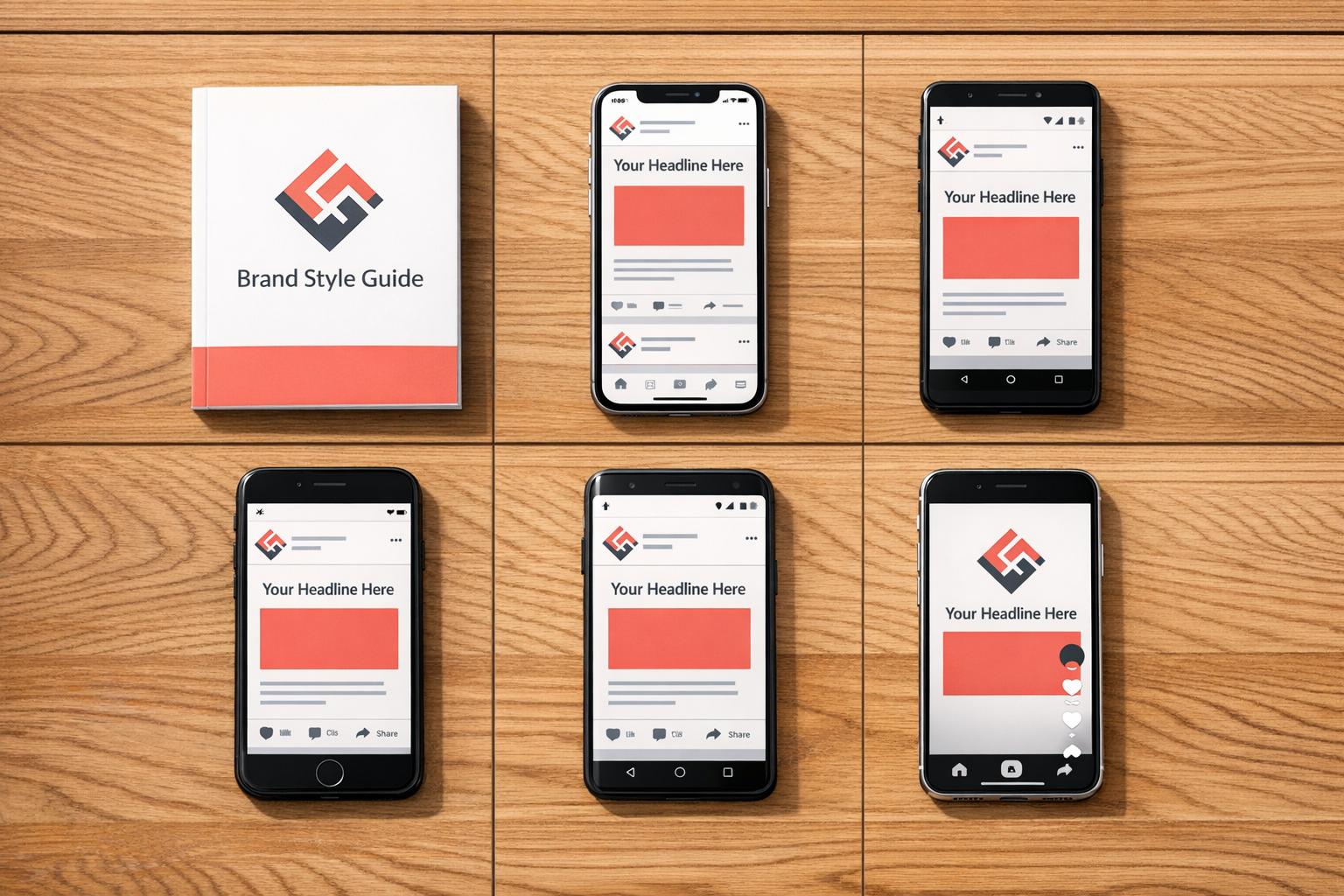
Best Practices for Consistent Branding on Social Media
April 2, 2026Consistency is the backbone of effective branding on social media. It builds trust, enhances recognition, and drives customer loyalty. Here’s what you need to know:
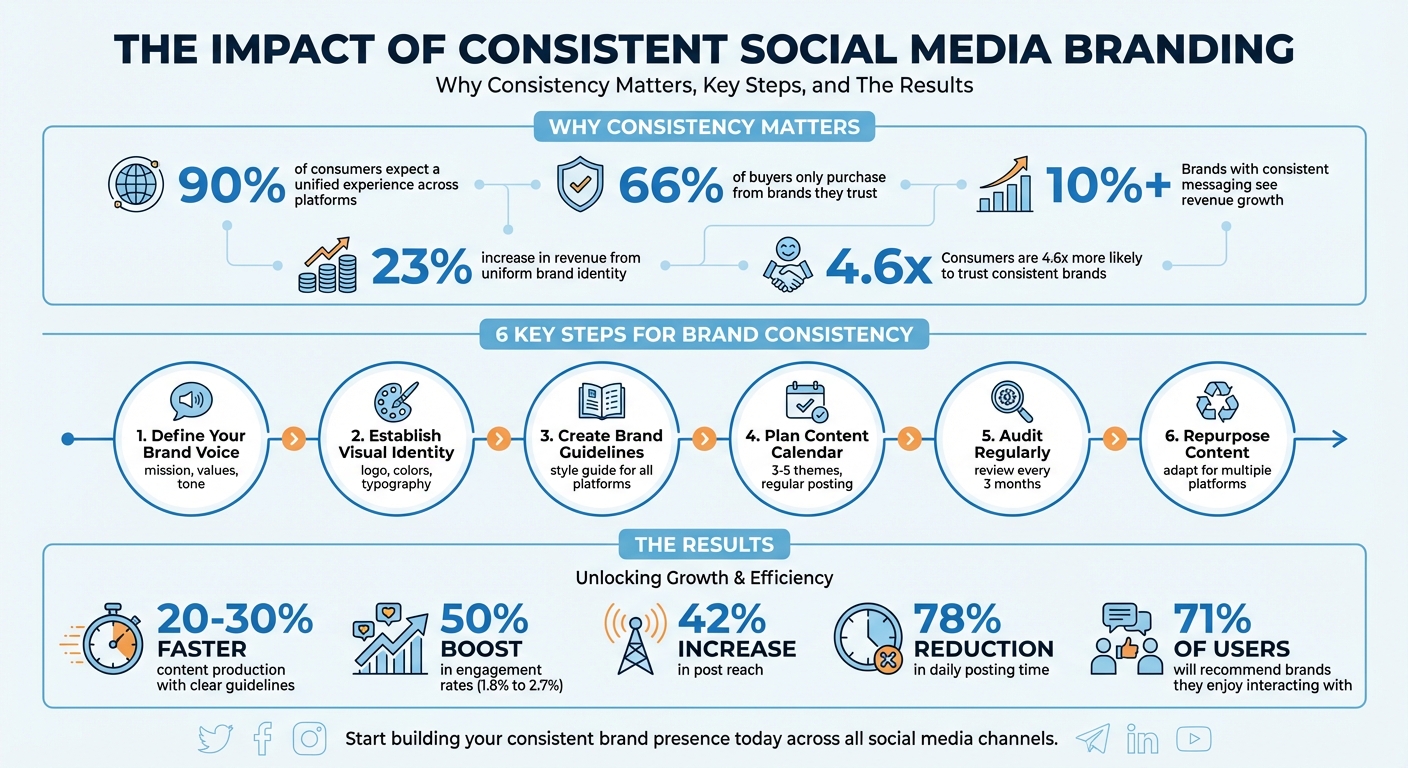
- 90% of consumers expect a unified experience across platforms.
- 66% of buyers only purchase from brands they trust.
- Brands with consistent messaging can see 10%+ revenue growth.
To achieve this, focus on these key areas:
- Define Your Brand Voice: Identify your mission, values, and tone. Use clear frameworks like "We Are / We Are Not" to guide messaging.
- Establish Visual Identity: Stick to a consistent logo, color palette, and typography. Document exact codes and formats for accuracy.
- Create Brand Guidelines: Develop a style guide covering design, messaging, and platform-specific rules.
- Plan a Content Calendar: Use 3–5 content themes and schedule posts to maintain regularity.
- Audit Regularly: Check profiles every 3 months to ensure alignment with your brand.
- Repurpose Content: Transform high-performing content into multiple formats tailored for each platform.
Consistency isn’t just about visuals - it’s about ensuring every interaction reflects your brand’s identity. By following these steps, you’ll create a recognizable, trustworthy presence across all platforms.
Social Media Branding Statistics and Best Practices
Creating Brand Consistency On Social Media
sbb-itb-cef5bf6
Define Your Brand Purpose and Voice
Building a consistent presence on social media starts with a clear sense of who you are as a brand. This means understanding your mission, values, and personality - elements that should shape every post, comment, and story you share.
Clarify Brand Mission and Values
Your mission is the driving force behind your brand - the reason you exist, the challenges you address, and the difference you aim to make. Your values, on the other hand, are the guiding principles that shape how you operate and engage with your audience.
To keep your messaging consistent, identify 3–5 key pillars that reflect your brand’s purpose. These could include educational content, behind-the-scenes glimpses, product features, community involvement, or thought leadership. For instance, a wellness brand might focus on topics like holistic health, eco-friendly practices, and community well-being.
Document these pillars in a framework your team can easily refer to. A simple "We Are / We Are Not" table can help set clear boundaries. For example: "We are knowledgeable, but not condescending" or "We are approachable, but not overly casual". This framework ensures your messaging stays consistent and aligned with your values, avoiding mixed signals. A clear mission and voice lay the foundation for a strong, cohesive social media strategy.
Develop a Consistent Brand Voice
Your brand voice is essentially your personality - it’s how your brand “sounds” in every interaction. Start by selecting 3–5 adjectives that describe your voice, such as friendly, bold, professional, playful, or authoritative. These traits should guide all your communication.
Knowing your audience is essential here. Research how your target audience speaks, the phrases they use, and what kinds of content resonate - or fall flat - with them. For example, busy professionals might appreciate concise, authoritative messaging, while creative entrepreneurs might connect with a more conversational and inspiring tone.
Create examples of on-brand versus off-brand messaging for common scenarios like greetings, apologies, product updates, or customer support. For instance, an on-brand greeting could be, “Hi there! Thanks for reaching out,” while an off-brand version might sound overly formal, like, “Dear valued customer, we acknowledge your inquiry.”
It’s important to note that while your voice remains consistent, your tone can adapt depending on the situation. Think of your voice as your brand’s personality - it doesn’t change. Tone, however, is the emotional layer you add to match the context. For example, you might use an upbeat tone for a product launch but take on a more empathetic tone when addressing a customer complaint. The personality stays the same; only the delivery shifts.
Once your purpose and voice are clearly defined, the next step is to establish a cohesive visual identity.
Establish Consistent Visual Identity
Your visual identity is often the first thing people notice about your brand. Alongside your brand voice and values, it shapes the overall customer experience. In a world where users scroll past more than 300 pieces of content every day, a consistent visual style across platforms can make your brand more recognizable and memorable. When your logo, colors, and fonts are uniform, your brand conveys professionalism, organization, and reliability.
Take Coca-Cola and Starbucks as examples. Coca-Cola has stayed true to its iconic red and Spencerian script font for over 120 years, from vintage 1930s billboards to today’s social media posts. Starbucks, on the other hand, uses its recognizable “Siren” logo consistently across platforms like Instagram, Twitter, Pinterest, and LinkedIn. They often rely on just the logo icon, ensuring it fits within the small profile image spaces of these platforms. This level of visual consistency helps build brand recognition more effectively than relying on standout posts alone.
"Visual identity is the collection of visual elements - logo, colors, typography, imagery, and design systems - that represent your brand and make it instantly recognizable across all touchpoints."
- SocialRails
Use Brand Colors and Fonts
Once you understand the value of a cohesive look, it’s time to focus on your color palette and typography. Colors aren’t just aesthetic - they evoke emotions and enhance recall. Select a palette that reflects your brand’s personality, keeping it simple with 3–5 colors. This could include a primary color, one or two secondary hues, a neutral tone, and an accent. Document the specific HEX, RGB, and CMYK codes to maintain consistency across digital and print formats. For example, blue often conveys trust and professionalism, red suggests energy and urgency, and green symbolizes growth and health. Oreo demonstrates this well by consistently using complementary tones of blue and white on its Instagram posts.
Typography also plays a key role in your visual identity. Stick to 2–3 fonts - one for headlines and another for body text. Ensure readability by using at least a 16-point font size and maintaining high contrast between text and backgrounds. This approach enhances clarity and ensures a polished look across all platforms.
Incorporate Logos and Graphics
Your logo is the cornerstone of your visual identity. Create a versatile logo system that includes a primary logo, a simplified secondary version, and variations suited for different backgrounds and sizes. Use the same logomark for profile pictures across platforms, ensuring consistency regardless of whether the format is circular (e.g., Twitter) or square (e.g., LinkedIn).
For smaller formats like watermarks, opt for a simplified version of your logo that remains clear even at 40 pixels. Since much of today’s social media engagement happens on mobile devices, it’s crucial to test how your logo appears at smaller sizes.
Beyond logos, ensure all graphics and imagery align with your brand’s visual style. Use uniform icon sets, consistent filters or lighting for photos, and reusable templates to streamline your design process. Templates for quotes, data posts, or carousel graphics can help maintain a cohesive layout while allowing room for creativity. These templates act as a foundation, enabling you to experiment and refine your designs over time without straying from your brand’s identity.
"Consistency doesn't mean monotony. Use your templates as a foundation, but be bold, experiment, and evolve your designs over time."
- Muneeb Awan, Founder, PostNitro.ai
To evaluate your visual identity, take a screenshot of your last nine Instagram posts and view them as a grid. If they don’t look like they belong to the same brand, it’s a sign your visual identity needs improvement. These elements collectively shape your profile’s overall appearance, reinforcing your brand’s presence and consistency.
Create Brand Guidelines and Style Guide
Once you've nailed down your visual identity, the next step is creating a detailed style guide. This document serves as your go-to resource for maintaining consistency in both design and messaging. Without a clear guide, even the most well-meaning team members can unintentionally stray from your brand's identity, leading to mixed signals that confuse your audience and weaken trust.
A well-crafted style guide does more than just ensure consistency - it speeds up content creation. Brands with clear guidelines often experience 20–30% faster content production by cutting down on back-and-forth approvals. When your team knows exactly which shade of blue to use or whether emojis are appropriate, they can focus on producing engaging content instead of waiting for answers.
"A brand style guide for social media is the blueprint that keeps all your content aligned across platforms."
- InfluenceFlow
Consistency also boosts your bottom line. Brands with a uniform identity can see a 23% increase in revenue, and consumers are 4.6x more likely to trust brands that stick to consistent messaging. Your style guide is the tool that ensures this consistency, even when multiple team members are posting across different platforms at different times.
Outline Design and Messaging Standards
Your style guide should cover both visual and messaging standards in detail. Start with the visual elements:
- Logo usage: Include rules for minimum sizes, required spacing, and acceptable background options.
- Color palette: List all brand colors with precise Hex, RGB, and CMYK codes. For example, your primary blue (#1A73E8) might be for CTAs, while secondary gray (#F5F5F5) is for backgrounds.
- Typography: Specify font families, hierarchy, and line spacing to ensure a cohesive look.
For messaging, define your brand's voice and tone. Use specific adjectives to describe your personality, and include a "This, Not That" framework. For instance, your brand might be "Confident, not cocky" or "Funny, but not sarcastic." Be sure to include situational adjustments - for example, a more empathetic tone for customer support and a playful tone for celebratory posts.
Additionally, your guide should include platform-specific details. Outline things like aspect ratios (e.g., 9:16 for Instagram Reels, 1:1 for LinkedIn posts), video length limits, and hashtag strategies for each platform. Don’t forget to address engagement protocols, such as response time goals, direct message handling, and crisis management plans.
Define your content pillars - 3 to 5 key themes that your brand will consistently focus on - to ensure every post aligns with your overall strategy. Finally, include accessibility and legal standards, such as alt text for images, minimum contrast ratios (e.g., 4.5:1 for readability), video captions, and FTC disclosure rules for influencer partnerships.
| Style Guide Component | Key Elements to Include | Purpose |
|---|---|---|
| Visual Identity | Logo rules, color codes, typography guidelines | Ensures consistent brand recognition |
| Voice & Tone | Personality traits, "This, Not That" examples, situational tone adjustments | Keeps messaging authentic and relatable |
| Platform Rules | Aspect ratios, video lengths, hashtag strategies | Tailors content to each platform's needs |
| Engagement Protocols | Response times, DM guidelines, crisis plans | Protects brand reputation during interactions |
| Accessibility Standards | Alt text, contrast ratios, caption rules | Promotes inclusivity and meets legal requirements |
These guidelines streamline collaboration and keep your brand consistent across all channels.
Share Guidelines Across Teams
To ensure everyone stays on the same page, share your style guide with all team members - whether they're in-house staff, freelancers, agencies, or influencers. This way, even a contractor posting on Instagram at 10 PM will follow the same rules as your marketing lead posting on LinkedIn at 9 AM.
Make your guide easy to access and update by hosting it on collaborative platforms like Notion or Figma. Real-time updates ensure that any changes to your brand voice or visual identity are instantly visible to everyone.
"A style guide is the workhorse of an effective social media marketing strategy."
Consider creating an asset library within your style guide. Tools like Sprout's Asset Library or Canva allow teams to access pre-approved logos, fonts, templates, and imagery. This prevents outdated or off-brand elements from slipping into your content.
Your style guide can also serve as an onboarding resource for new hires. A comprehensive guide helps new team members represent your brand accurately from day one, reducing the need for constant oversight. To maintain consistency over time, conduct regular audits. Review 20–30 pieces of content monthly against your style guide to calculate a "consistency score" and identify areas for improvement. These audits, combined with your guidelines, ensure that your content remains aligned with your brand's identity.
Develop a Content Calendar and Posting Schedule
A content calendar transforms your social media strategy from a last-minute scramble into a well-organized plan. Instead of stressing over daily posts, you'll have a clear schedule that ensures your brand voice stays consistent across platforms. Here's a compelling stat: brands using structured content calendars see engagement rates rise from 1.8% to 2.7% - a 50% boost - and post reach grow by 42%, jumping from 8,500 to 12,100 impressions in just three months.
One of the biggest benefits? Saving time. A content calendar can slash daily posting time by 78%, cutting it down from 45 minutes to just 10 minutes. By batching your content creation, you avoid the daily "what do we post?" panic and have more time to focus on other tasks. Plus, it gives you the chance to review your posts ahead of time, catching errors or off-brand messaging before they go live. This keeps your brand polished and professional.
"A content calendar isn't a restriction; it's your creative license. By planning your foundational content, you free up mental energy to engage, experiment, and jump on real-time opportunities."
- PostNitro
Plan Content Around Brand Themes
Start with 3–5 content pillars - broad themes that connect your audience's interests with your expertise. These pillars give your content a purpose, avoiding a chaotic or mismatched feed. For example, a fitness brand might focus on "Workout Tips", "Nutrition Advice", "Client Success Stories", "Behind-the-Scenes", and "Motivational Content."
Stick to the 80/20 rule: allocate 80% of your calendar to value-driven content (educational, entertaining, or inspiring) and only 20% to promotions. This balance keeps your audience engaged without feeling bombarded by sales pitches. John Li, Co-founder of Fig Loans, highlights the importance of planning for seasonal changes:
"Frequency is something we think about a lot, and while we want to maintain a constant social presence, we use the calendar to plan for the seasonal ebbs and flows of business."
- John Li, Co-founder, Fig Loans
Batching your content creation - setting aside time to create a week or even a month's worth of posts - helps maintain a consistent brand voice. By taking a "big picture" approach, you ensure your posts align with your overall goals. Tools for scheduling make it even easier to release these posts on time. Vikki Tokarz, Head of Community at Scribe, advises:
"Write timely, viral content when you have it, and schedule your core content to cultivate a persistent, relatable social presence."
- Vikki Tokarz, Head of Community, Scribe
This method keeps your content organized and ready to go.
Use Scheduling Tools
Scheduling tools make it easy to post at the best times across platforms. For example, Semrush Social allows bulk scheduling for up to 100 posts through CSV uploads and even uses AI to help draft captions. Sprout Social offers "ViralPost®", which identifies when your followers are most active, ensuring your posts reach the largest audience. Buffer uses a "Queue" system with preset time slots for consistent posting, while Later provides visual planning tools like grid previews, ideal for Instagram-focused brands.
These tools also let you adapt your message for different formats - like turning a LinkedIn post into a Reel - while keeping your brand voice consistent. For teams, scheduling tools offer approval workflows and asset libraries, preventing outdated logos or off-brand images from slipping through. This ensures every post aligns with your brand's guidelines and standards.
Maintain Consistent Messaging and Tone
Consistency in messaging helps build trust. When your audience encounters the same values and personality across every platform, it creates a sense of reliability - and that fosters loyalty. Here's some proof: 81% of consumers say trust is a must before they’ll even consider a purchase, and 88% of those who trust a brand will buy from it again. Trusted brands also tend to dominate their industries, often outperforming competitors in market value by as much as 400%.
Your brand voice - the essence of your personality and values - should remain constant everywhere. However, your tone - the emotional delivery - can shift to fit the context. Think of it this way: your voice is who you are, while your tone is how you express yourself in different situations. For example, you might take a professional and authoritative approach on LinkedIn but adopt a more casual, behind-the-scenes vibe on Instagram - all without straying from your brand's mission.
Consumers notice consistency. In fact, 90% of them expect a seamless brand experience across platforms, and 45% say a brand's words shape how they perceive it. Every post, comment, or message contributes to your overall image. If your messaging feels scattered or inconsistent, trust can erode quickly.
Align Messaging Across Channels
Keeping your messaging aligned across teams and platforms reinforces your brand's credibility. Whether it's marketing, customer service, or sales, everyone should use the same voice in captions, replies, and direct messages. And remember, 73% of social media users expect brands to respond to their inquiries within 24 hours, while 70% want those responses to feel personalized. Robotic or off-brand replies can quickly damage credibility.
One way to ensure consistency is by creating a messaging matrix - a document that outlines your core messages, selling points, and taglines. This ensures your team stays on the same page about the what, even if the how (tone) changes slightly. Pair this with a brand voice chart to define your voice attributes, preferred language, and examples of what works and what doesn’t. These tools act as a guide for every piece of content your team publishes.
Also, secure the same username across major platforms to prevent confusion, and regularly audit your social media profiles - bios, logos, and banners - to make sure they align with your current branding. Even small inconsistencies, like an old logo or mismatched tagline, can hurt your credibility.
Once your messaging is consistent, you can fine-tune your tone to match the culture of each platform.
Adapt Tone to Platform Differences
While your brand voice stays consistent, your tone should flex depending on the platform. For instance, LinkedIn users expect professional insights and leadership-focused content, while Instagram thrives on visual storytelling and casual, emoji-friendly captions. TikTok audiences prefer authentic, high-energy posts, and X (formerly Twitter) users tend to appreciate concise, witty commentary. The trick is to adapt to these nuances without losing your brand’s identity.
Take Northwestern Mutual’s July 2025 campaign as an example. They launched a seven-day virtual "Museum of Recent History" on Instagram to explore changing personal priorities. By using Sprinklr AI to test content resonance and sticking to a consistent, reflective tone, the campaign achieved 10x the engagement compared to the previous year, including over 57,000 interactions and 31,000 likes on a single post.
Another example comes from Lenovo. In 2025, they introduced the Sprinklr Advocacy platform, enabling employees to share authentic, personalized stories while aligning with corporate messaging. This approach led to a 360% increase in social sharing.
No matter the platform, stay true to your core values. It’s worth noting that 38% of consumers find brands that prioritize original content more memorable than those that simply follow trends. By staying authentic, your audience will trust and recognize you - wherever they engage with your brand.
At SEO Werkz, we know how critical consistent messaging is for building trust and fostering long-term relationships. By applying these strategies and ensuring every interaction reflects your brand's identity, you’ll create a unified presence that resonates with your audience.
Audit and Monitor Brand Presence Regularly
Your brand’s consistency doesn’t happen automatically. Over time, profiles can drift - logos might be outdated, bios could lose relevance, and messaging may stray from your core identity. Regular audits help catch these issues before they damage trust. In fact, inconsistent branding is a fast track to losing audience confidence, with 70% of marketers agreeing that maintaining consistency is crucial for effective communication. Without routine reviews, you risk confusing your audience and undermining your credibility.
Audits also provide valuable insights. They reveal which platforms your audience engages with most, help you identify impostor accounts, ensure your social media efforts align with business goals, and give you a competitive edge. Think of an audit as a roadmap - it shows where you stand, what’s working, and where you’re falling short. By conducting these audits regularly, you can address gaps and keep your brand aligned with its objectives.
Conduct Regular Social Media Audits
Using your established brand guidelines as a foundation, audits ensure your social media profiles stay aligned with your identity. Begin by creating a full inventory of every social media account your business owns. Then, confirm that visuals, like logos and banners, follow your brand’s design standards. For example, Starbucks uses its "Creative Expression" site to maintain consistent presentation of its iconic "Siren" logo across platforms like Twitter, Instagram, Pinterest, and LinkedIn.
Consistency in usernames (handles) is equally important. Cars.com, for instance, secured the same username across all major platforms, ensuring their brand remains easily recognizable and avoiding customer confusion. They also use their domain name as the company name and maintain uniform logo placement on Facebook and Twitter. Additionally, check that every "link in bio" directs users to an active, relevant landing page. Update pinned posts every three months to keep visitors informed with the latest messaging.
Plan a thorough audit every three months to identify trends and make strategic updates. Between these, conduct lighter monthly check-ins to focus on content performance and analytics. A good benchmark for social media health is a monthly follower growth rate of 1% to 3%, with an average organic click-through rate (CTR) for link posts between 1% and 3%. Once your visual and textual elements are reviewed, shift your attention to audience engagement to understand how well your brand is connecting with its followers.
Track Engagement and Feedback
Consistency in visuals and messaging is only part of the equation. Tracking engagement ensures your brand resonates with the audience. Monitoring interactions with your content - such as comments, shares, and saves - can reveal whether your branding is effective. For instance, frequent support queries in Direct Messages might signal a need for clearer public communication. Similarly, comments and community discussions can shed light on how your audience perceives your brand. If your current audience demographics don’t align with your target buyer persona, it may be time to rethink your content or platform strategy.
Focus on metrics that matter. While "likes" are nice, "saves" and "shares" indicate deeper value. If your content gets likes but few saves, it may be entertaining but not positioning your brand as a trusted resource. A rising follower count paired with a drop in reach suggests your content may not be resonating and could be penalized by platform algorithms.
Sort posts by engagement to identify what’s underperforming. You can also learn from competitors by reading comments on their posts - this can highlight unanswered questions or gaps where your brand can step in with reliable, consistent answers. Additionally, review customer service messages, live chats, and response threads to ensure your tone remains consistent across all touchpoints. On Instagram, use metrics like tap-forward and exit rates on Stories to find out where your messaging might be losing attention.
At SEO Werkz, we specialize in helping businesses maintain a cohesive brand presence across social media. By regularly auditing your profiles and keeping a close eye on engagement, you can address inconsistencies early and ensure every interaction strengthens your brand identity.
Repurpose Content Across Platforms
Creating fresh content for every platform can be exhausting. That’s why repurposing is a game-changer. Did you know that 94% of marketers already repurpose their content? This method allows them to take one major asset - like a blog post or a webinar - and turn it into 10–30 tailored posts for different platforms. Not only does this save time, but it also strengthens your brand by reinforcing your message across multiple formats. The "Rule of Seven" suggests that prospects need to encounter your message at least seven times before acting, making repurposing a smart way to maintain consistent branding.
PostQuickAI sums it up perfectly: "Same core message, different packaging". The trick is to adapt your message to each platform’s unique style. For instance, a polished, data-heavy LinkedIn post won’t resonate on TikTok, where entertaining, fast-paced clips dominate. By tailoring your content to match each platform’s vibe, you can maintain a consistent brand voice while boosting engagement. In fact, repurposed content can drive up to 3x more engagement compared to sticking to one platform, and distributing across multiple platforms can expand your reach by 60%.
Adapt Content for Platform Formats
Start by identifying your top-performing content - whether it’s a high-traffic blog post, a popular webinar, or a compelling video. Break it down into smaller, standalone pieces like quick tips, quotes, or "do this/not that" comparisons. For example, Amazon took an expert-led video answering a follower’s question in 2024 and repackaged the same insights into a detailed blog post to appeal to different audiences. Similarly, SAP converts webinar recordings into short, engaging clips for social media, making long-form content more digestible for various platforms.
Each platform has its own preferred formats. Instagram thrives on 4:5 feed posts and 9:16 Reels with strong visuals, while LinkedIn works best with 1:1 or 1.91:1 images paired with concise, professional captions (150–300 words). On TikTok, vertical 9:16 videos that focus on one clear idea perform well, and X (formerly Twitter) is ideal for quick, conversational threads. Starbucks demonstrated this approach by using an eye-catching GIF to highlight their cold foam product, which boosted shareability and engagement compared to static images.
To ensure all your repurposed content feels cohesive, stick to your brand’s fonts, colors, and logo placement. This consistency reinforces brand recognition, even when the format varies. Spread out your republished content over 2–4 weeks to maximize the lifespan of your original material. For variety, lead with different hooks for each version - try a bold opinion in one post, a key statistic in another, and a memorable quote in a third. This keeps your feed fresh while tailoring content to specific platform audiences.
Leverage Evergreen Content
Evergreen content - like how-to guides, industry benchmarks, or educational resources - stays relevant for months or even years. Unlike trendy topics that fade quickly, evergreen pieces can be updated and reshared regularly, keeping your message alive without needing constant reinvention. In fact, 46% of marketers report success with repurposing evergreen content, and 65% view it as a cost-efficient strategy.
To maximize its potential, conduct quarterly reviews to spot high-performing evergreen content that may have lost visibility. Refresh these pieces with updated stats, new visuals, or revised headlines to regain traction and boost engagement. As Ross Simmonds, Founder of Distribution.ai, wisely said:
"Your best content shouldn't have a publish date, it should have a lifespan".
Conclusion
Keeping your branding consistent across social media isn’t just a nice-to-have - it’s a must. With 90% of consumers expecting a seamless brand experience across platforms, consistency becomes the backbone of recognition and loyalty. Whether it’s defining your brand voice, setting visual standards, sticking to a posting schedule, or running regular audits, these steps all work together to strengthen your brand identity.
The payoff? Consistency can directly impact your bottom line. Brands with cohesive messaging have reported revenue growth of 10% or more, with some seeing increases as high as 20%. Trust is another big factor - 66% of consumers say they’ll only buy from brands they trust, and a unified brand presence plays a huge role in building that trust. As Adobe Express puts it:
"Brand consistency is like the glue that holds a company's identity together".
To make this work, a detailed style guide is essential. It should cover everything: your hex codes, logo usage, tone of voice, and even examples of how to communicate. Locking down the same username across platforms, using content templates, and sticking to a realistic posting schedule are also key. Remember, 45% of how people perceive your brand comes from what you say and how you say it. Every post, comment, and interaction matters.
When your visual style aligns with your messaging, your content calendar supports your brand themes, and audits ensure everything stays on track, you create a strong, cohesive identity. Tailoring your core message to fit each platform - whether it’s professional on LinkedIn, visual on Instagram, or concise on X - helps you maintain consistency while engaging effectively.
These strategies don’t just build trust - they drive action. Positive social experiences matter, with 71% of users saying they’re likely to recommend a brand they enjoy interacting with. That kind of word-of-mouth starts with consistency.
At SEO Werkz, we’re here to help you put these strategies into action, strengthen your brand, and achieve long-term growth. Let’s make your brand unforgettable.
FAQs
How do I create a brand voice that works on every platform?
To ensure your brand voice resonates across platforms, start by identifying 3–5 core personality traits that embody your brand's essence. These traits should act as your foundation, guiding how your brand communicates.
Next, create a clear set of guidelines that include specific examples of how to apply these traits in various scenarios. This step ensures everyone on your team understands how to maintain consistency in messaging. Training your team on these guidelines is equally important, as it reinforces uniformity in how your brand communicates.
While your brand voice remains consistent, remember to adjust your tone based on the context or platform. For example, a playful tone might work on social media, but a more professional tone may be better suited for official emails. This adaptability strengthens recognition, builds trust, and fosters an emotional connection with your audience. Over time, your content will become so distinct that people will recognize it - even without accompanying visuals.
What should a social media brand style guide include?
A social media brand style guide lays out the essentials for keeping your brand consistent and recognizable online. It typically includes:
- Visual identity: Guidelines for logos, colors, typography, and imagery to maintain a unified look.
- Messaging and tone of voice: Instructions on how to communicate in a way that aligns with your brand's personality.
- Platform-specific rules: Tailored recommendations for posting on different social platforms.
- Consistency strategies: Tips for ensuring your brand stays cohesive across all channels.
These elements work together to create a seamless experience for your audience, no matter where they interact with your brand.
How often should I audit my social media profiles for brand consistency?
Auditing your social media profiles every quarter is a smart move to keep your branding consistent. These regular check-ins allow you to spot and correct any mismatches in your messaging, visuals, or content. Plus, with social media trends and platforms changing so rapidly, staying aligned and up-to-date is more crucial than ever.