Different business types often require varying approaches to internet marketing, search engine optimization (SEO) and related themes, and a great example here is a business formatted as a national franchise. While such businesses often have their national marketing locked down and under control, they tend to be short on tools for reaching local customers in certain franchise areas – but this is an area where experienced online marketing pros can lend a big hand.
At SEO Werkz, our comprehensive SEO services package includes detailed local SEO service for businesses taking this approach, including franchises looking to reach individual local areas and expand their reach. In this multi-part blog series, we’ll go over several themes and recommendations when it comes to building local SEO for franchises, including target audience acquisition, listing basics, branding tips and numerous other areas.
The first step to any of these efforts to improve local SEO for a franchise involves identifying and locating your target audience. Luckily, many franchises are at a built-in advantage here: They already have existing franchises in other locations, meaning they can draw from their customer data for insights that help kick things off here.
Here are some of the areas you want to keep an eye on with regard to target audiences:
Another big part of the target audience acquisition phase involves detailing the steps involved in the process, from the moment customers discover your brand until they buy products and create a relationship. Many in the franchise world will refer to this as the “sales funnel,” which includes a few distinct areas in a specific order:
In part two of this series, we’ll dig into some details on listing locations, using keywords and other branding tips for your franchise marketing. For more on this or any of our SEO, PPC, web design or other internet marketing services, speak to the staff at SEO Werkz today.
For many businesses, the ability to advertise and show up prominently in search results within local areas is a vital factor to success. Many business types, from home services to mortgage brokers and many others in between, draw the vast majority of their leads and clients from local pools, meaning it’s extremely important to remain visible and accessible in local searches.
At SEO Werkz, we provide a variety of detailed search engine optimization and internet marketing services, including those tailored directly to local search and strong performance in these results. Whether you’re working with content optimization, link building or any other area of our diverse services, here are the three factors Google tends to prioritize when it comes to their local algorithms that drive search traffic.
The first and potentially most important area that’s being tracked by Google’s local search algorithm is the relevance of a given site or page. The algorithm is looking to see whether the business and its web pages contain the attributes common searchers in the area tend to be looking for – it’s a direct connection between what people in your local area are searching for and how well your site meets those needs.
Now, it’s important to realize that relevance is just one factor within the overall picture for local search. It’s important for Google to help searchers identify which businesses or services meet the needs they have – but it’s also important to determine which of them are most viable as options for individual customers, and that’s where our next sections come into play.
In addition to asking whether a given site meets the needs of regular searches, Google’s local algorithm will also dig into which businesses that meet these needs are most reputable, popular and well-regarded in their area. This is generally referred to as the “prominence” section of the rankings algorithm, which will vary pretty widely based on the specific terms used in the search.
If someone is searching for the cheapest services in a given area, for instance, the result would vary based on that request. Generally speaking, the factors that play a role in prominence are the search query itself, the searcher’s location and the general relevance or reputation of the business.
Finally, perhaps the simplest factor in the algorithm is proximity, or how close a business is to a given searcher so it can provide a good answer to the query. Many of us have searched for a given business using the “near me” tag at the end – this is a specific nod to Google’s proximity section of the algorithm, and will trigger the search to only show results within a reasonable distance for the service requested.
For more on the factors that play a big role in Google’s local search algorithm, or to learn about any of our SEO or other services, speak to the staff at SEO Werkz today.
Advances in modern technology have increased the number of ways potential customers can reach out to or otherwise interact with a business through its various online marketing channels, and those in the SEO field are well aware of these varying pathways. There are several distinct categories involved in search engine optimization and related marketing areas, and two that offer some instructive differences and similarities are local SEO and organic SEO.
At SEO Werkz, we’re proud to offer a variety of services to meet both organic and local SEO needs for varying businesses, plus a variety of additional services like PPC, web design, social media marketing and others. In this two-part blog series, we’ll go over everything you need to know about organic and local SEO, including areas where they’re both similar and different and how you can be sure your business’s marketing efforts are focused in the right direction.
Broadly speaking, organic SEO refers to the multifaceted practice of optimizing a website for search engines. Ranking for relevant keywords, for instance, is a common organic SEO practice – generally, organic SEO revolves around a central website for the business in question.
When evaluating organic SEO results, search engines tend to prioritize and favor trusted, relevant content. Google is looking for legitimate businesses and resources within a given search area, both in terms of the content they offer but also the products and services related to it.
Now, many smaller business owners might be reading this and wondering: That’s all fine, but how do I become visible and reputable enough to show up within these queries? This is where local SEO comes into play.
Local SEO, on the other hand, revolves around building that same reliability and relevance as local SEO, but with a particular focus on specific locations. Many people using Google and other search engines to find personal services or products will list their location to help inform the search, and engines will display results based on these geographical terms. Local businesses want to do everything they can to show up within the top areas of these results, particularly the top three – the Google Local Listings Pack.
In part two of our series, we’ll be going over several distinct differences between organic and local SEO. However, there are also some areas where they’re similar or will require comprehensive approaches. A few examples:
For more on the differences between organic and local SEO, or to learn about any of our SEO, PPC or web design services, speak to the staff at SEO Werkz today.
In part one of this two-part blog series, we went over some of the basics on both organic and local SEO. These two categories of search engine optimization relate in several ways, but also have a few important differences that business owners and online marketers should be aware of while utilizing both toward optimizing pages and search results.
At SEO Werkz, we’re proud to offer a diverse array of SEO services, from local SEO to services more geared toward organic SEO, such as link-building. While part one was mostly focused on the basics of both organic and local SEO plus certain areas where their approaches are similar, today’s part two will dig into a few primary differences between them for online marketers to focus on as they look to optimize both areas.
As we noted in part one, the largest and most noticeable difference between these forms of SEO is based around location. Organic SEO is not as connected to a physical location – in fact, many businesses marketing through organic SEO have no brick-and-mortar storefront at all (others do). Achieving organic results comes down to areas like content, business quality, social media linkage and other related areas.
Local SEO, on the flip side, is directly associated with specific locations and brick-and-mortar businesses. It involves a specific geographical component along with the products or services requested.

In addition, organic SEO’s primary goal is to rank as high as possible for keywords. Local SEO, on the other hand, is looking for placement within the three-pack at the top of Google location searches – plus helps maintain presence and listings in all other online locations where a potential client might look for niche information.
When it comes to organic SEO, link-building is a vital factor involved in success. High-quality, relevant links help increase both your relevance and authenticity to Google, and our team will go over several important themes here for building these links.
Local SEO, meanwhile, does not involve links in the traditional way. Rather, citations are used: These are just the business name, physical address and phone number, which local SEO focused on standardizing across all possible platforms and pages. When your business is consistently cited at relevant places in your niche market, this increases relevance and authority to Google and increases the chances of your business showing up in Google’s local search three-pack.
As we noted, organic SEO is aimed at reaching the highest position possible on SERPs. To do so, marketers will utilize a wide range of both on-page and off-page optimization formats: Areas like title tags, heading tags, meta descriptions, content creation and strong link-building, which we discussed above.
Local SEO, however, is focused on the local result areas, which involves heavily leaning on Google My Business listings. Ensuring you are both listed and optimized for title tags and keyword density is vital within this realm, making sure all directories carry the proper info and will connect you with customers who want to write reviews, contribute local content and otherwise naturally support your efforts.
For more on local and organic SEO, or to learn about any of our SEO, PPC or web design services, speak to the staff at SEO Werkz today.
To improve listing quality and limit spam, Google maintains the Local Guide program, which allows people to provide information about local businesses directly to Google. This local search data is very hard to fake, and is comprised of about one-third engagement, one-third local data, and one-third traditional SEO.
In the future, though, engagement will become a much more important factor for local SEO marketing, as it’s the most effective way for Google to separate the quality of one business from another. In part one of our two-part blog series, let’s look at some tactics on how to build your engagement within local searches.
The knowledge panel is one of your primary baselines when it comes to local SEO. It’s the basic “health check” of your SEO, so you should be regularly reviewing all information in this panel. Make sure information is accurate and up-to-date, and update things if needed.
A big part of local SEO is an email newsletter, which helps with engagement in multiple ways. You want to keep customers engaged here to prevent them from unsubscribing – put some resources into creative, consistently interesting newsletter topics.
In addition, customers don’t want to feel like they’re being sold to in any kind of electronic correspondence. When you do have to send transactional emails, try to add value and elements your clients will appreciate.
Google also has a Q&A feature, and it’s important to keep track of this and respond in the proper ways.
Within your email marketing, there’s value to separating Gmail users from those who use other platforms. Within specific Google users, it’s possible to see if people are opening your emails, and this data can be used for local map-pack listings. Other mail services cannot perform these functions through Google.
Google maintains that social signals don’t affect rankings, but they still could be taking note of these signals. They’re pure engagement metrics, so they definitely have some value.
For more on how to build engagement within local search, or to learn about any of our SEO services, speak to the pros at SEO Werkz today.
In part one of this two-part blog series, we went over some tactics for helping raise your engagement within local search. This feature of Google, which is growing in importance due to the way it helps Google separate the quality of various local businesses, could be very important for you.
Google knows a ton about people, from the topics you’re interested into the places you go. Let’s look at some more tactics for raising local engagement.
Using Zapier, you can set your major search terms. Essentially, you can set your system to detect anyone who mentions a given keyword within a specific location radius, and then this can, in turn, trigger a tweet bot to send them something like a coupon or discount.
You should be using a review management system for your site – find out what the best review sites are for your locality, and consider these. You also need to be proactive about asking for reviews, including leaving clear places for customers to do so. Be sure to focus on more than just Google here – people leave reviews in several different places, so you could be leaving some out if you only look at Google.
One note of caution here: Do not attempt to spam reviews. Google will know if you do this because you never actually visited the business – another benefit of location searches.
There are some clients who don’t enjoy talking on the phone, so if you have the capability, make sure they know they can text you as well. Add a CTA on your website along with a telephone number.
This is a basic, simple way to confirm your appointments using Google.
To help people find your business location, you can use a custom trackable link. This can be placed in your contact page, footer, and any confirmation emails you send. You can also use the clicks on these links as a signal of basic engagement.
For more on raising local engagement, or to learn more about any of our web design or SEO services, speak to the pros at SEO Werkz today.
When you increase website traffic for your business, you capture more leads and boost your chances of converting prospects to clients. And for most companies, conversions lead to sales, and in turn, higher revenues.
So what you need to do is increase your site’s visibility in order to get more traffic.
But how?
Using proven search engine optimization (SEO) techniques is imperative; otherwise Google and the other search engines won’t reward you with the rankings you need for potential customers to find you online. But in addition to your SEO optimization strategies, you can use other forms of digital marketing to help prospects can find their way to your website.
For a quicker way to increase your website traffic, try the three proven tricks below.
Google favors sites that allow visitors to find what they’re looking for and accomplish what they need to do, quickly and without any problems, no matter what type of device they’re using.
If your site doesn’t render quickly and correctly across desktop computers, laptops, tablets, smartphones, gaming systems and wearable devices, Google will penalize you. In fact, if your site isn’t optimized for mobile search, you won’t show up in the mobile SERPs at all.
And website security is critical right now — to Google as well as to your prospects and customers. If you haven’t made the transition from HTTP to HTTPS, Google will force the issue in the coming months. Meanwhile, your competitors who have made the transition already are getting preferential placement in the SERPs.
These days, Google favors engaging, well-written content over backlinks and other key metrics of SEO ranking. To drive more traffic to your website, add a constant supply of fresh content — two new blog posts a week is the sweet spot for most businesses.
To make Google happy, make sure your content addresses a problem or answers a question that your prospects have. Ensure that the reader can instantly recognize the value that your content potentially provides.
Ensure that your content is free of misspellings and errors in grammar and punctuation. You may not believe this is important, but we assure you, your prospects think they’re important.
Format your content using visual elements — photos, infographics, animation, etc. — and break up the text so that it’s visually appealing. Giant chunks of text are likely to get the TL;DR (too long; didn’t read) reaction. To help in this effort, make liberal use of reader-friendly text elements such as:
Finally, if you cite statistics or salient facts, include a link to an authoritative source. Authoritative sources include government statistics, peer-reviewed journals, professional publications and true subject-matter experts. Sites with .gov, .org or .edu extensions are usually good choices.
Local SEO is one of the most powerful tools you can use to drive more traffic to your website if you serve one or more geographic areas. Google, Bing and Yahoo all offer local search platforms.
If it works for your business, consider incorporating hyperlocal SEO elements into your digital marketing strategy. You can leverage organic or pay-per-click (PPC) strategies — or both — to drive more traffic to your website.
If you haven’t already, you’ll need to claim your Google My Business (GMB) account and ensure your information is current and accurate. You can give yourself an even bigger boost in web traffic if you work on building your collection of customer reviews within the Google interface.
You can increase your website traffic even more by adding areas-served pages to your website. Finally, if you start incorporating location-specific long-tail keywords and phrases into your content, you can better target even more well-qualified prospects in your area who are looking for your products and services.
Would you like a free consultation with one of the Be Locally SEO experts to learn more about how you can leverage internet marketing strategies to achieve your business goals? We use these and other proven digital marketing techniques — including web design, content marketing and Google AdWords campaigns — to help businesses achieve their sales and revenue goals. Contact us to learn more about how we can help you increase website traffic today.
In today’s tech-heavy world, having an online presence as a business is nothing short of a necessity. And unlike previous decades, where “online presence” meant little beyond having a functional website with a few basic contact and product links, that means digital marketing that extends across several distinctly different online mediums.
At SEO Werkz, we’re here to help. We have you covered in a full range of digital marketing services, from web design and layout to SEO, PPC and more. We’ve realized in our years in this industry that many businesses are not fully aware of the benefits of a diverse digital marketing portfolio, or simply don’t know how to achieve one – particularly when it comes to SEO. In part one of this two-part blog series, let’s look at a recent study by Clutch that surveyed over 500 digital marketers across the country and see what it said about basic online marketing and why SEO isn’t being utilized by enough businesses.
Through a survey that included exactly 501 digital marketing pros across US businesses, Clutch was able to determine the following basic data points:
One major finding from Clutch’s study, and one that shouldn’t surprise professionals in the internet marketing industry: Diversifying your digital marketing channels is vital, and more and more businesses are coming around to this basic reality. We noted social media, websites and email marketing as the three most well-used mediums above – this is largely due to the fact that these are direct methods of reaching customers, plus they allow brands to tell stories and shape narratives about products or services.
There are other important channels as well, however, including display and search ads, content marketing, and mobile apps. Using each of these in coordination with the overall project goals is the name of the game for smart marketers; our pros can help you understand how each channel will benefit you and which you should prioritize.
As noted above, just 44 percent of businesses invested in SEO for the year 2018, meaning over half did not. Clutch’s study identified two primary reasons for this:

For more on why SEO is an underutilized tool for many businesses, or to learn about any of our online marketing services and how we can help, speak to the pros at SEO Werkz today.
In part one of this two-part blog series, we went over some of the basic trends found in a recent Clutch survey of over 500 digital marketing pros across the country. This survey found numerous interesting results for those in the online marketing world, including the revelation that under half of all businesses utilize SEO itself in the proper ways.
At SEO Werkz, we can help you with SEO services as well as all other relevant digital marketing areas, from web design to social media and more. Today, let’s look at what this recent survey said about how businesses of different sizes use digital marketing to their advantage, plus how digital marketing ties directly to your business’s revenue stream.
To the surprise of few, the primary goal of digital marketing across all businesses in the US is to increase revenue. Here are the top listed goals of digital marketing as reported by professionals across the country, with the percentage of responders who answered this way listed as well:
Every business is different, of course, and your digital marketing efforts should center around how you believe you can influence your prospective customers’ purchasing decisions. Regardless of which channel you’re looking at, the theme you should always come back to is figuring out how to convert leads into actual purchases through a combination of efforts.
Clutch’s data also revealed that the goals for digital marketing can vary greatly for a business depending on its size. The basic line here was whether or not a business has 5,000 employees, with these trends noted:
This makes inherent sense when you think about it. Larger businesses already have solid brand awareness in most cases – they don’t need as many new eyes on their products and services, but rather need ways to convert the leads they already have into purchases.
Smaller businesses, though, are still often looking for those leads to begin with. They’re regularly trying to carve a footprint in a competitive market, and that means getting their name out there and raising awareness about products, services and overall branding. Becoming more visible is the first step to growing the business to where you want it to go.

Clutch’s study also found that a robust 83 percent of responders believed their businesses were doing an effective job at digital marketing to reach their stated goals. Businesses are far more confident overall in online marketing services than they are in traditional forms of advertising, and this theme figures to only grow as more and more people live online in their daily lives. It’s increasingly clear that a digital presence is an absolute must for any successful business, and a use of diverse channels and smart implementation is a huge factor in conversion and growth.
To learn more about important trends in 2018 in internet marketing, or for information on any of our SEO services, speak to the staff at SEO Werkz today.
Local SEO is one of the most powerful search engine optimization tools available today, and a great way to reach highly qualified prospects in your area.
You’re probably already taking advantage of the invaluable — and free — Google My Business (GMB) tool as a part of the Google Local Search (GLS) platform. But if you’re located in a large metropolitan area, you may have a hefty amount of competition, particularly in crowded industries.
For a big local SEO boost — and to gain an advantage in the organic search results — consider adding service area pages to your website.
Some businesses pose a greater challenge than others for local SEO optimization.
If your geographic location (your physical business address) is in the middle of a large city — especially if that city is surrounded by multiple suburbs and exurbs — getting noticed can be more difficult.

The puzzle becomes even more complex if you’re in a highly saturated industry, like real estate, medical or dental care, or construction. If you’re between two cities, it can present an even bigger hurdle. Google might not display your business info to someone in the adjacent city, even though you’re close by and fit their needs.
Google is working on these challenges, and we are starting to see some improvement in the local SEO algorithms. However, if you have any of these issues, you may want to consider some alternative strategies for local SEO.
This is also true if you have multiple locations within a metropolitan area.
Fortunately, service area pages, or SAPs, offer a simple and effective way to address these challenges.
One of the most effective strategies that we have discovered for boosting local SEO is the use of service area pages on your business website. Also known as “areas served” pages, service area pages (SAPs) are a hybrid of sorts that combine content marketing strategies and landing pages.
Service area pages, depending on how a prospect searches, can serve as an alternative to your homepage. In other words, with good local SEO practices, someone searching for your services in their area may find your corresponding SAP before they find your homepage.
You can create SAPs for each city or town you work in as well as for neighborhoods, districts (The Avenues, South Temple, Daybreak) or even prominent landmarks. The more of these pages you add to your site, the bigger the SEO boost you’re likely to get.

The purpose of SAPs is to highlight the products or services you offer, provide a little information about your company and your unique value, and motivate visitors to take the next steps down the path to purchase, helping you increase conversions.
A well-crafted service area page will gain traction in the search engine rankings as long as the page is optimized for the location in question.
Bear in mind that this may require a healthy dose of keyword research, because each area has different data. For example, a common, industry-specific keyword or key phrase may have a ton of competition in one nearby city, but very little in another. This means that you will need keyword research for each area that you serve to improve your chances of ranking highly for that location.
If your areas-served pages address the primary objectives, challenges and questions of your prospects — and they meet all of Google’s demands — the algorithms will reward you by presenting your page to a prospect (hopefully more readily than your competitors’ sites).
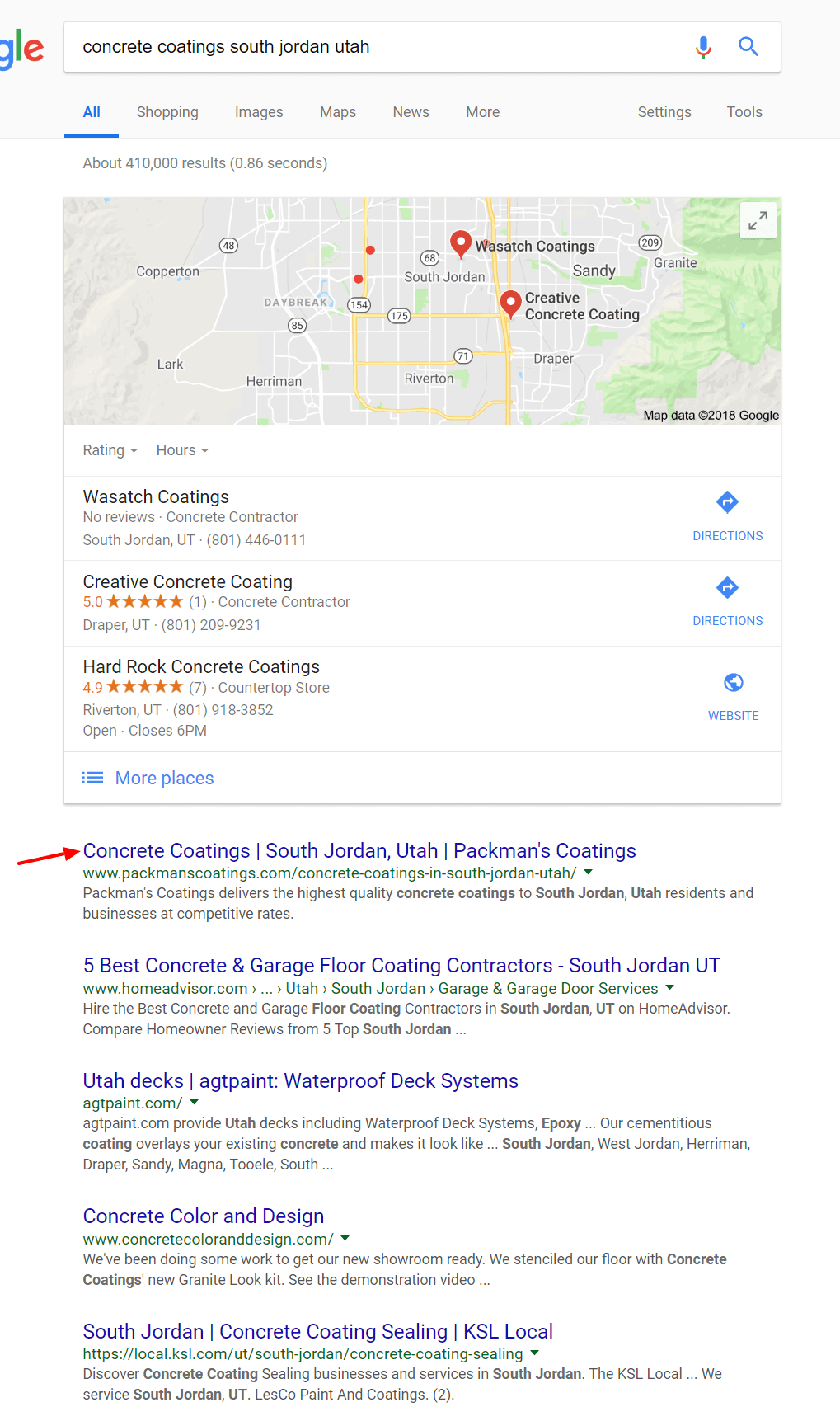
Because they may take the place of your homepage depending on how Google ranks you in the SERPs, your SAPs must provide the same user experience, menu structure and calls to action as your site’s main page, in addition to informative, engaging and original content.
If you work in multiple cities or towns around your physical location, add an area-served page for each one.
Start by identifying the local areas you serve and create a unique page of content for each one. For example, if your physical business location is in Taylorsville, Utah, your customers likely come from West Jordan, Murray, West Valley City, Salt Lake City and maybe even Sandy and Cottonwood Heights.
Once you have a list of all the local areas you serve, rank them by most populous area or by where most of your customers come from. Then simply go down the list in order and create an SAP for each one.
The most important information to include in your service area pages is what your business does.
You can include some language on the benefits of working with your company, but remember what your prospects will be searching for if they need your products or services. (Hint: it won’t be “friendly plumber.”)
Incorporate your keywords and phrases into each SAP, but also work in a variety of long-tail keywords based on geographic locations.
If your business is listed on other websites or directories for that specific location, include a link to that resource whenever possible. If you have customer reviews that reference a specific area that you serve, you can link directly to those as well. Also use images and other visual elements, each optimized for geo-specific local or hyper-local SEO.
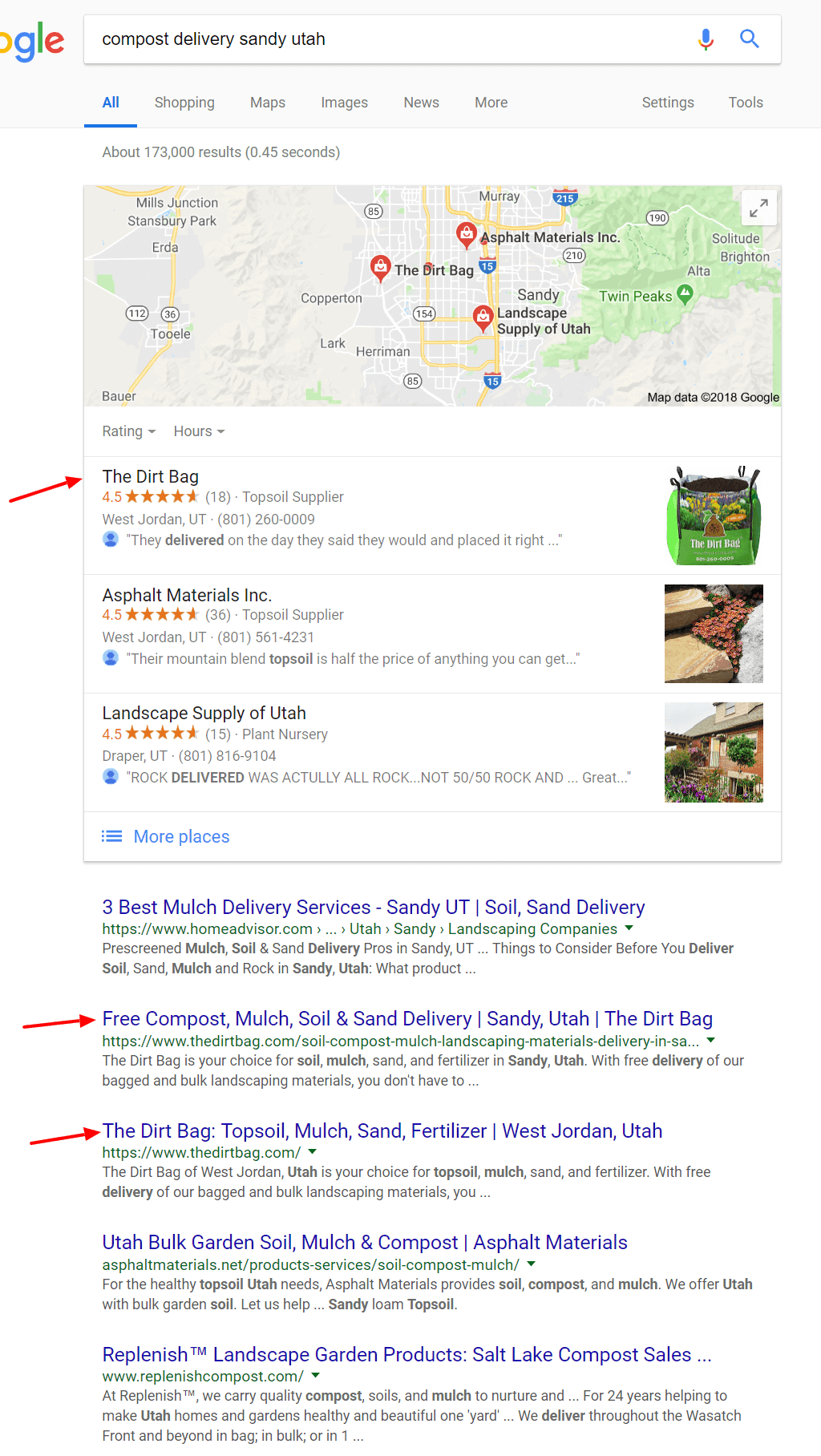
One word of warning: Each of your SAPs must contain original, well-written content. You cannot simply duplicate these pages and substitute the city name each time because Google does not tolerate duplicate content. At best, the algorithms will ignore your SAPs. At worst, they could penalize your site and eliminate you (or severely demote you) in the rankings.
Service area pages do not take the place of the Google Local Search and Google My Business platforms — they only serve to augment them.
In fact, if you haven’t claimed your GMB profile or kept your GMB listing updated, you won’t get many of the benefits you could otherwise. And as Google offers these tools at no cost to you, you have no reason not to put them to their fullest and best use.
Finally, make sure you add local business schema to alert Google of the connection between your company and that location.
If you aren’t sure how to use these tools to help you build your business, an internet marketing expert such as SEO Werkz can help.
Our team of local SEO experts can assist you with all your digital marketing needs, including web design and development, business blogging, pay-per-click campaigns and social media marketing. Contact us today to learn more about how service area pages can help your local SEO efforts.



